Disclosure
This post contains affiliate links, which means I may earn a small commission if you make a purchase through my links, at no extra cost to you.
Does Nood work? Short answer: yes, for the people IPL works for. That means dark hair (black, brown, or dark blonde) on very fair to light brown skin, a steady schedule for about two months, and touch-ups after that. What it delivers is less hair and finer regrowth, not permanent hair removal, and it is not a match for a clinic laser. If your hair and skin fit the chart, the Nood Flasher Pro is a reasonable buy. Here’s what to look for before spending the money.
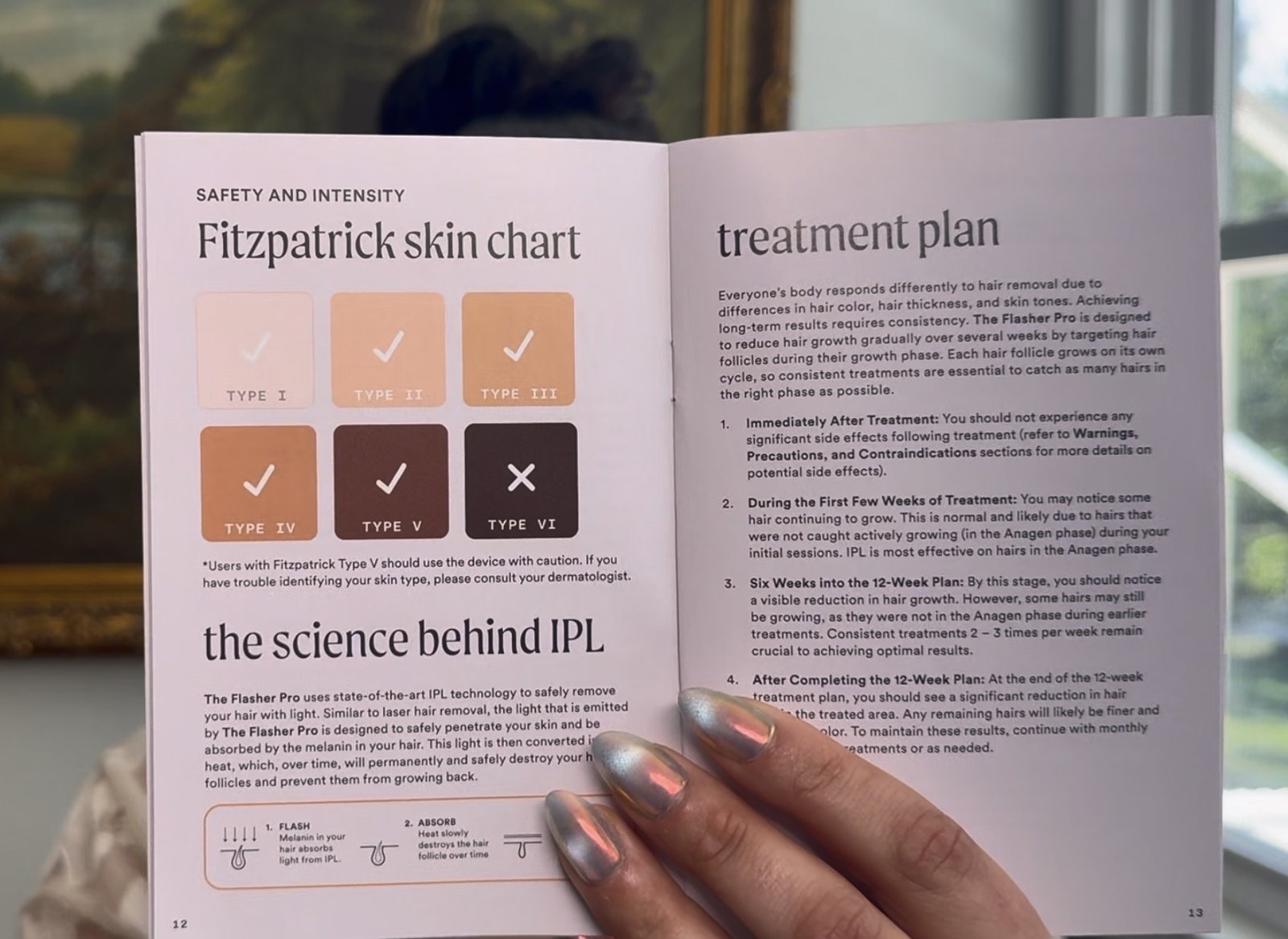
It works on: black, brown, and dark blonde hair on very fair, fair, and olive to light brown skin. That is Nood’s own chart.
It does not work on: light blonde, red, or grey hair. Nood also lists brown and dark brown to black skin as not recommended.
What you get: hair reduction that lasts while you keep up maintenance. Not permanent removal.
What it takes: sessions twice a week for about two months, then touch-ups.
What it is not: a clinic laser. Professional devices run at higher energy and get there faster.
What working means for an IPL device
The Nood Flasher Pro is an intense pulsed light (IPL) device. Pigment in the hair absorbs the flash and turns it into heat, and that heat damages the follicle enough to slow regrowth. No pigment in the hair, no result. Too much pigment in the skin, and the skin takes the heat instead.
The device is FDA cleared, not FDA approved. Its clearance, 510(k) K241106, covers removal of unwanted hair and permanent reduction in hair regrowth. The FDA file defines that as a long-term, stable reduction in the amount of hair regrowing, measured at 6, 9, and 12 months after a treatment course. The same file states that no clinical study was performed for the clearance. Cleared means substantially equivalent to devices already on the market. It is not proof of a specific result.
So the useful question is not whether Nood removes hair forever. It is whether at-home light devices reduce hair, and by how much.
What the research says about at-home devices
No published trial has tested the Nood itself. The evidence is for the category.
A 2012 systematic review in the Journal of the European Academy of Dermatology and Venereology found seven studies of home light devices. Hair reduction ranged from 6% to 72% after repeated treatments. Most of the studies were uncontrolled, and the authors described the evidence as short term.
A 2015 randomized trial in the British Journal of Dermatology followed women through eight weekly treatments with a low-energy home laser. Growing hair dropped by up to 59%, and the hair that remained was up to 38% thinner. Three months after treatment stopped, hair counts were back above where they started.
A 2023 study in PLOS ONE compared a professional diode laser with a home device on underarms over six sessions. The professional laser reached 85% to 88% hair reduction. The home device reached 46% to 52%. It was small, with 15 people finishing.
Dermatologists read it the same way. Rachel Ward, MD, of Cleveland Clinic, says at-home devices have less power than office lasers and do not work as well, and that they suit light skin with dark hair.
The takeaway: these devices reduce hair while you keep using them. Stop, and hair comes back. Plan on maintenance from the start.
Will Nood work for you?
Hair color and skin tone decide it. This is how Nood’s chart sorts out.
Your hair and skin
Nood’s chart
The move
Black or brown hair, very fair to olive skin
Good fit
IPL is built for this contrast
Dark blonde hair, fair skin
Good fit
IPL works, with less pigment to target
Light blonde, red, or grey hair
Not recommended
Electrolysis, or dermaplaning for facial fuzz
Brown to dark brown or black skin
Not recommended
A clinic consult. Office lasers cover more skin tones
Tattoos in the treatment area
Do not flash over them
Work around them
The skin type chart from the Nood manual. Check it against your own skin before buying.
Nood’s FAQ sets the schedule at twice a week for the first two months, then a touch-up every three to six months as needed. Its product page words it differently: every three days for up to 12 weeks, then monthly. Either way, budget two to three months before judging it.
The listing promises visible results after the first use. A better checkpoint is the end of the starter schedule. Hair grows in cycles, and light only affects follicles in the active growth phase, which is why every source calls for repeated sessions.
What works here:
Shave first. Nood says to shave the whole treatment area so the light reaches the follicle.
Skip waxing, plucking, threading, and epilating. Nood says they reduce effectiveness, because the follicle has to be intact.
Start at level 3 of 5 and move up or down by comfort. That is Nood’s guidance. The cooling plate, which Nood calls CryoSoothe, keeps the skin cool during flashes.
Keep it off tattoos and away from the eyebrows and eye area.
Where Nood falls short
It is not permanent removal. Light devices are cleared for permanent hair reduction. Electrolysis is the method recognized for permanent removal.
It is weaker than a clinic laser by design. Even clinic laser is not one and done: the American Academy of Dermatology says most patients need two to six treatments and may need maintenance after that. The cost and session math is in Nood vs laser hair removal.
The marketed energy figure runs higher than the cleared one. Nood’s product page says 7 J/cm². The FDA file for the Flasher Pro’s model clears 1.84 to 5.23 J/cm². Go by the cleared range.
The brand guarantee has a catch. Nood’s 90-day guarantee refunds the purchase minus a restocking fee. Read the return terms wherever you buy.
It is corded. The box includes a six-foot power adapter, so plan to sit near an outlet.
Is the Nood Flasher Pro worth it?
Worth it if your hair and skin fit the chart, you want to treat more than one area, and you will keep the twice-weekly schedule for two months. A clinic charges by the area. The device is one purchase for all of them.
Skip it if your hair is light blonde, red, or grey, if your skin tone is on the not recommended side of Nood’s chart, if you want one small area gone for good (book electrolysis), or if you want the fastest result and have the budget for a clinic.
The Flasher Pro also ships with a second lens for skin, the Ageless lens. Treat it as a bonus, not the reason to buy. The details are in the Nood Ageless lens review.
Still comparing brands? The full IPL comparison shows what each brand publishes about its energy output, and what it leaves out.
Yes, for dark hair on very fair to light brown skin, as long as the schedule is kept up. It reduces hair and thins regrowth. It does not remove hair permanently, and it does not work on light blonde, red, or grey hair.
Is Nood FDA approved?
No. The Flasher Pro is FDA cleared under 510(k) K241106, which means the FDA found it substantially equivalent to devices already on the market. Cleared and approved are different things, and at-home IPL devices are cleared.
How long does Nood take to work?
Nood’s schedule is twice a week for the first two months. Judge it at the end of that stretch, not after one session.
Is Nood permanent?
No. The cleared claim is permanent hair reduction, and research on home devices shows hair returning after treatment stops. Nood itself recommends touch-ups every few months.
Can you use Nood on your face?
Nood lists the chin and neck among its treatment areas and says not to use it on the eyebrows or around the eyes. The FDA clearance wording is facial hair below the chin line. Peach fuzz is usually too fine and light for IPL to target. For that, see the best at-home dermaplaning tools.
Does Nood work as well as laser hair removal?
No. Clinic lasers run at higher energy and reach a result in fewer sessions. What the at-home device offers is one purchase that covers every area, on your own schedule. The numbers are in Nood vs laser hair removal.
Does Nood work on blonde hair?
On dark blonde, yes, according to Nood’s chart. On light blonde, no. There is not enough pigment in the hair for the light to target. More in Does Nood work on blonde hair?
Checked October 2026 against Nood’s Flasher Pro product page and FAQ, the Amazon listing, FDA 510(k) K241106, Thaysen-Petersen et al. (Journal of the European Academy of Dermatology and Venereology, 2012, and British Journal of Dermatology, 2015), Hendricks et al. (PLOS ONE, 2023), Cleveland Clinic, and the American Academy of Dermatology. This post is general information, not medical advice.
Leave a Reply