Disclosure
This post contains affiliate links, which means I may earn a small commission if you make a purchase through my links, at no extra cost to you.
Quick answer: Pick the HigherDOSE Red Light Face Mask if your goal is fine lines and firmness and you want a simple mask you can wear while you move around. It runs the two most studied skin wavelengths (red and near-infrared), offers a 10 or 20 minute session, and costs less. Pick the CurrentBody Series 3 if you also want blue light for breakouts, yellow for redness and green for tone, a third, deeper near-infrared wavelength, and an app that lets you control where each light goes. The HigherDOSE is the focused anti-aging mask; the CurrentBody is the do-everything mask.
6: red 633nm, near-infrared 830nm and 1072nm, plus blue 415nm, green 532nm and yellow 590nm
LEDs
66 dual-core LEDs (132 diodes)
750
Stated output
50 mW/cm2 total (26 red, 24 near-infrared)
Up to 40 mW/cm2
Session
10 or 20 minutes, 3 to 5 times a week
10 minutes, 3 to 5 times a week
App
None
CurrentBody app with MyDose and full-face presets
Fit
Flexible silicone with face and head straps
Flexible silicone with a chin strap
Controller
Rechargeable, USB-C, about 80 to 100 minutes per charge
Rechargeable, USB-C
In the box
Mask, controller, power adapter, head straps, goggles, storage bag
Mask, controller, USB-C cable, eye inserts, storage bag
FDA status
Described by HigherDOSE as FDA cleared
Described by CurrentBody as FDA cleared
Best for
Lines, firmness and glow, kept simple
Aging plus breakouts, redness or uneven tone
Specs come from each brand’s own product page. Output figures are the brands’ numbers, measured their own way, not independent tests, so a higher number on paper is not proof of a stronger mask.
The real difference: two lights or six
Both masks share the core of an anti-aging LED routine: red light around 630nm and near-infrared at 830nm. Those are the wavelengths with the most research behind them for fine lines, texture and firmness.
The CurrentBody Series 3 adds four more. A deeper near-infrared at 1072nm sits alongside the other two, and blue, green and yellow cover other concerns:
Blue (415nm) is the best studied of the extras and is used for breakout-prone skin. If you still get blemishes along with lines, this is the strongest reason to pay for the Series 3.
Yellow (590nm) is used for redness. The research is smaller and more mixed.
Green (532nm) is marketed for uneven tone. It has the thinnest evidence of the six.
If your skin goals are lines and firmness only, the extra colors add little for you, and the HigherDOSE covers the part that matters. The full breakdown of what those extra lights do is in CurrentBody Series 3 vs Series 2.
LED count and output: what the numbers mean
The CurrentBody lists 750 LEDs against the HigherDOSE’s 66 dual-core LEDs, and HigherDOSE lists a higher total output (50 against up to 40 mW/cm2). Those two facts pull in opposite directions, which is the point: neither number settles which mask delivers more light to your skin. LED count partly reflects how many colors a mask has to fit in, and output figures depend on how and where each brand measures. If tested, published output matters most to you, the INIA vs Omnilux comparison covers what to look for.
Session length and routine
The HigherDOSE gives you a choice of 10 or 20 minutes. HigherDOSE suggests 10 minutes 4 to 5 times a week or 20 minutes 3 to 4 times a week. The CurrentBody runs 10 minute sessions, 3 to 5 times a week. Either way, consistency over weeks is what counts, and more is not better. How often to use red light therapy for wrinkles goes deeper on frequency.
App or no app
The Series 3 pairs with the CurrentBody app. Its MyDose feature lets you run one light on the chin and another across the forehead in the same session, and there are presets for anyone who does not want to build their own. The HigherDOSE has no app: pick a session length on the controller and go. If you like to customize, the app is a real plus. If you want to put a mask on and press one button, the HigherDOSE is simpler.
Fit, comfort and moving around
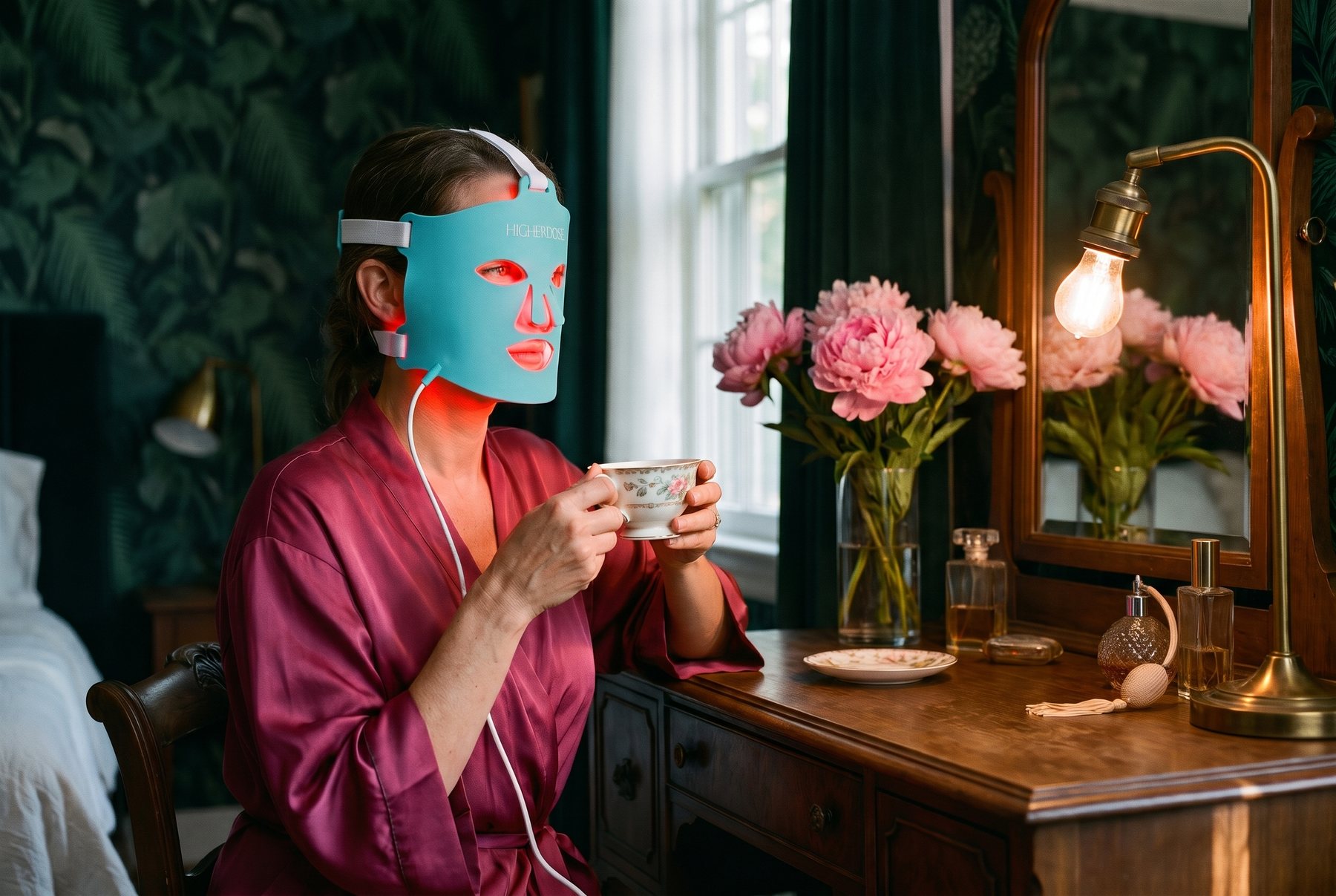
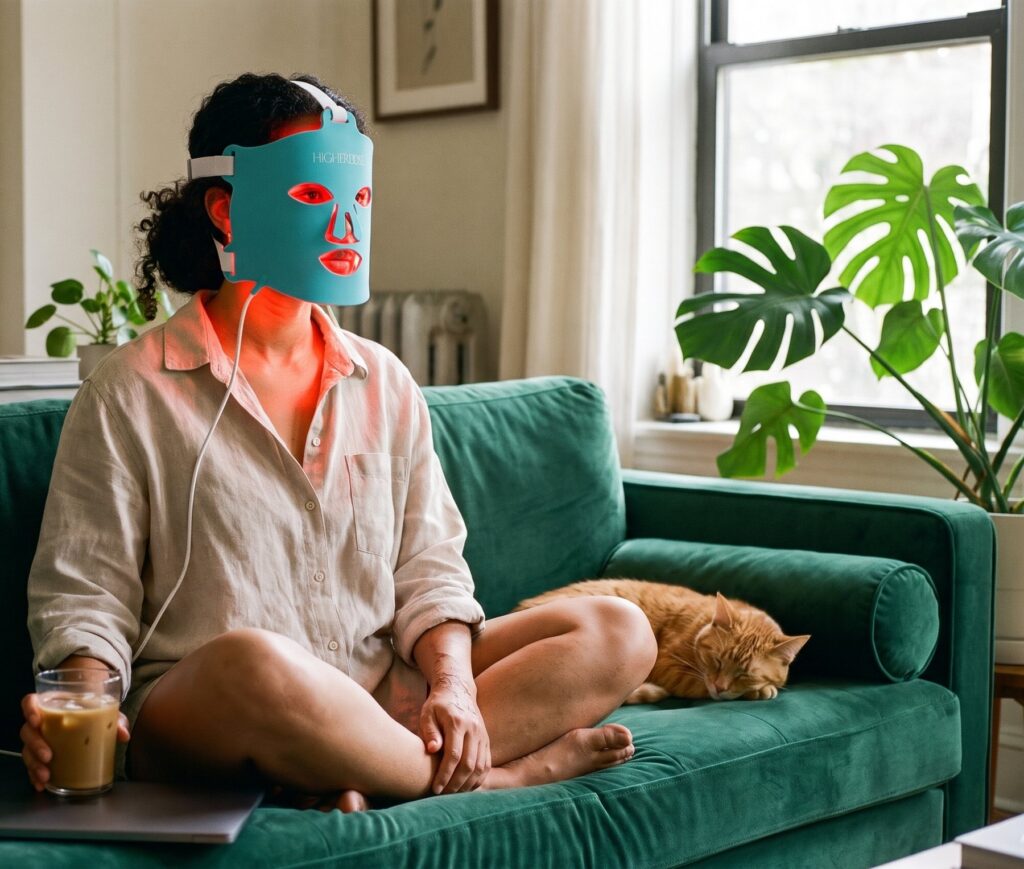
Both are flexible silicone masks rather than rigid shells. The HigherDOSE uses face and head straps and a rechargeable controller that HigherDOSE designed so you can move around during a session; the brand lists about 80 to 100 minutes of battery per charge. The CurrentBody uses a chin strap and eye inserts, and its controller also charges over USB-C. The HigherDOSE box includes goggles.
Which one to buy
Buy the HigherDOSE if fine lines, firmness and glow are the goal, you want a longer 20 minute option, and you would rather keep the difference in price.
Buy the CurrentBody Series 3 if you are dealing with aging and breakouts or redness at the same time, or you want app control over where each light goes.
Compare a third option if you are also weighing the Solawave mask: Solawave vs CurrentBody covers it.
LED masks are cosmetic devices, not treatments for any medical condition. Check with your doctor before starting either one if you are pregnant or breastfeeding, have a light-sensitive condition such as lupus, take medication that causes light sensitivity, get headaches triggered by light, or have an eye condition. If you have had injectables or an in-office procedure, HigherDOSE suggests waiting 24 to 48 hours before a session.
FAQ
Is the HigherDOSE Red Light Face Mask worth it?
For lines and firmness, it covers the two wavelengths with the most research behind them and costs less than the Series 3. What it lacks is blue, green and yellow light and an app.
What is the difference between HigherDOSE and CurrentBody LED masks?
The HigherDOSE uses red and near-infrared only, with 10 or 20 minute sessions and no app. The CurrentBody Series 3 uses six wavelengths, including a deeper near-infrared and blue light for breakouts, with 10 minute sessions and app control.
Which LED mask is better for acne?
The CurrentBody Series 3, because it includes blue light (415nm), the most studied LED color for breakout-prone skin. The HigherDOSE has no blue light.
Can you use a red light mask every day?
Both brands suggest 3 to 5 sessions a week rather than daily. HigherDOSE notes that going over the recommended use brings diminishing returns.
Should you put skincare on before an LED mask?
Start with clean, dry skin. HigherDOSE advises against sunscreen, heavy moisturizer or mineral makeup under the mask, since they can block light. Apply the rest of your routine after.
How long until you see results?
HigherDOSE says most changes start to show after 3 to 4 weeks of consistent use, and CurrentBody suggests 3 to 5 sessions a week for 8 weeks. Any change builds gradually.
Sources
Sources checked on October 24, 2026. Figures from brands are reported as the brand’s own claims.
Leave a Reply