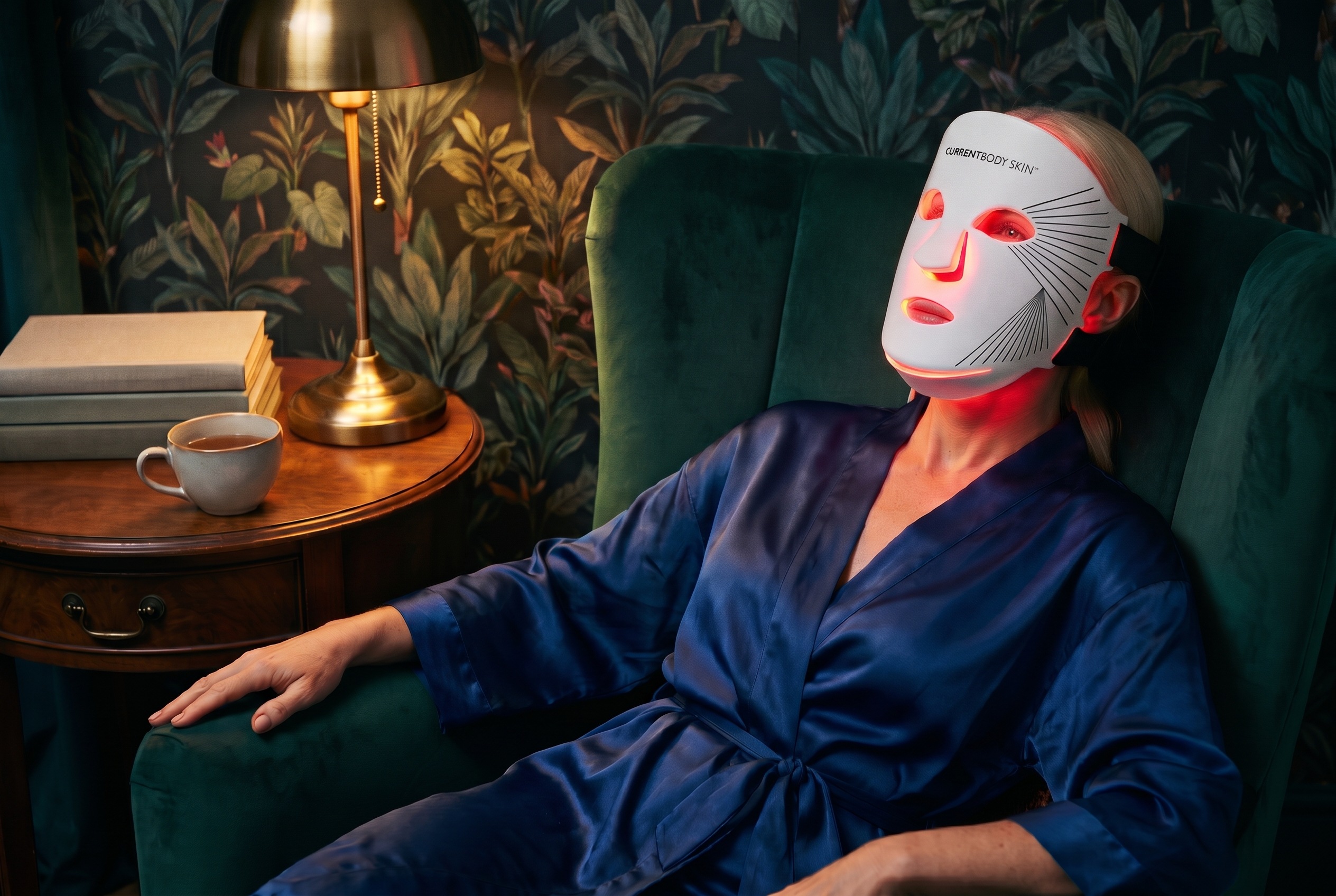
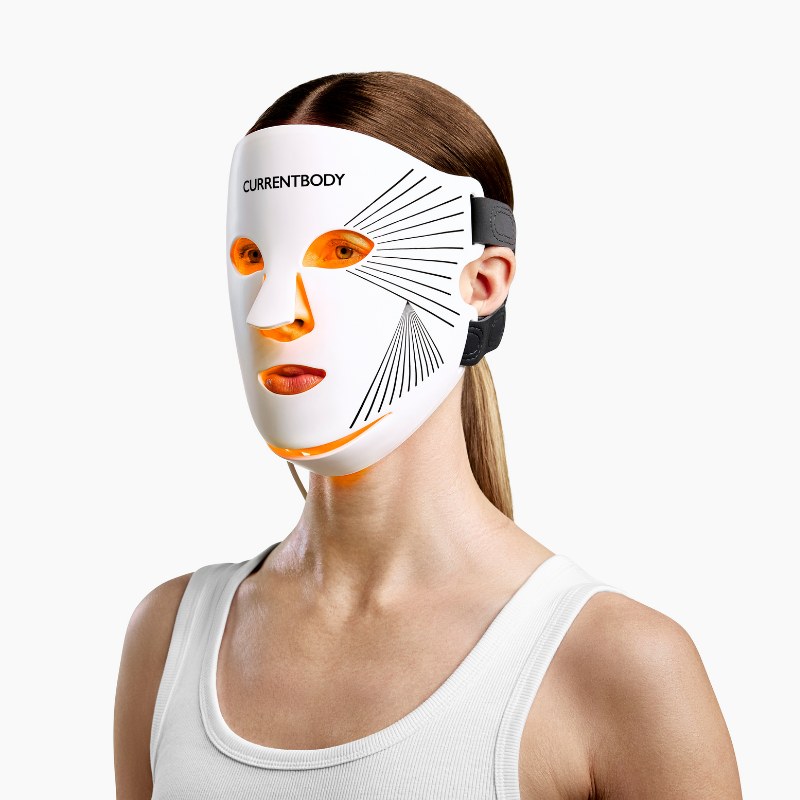
Quick answer: Buy the CurrentBody Series 2 (the CurrentBody Skin LED Red Light Therapy Face Mask: Series 2) if fine lines and firmness are the goal and you want fuller face coverage: it has 236 LEDs, a deep near-infrared 1072nm channel and a published output of 30 mW/cm². Buy the INIA GLOW (INIA GLOW Wireless Red Light Therapy Mask) if budget and a truly cordless mask matter most, since independent testing measured similar output at each LED for far less money.
236 LEDs: 110 red, 110 near-infrared, 16 deep near-infrared
Stated output
Up to 105 mW/cm² (INIA’s claim)
30 mW/cm² (CurrentBody’s figure)
Independent measurement
About 30 mW/cm² at the LED (Light Therapy Insiders)
None found for this post
Power
Magnetic battery on the mask, two controllers, no cable
Clip-on controller with a cable, charges over USB-C
Session
10 minutes
10 minutes, 3 to 5 times a week for 8 weeks
Brand’s own study
INIA cites its own clinical testing
CurrentBody cites independent studies on the Series 2
FDA status
Described by INIA as FDA cleared
Described by CurrentBody as FDA cleared
Best for
Budget, travel, moving around during a session
Lines and firmness with fuller coverage
In this INIA vs CurrentBody table, specs come from each brand’s own product page unless a row names another source. Output figures from brands are the brands’ own claims.
The INIA vs CurrentBody question comes up because INIA markets the GLOW as a budget alternative to the Series 2. On the core red and near-infrared light, the two are closer than the price gap suggests. On coverage and depth, they are not.
Why the CurrentBody Series 2 is the stronger anti-aging mask
Three things separate the two masks for someone buying for fine lines and firmness.
Coverage. CurrentBody lists 236 LEDs on the Series 2, set in a flexible silicone shape with a chin strap for the jawline. INIA’s own page lists 68 light beads on the GLOW. Light Therapy Insiders notes that the INIA GLOW’s LEDs are fairly spread out, so output drops sharply in the gaps between them.
A third wavelength. The Series 2 adds 16 deep near-infrared LEDs at 1072nm, which CurrentBody places under the eyes and around the mouth. The INIA GLOW pairs red with 850nm near-infrared and has no deep near-infrared channel.
Honest numbers. CurrentBody publishes 30 mW/cm² for the Series 2. INIA advertises up to 105 mW/cm² for the GLOW, while Light Therapy Insiders measured roughly 30 at the LED. The same real-world figure is more useful when the brand states it plainly.
For anti-aging, this is where INIA vs CurrentBody tips toward CurrentBody, and the Series 2 is also the simpler of its two masks. CurrentBody Series 3 vs Series 2 explains why the newer model’s extra colors matter mainly for breakouts and redness.
A walkthrough of the INIA GLOW Wireless on the Anna Katherine Page YouTube channel.
No cord at all. INIA’s magnetic controller snaps onto the side of the mask and powers it on. Two controllers come with it, and INIA rates them for up to 90 minutes of cordless runtime, so one can charge while the other is in use.
The right core wavelengths. Light Therapy Insiders measured the main channel at about 630nm red with 850nm near-infrared, which matches what INIA claims.
Cost. The INIA GLOW sells for a small fraction of the Series 2, which is the whole reason it gets compared to masks like it.
Two cautions. The “blue” acne channel measured at about 557 to 560nm in Light Therapy Insiders’ testing, which reads as green, and the amber channel measured at about 607 to 610nm. Treat the extra modes as a bonus, not the reason to buy. The INIA Red Light Therapy Mask review walks through the specs and the FDA paperwork in more detail.
In any INIA vs CurrentBody decision, the deciding question is whether you need the deeper channel and fuller coverage of the Series 2, or whether a lighter, cordless mask is the one you will actually wear three to five times a week.
Buy the CurrentBody Series 2 if fine lines and firmness are the goal, you want light across the whole face including the jawline, and a published, consistent spec sheet matters to you.
Buy the INIA GLOW if you want to try red light therapy without a big spend, you travel, or you know you will only stick with a mask that has no cord.
Look elsewhere if breakouts are the main concern. Neither mask has a measured true blue channel. INIA vs Omnilux Contour compares another mask that publishes its output.
CurrentBody’s own contraindications say not to use its mask if you are pregnant, planning a pregnancy or breastfeeding; if you have lupus, photosensitive eczema, albinism or another light-sensitive condition; if you take medication that can cause light sensitivity, such as certain antibiotics, chemotherapy drugs or diuretics; if light triggers headaches; or if you have an eye condition such as glaucoma or cataracts. The same cautions apply to both sides of INIA vs CurrentBody, and to any LED mask. If any of them apply, or you are unsure about a medication, check with your doctor before starting.
FAQ
Is the INIA GLOW as good as the CurrentBody Series 2?
For red and near-infrared light at the LED, it comes close: Light Therapy Insiders measured the INIA GLOW at roughly 30 mW/cm², the same figure CurrentBody publishes for the Series 2. The Series 2 still wins on coverage, with 236 LEDs against 68 light beads, plus a deep near-infrared 1072nm channel the INIA GLOW does not offer.
Is INIA a good brand?
INIA is a budget brand whose GLOW mask gets the basics right: red at about 630nm and near-infrared at about 850nm, both confirmed by independent spectrometer testing. The weak spot is its marketing. INIA advertises up to 105 mW/cm², while Light Therapy Insiders measured about 30. Buy it for the wireless design and the price, not the headline output number.
Are INIA products FDA approved?
No LED face mask is FDA approved; the right term is FDA cleared. INIA describes the GLOW Wireless as FDA cleared, but the clearance on file is held by the factory that builds it rather than by INIA itself, as the INIA review on this site explains. CurrentBody also describes the Series 2 as FDA cleared.
Is the CurrentBody Series 2 wireless?
Not in the way the INIA GLOW is. The CurrentBody Series 2 runs from a clip-on controller that charges over USB-C, with a cable between the controller and the mask, so you can move around during a session but the controller comes with you. The INIA GLOW snaps a magnetic battery straight onto the mask with no cable at all.
Which mask is better for acne?
Neither is a strong acne pick. The CurrentBody Series 2 has no blue light at all. The INIA GLOW lists a blue acne mode, but Light Therapy Insiders measured that channel at about 557 to 560nm, which is green rather than the 415 to 460nm blue used in acne research. For breakouts, a mask with true blue light is the better move.
How often should you use an LED face mask?
Both brands build their routines around 10 minute sessions. CurrentBody recommends 3 to 5 sessions a week for 8 weeks with the Series 2, and more is not better. Consistency matters far more than frequency, so pick a schedule you can keep, use clean, dry skin, and give it at least several weeks before judging any change in fine lines or firmness.
Sources
Sources checked on October 26, 2026. Figures from brands are reported as the brand’s own claims.
Quick answer: For most buyers, the CurrentBody LED Neck & Décolletage Mask: Series 2 is the CurrentBody neck mask to get: red, near-infrared and deep near-infrared light cover the main goal, softer-looking neck and chest lines. Choose the Series 3 if you also want to treat breakouts, redness or uneven tone on the chest, with six wavelengths and app control. See the Series 2 neck mask or see the Series 3 neck mask.
Last updated: October 27, 2026
CurrentBody neck mask: the short answer
Best for neck lines
Neck Mask: Series 2
Red 633nm, near-infrared 830nm, deep near-infrared 1072nm
The neck and chest show lines early, and most face masks stop at the jaw. A CurrentBody neck mask is a separate, strap-on LED panel shaped for the full neck and upper chest. CurrentBody sells two generations, and the right one depends on whether you only want anti-aging light or the full range. If you are choosing a face mask too, the CurrentBody Series 3 vs Series 2 comparison uses the same logic.
Key facts at a glance
6 vs 3
Wavelengths: Series 3 vs Series 2
10 min
Per session, 3 to 5 times a week
37%
Series 3 neck and chest wrinkle reduction, per CurrentBody
Hands-free
Strap-on design on both
CurrentBody neck mask Series 3 vs Series 2 at a glance
Feature
Neck Mask: Series 2
Neck Mask: Series 3
Wavelengths
3: red 633nm, near-infrared 830nm, deep near-infrared 1072nm
6: the same three plus blue 415nm, green 532nm, yellow 590nm
LEDs
229
750 LED bulbs listed on the product page
Modes
No preset modes listed
4 presets plus custom treatments with MyDose
App
None listed
CurrentBody app
Session
10 minutes, 3 to 5 times a week
10 minutes, 3 to 5 times a week
Brand results
30% fewer neck wrinkles, 57% plumper skin at 8 weeks
37% fewer neck and chest wrinkles, 57% plumper skin at 8 weeks
Specs from the CurrentBody Series 2 and Series 3 LED Neck & Décolletage Mask product pages, checked October 27, 2026.
What the Series 3 neck mask adds
The Series 3 keeps the three anti-aging wavelengths and adds three more. CurrentBody describes blue at 415nm for spots and irritation, green at 532nm for the look of pigmentation, and yellow at 590nm for redness. You can run one of four preset modes or build your own treatment with MyDose, which CurrentBody says calculates the dose for the wavelengths you choose.
If your neck and chest only need help with lines and crepey texture, the extra colors add cost without adding much. If you deal with chest breakouts, sun spots or redness as well, the Series 3 covers more ground in one device.
Wavelengths included (count)
Series 3 neck mask: 6 wavelengths
Series 2 neck mask: 3 wavelengths
Source: CurrentBody product pages. Both include red 633nm, near-infrared 830nm and deep near-infrared 1072nm.
How a neck mask session works
1
Start with clean, dry skin on the neck and chest
2
Pick a strap length and attach it to the mask
3
Secure it around your neck and switch it on
4
Relax for the hands-free 10 minutes, then wipe it clean
Which CurrentBody neck mask should you buy?
Pick this if
Neck Mask: Series 2
✓ Neck lines and crepey chest skin are the main goal
The CurrentBody LED Neck & Décolletage Mask: Series 2 is the smart pick for most readers, because the three anti-aging wavelengths do the job most people buy a neck mask for. Step up to the Series 3 if your chest has more going on than lines. For the full face, the best LED face masks guide and how often to use red light therapy for wrinkles cover the rest of the routine.
FAQ
Does the CurrentBody neck mask work?
CurrentBody reports that the LED Neck & Décolletage Mask: Series 3 reduced neck and chest wrinkles by 37% and improved plumpness by 57% in 8 weeks, and that the Series 2 reduced neck wrinkles by 30% with the same plumpness figure. These are the brand’s own clinical claims. Results depend on regular use, 10 minutes, 3 to 5 times a week, for at least several weeks.
What is the difference between the CurrentBody neck mask Series 3 and Series 2?
The Series 2 uses 229 LEDs and three wavelengths: red at 633nm, near-infrared at 830nm and deep near-infrared at 1072nm. The Series 3 adds blue, green and yellow light for six wavelengths, four preset modes and MyDose control in the CurrentBody app, so it can also target breakouts, redness and uneven tone on the neck and chest.
How long should you use the CurrentBody neck mask?
CurrentBody recommends 10-minute sessions, 3 to 5 times a week, for both the Series 2 and Series 3 neck masks, and calls 10 minutes the optimal session length. The mask straps on, so the treatment is hands-free. CurrentBody says Series 2 users can expect results in about 4 weeks of consistent use, with its headline figures measured at 8 weeks.
Can you use a face LED mask on your neck?
A face mask is shaped for the face, so it leaves most of the neck and chest untreated. That is why CurrentBody sells a separate LED Neck & Décolletage Mask with a large silicone shape that covers the full neck and upper chest, plus Face & Neck Kits that pair it with the matching face mask. A neck mask is the cleaner way to treat that area.
Is the CurrentBody neck mask FDA cleared?
CurrentBody describes the Series 2 neck mask’s red and near-infrared light as FDA cleared on its product page. The Series 3 neck mask page highlights clinical testing and its Veritace quality guarantee; check CurrentBody directly if FDA status matters to your decision. FDA clearance relates to safety for the stated use, not to the size of results.
What comes with the CurrentBody neck mask?
Both the Series 2 and Series 3 LED Neck & Décolletage Masks ship with the mask, two multi-straps, a USB-C charging cord, a storage bag, a user manual and an NFC card, according to CurrentBody. CurrentBody also sells each one in a kit with its Hydrogel Décolletage Masks and in a Face & Neck Kit with the matching face mask.
Sources
Sources checked on October 27, 2026. Figures from brands are reported as the brand’s own claims.
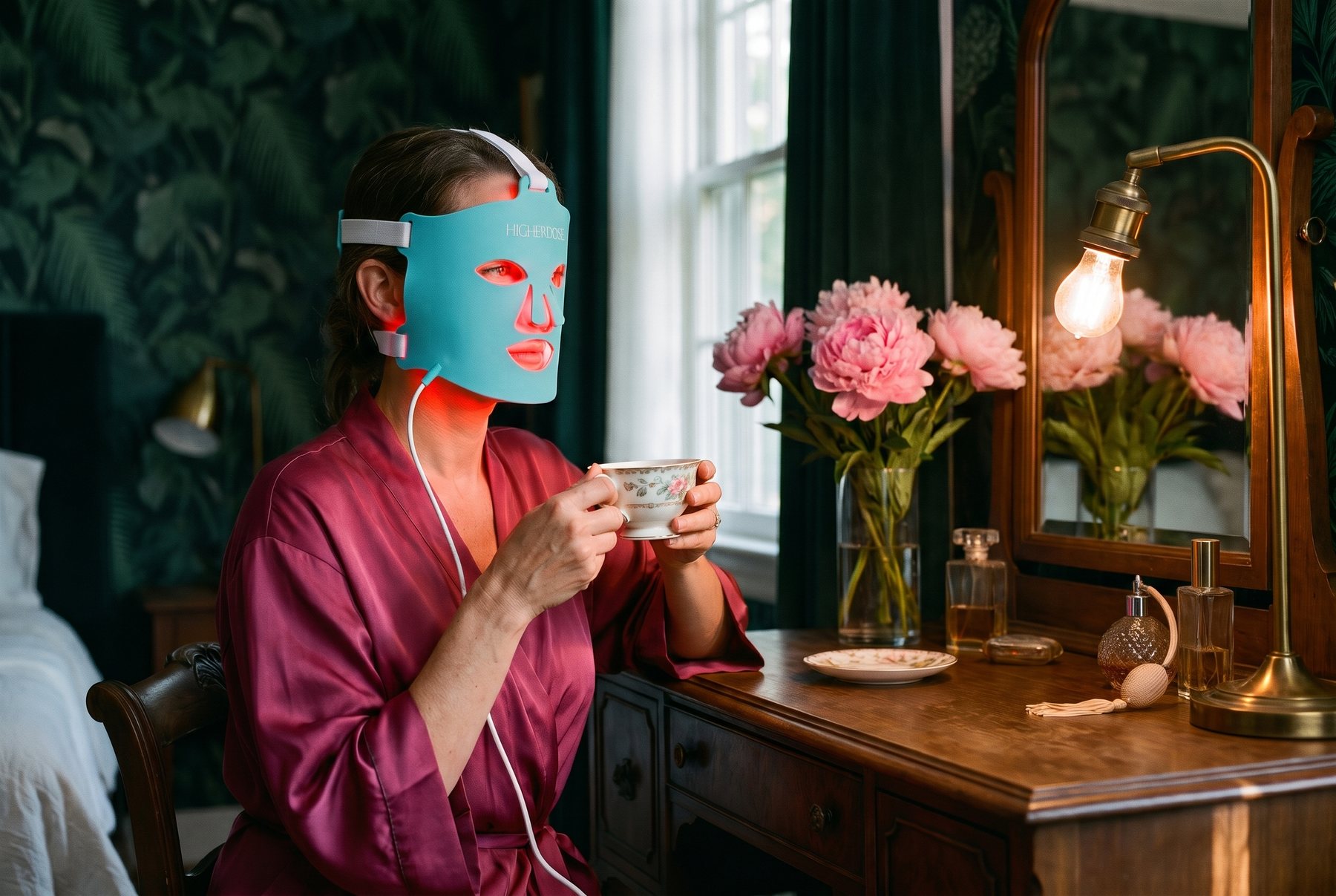
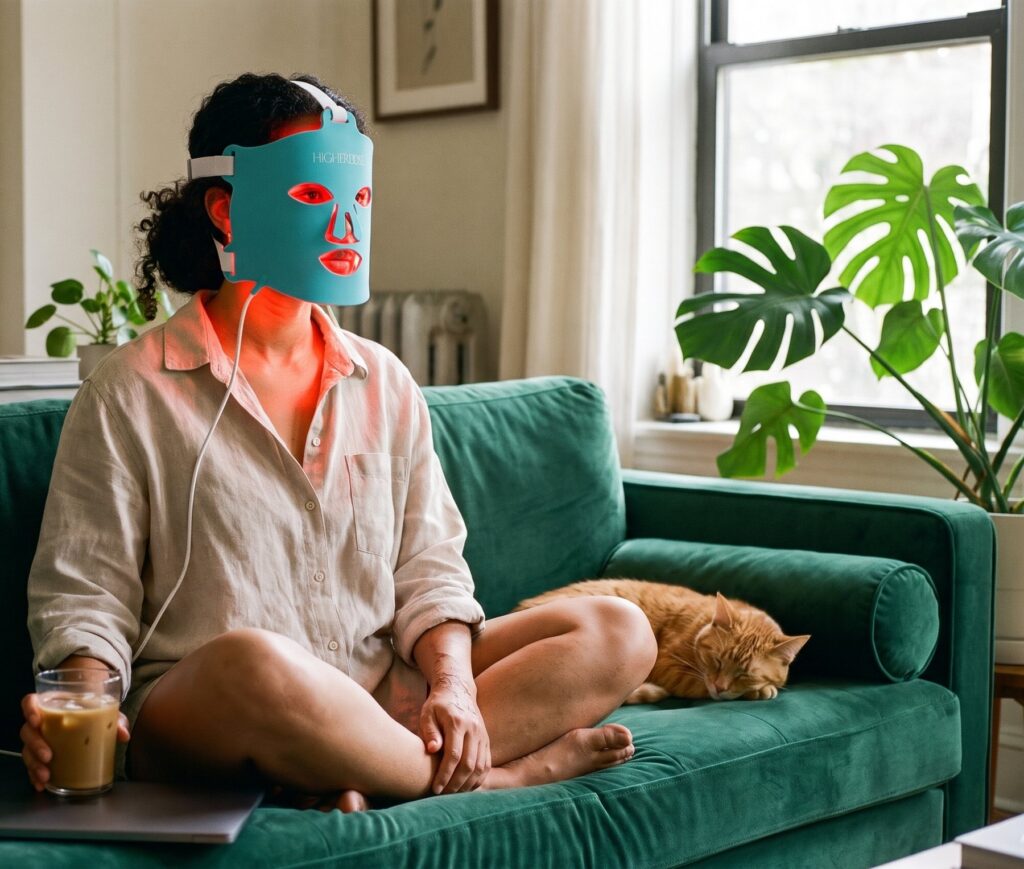
Quick answer: Pick the HigherDOSE Red Light Face Mask if your goal is fine lines and firmness and you want a simple mask you can wear while you move around. It runs the two most studied skin wavelengths (red and near-infrared), offers a 10 or 20 minute session, and costs less. Pick the CurrentBody Series 3 if you also want blue light for breakouts, yellow for redness and green for tone, a third, deeper near-infrared wavelength, and an app that lets you control where each light goes. The HigherDOSE is the focused anti-aging mask; the CurrentBody is the do-everything mask.
6: red 633nm, near-infrared 830nm and 1072nm, plus blue 415nm, green 532nm and yellow 590nm
LEDs
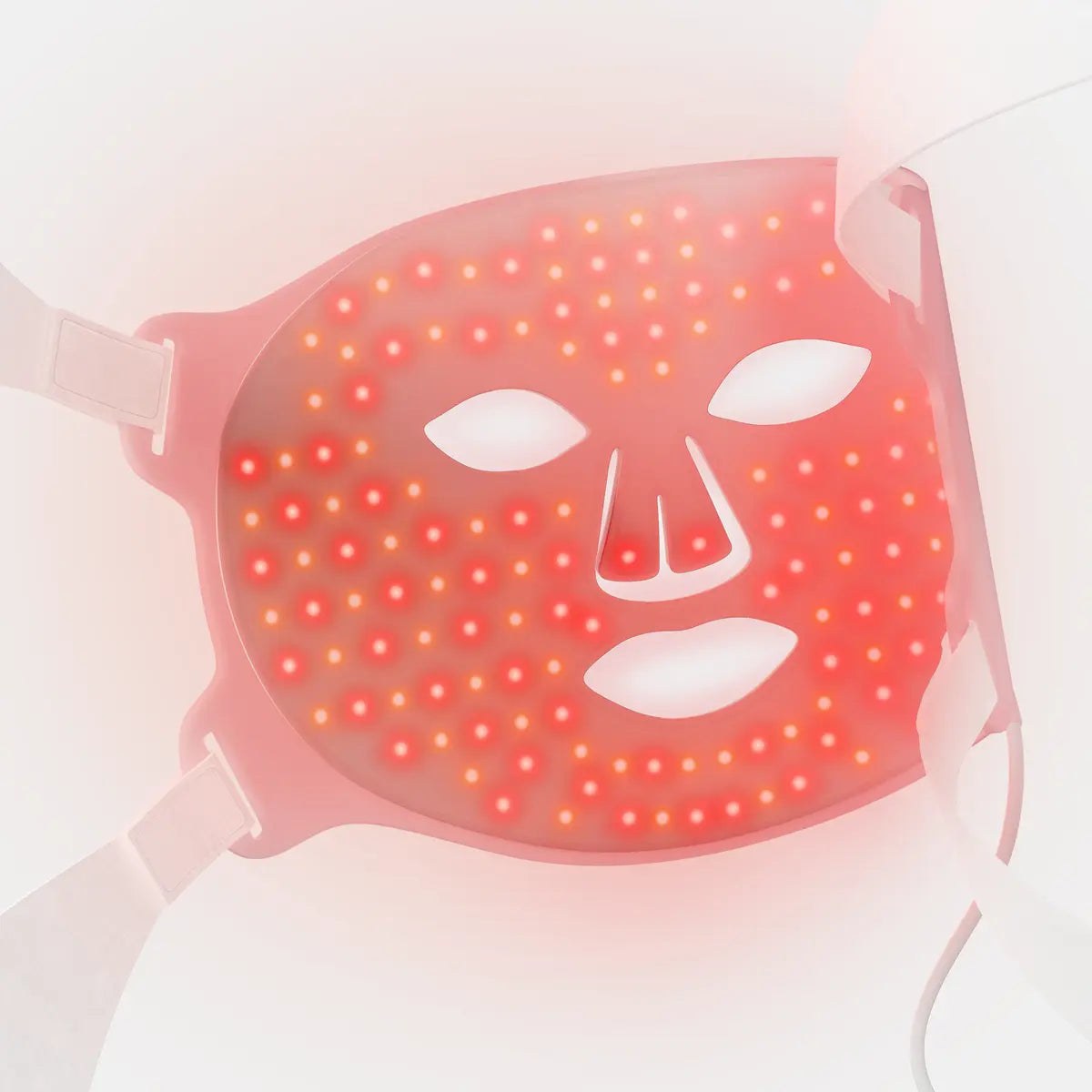
66 dual-core LEDs (132 diodes)
750
Stated output
50 mW/cm2 total (26 red, 24 near-infrared)
Up to 40 mW/cm2
Session
10 or 20 minutes, 3 to 5 times a week
10 minutes, 3 to 5 times a week
App
None
CurrentBody app with MyDose and full-face presets
Fit
Flexible silicone with face and head straps
Flexible silicone with a chin strap
Controller
Rechargeable, USB-C, about 80 to 100 minutes per charge
Rechargeable, USB-C
In the box
Mask, controller, power adapter, head straps, goggles, storage bag
Mask, controller, USB-C cable, eye inserts, storage bag
FDA status
Described by HigherDOSE as FDA cleared
Described by CurrentBody as FDA cleared
Best for
Lines, firmness and glow, kept simple
Aging plus breakouts, redness or uneven tone
Specs come from each brand’s own product page. Output figures are the brands’ numbers, measured their own way, not independent tests, so a higher number on paper is not proof of a stronger mask.
The real difference: two lights or six
Both masks share the core of an anti-aging LED routine: red light around 630nm and near-infrared at 830nm. Those are the wavelengths with the most research behind them for fine lines, texture and firmness.
The CurrentBody Series 3 adds four more. A deeper near-infrared at 1072nm sits alongside the other two, and blue, green and yellow cover other concerns:
Blue (415nm) is the best studied of the extras and is used for breakout-prone skin. If you still get blemishes along with lines, this is the strongest reason to pay for the Series 3.
Yellow (590nm) is used for redness. The research is smaller and more mixed.
Green (532nm) is marketed for uneven tone. It has the thinnest evidence of the six.
If your skin goals are lines and firmness only, the extra colors add little for you, and the HigherDOSE covers the part that matters. The full breakdown of what those extra lights do is in CurrentBody Series 3 vs Series 2.
LED count and output: what the numbers mean
The CurrentBody lists 750 LEDs against the HigherDOSE’s 66 dual-core LEDs, and HigherDOSE lists a higher total output (50 against up to 40 mW/cm2). Those two facts pull in opposite directions, which is the point: neither number settles which mask delivers more light to your skin. LED count partly reflects how many colors a mask has to fit in, and output figures depend on how and where each brand measures. If tested, published output matters most to you, the INIA vs Omnilux comparison covers what to look for.
Session length and routine
The HigherDOSE gives you a choice of 10 or 20 minutes. HigherDOSE suggests 10 minutes 4 to 5 times a week or 20 minutes 3 to 4 times a week. The CurrentBody runs 10 minute sessions, 3 to 5 times a week. Either way, consistency over weeks is what counts, and more is not better. How often to use red light therapy for wrinkles goes deeper on frequency.
App or no app
The Series 3 pairs with the CurrentBody app. Its MyDose feature lets you run one light on the chin and another across the forehead in the same session, and there are presets for anyone who does not want to build their own. The HigherDOSE has no app: pick a session length on the controller and go. If you like to customize, the app is a real plus. If you want to put a mask on and press one button, the HigherDOSE is simpler.
Fit, comfort and moving around
Both are flexible silicone masks rather than rigid shells. The HigherDOSE uses face and head straps and a rechargeable controller that HigherDOSE designed so you can move around during a session; the brand lists about 80 to 100 minutes of battery per charge. The CurrentBody uses a chin strap and eye inserts, and its controller also charges over USB-C. The HigherDOSE box includes goggles.
Which one to buy
Buy the HigherDOSE if fine lines, firmness and glow are the goal, you want a longer 20 minute option, and you would rather keep the difference in price.
Buy the CurrentBody Series 3 if you are dealing with aging and breakouts or redness at the same time, or you want app control over where each light goes.
Compare a third option if you are also weighing the Solawave mask: Solawave vs CurrentBody covers it.
LED masks are cosmetic devices, not treatments for any medical condition. Check with your doctor before starting either one if you are pregnant or breastfeeding, have a light-sensitive condition such as lupus, take medication that causes light sensitivity, get headaches triggered by light, or have an eye condition. If you have had injectables or an in-office procedure, HigherDOSE suggests waiting 24 to 48 hours before a session.
FAQ
Is the HigherDOSE Red Light Face Mask worth it?
For lines and firmness, it covers the two wavelengths with the most research behind them and costs less than the Series 3. What it lacks is blue, green and yellow light and an app.
What is the difference between HigherDOSE and CurrentBody LED masks?
The HigherDOSE uses red and near-infrared only, with 10 or 20 minute sessions and no app. The CurrentBody Series 3 uses six wavelengths, including a deeper near-infrared and blue light for breakouts, with 10 minute sessions and app control.
Which LED mask is better for acne?
The CurrentBody Series 3, because it includes blue light (415nm), the most studied LED color for breakout-prone skin. The HigherDOSE has no blue light.
Can you use a red light mask every day?
Both brands suggest 3 to 5 sessions a week rather than daily. HigherDOSE notes that going over the recommended use brings diminishing returns.
Should you put skincare on before an LED mask?
Start with clean, dry skin. HigherDOSE advises against sunscreen, heavy moisturizer or mineral makeup under the mask, since they can block light. Apply the rest of your routine after.
How long until you see results?
HigherDOSE says most changes start to show after 3 to 4 weeks of consistent use, and CurrentBody suggests 3 to 5 sessions a week for 8 weeks. Any change builds gradually.
Sources
Sources checked on October 24, 2026. Figures from brands are reported as the brand’s own claims.
Quick answer: Buy the Solawave Wrinkle Retreat Pro if your goal is fine lines and firmness and you want the shortest routine: three-minute sessions, four red and near-infrared wavelengths, the higher stated output, and a 60-day money-back guarantee. Buy the CurrentBody Series 3 if you want more than anti-aging: it adds blue, green and yellow light for breakouts, uneven tone and redness, plus an app to build your own treatments. One is the fast, focused mask. The other is the do-everything mask.
Output and LED figures are each brand’s own claims. Brands measure output in different ways, so treat the gap as a direction, not a lab result.
The real difference: focus vs range
Both masks are built around red and near-infrared light, the pairing with the most research behind it for the look of fine lines and firmness. Where they split is everything around that core.
Solawave goes deep on anti-aging. Every one of its four wavelengths sits in the red, deep red, amber and near-infrared range. There is no blue light for breakouts and no app. It is a single-purpose mask.
CurrentBody goes wide. The Series 3 keeps the red, near-infrared and deep near-infrared trio from the Series 2 and adds blue, green and yellow. If breakouts, redness or uneven tone sit on your list next to lines, it covers more ground.
Here’s what to look for: write down your top two skin goals. If both are about lines, firmness and glow, the extra colors on the Series 3 are paying for features you will not use.
Session time: 3 minutes vs 10
This is the biggest day-to-day difference. Solawave’s routine is three minutes, three to five times a week. CurrentBody’s is ten. At five sessions a week that is about 15 minutes against about 50.
Shorter is not automatically better, since total light dose depends on output and time together. But with any LED mask, the routine you keep is the one that works. If ten minutes is the reason a mask ends up in a drawer, the Solawave is the safer bet. More on building a schedule that sticks is in how often to use red light therapy for wrinkles.
Light and output
Solawave Wrinkle Retreat Pro: 320 LEDs, amber 605nm, red 630nm, deep red 660nm and near-infrared 830nm, with a stated output of 65 mW/cm2.
CurrentBody Series 3: 750 LEDs across six wavelengths, including deep near-infrared at 1072nm, with a stated output of up to 40 mW/cm2.
More LEDs on the CurrentBody does not mean more anti-aging light, because many of those bulbs are the blue, green and yellow channels. And a higher number on the Solawave spec sheet is a brand claim, not an independent test. The honest read: both deliver red and near-infrared light in a range designed for at-home use, and neither should be bought on a single number.
Fit, controls and convenience
Solawave: soft, flexible silicone held on with adjustable head straps, a handheld remote with a rechargeable battery that Solawave rates at up to 60 minutes of use (about 20 treatments), automatic shut-off, and protective goggles in the box.
CurrentBody Series 3: flexible silicone with a chin strap, a controller, eye inserts, and the CurrentBody app. The app’s MyDose feature lets you choose which lights run, which is the point of the Series 3 if you want to target more than one concern.
If you want to set it and forget it, Solawave is simpler. If you like tweaking a routine, the CurrentBody app gives you control the Solawave does not have.
Returns and risk
LED masks take weeks of consistent use before you can judge them, so the return window matters. Solawave offers a 60-day money-back guarantee that covers opened and used masks, plus a one-year limited warranty. For the CurrentBody, check the return terms on the product page before you buy, since the window and conditions can change by promotion.
Already deciding between CurrentBody models?
If you are drawn to CurrentBody but only care about lines and firmness, the older Series 2 keeps the same red, near-infrared and deep near-infrared trio without the extra colors. The full breakdown is in CurrentBody Series 3 vs Series 2. Comparing more brands? See INIA vs Omnilux.
Who should skip both, or check first
Solawave lists these cautions for its mask, and they are worth applying to any LED mask: pregnancy, planning a pregnancy or breastfeeding; active cancer; a photosensitivity disorder or medication that makes you sensitive to light; light-triggered headaches; epilepsy or seizures; recent facial surgery; a recent sunburn; or an allergy to silicone or plastics. Solawave also notes a small risk of pigment changes for deeper skin tones (Fitzpatrick V and VI) and suggests a dermatologist visit first. If any of these apply, or you are unsure, check with your doctor before starting. LED masks are cosmetic devices, not a treatment for any skin condition.
Which one to buy
Buy the Solawave Wrinkle Retreat Pro if fine lines, firmness and glow are the whole goal, you want the shortest possible routine, and a 60-day money-back guarantee makes the decision easier.
Buy the CurrentBody Series 3 if you also deal with breakouts, redness or uneven tone, or you want an app that lets you choose which lights run.
Look at the CurrentBody Series 2 if you like CurrentBody’s build but only need anti-aging light.
Is Solawave better than CurrentBody? For anti-aging alone on a short routine, the Solawave Wrinkle Retreat Pro is the more focused pick. For mixed concerns like breakouts or redness, the CurrentBody Series 3 covers more.
How long do you wear the Solawave mask? Three minutes per session, three to five times a week, according to Solawave.
How long is a CurrentBody Series 3 session? Ten minutes, three to five times a week.
Does the Solawave mask have blue light for acne? No. Its wavelengths are amber, red, deep red and near-infrared. The CurrentBody Series 3 includes blue light.
Are both masks FDA cleared? Both brands describe their masks as FDA cleared. Check the model on the product page before you buy.
Does either mask cover the neck? Neither is designed for the neck. Solawave sells a separate Neck and Chest mask.
Quick answer: Buy the CurrentBody Series 2 if your goal is fine lines and firmness. It uses the same red, near-infrared and deep near-infrared wavelengths as the Series 3, it costs less, and CurrentBody still sells it new. Buy the Series 3 if you also want blue light for breakouts, yellow for redness and green for uneven tone, plus an app that lets you build your own treatments. The upgrade is about range and control, not a stronger anti-aging mask.
3: red 633nm, near-infrared 830nm, deep near-infrared 1072nm
6: the same three, plus blue 415nm, green 532nm and yellow 590nm
LED count
236
750
Stated output
30 mW/cm2
Up to 40 mW/cm2
App
None listed
CurrentBody app with MyDose and four full-face presets
Session
10 minutes, 3 to 5 times a week
10 minutes, 3 to 5 times a week
Fit
Flexible silicone with a chin strap
Flexible silicone with a chin strap
In the box
Mask, controller, USB-C cable, eye inserts, storage bag
Mask, controller, USB-C cable, eye inserts, storage bag
FDA status
Described by CurrentBody as FDA cleared
Described by CurrentBody as FDA cleared
Best for
Fine lines, firmness, a simple routine
Mixed concerns: aging plus breakouts, redness or uneven tone
Specs come from CurrentBody’s own product and comparison pages. Output figures are the brand’s numbers, not independent measurements.
What actually changed on the Series 3
Three new colors. The Series 2 is an anti-aging mask: red plus two depths of near-infrared. The Series 3 keeps those three and adds blue, green and yellow, so one mask can cover breakouts, redness and dullness as well as lines.
Far more LEDs. 750 bulbs against 236. Launch coverage of the Series 3 says each LED can emit all six wavelengths, which is how it fits six colors into one face.
Higher stated output. CurrentBody lists the Series 3 at up to 40 mW/cm2 and the Series 2 at 30. Treat that as the brand’s claim until independent testing appears.
An app with dose control. The Series 3 pairs with the CurrentBody app. Its MyDose feature lets you choose which wavelength runs where on the face, and the app calculates the dose. There are also four preset full-face treatments if you would rather not build your own.
What stayed the same
The same red (633nm) and near-infrared (830nm and 1072nm) wavelengths, the ones with the most research behind them for skin.
The same flexible silicone shape with a chin strap, eye inserts and a controller that charges over USB-C.
The same routine: 10-minute sessions, 3 to 5 times a week.
Do the extra colors matter to you?
This is the whole decision. Here is what each new light is generally used for, and how strong the evidence is.
Blue (415nm): the best studied of the three, used for breakout-prone skin. If you still get blemishes alongside fine lines, this is the strongest reason to pick the Series 3.
Yellow (590nm): used for redness and a calmer look. The research is smaller and more mixed.
Green (532nm): marketed for brightness and uneven tone. This one has the thinnest evidence of the six.
If your main goals are lines, texture and firmness, those extra lights do not add much for you, and the Series 2 covers what you need. Dark spots are a similar story: light alone is not the strong move there, as Does Red Light Therapy Help Dark Spots? explains.
Is the MyDose app worth it?
It is worth it for someone who likes to customize. You can run blue on the chin and red across the forehead in the same session, for example, instead of one light over the whole face. If you want to put the mask on and press one button, the Series 2’s single program is simpler, and the Series 3’s presets get you close to that too.
Is a Series 2 still the smart buy?
Yes, for most anti-aging buyers. CurrentBody still sells the Series 2 new, in the mask-only version and in kits, and it sits below the Series 3 in price. You give up the extra colors and the app, not the core red and near-infrared treatment. Two things to check before you order:
Buy from CurrentBody or an authorized retailer. A third-party listing for an older model can mean an older stock unit or no warranty support.
Check the box contents. Both masks come in mask-only and kit versions, so compare the same version when you weigh them up.
There is no urgent reason to upgrade if you use it for lines and firmness. The anti-aging wavelengths are the same. Upgrade only if breakouts or redness have become a bigger concern, or you want the app’s control.
Which one to buy
Buy the Series 2 if fine lines, firmness and a simple routine are the goal and you would rather keep the difference in your pocket.
Buy the Series 3 if you are dealing with aging and breakouts or redness at the same time, or you want to customize where each light goes.
Look at other brands if published, independently tested output matters most to you. INIA vs Omnilux Contour compares two masks on exactly that.
CurrentBody’s own guidance says not to use its masks if you are pregnant, planning a pregnancy or breastfeeding; if you have lupus, photosensitive eczema, albinism or another light-sensitive condition; if you take medication that causes light sensitivity, such as certain antibiotics, chemotherapy drugs or diuretics; if light triggers headaches; or if you have an eye condition such as glaucoma or cataracts. If any of that applies, or you are unsure about a medication, check with your doctor before starting.
FAQ
Is the CurrentBody Series 2 worth it? For lines and firmness, yes. It runs the same red and near-infrared wavelengths as the Series 3 and costs less. What it lacks is blue, green and yellow light and the app.
What is the difference between CurrentBody Series 2 and Series 3? The Series 3 adds three wavelengths (blue, green and yellow), triples the LED count to 750, raises the stated output from 30 to up to 40 mW/cm2, and adds an app with dose control. Session length, fit and routine are the same.
Is CurrentBody better than Omnilux? They suit different buyers. Both CurrentBody masks add a deep near-infrared wavelength (1072nm) on top of red and near-infrared, and the Series 3 adds acne and tone lights. The Omnilux Contour pairs red with one near-infrared wavelength. The INIA vs Omnilux comparison covers what to look for in output and proof.
Can you overdo red light therapy on your face? More is not better. Stick to the brand’s schedule of 10 minutes, 3 to 5 times a week. How Often to Use Red Light Therapy for Wrinkles goes deeper on frequency.
Is the Series 2 discontinued? Not as of October 2026. CurrentBody still lists it for sale in the US alongside the Series 3.
How long until you see results? CurrentBody suggests 3 to 5 sessions a week for 8 weeks. Any change builds gradually and depends on sticking to the routine.
(function () {
var LABEL = "Send me the cheat sheet";
var PDF = "https://annakatherinepage.com/wp-content/uploads/2026/11/flower-price-cheat-sheet.pdf";
var CONFIRM = '<p>Your Flower Price Cheat Sheet is ready. <a href="' + PDF + '">Download the two-page PDF</a> now.</p><p>Give the email a minute, and peek in spam the first time so the next one lands in your inbox. The formulas use labeled sample numbers. Type over them with yours.</p>';
function retitle() {
var buttons = document.querySelectorAll(".fluent_form_5 .ff-btn-submit, form.fluent_form_5 .ff-btn-submit, .frm-fluent-form.fluent_form_5 .ff-btn-submit");
for (var i = 0; i < buttons.length; i++) {
var b = buttons[i];
if ((b.textContent || "").indexOf("cheat sheet") === -1) {
b.textContent = LABEL;
b.setAttribute("aria-label", LABEL);
}
b.style.backgroundColor = "#5a6b4e";
b.style.borderColor = "#5a6b4e";
b.style.color = "#ffffff";
}
var styles = document.querySelectorAll(".ff-form-inline-style style");
for (var j = 0; j < styles.length; j++) {
var s = styles[j];
if ((s.textContent || "").indexOf("fluent_form_5") !== -1 && (s.textContent || "").indexOf("#123d2e") !== -1) {
s.textContent = s.textContent.replace(/#123d2e/g, "#5a6b4e");
}
}
}
if (document.readyState === "loading") document.addEventListener("DOMContentLoaded", retitle);
else retitle();
setTimeout(retitle, 400);
function maybeFixSuccess(root) {
if (!root) return;
var success = root.querySelector(".ff-message-success, .ff-el-success, .ff-form-success");
if (!success) return;
var t = (success.textContent || "").toLowerCase();
if (t.indexOf("inbox") !== -1 || t.indexOf("cheat sheet") === -1) {
success.innerHTML = CONFIRM;
}
}
document.addEventListener("fluentform_submission_success", function () {
maybeFixSuccess(document.querySelector(".fluentform_wrapper_5, #fluentform_5, .ff_form_wrapper_5"));
});
if (window.jQuery) {
window.jQuery(document).on("fluentform_submission_success", function () {
maybeFixSuccess(document.querySelector(".fluentform_wrapper_5, #fluentform_5, .ff_form_wrapper_5"));
});
}
})();
(function(){
function rgb(c){var m=(c||"").match(/[0-9.]+/g);return m?m.map(Number):null;}
function lum(a){return (0.299*a[0]+0.587*a[1]+0.114*a[2])/255;}
function effbg(el){var n=el;while(n){var c=rgb(getComputedStyle(n).backgroundColor);if(c&&(c.length<4||c[3]>0.5))return c;n=n.parentElement;}return null;}
var sel="main h1,main h2,main h3,main h4,main p,main li,main span,#frc h1,#frc h2,#frc h3,#frc p,#frc span,#frc li";
document.querySelectorAll(sel).forEach(function(t){
var bg=effbg(t);
if(!bg) return;
if(lum(bg)<0.30){
var fc=rgb(getComputedStyle(t).color);
if(fc && lum(fc)<0.5){ t.style.setProperty("color","#f7f1e6","important"); }
}
});
})();
(function () {
function formIdFrom(ev, data) {
var id = "";
var form = null;
if (data) {
if (data.formId != null) id = String(data.formId);
else if (data.form_id != null) id = String(data.form_id);
form = data.form;
if (form && form.jquery) form = form[0];
}
if (!form && ev && ev.detail) {
form = ev.detail.form;
if (form && form.jquery) form = form[0];
if (!id) {
if (ev.detail.formId != null) id = String(ev.detail.formId);
else if (ev.detail.form_id != null) id = String(ev.detail.form_id);
}
}
if (!form && ev && ev.target && ev.target.nodeType === 1) {
form = ev.target.closest ? (ev.target.closest("form") || ev.target.closest("[id^='fluentform_']") || ev.target.closest("[class*='fluent_form_']")) : ev.target;
}
if (!id && form) {
var src = String((form.id || "") + " " + (form.className || "") + " " + (form.getAttribute && (form.getAttribute("data-form_id") || form.getAttribute("data-id") || "") || ""));
var m = src.match(/fluentform_wrapper_(\d+)/) || src.match(/fluentform_(\d+)/) || src.match(/fluent_form_(\d+)/);
if (m) id = m[1];
}
return id;
}
function newEventId() {
try {
if (window.crypto && typeof crypto.randomUUID === "function") return crypto.randomUUID();
} catch (err) {}
return "ff5lead_" + Date.now() + "_" + Math.random().toString(16).slice(2);
}
var lockUntil = 0;
function fireLead(ev, data) {
if (formIdFrom(ev, data) !== "5") return;
if (typeof window.fbq !== "function") return;
var now = Date.now();
if (now < lockUntil) return;
lockUntil = now + 2000;
var eid = newEventId();
try {
fbq("track", "Lead", { content_name: "Flower Price Cheat Sheet" }, { eventID: eid });
} catch (err) {}
}
document.addEventListener("fluentform_submission_success", function (ev) {
fireLead(ev, ev && ev.detail);
});
if (window.jQuery) {
window.jQuery(document).on("fluentform_submission_success", function (ev, data) {
fireLead(ev, data);
});
window.jQuery(document.body).on("fluentform_submission_success", function (ev, data) {
fireLead(ev, data);
});
}
})();