This post contains affiliate links, which means I may earn a small commission if you make a purchase through my links, at no extra cost to you.
Review
Quick answer: The INIA GLOW is a wireless silicone LED face mask with 630nm red and 850nm near-infrared light, and it is the one I have actually used for two years. Independent spectrometer testing measures its output at roughly 30 mW/cm², the same as the Omnilux Contour Face at around a third of the price. Its own marketing claims 105 mW/cm², and that number does not hold up.
Check the current INIA GLOW price on Amazon
Some links in this post are affiliate links. If you buy through them I earn a commission at no extra cost to you. I bought this mask with my own money on TikTok Shop before any brand relationship existed. I am not a doctor and nothing here is medical advice.
- I bought this in late 2024 after looking for an LED mask for a year and a half. I have used it since. This is a two-year review, not a two-week one.
- The red light measures at about 630nm and the near-infrared at 849 to 850nm. Both match what the brand claims.
- The “105 mW/cm²” output figure in the listing title does not survive checking. An independent spectrometer review measured roughly 30 mW/cm². The FDA filing from the factory that builds INIA masks lists 3.5 to 27 mW/cm² depending on model and mode.
- Measured at 30 mW/cm², it is putting out about the same as the Omnilux Contour Face, which publishes ~30 mW/cm² and costs $350 to $395.
- The “272 LEDs” figure counts individual chips inside multi-chip packages. INIA’s own site says 69 lamp beads. Both are true. Only one is useful.
- The blue channel is the weak point. An independent measurement put it near 558nm, which is green, and INIA’s own product page describes the spectrum as “red, blue, green and near-infrared.”
- Wireless with two swappable magnetic batteries is the feature I actually use, and it is the thing most masks at any price do not have.
What is the INIA GLOW red light therapy mask?
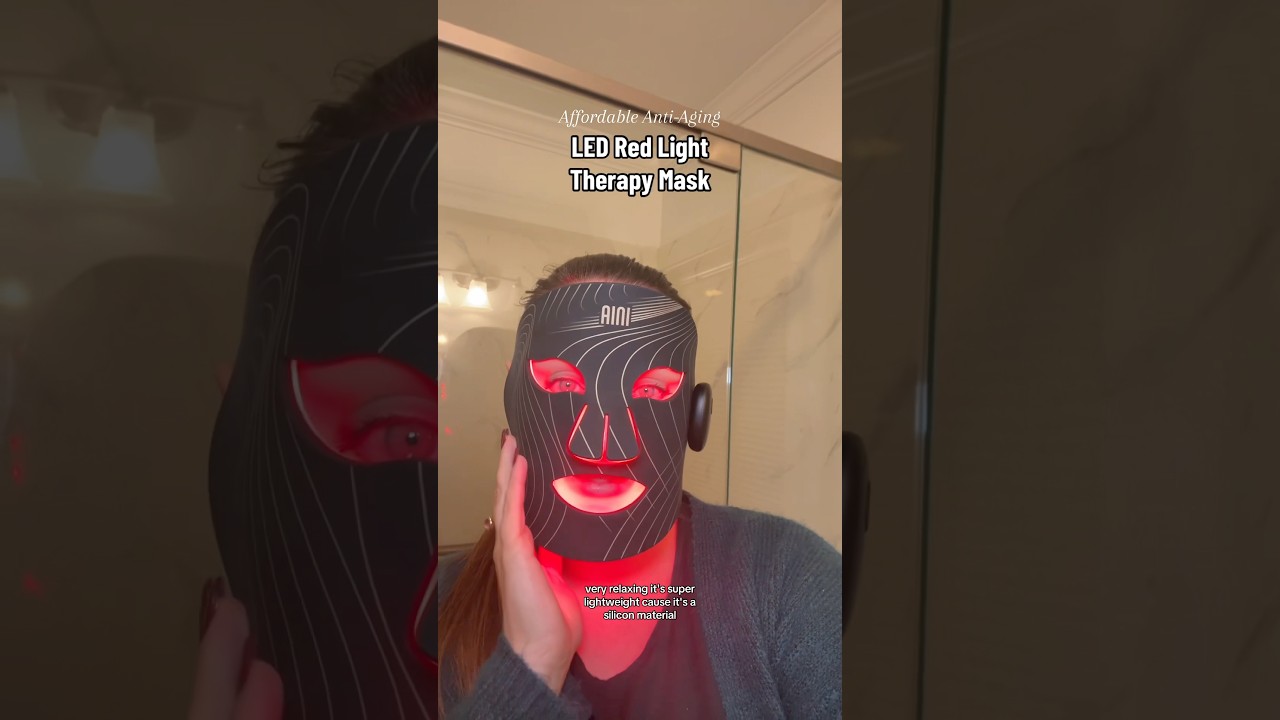
It is a flexible silicone LED mask that sits on your face like a hockey mask and runs on a small magnetic battery pack instead of a cord. The listing sells it as 272 LEDs, four light modes, 850nm near-infrared, and 105 mW/cm² of output.
I found it after eighteen months of looking. Here is what I said at the time, in the first video I made about it:
“After a year and a half of searching I have finally found an LED mask that is within my price range. Very budget friendly, considering what benefits you’re getting.”
I paid about $99 on TikTok Shop with a coupon stacked on top. That price point is the entire reason this mask is interesting, and it is also the reason its spec sheet deserves a harder look than a $400 mask would get. Cheap devices in this category are usually cheap because something was cut. I wanted to know what.
If you want to see the current price, the INIA GLOW mask is on Amazon here.
How do you actually use it?
Clean, dry, bare skin. No serum, no oil, no makeup underneath, because anything sitting on your face is sitting between the light and your skin. Snap a charged battery onto the side, press the button to choose a mode, and leave it on for ten minutes.
I do mine lying down before bed. That is a preference, not a rule, and it is worth saying that the wireless design means it does not have to be. I have worn this thing while answering emails and while cleaning the kitchen, which is not something you can do with a mask that is tethered to a wall.
The brand recommends ten minutes, three to five times a week, for two to five weeks, then maintenance. The FDA filing for the model family that INIA’s manufacturer cleared says something slightly more conservative: ten minutes a day, three times per week. I have settled at three or four nights a week and I would not push past that, for reasons I get into in how often you should actually use red light therapy on your face.
What do the specs actually measure?
This is the part of the review that took the longest and it is the part I would want to read.
Three numbers in the listing title are doing the selling: 272 LEDs, 850nm, and 105 mW/cm². Two of them survive checking and one does not.
| Spec | What INIA claims | What I could verify |
|---|---|---|
| Red wavelength | 630nm | Measured about 630nm. Matches. |
| Near-infrared | 850nm | Measured 849 to 850nm. Matches. |
| Amber / orange | 610nm | Measured about 607 to 610nm. Matches. |
| Blue | 460nm | Measured near 558nm, which is green. INIA’s own GLOW page calls the spectrum “red, blue, green and near-infrared.” |
| LED count | 272 LEDs (Amazon), 276 LEDs (brand image) | About 68 to 69 physical emitters, each a multi-chip package. INIA’s own site says “69 pieces.” |
| Irradiance | 105 mW/cm² | Measured about 30 mW/cm². The brand’s own page prints it as “105W/cm²,” which is a unit error. |
| Wireless, two batteries | Dual magnetic batteries, USB-C | Correct, and it is the best thing about the mask. |
| Silicone, flexible | Lightweight silicone | Correct. No published weight anywhere. |
On the irradiance number. I am not going to soften this. The listing headline says 105 mW/cm². An independent spectrometer review measured roughly 30. And the FDA clearance covering the model family INIA’s manufacturer filed lists red at 3.5 to 10 mW/cm², blue at 2.5 to 8, and red plus infrared at 6 to 27. Those are the factory’s own numbers, submitted to a regulator. The marketing figure is not consistent with them.
Here is the twist, and it is the reason I still use this mask: 30 mW/cm² is a perfectly reasonable output. It is the same figure Omnilux publishes for the Contour Face, which sells for $350 to $395. Ten minutes at 30 mW/cm² delivers about 18 J/cm², which sits inside the 1 to 20 J/cm² band that Huang and Hamblin describe as standard for stimulation in the photobiomodulation literature.
So the honest version of the sales pitch is not the one on the box. It is this: the measured output is in the same range as a mask costing three times more. The brand did not need the inflated number and it damaged its own credibility by printing it.
How does it compare to Omnilux, Dr Dennis Gross and CurrentBody?
In my first video I said I had put the top masks side by side and this one came out ahead on LED count and colour options. That comparison was based on the published spec sheets. Having now gone through what those sheets actually mean, here is the version I would give you today.
| Mask | Price | Wavelengths | Published irradiance | Power | Session |
|---|---|---|---|---|---|
| INIA GLOW | ~$120 to $150 | 630, 610, 850, plus a “blue” that measures green | Claims 105. Measures ~30. | Wireless | 10 min |
| Omnilux Contour Face | $350 to $395 | 633 + 830 | Yes, ~30 mW/cm² | Wireless | 10 min |
| Dr Dennis Gross FaceWare Pro | ~$455 | 630 + 415 | No | Corded | 3 min |
| CurrentBody Skin Series 2 | ~$469 | 633 + 830 + 1072 | No (~30 measured) | Corded | 10 min |
| Shark CryoGlow | ~$350 | 630 + 830 + 415 | No | Corded | 4 to 8 min |
The finding that surprised me most is in the fourth column. Of the major masks on the market, Omnilux is the only one that publishes an irradiance figure at all. Dr Dennis Gross, CurrentBody and Shark all decline to. That is the same pattern I ran into when I compared the Nood Flasher Pro against other IPL devices, where not one competing brand published an energy figure anywhere on its own website. Light-based beauty devices sell on wavelength numbers and stay quiet about dose.
INIA is the odd one out for publishing a number at all. Unfortunately it published the wrong one.
What does red light therapy actually do, and what does it not?
Short version: the evidence for wrinkles is real but much weaker than the category implies, and the evidence for dark spots is close to nonexistent.
The best-designed facial trial I could find is Bragato and colleagues, published in Lasers in Medical Science in 2025: 95 women, sham-controlled, double-blind, a 660nm red LED mask. On the blinded clinician-rated Wrinkle Assessment Scale, there was no significant difference between the treated groups and sham. Software-measured wrinkle length improved at two sites, and satisfaction scores were high in the treated groups. That gap between how people feel about it and what a blinded assessor can see runs through this entire literature. A 2025 narrative review of 59 red light studies covering 1,882 patients found patient satisfaction for photoaging running 59 to 91 percent against objective clinically significant change of 0 to 52 percent.
On the other side, Lee and colleagues in 2007 ran a double-blind, sham-controlled, split-face study of 76 subjects and reported large improvements. But that study delivered 66 to 126 J/cm² per session. This mask delivers about 18. The strongest study in the field used roughly four to seven times the dose the consumer devices give you, and nobody has run the trial that bridges the two.
I bought this mask partly for hyperpigmentation, which was a mistake I made with good intentions. There is no controlled human evidence that red LED fades dark spots. The one randomised, double-blind trial of LED for melasma was null on the pigment score. I wrote that up properly in does red light therapy work for dark spots, because it is the thing I most wish someone had told me.
The mask I have actually used for two years
INIA GLOW Wireless, 630nm red and 850nm near-infrared, silicone, two swappable batteries.
Is the INIA mask FDA cleared?
This needs a careful answer, because the honest one is “sort of, and not in the way the marketing implies.”
There is no FDA clearance held by a company called INIA. I searched the FDA 510(k) database and there is nothing under that applicant name. What exists is clearances held by the Chinese factories that build the masks. FDA’s own device identifier database links the brand name “INIA,” model FM-02, described as “INIA GLOW LED light therapy mask,” to clearance K223544, held by Guangdong Newdermo Biotech. A second clearance, K243040, held by Shenzhen Siken 3D, covers nine models, eight of which are the factory’s own house codes and one of which is IN-FM002.
Two things follow from that. First, a single clearance can cover a family of masks with very different outputs, and K243040’s own table spans 3.5 to 27 mW/cm² across the models it covers. A brand can accurately say it is covered by a 510(k) while shipping the weakest unit in the family. Second, INIA’s current face mask models appear in FDA’s registration listing with an empty K-number field, and registration is not clearance. Registration means a facility paid a fee and told FDA it exists.
Worth knowing generally: a 510(k) clearance is a finding that a device is substantially equivalent to something already on the market. It is not a finding that the device works, and it is never “FDA approved.” FDA says plainly on its own consumer page that phrases like “FDA registered” and “FDA certified” “may be used to mislead you.”
One claim I will not repeat. INIA’s site states the mask is “FDA-cleared, meaning it meets safety standards and can be used without protective goggles.” Clearance is not an eye-safety certification. The FDA filing for the sister model family explicitly relies on a “protective eye-shield which blocks light energy from LEDs.” The mask ships with removable eye pads. Use them.
What is it actually like to live with?
Two years in, here is what I would tell a friend.
The wireless part is not a gimmick. It is the whole product. Two magnetic batteries means one charges while the other is in use, and I have never once skipped a session because something was not plugged in. Corded masks lose to this every time in real life.
It presses on the nose bridge. This is the most common complaint in the reviews and it matches my experience. Tighten the strap too far and you will get LED contact marks on your brow bones and the bridge of your nose that take a while to fade. Looser than you think is correct.
Coverage is uneven. The emitters are spread out, and the forehead, cheeks and under-eye get good coverage while the jaw and chin get noticeably less. If your concern is along the jawline, this is not the mask.
There is a smell out of the box. Silicone off-gassing. It went away after a couple of uses.
Results are slow and undramatic. I am not going to tell you my skin transformed. The shortest published trial showing any objective change ran four weeks, and the FDA-cleared indication for this device class assumes six. What I can say honestly after two years is that I keep using it, which is more than I can say for most of the skincare devices I have bought.
Who should skip the INIA mask?
Anyone buying it for dark spots or melasma. The evidence is not there, and visible light is an established melasma aggravator. If pigment is your main concern, this is the wrong purchase and I would rather lose the sale than have you waste $120.
Anyone buying it primarily for acne. The blue channel is the weakest part of this mask. Blue light acne evidence rests on roughly 415 to 460nm, and independent measurement puts this channel near 558nm. Separately, the meta-analysis of blue light for acne, 14 randomised trials and 698 participants, found no significant effect on either inflammatory or non-inflammatory lesion counts.
Anyone with a photosensitive condition or on photosensitising medication. Talk to a doctor first, not a review site.
Anyone expecting a device to replace a retinoid. Topical tretinoin has a systematic review and meta-analysis of randomised trials behind it for photodamage. LED has nothing of comparable weight for wrinkles. If you only have money for one thing, the evidence points at the retinoid. I use the PRMR Youth Radiance serum and wrote about it separately.
Anyone who will not be consistent. Ten minutes, three times a week, for at least six weeks before you judge it. The device does not fail nearly as often as the schedule does.
Frequently asked questions
Is the INIA red light therapy mask worth it?
For the price, yes, with conditions. Its measured output of roughly 30 mW/cm² is the same as the Omnilux Contour Face at about a third of the cost, and the wireless design is genuinely better than most corded masks. Buy it for red and near-infrared light on general skin texture, not for dark spots or acne.
How many LEDs does the INIA mask really have?
About 68 to 69 physical emitters. The “272 LEDs” figure counts the individual chips inside each multi-chip package, which is a legitimate way to count and a misleading way to advertise. INIA’s own website says “69 pieces” in its FAQ.
Does the INIA mask really put out 105 mW/cm²?
No. Independent spectrometer measurement put it at roughly 30 mW/cm². The FDA filing from the factory that builds INIA masks lists 3.5 to 27 mW/cm² depending on model and mode. The brand’s own page prints the figure as “105W/cm²,” which is a unit error that would describe a dangerous device if taken literally.
Is the INIA mask FDA cleared?
Not under the name INIA. FDA’s device identifier database links the INIA brand and model FM-02 to clearance K223544, held by the Chinese manufacturer Guangdong Newdermo Biotech, and a second clearance K243040 covers a model family including IN-FM002. INIA’s current face mask models appear in FDA’s registration listing with no K-number attached, and registration is not clearance.
Do you need goggles with the INIA mask?
Use the eye pads it comes with. INIA says clearance means the mask can be used without protective goggles, but a 510(k) is not an eye-safety certification, and the FDA filing for the related model family relies on a protective eye shield. FDA’s adverse event database holds 100 reports for this device class, 25 of which mention the eyes.
How long does it take to see results from an LED mask?
At least four weeks, and the FDA-cleared indication for this device class assumes six. Nothing credible in the published literature reports meaningful objective change sooner. Any before and after posted at two weeks is showing you lighting.
Can you use the INIA mask every day?
You can, but the evidence does not suggest you should. The one sham-controlled trial that compared frequencies found two sessions a week performed no worse than three, and photobiomodulation has a documented biphasic dose response where more can work against you. Three times a week is where I have settled.
Is the INIA mask a white-label product?
Yes. INIA holds no manufacturing facility and no clearance of its own. Its devices are built by at least three separate contract manufacturers in Guangdong province, and the clearance covering one of its face mask models also covers eight of the factory’s own house-branded units. This is normal in the category rather than unique to INIA, and it is worth knowing before you pay a premium for any brand name in this space.
The one I own
INIA GLOW Wireless Red Light Therapy Mask. 630nm red, 610nm amber, 850nm near-infrared, silicone, dual magnetic batteries, 10 minute sessions. Around $120 to $150.
Related reading: how often to use red light therapy on your face · does red light therapy work for dark spots · how to choose a red light mask on Amazon · the Nood Ageless IPL lens review
Leave a Reply