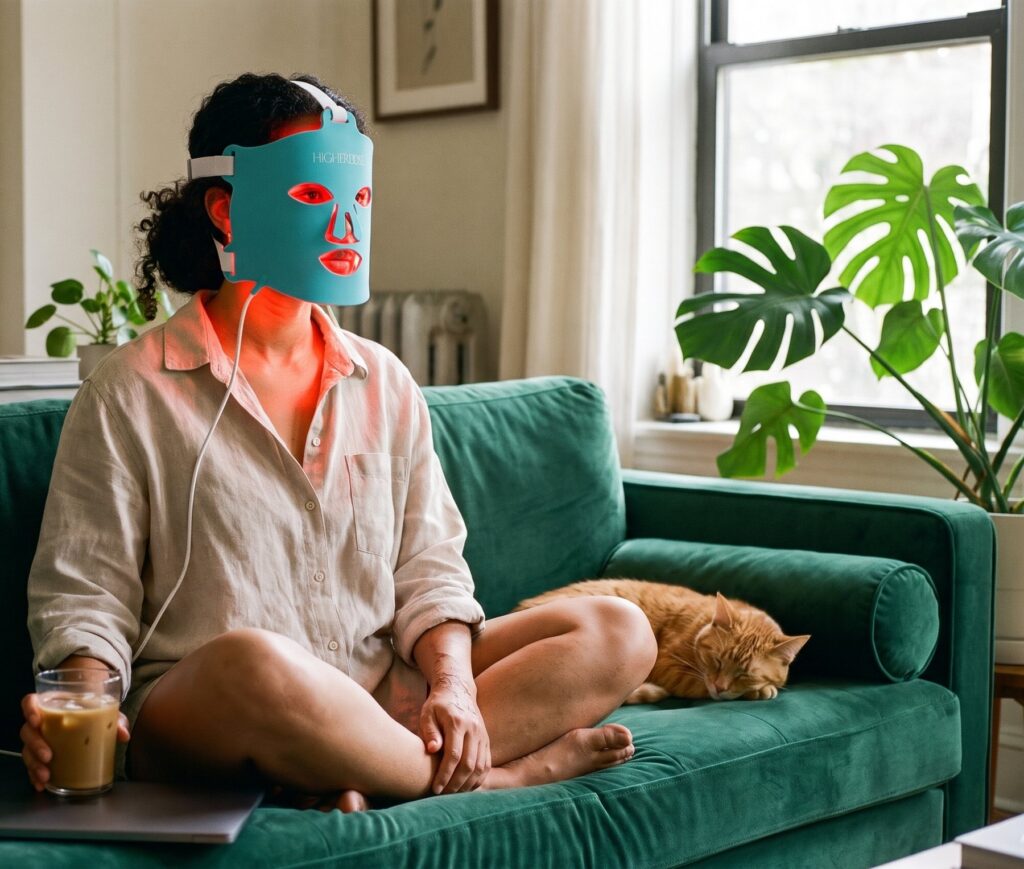
Quick answer: Buy the HigherDOSE Infrared PEMF Go Mat first if you want warmth you can use every day with no setup or cleanup, sitting in a chair or lying on the floor. Buy the HigherDOSE Infrared Sauna Blanket first if what you want is a full sweat session and you have about an hour, a heat-safe surface and time to wipe it down afterward. For most people choosing one, the Go Mat is the easier first buy because it fits into a normal evening.
Last updated: November 4, 2026
This HigherDOSE PEMF mat vs sauna blanket guide is for the buyer who wants one HigherDOSE heat product and is stuck between the two. Everything below comes from HigherDOSE’s own product pages and FAQ, checked on November 4, 2026. Benefits are reported as HigherDOSE’s claims, not as results.
Table of Contents
HigherDOSE PEMF mat vs sauna blanket at a glance
Feature
HigherDOSE Infrared PEMF Go Mat
HigherDOSE Infrared Sauna Blanket
What it is
A half-size infrared mat with PEMF
A zip-up infrared sauna you lie inside
How you use it
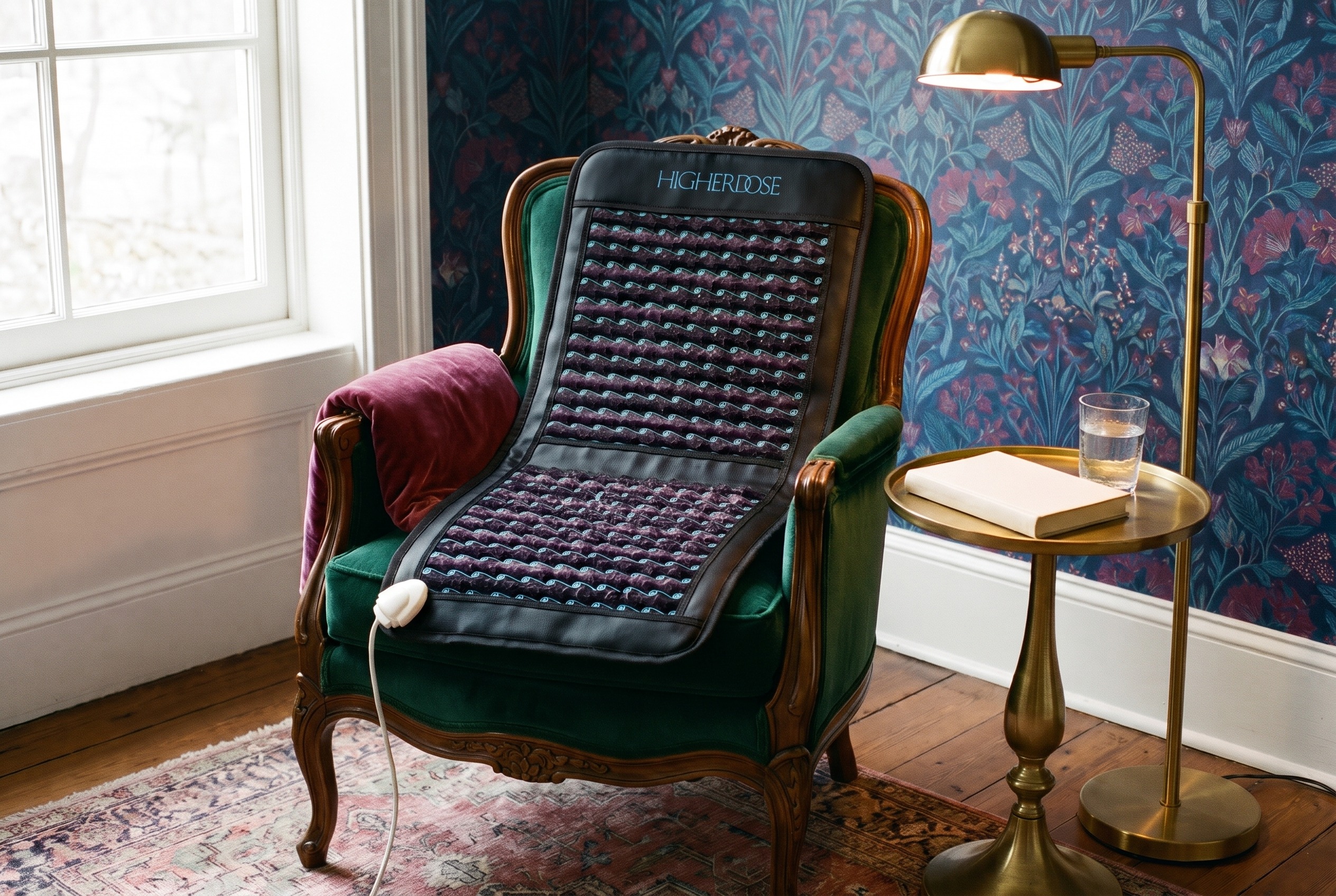
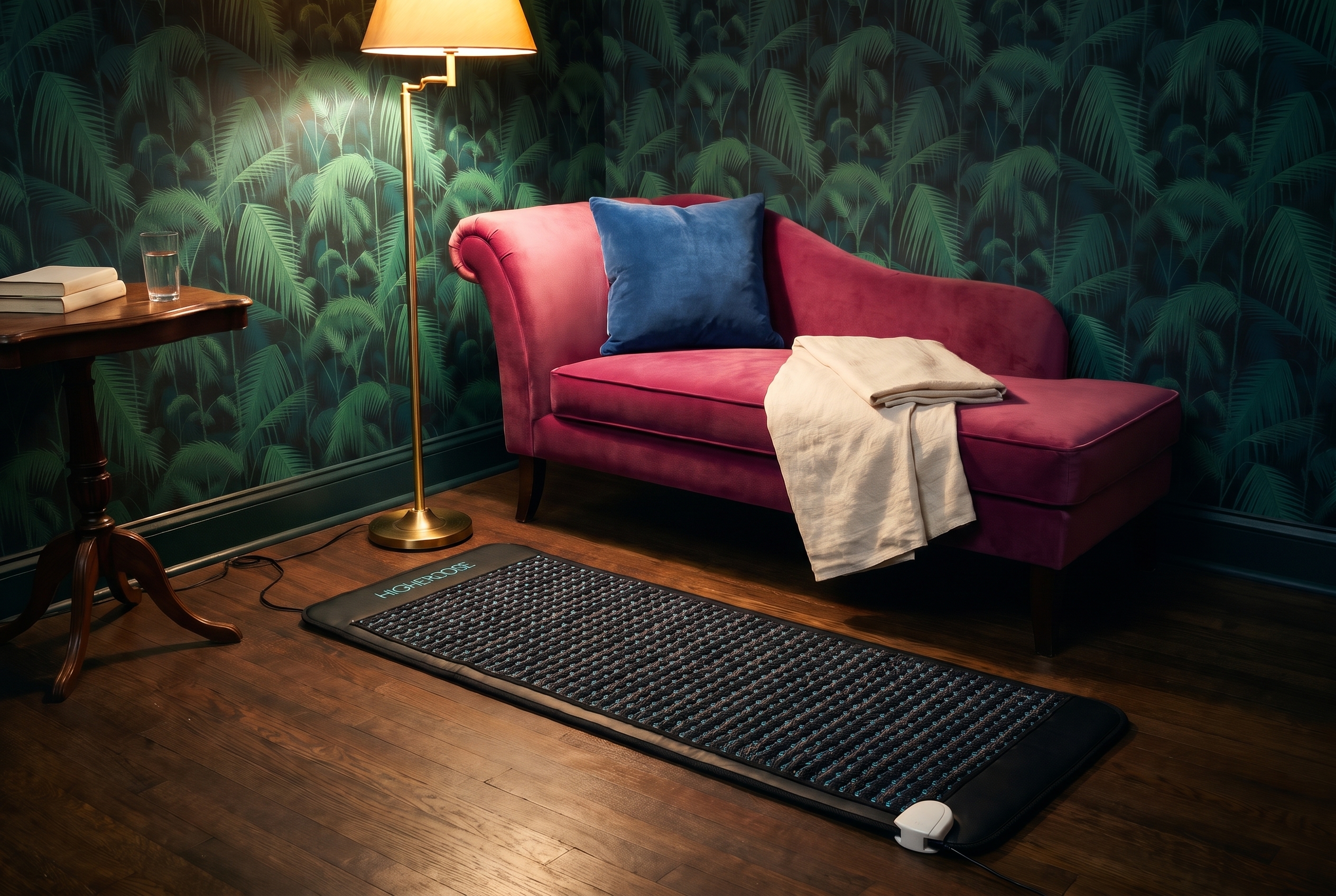
Sit on it in a heat-resistant chair or lie on it on the floor
Lie inside it on a flat, heat-safe surface, zipped in
Size
19.5 x 39 in (50 x 100 cm)
Not listed by HigherDOSE
Weight
11 lbs (5.2 kg)
Not listed by HigherDOSE
Heat
Far infrared, set on the controller
Far infrared, up to 175°F, levels 1 to 9
PEMF
2 cores, 4 levels (3 Hz to 23 Hz)
None
Layers
6: PEMF, far infrared heat, charcoal, clay, magnetic, amethyst and obsidian crystals
5: far infrared heating, charcoal, clay, magnetic strip, amethyst and obsidian crystals
Session
20-minute PEMF cycles, repeat as you like; auto-shutoff after up to 8 hours
1-hour timer; start with 30 to 40 minutes
Setup
Plug in and turn on
Preheat 10 to 15 minutes, dress in long sleeves, pants and socks or use an insert
Specs are from the HigherDOSE Go Mat and Sauna Blanket product pages. HigherDOSE lists a 120-day money back guarantee on its own site; when you buy from a retailer, check that retailer’s return policy before you order.
The real difference: warm and still, or a full sweat
HigherDOSE’s own comparison page puts it simply: the sauna blanket is for sweat sessions, and the PEMF mat is for relaxing with no setup or cleanup and no sweat. That one line decides it for most buyers. The two products share far infrared heat, a charcoal layer, a clay layer, a magnetic layer and a crystal layer, so the choice is really about the session you want, not the materials.
The Go Mat is something you sit or lie on while you read, meditate, stretch or wind down. You can step on and off. HigherDOSE says each PEMF cycle runs 20 minutes and can be restarted as many times as you like.
The Sauna Blanket is something you get inside. It is a planned session: preheat, dress for it, zip in, then cool down and wipe it clean.
You want to sweat. HigherDOSE positions the blanket for full sweat sessions; the mat is not built for that.
You can set aside about an hour, counting the 10 to 15 minute preheat, a 30 to 40 minute session and cooldown.
You have a flat, heat-safe spot to lay it out, and you are fine wiping it down after it cools.
You are happy with one or two sessions a week to start, which is what HigherDOSE’s FAQ suggests.
HigherDOSE says to wear long sleeves, pants and socks inside the blanket, with 100% cotton working best, or to use its sauna blanket insert, which is sold separately. Plan for that in what you buy.
Setup, cleanup and space
This is where the HigherDOSE PEMF mat vs sauna blanket choice feels most different day to day.
HigherDOSE PEMF Go Mat
HigherDOSE says to place the Go Mat on a heat-resistant chair or surface, or lay it flat on the floor, plug it in, press power, then use the PEMF button to cycle levels and the controller for heat. The mat shuts off after up to 8 hours. HigherDOSE also says not to leave the heat set high unattended.
HigherDOSE Infrared Sauna Blanket
HigherDOSE says to lay the blanket flat on a heat-safe surface, plug it in and preheat for 10 to 15 minutes before zipping in. It runs on a 1-hour timer with heat levels 1 to 9, up to 175°F. After a session, let it cool before wiping it down. HigherDOSE describes the shell as waterproof polyurethane and includes a carrying bag for storage.
What the research says about heat sessions
HigherDOSE lists benefits for both products, including relaxation, recovery, mood and sleep. Those are the brand’s own claims; HigherDOSE’s pages also state that the products are not intended to diagnose, treat, cure or prevent any disease. Neither product is presented here as a treatment for anything.
On infrared saunas in general, Cleveland Clinic says the evidence is limited: some studies suggest sauna use may support heart function, but more research is needed, especially on infrared saunas, and many pain studies are small. Its main safety concern is dehydration. It suggests bringing water, avoiding alcohol and getting out right away if you feel dizzy or nauseated.
Check with your doctor first before using either product if you are pregnant or trying to conceive, are nursing, take medication, or have a heart condition or any condition affected by heat. HigherDOSE says the PEMF Go Mat is not for use during pregnancy or by people with hemophilia, pacemakers or other implanted electrical devices. Cleveland Clinic notes that sauna use, especially early in pregnancy, can be harmful to the fetus.
HigherDOSE PEMF mat vs sauna blanket: which one to buy first
Most people: the HigherDOSE Infrared PEMF Go Mat. Daily use, no cleanup, fits a chair or the floor and stores under the bed.
The sweat-session person: the HigherDOSE Infrared Sauna Blanket. Built for a full sweat, with a planned hour and a quick wipe-down after.
Neither is better for everyone. HigherDOSE positions its Infrared Sauna Blanket for full sweat sessions and its Infrared PEMF Go Mat for calm warmth with no setup or cleanup. If you want something you can use most days in a chair or on the floor, the Go Mat fits better. If you want a planned sweat session once or twice a week, the Sauna Blanket is the one to buy.
How long should you stay in the HigherDOSE sauna blanket?
HigherDOSE says to start with 30 to 40 minutes per session and adjust to your comfort, and its FAQ suggests 30 to 50 minutes once you are used to it. The blanket has a 1-hour timer. Cleveland Clinic suggests easing into heat sessions and getting out right away if you feel dizzy or nauseated. Drink water before and after, and skip alcohol.
Can you use the HigherDOSE PEMF Go Mat every day?
HigherDOSE says you can use the Go Mat as long as you want, with each PEMF cycle running 20 minutes and restarting as often as you like. The mat shuts off after up to 8 hours. HigherDOSE also says not to leave the heat set high unattended and to avoid Level 4, the Focus setting, before bed. Check with your doctor first if you have a health condition.
Do you have to clean the HigherDOSE sauna blanket?
Yes. HigherDOSE says to let the Infrared Sauna Blanket cool and then wipe it down after each session, and it sells a cleaner separately. It also recommends wearing long sleeves, pants and socks inside, ideally 100% cotton, or using its sauna blanket insert, so your skin is not directly on the heated surface. The PEMF Go Mat has no cleanup step listed.
Can you put the HigherDOSE PEMF Go Mat on a bed?
HigherDOSE says to place the Go Mat on a heat-resistant chair or surface, or to lay it flat on the floor for stretching and meditation. It does not list a bed as a place to use it, so treat the floor or a heat-resistant chair as the safe choice. HigherDOSE does say the Go Mat slides under the bed for storage when you are not using it.
Who should not use a sauna blanket or a PEMF mat?
HigherDOSE says its PEMF Go Mat is not for use during pregnancy or by people with hemophilia, pacemakers or other implanted electrical devices. Cleveland Clinic says sauna use, especially early in pregnancy, can be harmful to the fetus, and advises people with existing health conditions to check with a doctor first. Ask your doctor before starting either one if you take medication or have a heart condition.
Sources
Sources checked on November 4, 2026. Figures from brands are reported as the brand’s own claims.
Quick answer: Of all the red light therapy gifts for men, the best for most men is the Omnilux Men, an LED face mask Omnilux built and FDA cleared for full face wrinkles with men’s thicker skin in mind. For a man who will only use something fast, give the Solawave Wrinkle Retreat Pro LED Face Mask (3-minute sessions); for a gadget lover, the Therabody TheraFace Mask; and for a wellness and sauna fan, the HigherDOSE Red Light Face Mask.
Last updated: November 4, 2026
Most LED mask gift guides are written for women, so they skip the questions men and the people buying for them actually ask: will it work over a beard, does it fit a bigger face, and will he use it more than twice. These red light therapy gifts for men are four FDA-cleared masks sorted by the kind of man you are shopping for, with every spec taken from the brand’s own product page. All four product pages loaded with an Add to cart button on November 3, 2026.
Shopping for someone else’s skin routine? Check with a doctor before starting any light therapy device if he takes medication that makes skin sensitive to light, has a history of skin cancer, or has an eye condition. Cleveland Clinic names those groups in its LED light therapy guide.
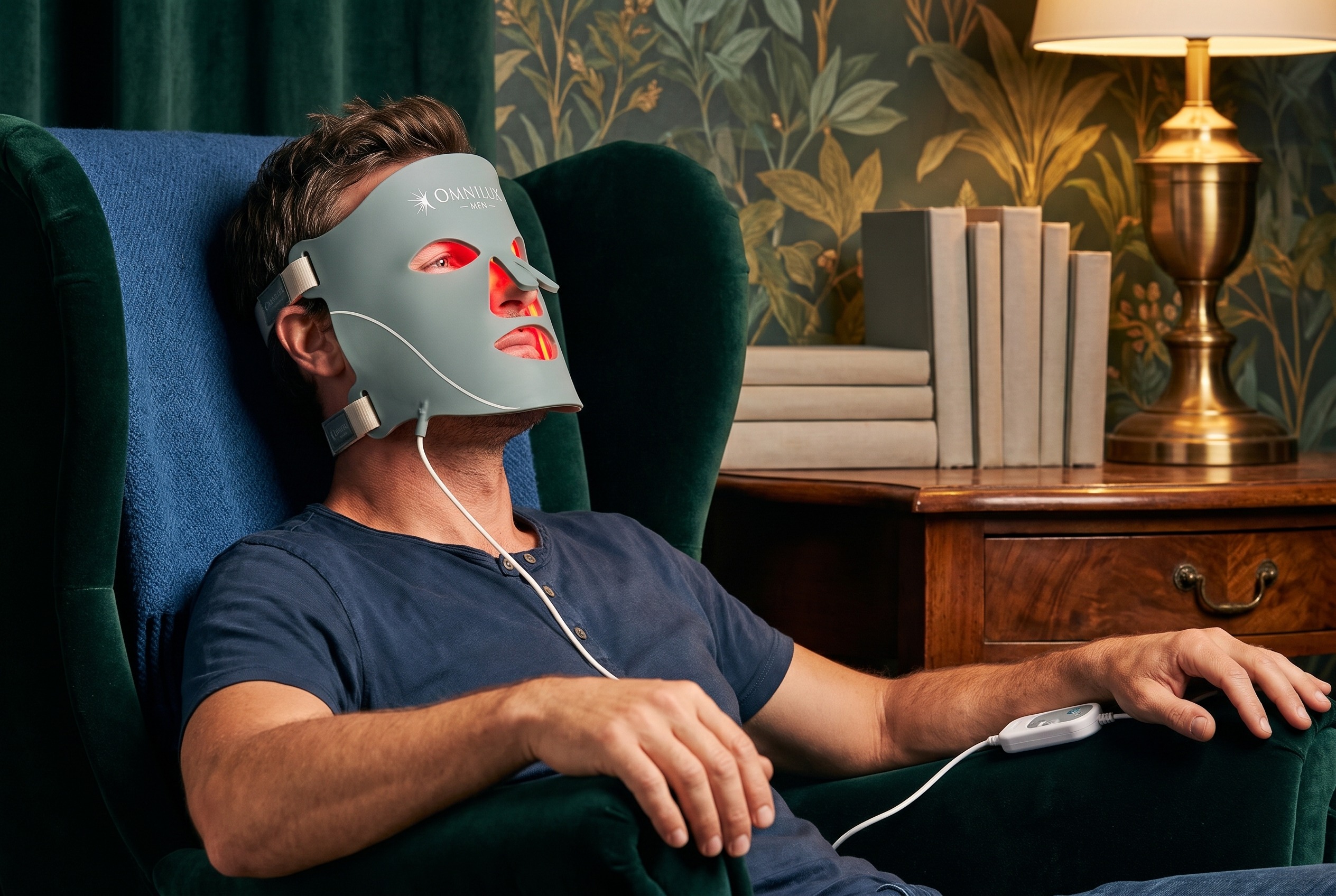
Beard or no beard. Omnilux says heavier beards can block light and its men’s mask works best on clean faces and light beards. If he has a full beard, expect the mask to reach his forehead, cheeks and under the eyes more than his jawline.
Time he will actually give it. The masks here run 3 to 20 minutes a session, and the brands suggest using them several times a week. A short session is the difference between a gift that gets used and one that lives in a drawer.
Cordless or tethered. All four run on a rechargeable battery. The Omnilux Men and HigherDOSE masks plug into a small controller; the TheraFace Mask is cordless; the Solawave uses a handheld remote.
FDA cleared, not FDA approved. Each brand calls its mask FDA cleared, which is the label Cleveland Clinic says to look for on an at-home device. It is not a promise of a specific result.
Return window. A gift should be easy to return if it does not fit. Brand pages list 30 days for Omnilux, 60 days for Solawave (opened products included), 120 days for HigherDOSE and 30 days on the TheraFace Mask page.
Best overall for men: Omnilux Men
The Omnilux Men is the easiest answer because it is the only mask here that Omnilux designs and markets for men specifically. Omnilux says men’s skin is about 25% thicker on average and that it added a 1072 nm near-infrared wavelength to reach deeper into thicker skin. The mask is flexible silicone with head straps and a rechargeable battery controller, and the brand lists it as FDA cleared for the treatment of full face wrinkles.
Routine: 10-minute sessions, three to five times a week for four to six weeks, then maintenance, per Omnilux.
In the box: the mask, battery controller, power supply and plug adapters, USB-C cable, head straps and a carry bag.
Good to know: two-year warranty on the device and controller. Omnilux says it works best on a clean face and light beard.
Who should skip it: a man with a thick full beard who mainly wants his jawline covered.
Best for a busy man: Solawave Wrinkle Retreat Pro LED Face Mask
The Solawave Wrinkle Retreat Pro LED Face Mask suits the man who says he has no time, because Solawave built it around a hands-free 3-minute treatment. It packs 320 LEDs across four wavelengths (red 630 nm, deep red 660 nm, amber 605 nm and near-infrared 830 nm) into soft medical-grade silicone with adjustable straps, and runs from a rechargeable handheld remote. Solawave labels it FDA cleared.
Routine: 3 minutes, 3 to 5 times a week, per Solawave.
In the box: protective goggles, head straps, remote, charging cable, storage bag and instructions.
Good to know: Solawave lists a 60-day money-back guarantee that covers opened and used masks, the most gift-friendly return policy of the four, plus a one-year warranty.
Who should skip it: someone who wants blue light in the same device.
Best for the gadget lover: Therabody TheraFace Mask
The Therabody TheraFace Mask is the pick for a man who already owns a Theragun and likes tech that does more than one thing. Therabody lists 648 lights across three modes (red 633 nm, red plus infrared 830 nm, and blue 415 nm) and adds VibraWave vibration that gently massages around the eyes and the top and back of the head. It is cordless, charges by USB-C and runs a pre-programmed 9-minute treatment. Therabody calls it FDA cleared.
Routine: a 9-minute program. Therabody’s clinical study used it once a day for 12 weeks.
In the box: the mask, removable eye shields, a display stand and a USB-C cable.
Good to know: Therabody lists a PC and ABS plastic housing with silicone eye shields rather than an all-silicone mask, plus a one-year limited warranty.
Who should skip it: someone who prefers a soft, all-silicone mask.
Best for the sauna and recovery fan: HigherDOSE Red Light Face Mask
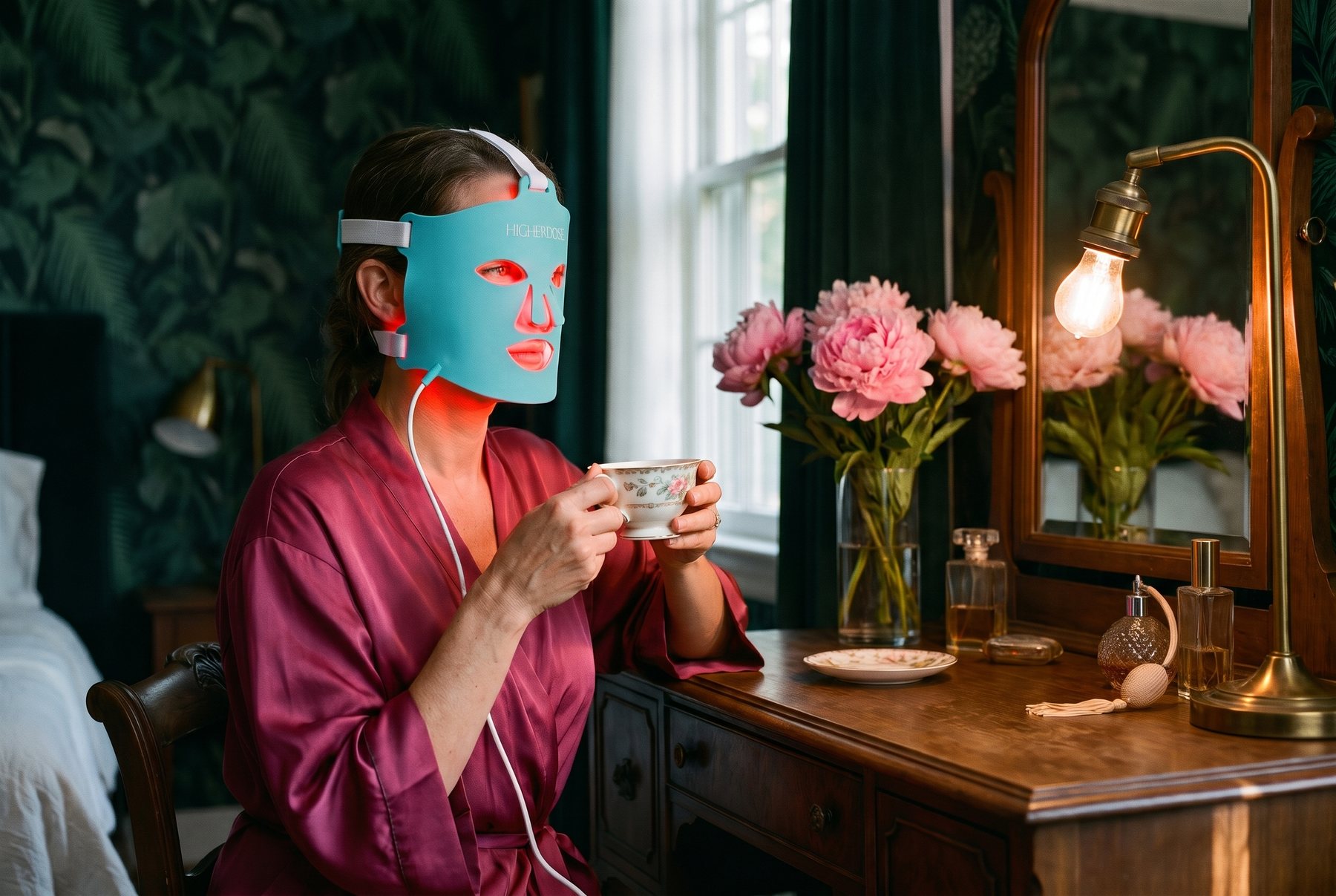
The HigherDOSE Red Light Face Mask fits the man whose routine already includes a sauna, cold plunge or infrared mat, since HigherDOSE is a wellness brand first. It uses red 630 nm and near-infrared 830 nm light from 66 dual-core LEDs in flexible medical-grade silicone with straps and an external rechargeable controller. HigherDOSE says the mask is FDA cleared and offers 10 or 20 minute sessions.
Routine: 3 to 5 times a week, per HigherDOSE.
In the box: mask, controller, power supply, USB-C cable, head straps, storage bag, manual and goggles.
Good to know: HigherDOSE advertises a 120-day money-back guarantee, the longest window here.
Who should skip it: someone who wants blue light or the shortest possible session.
Set expectations before you wrap any of these red light therapy gifts for men. Cleveland Clinic says research suggests LED light therapy can help some skin concerns, including reducing fine lines, and that red light may reduce inflammation and support collagen. It also says results usually take a series of regular treatments and that at-home devices tend to give subtler changes than in-office treatment. None of these masks is a substitute for a dermatologist, and every brand figure in this guide is the brand’s own claim.
Cleveland Clinic also advises eye protection during treatment and extra sunscreen afterward. Solawave and HigherDOSE include goggles in the box; check the manual for the others.
How to give it so he uses it
Pick his time slot. Match the session to his day: the Solawave’s 3 minutes fits a morning, a 10-minute mask fits an evening on the couch.
Charge it before you wrap it. All four are rechargeable, so a full battery means he can try it the day he opens it.
Keep the receipt and the box. Return windows run from 30 to 120 days on the brand pages, so keep the packaging until he has worn it a few times.
A red light therapy mask can be a good gift for a man who already cares about his skin or likes wellness gadgets, because it is hands-free and takes minutes. The Omnilux Men is made with men in mind, while the Solawave Wrinkle Retreat Pro suits a busy schedule with 3-minute sessions. Pick a mask with a generous return window in case it is not a fit.
Does red light therapy work on men’s skin?
Cleveland Clinic says research suggests LED light therapy can help reduce fine lines and that red light may support collagen, with results building over a series of regular treatments. Omnilux says men’s skin is about 25% thicker on average and adds a 1072 nm near-infrared wavelength to its men’s mask for that reason. At-home results are usually subtler than in-office treatment.
Can men with beards use an LED face mask?
Men with beards can use an LED face mask, but hair can get in the way of the light. Omnilux says heavier beards can block light and that its Omnilux Men mask works best on clean faces and light beards. With a full beard, expect the forehead, cheeks and under-eye area to get more of the light than the jawline and chin.
What is the best LED face mask for men?
The Omnilux Men is the best LED face mask for most men because Omnilux designed it for men’s skin and lists it as FDA cleared for full face wrinkles. For the fastest routine, the Solawave Wrinkle Retreat Pro LED Face Mask runs 3-minute sessions. For red, infrared and blue light plus vibration, the Therabody TheraFace Mask is the more high-tech choice.
How often should men use a red light mask?
Most brands suggest several sessions a week rather than daily marathons. Omnilux recommends 10-minute treatments three to five times a week for four to six weeks, then maintenance. Solawave suggests 3 minutes 3 to 5 times a week, and HigherDOSE suggests 3 to 5 times a week. Follow the manual for the specific mask, since timing differs by device.
Is a red light therapy mask safe?
Cleveland Clinic says LED light therapy does not use UV light and side effects are rare, though redness, rash or irritation can happen. It advises eye protection and extra sunscreen after treatment. People who take medication that increases sun sensitivity, have a history of skin cancer or have an inherited eye disease should check with a doctor before using one.
Sources
Sources checked on November 3, 2026. Figures from brands are reported as the brand’s own claims.
Quick answer: Pick the HigherDOSE Infrared PEMF Pro Mat if you want to lie down on it head to toe and have floor space for a 6-foot mat. Pick the HigherDOSE Infrared PEMF Go Mat if you will mostly sit on it in a desk or reading chair, or need to slide it under the bed when you are done. HigherDOSE says both use the same six layers and the same four PEMF levels, so the choice comes down to size, weight and where you will use it.
Last updated: October 31, 2026
This HigherDOSE PEMF Go Mat vs Pro Mat comparison covers what each infrared mat is, the specs HigherDOSE lists for both, where each one fits in a home, and who should buy which. Everything below comes from HigherDOSE’s own product pages, checked on the date above. Anyone searching “HigherDOSE PEMF Go Mat vs PEMF mat” is asking the same question: the full-size mat is now sold as the Infrared PEMF Pro Mat.
Table of Contents
HigherDOSE PEMF Go Mat vs Pro Mat at a glance
Feature
HigherDOSE Infrared PEMF Go Mat
HigherDOSE Infrared PEMF Pro Mat
Size
19.5 x 39 in (50 x 100 cm)
29 x 73 in (73.5 x 185 cm)
Weight
11 lbs (5.2 kg)
43 lbs (19 kg)
PEMF cores
2
4
PEMF levels
4 (3 Hz to 23 Hz)
4 (3 Hz to 23 Hz)
Layers
Six: PEMF, far infrared, charcoal, clay, magnetic, amethyst and obsidian crystals
The same six layers
Crystals
Amethyst and obsidian (weight not listed on its page)
20 lbs of amethyst and obsidian, per the Pro Mat page
Negative Ion button
Not listed on the Go Mat page
Yes, listed in the how-to steps
Power (US)
110V, 120 watts
110V, 180 watts
Where HigherDOSE says to use it
A heat-resistant chair or surface, or flat on the floor
A heat-resistant surface; skip beds, couches, memory foam and leather
Storage
Slides under a bed, per HigherDOSE
Large and heavy; plan a spot to leave it out
Best for
Sitting at a desk, a reading chair, small rooms
Lying down head to toe on the floor
HigherDOSE PEMF Go Mat vs Pro Mat specs from HigherDOSE’s own product pages. The 20-pound crystal figure for the Pro Mat also matches The Sleep Code’s listing.
What the two mats have in common
Both are HigherDOSE infrared PEMF mats, which pair two things: far infrared heat you can feel, and PEMF (pulsed electromagnetic field) settings that run at low frequencies. HigherDOSE lists the same four PEMF levels for both mats, each named for a brain wave frequency:
Level 1, Sleep (3 Hz, Delta): for winding down before bed.
Level 2, Grounding (7.8 Hz, Theta): for resetting when you feel overstimulated.
Level 3, Create (10 Hz, Alpha): for meditating or relaxing while awake.
Level 4, Focus (23 Hz, Beta): for energy and focus. HigherDOSE says to avoid it before bed.
The heat is set separately on the controller, and HigherDOSE describes a full PEMF session as one 20-minute cycle that can be repeated. Both product pages carry the same safety note: the mats are not for use during pregnancy or by people with hemophilia, pacemakers or other implanted electrical devices.
What the Pro Mat adds
The HigherDOSE Infrared PEMF Pro Mat is the full-length version: 29 by 73 inches, which is long enough for most adults to lie on with their head and feet on the mat. HigherDOSE lists four PEMF cores in the Pro Mat against two in the Go Mat, plus 20 pounds of amethyst and obsidian crystals and a Negative Ion button in its how-to steps. The cover is listed as non-toxic vegan leather.
The tradeoff is size. At 43 pounds and just over 6 feet long, the Pro Mat is a piece of furniture more than an accessory, and HigherDOSE says it should go on a heat-resistant surface, not a bed, couch, memory foam or leather. In practice that means the floor, ideally a spot where it can stay out. The move here is to measure the floor space next to a bed or in a quiet corner before ordering.
The HigherDOSE Infrared PEMF Go Mat is half the length of the Pro Mat, at 19.5 by 39 inches and 11 pounds. HigherDOSE designed it to drape over a work-from-home chair, lay flat for stretching or meditation, and slide under the bed when it is not in use. It runs the same four PEMF levels through two PEMF cores, with infrared heat set on the same kind of controller.
The Go Mat is the practical pick for anyone whose real routine is sitting: answering email, reading in the evening, or winding down in an armchair. It is not long enough to lie on from head to toe, so anyone who pictures a full-body session on the floor will be happier with the Pro Mat.
A bedroom or living room with open floor: the Pro Mat, laid flat on the floor for full-body sessions before bed.
A home office or reading chair: the Go Mat, draped over the chair seat and back.
A small apartment or shared room: the Go Mat, since it can be stored under the bed.
Stretching or yoga on the floor: either works, but only the Pro Mat fits a full lying position.
A note on the sleep angle in the HigherDOSE PEMF Go Mat vs Pro Mat decision: HigherDOSE names Level 1 its Sleep setting and suggests it before bed. Since neither mat is meant for a mattress, the realistic routine is a session on the floor or in a chair before getting into bed, not sleeping on the mat.
HigherDOSE PEMF Go Mat vs Pro Mat: who should buy which
Buy the HigherDOSE Infrared PEMF Pro Mat if
You want to lie down on it head to toe.
You have floor space where a 6-foot, 43-pound mat can stay out.
You want the four PEMF cores, the larger crystal layer and the Negative Ion button HigherDOSE lists.
Buy the HigherDOSE Infrared PEMF Go Mat if
You mostly want warmth and PEMF while sitting in a desk or reading chair.
You need to store it under a bed or move it between rooms.
You want the same four PEMF levels in a smaller, lighter mat.
Skip both, or ask a doctor first, if
You are pregnant, or have hemophilia, a pacemaker or another implanted electrical device. HigherDOSE says the mats are not for you.
You are nursing, take medication, or have a heart or heat-sensitive condition. Check with your doctor before your first session.
One buying note for either side of the HigherDOSE PEMF Go Mat vs Pro Mat choice: return windows differ by store. HigherDOSE lists a 120-day money back guarantee when you buy from its own site. The Sleep Code’s refund policy gives 30 days from delivery to request a return, for items in the condition they arrived, unused and in the original packaging, and it excludes sale items. Anyone who wants a long at-home trial can buy the Pro Mat from HigherDOSE or the Go Mat from HigherDOSE directly.
For a full-body session lying on the floor, the HigherDOSE Infrared PEMF Pro Mat is the one to buy: it is the only one of the two long enough to lie on, and HigherDOSE gives it four PEMF cores and the larger crystal layer. For warmth and PEMF in a chair, or in a home without floor space to spare, the HigherDOSE Infrared PEMF Go Mat delivers the same four PEMF levels in a mat that weighs 11 pounds and stores under the bed.
HigherDOSE PEMF Go Mat vs Pro Mat FAQ
What is the difference between the HigherDOSE Go Mat and the Pro Mat?
HigherDOSE says the Infrared PEMF Go Mat and the Infrared PEMF Pro Mat share the same six layers and the same four PEMF levels. The difference is size and build. The Pro Mat measures 29 by 73 inches, weighs 43 pounds and has four PEMF cores for lying down head to toe. The Go Mat measures 19.5 by 39 inches, weighs 11 pounds and has two PEMF cores for a chair or a small space.
Does a HigherDOSE mat work?
HigherDOSE says its PEMF mats help with recovery, stress and restful sleep. Those are the brand’s own claims, and neither mat is presented here as a treatment for any condition. What a buyer can count on is the far infrared warmth, which is easy to feel, and the four PEMF levels HigherDOSE lists. Anyone hoping a mat will help with pain or a health issue should ask a doctor first.
Can you put a HigherDOSE PEMF mat on a bed?
HigherDOSE’s instructions for the Infrared PEMF Pro Mat say to use it on a heat-resistant surface and to skip beds, couches, memory foam and leather. For the Go Mat, HigherDOSE says to use any heat-resistant chair or surface, or to lay it flat on the floor, and it suggests sliding the Go Mat under the bed for storage. The floor or a firm chair is the safer setup for either mat.
How long should you lie on a HigherDOSE PEMF mat?
HigherDOSE describes a full PEMF session as one 20-minute cycle, and says the cycle can be restarted as many times as you like. On the Go Mat page, the brand adds that the infrared heat runs for up to 8 hours before it shuts off on its own, and advises against leaving the heat on high unattended. Starting with one cycle at a low heat setting is a sensible first step.
Who should not use a PEMF mat?
HigherDOSE says its PEMF mats are not for use during pregnancy or by people with hemophilia, pacemakers or other implanted electrical devices, and that anyone unsure should check with a healthcare provider first. The same caution makes sense for anyone with a heart condition, a heat-sensitive condition, or who is nursing or taking medication. A quick question to your doctor before the first session costs nothing.
Is the HigherDOSE Pro Mat worth it over the Go Mat?
The HigherDOSE Infrared PEMF Pro Mat is worth it for someone who wants to lie down on it head to toe and has floor space for a 6-foot, 43-pound mat. The Go Mat is the better buy for someone who mostly wants to sit on it at a desk or in a reading chair, or who needs to store it out of sight. Both use the same four PEMF levels, according to HigherDOSE.
Sources
Sources checked on October 31, 2026. Figures from brands are reported as the brand’s own claims.
Quick answer: Pick the HigherDOSE Red Light Face Mask if your goal is fine lines and firmness and you want a simple mask you can wear while you move around. It runs the two most studied skin wavelengths (red and near-infrared), offers a 10 or 20 minute session, and costs less. Pick the CurrentBody Series 3 if you also want blue light for breakouts, yellow for redness and green for tone, a third, deeper near-infrared wavelength, and an app that lets you control where each light goes. The HigherDOSE is the focused anti-aging mask; the CurrentBody is the do-everything mask.
6: red 633nm, near-infrared 830nm and 1072nm, plus blue 415nm, green 532nm and yellow 590nm
LEDs
66 dual-core LEDs (132 diodes)
750
Stated output
50 mW/cm2 total (26 red, 24 near-infrared)
Up to 40 mW/cm2
Session
10 or 20 minutes, 3 to 5 times a week
10 minutes, 3 to 5 times a week
App
None
CurrentBody app with MyDose and full-face presets
Fit
Flexible silicone with face and head straps
Flexible silicone with a chin strap
Controller
Rechargeable, USB-C, about 80 to 100 minutes per charge
Rechargeable, USB-C
In the box
Mask, controller, power adapter, head straps, goggles, storage bag
Mask, controller, USB-C cable, eye inserts, storage bag
FDA status
Described by HigherDOSE as FDA cleared
Described by CurrentBody as FDA cleared
Best for
Lines, firmness and glow, kept simple
Aging plus breakouts, redness or uneven tone
Specs come from each brand’s own product page. Output figures are the brands’ numbers, measured their own way, not independent tests, so a higher number on paper is not proof of a stronger mask.
The real difference: two lights or six
Both masks share the core of an anti-aging LED routine: red light around 630nm and near-infrared at 830nm. Those are the wavelengths with the most research behind them for fine lines, texture and firmness.
The CurrentBody Series 3 adds four more. A deeper near-infrared at 1072nm sits alongside the other two, and blue, green and yellow cover other concerns:
Blue (415nm) is the best studied of the extras and is used for breakout-prone skin. If you still get blemishes along with lines, this is the strongest reason to pay for the Series 3.
Yellow (590nm) is used for redness. The research is smaller and more mixed.
Green (532nm) is marketed for uneven tone. It has the thinnest evidence of the six.
If your skin goals are lines and firmness only, the extra colors add little for you, and the HigherDOSE covers the part that matters. The full breakdown of what those extra lights do is in CurrentBody Series 3 vs Series 2.
LED count and output: what the numbers mean
The CurrentBody lists 750 LEDs against the HigherDOSE’s 66 dual-core LEDs, and HigherDOSE lists a higher total output (50 against up to 40 mW/cm2). Those two facts pull in opposite directions, which is the point: neither number settles which mask delivers more light to your skin. LED count partly reflects how many colors a mask has to fit in, and output figures depend on how and where each brand measures. If tested, published output matters most to you, the INIA vs Omnilux comparison covers what to look for.
Session length and routine
The HigherDOSE gives you a choice of 10 or 20 minutes. HigherDOSE suggests 10 minutes 4 to 5 times a week or 20 minutes 3 to 4 times a week. The CurrentBody runs 10 minute sessions, 3 to 5 times a week. Either way, consistency over weeks is what counts, and more is not better. How often to use red light therapy for wrinkles goes deeper on frequency.
App or no app
The Series 3 pairs with the CurrentBody app. Its MyDose feature lets you run one light on the chin and another across the forehead in the same session, and there are presets for anyone who does not want to build their own. The HigherDOSE has no app: pick a session length on the controller and go. If you like to customize, the app is a real plus. If you want to put a mask on and press one button, the HigherDOSE is simpler.
Fit, comfort and moving around
Both are flexible silicone masks rather than rigid shells. The HigherDOSE uses face and head straps and a rechargeable controller that HigherDOSE designed so you can move around during a session; the brand lists about 80 to 100 minutes of battery per charge. The CurrentBody uses a chin strap and eye inserts, and its controller also charges over USB-C. The HigherDOSE box includes goggles.
Which one to buy
Buy the HigherDOSE if fine lines, firmness and glow are the goal, you want a longer 20 minute option, and you would rather keep the difference in price.
Buy the CurrentBody Series 3 if you are dealing with aging and breakouts or redness at the same time, or you want app control over where each light goes.
Compare a third option if you are also weighing the Solawave mask: Solawave vs CurrentBody covers it.
LED masks are cosmetic devices, not treatments for any medical condition. Check with your doctor before starting either one if you are pregnant or breastfeeding, have a light-sensitive condition such as lupus, take medication that causes light sensitivity, get headaches triggered by light, or have an eye condition. If you have had injectables or an in-office procedure, HigherDOSE suggests waiting 24 to 48 hours before a session.
FAQ
Is the HigherDOSE Red Light Face Mask worth it?
For lines and firmness, it covers the two wavelengths with the most research behind them and costs less than the Series 3. What it lacks is blue, green and yellow light and an app.
What is the difference between HigherDOSE and CurrentBody LED masks?
The HigherDOSE uses red and near-infrared only, with 10 or 20 minute sessions and no app. The CurrentBody Series 3 uses six wavelengths, including a deeper near-infrared and blue light for breakouts, with 10 minute sessions and app control.
Which LED mask is better for acne?
The CurrentBody Series 3, because it includes blue light (415nm), the most studied LED color for breakout-prone skin. The HigherDOSE has no blue light.
Can you use a red light mask every day?
Both brands suggest 3 to 5 sessions a week rather than daily. HigherDOSE notes that going over the recommended use brings diminishing returns.
Should you put skincare on before an LED mask?
Start with clean, dry skin. HigherDOSE advises against sunscreen, heavy moisturizer or mineral makeup under the mask, since they can block light. Apply the rest of your routine after.
How long until you see results?
HigherDOSE says most changes start to show after 3 to 4 weeks of consistent use, and CurrentBody suggests 3 to 5 sessions a week for 8 weeks. Any change builds gradually.
Sources
Sources checked on October 24, 2026. Figures from brands are reported as the brand’s own claims.
(function () {
var LABEL = "Send me the cheat sheet";
var PDF = "https://annakatherinepage.com/wp-content/uploads/2026/11/flower-price-cheat-sheet.pdf";
var CONFIRM = '<p>Your Flower Price Cheat Sheet is ready. <a href="' + PDF + '">Download the two-page PDF</a> now.</p><p>Give the email a minute, and peek in spam the first time so the next one lands in your inbox. The formulas use labeled sample numbers. Type over them with yours.</p>';
function retitle() {
var buttons = document.querySelectorAll(".fluent_form_5 .ff-btn-submit, form.fluent_form_5 .ff-btn-submit, .frm-fluent-form.fluent_form_5 .ff-btn-submit");
for (var i = 0; i < buttons.length; i++) {
var b = buttons[i];
if ((b.textContent || "").indexOf("cheat sheet") === -1) {
b.textContent = LABEL;
b.setAttribute("aria-label", LABEL);
}
b.style.backgroundColor = "#5a6b4e";
b.style.borderColor = "#5a6b4e";
b.style.color = "#ffffff";
}
var styles = document.querySelectorAll(".ff-form-inline-style style");
for (var j = 0; j < styles.length; j++) {
var s = styles[j];
if ((s.textContent || "").indexOf("fluent_form_5") !== -1 && (s.textContent || "").indexOf("#123d2e") !== -1) {
s.textContent = s.textContent.replace(/#123d2e/g, "#5a6b4e");
}
}
}
if (document.readyState === "loading") document.addEventListener("DOMContentLoaded", retitle);
else retitle();
setTimeout(retitle, 400);
function maybeFixSuccess(root) {
if (!root) return;
var success = root.querySelector(".ff-message-success, .ff-el-success, .ff-form-success");
if (!success) return;
var t = (success.textContent || "").toLowerCase();
if (t.indexOf("inbox") !== -1 || t.indexOf("cheat sheet") === -1) {
success.innerHTML = CONFIRM;
}
}
document.addEventListener("fluentform_submission_success", function () {
maybeFixSuccess(document.querySelector(".fluentform_wrapper_5, #fluentform_5, .ff_form_wrapper_5"));
});
if (window.jQuery) {
window.jQuery(document).on("fluentform_submission_success", function () {
maybeFixSuccess(document.querySelector(".fluentform_wrapper_5, #fluentform_5, .ff_form_wrapper_5"));
});
}
})();
(function(){
function rgb(c){var m=(c||"").match(/[0-9.]+/g);return m?m.map(Number):null;}
function lum(a){return (0.299*a[0]+0.587*a[1]+0.114*a[2])/255;}
function effbg(el){var n=el;while(n){var c=rgb(getComputedStyle(n).backgroundColor);if(c&&(c.length<4||c[3]>0.5))return c;n=n.parentElement;}return null;}
var sel="main h1,main h2,main h3,main h4,main p,main li,main span,#frc h1,#frc h2,#frc h3,#frc p,#frc span,#frc li";
document.querySelectorAll(sel).forEach(function(t){
var bg=effbg(t);
if(!bg) return;
if(lum(bg)<0.30){
var fc=rgb(getComputedStyle(t).color);
if(fc && lum(fc)<0.5){ t.style.setProperty("color","#f7f1e6","important"); }
}
});
})();
(function () {
function formIdFrom(ev, data) {
var id = "";
var form = null;
if (data) {
if (data.formId != null) id = String(data.formId);
else if (data.form_id != null) id = String(data.form_id);
form = data.form;
if (form && form.jquery) form = form[0];
}
if (!form && ev && ev.detail) {
form = ev.detail.form;
if (form && form.jquery) form = form[0];
if (!id) {
if (ev.detail.formId != null) id = String(ev.detail.formId);
else if (ev.detail.form_id != null) id = String(ev.detail.form_id);
}
}
if (!form && ev && ev.target && ev.target.nodeType === 1) {
form = ev.target.closest ? (ev.target.closest("form") || ev.target.closest("[id^='fluentform_']") || ev.target.closest("[class*='fluent_form_']")) : ev.target;
}
if (!id && form) {
var src = String((form.id || "") + " " + (form.className || "") + " " + (form.getAttribute && (form.getAttribute("data-form_id") || form.getAttribute("data-id") || "") || ""));
var m = src.match(/fluentform_wrapper_(\d+)/) || src.match(/fluentform_(\d+)/) || src.match(/fluent_form_(\d+)/);
if (m) id = m[1];
}
return id;
}
function newEventId() {
try {
if (window.crypto && typeof crypto.randomUUID === "function") return crypto.randomUUID();
} catch (err) {}
return "ff5lead_" + Date.now() + "_" + Math.random().toString(16).slice(2);
}
var lockUntil = 0;
function fireLead(ev, data) {
if (formIdFrom(ev, data) !== "5") return;
if (typeof window.fbq !== "function") return;
var now = Date.now();
if (now < lockUntil) return;
lockUntil = now + 2000;
var eid = newEventId();
try {
fbq("track", "Lead", { content_name: "Flower Price Cheat Sheet" }, { eventID: eid });
} catch (err) {}
}
document.addEventListener("fluentform_submission_success", function (ev) {
fireLead(ev, ev && ev.detail);
});
if (window.jQuery) {
window.jQuery(document).on("fluentform_submission_success", function (ev, data) {
fireLead(ev, data);
});
window.jQuery(document.body).on("fluentform_submission_success", function (ev, data) {
fireLead(ev, data);
});
}
})();