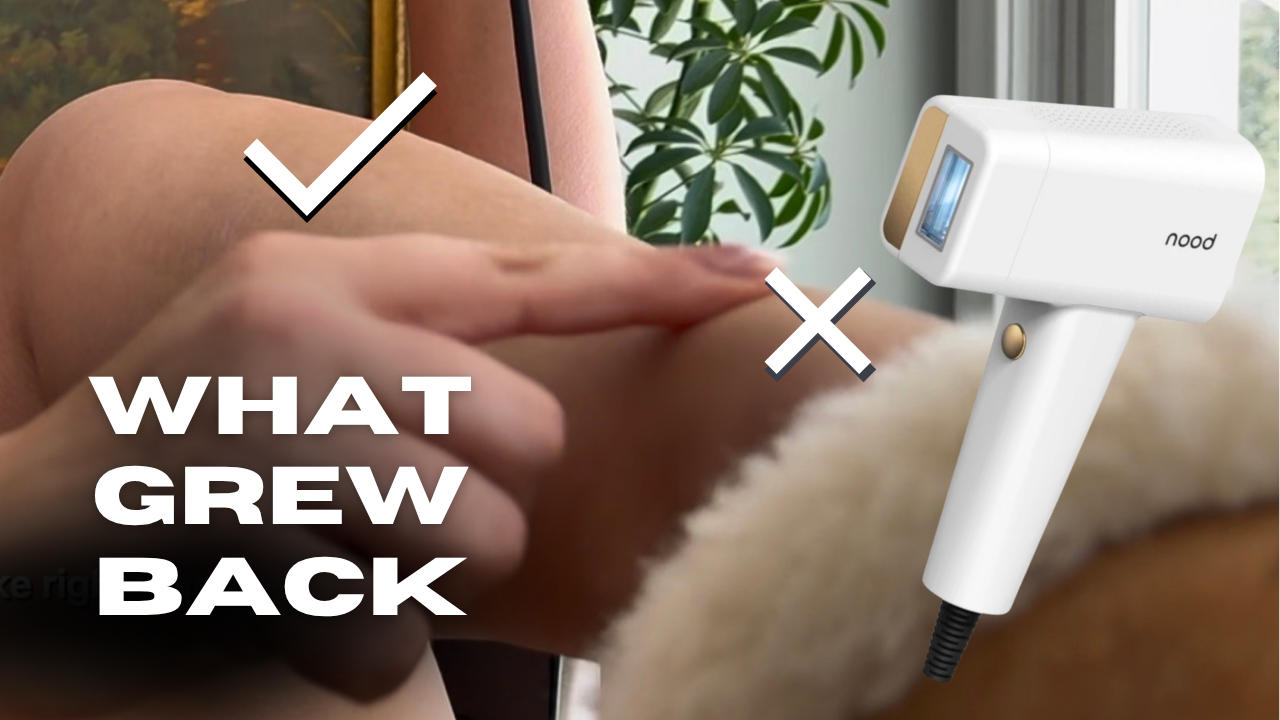
The short answer: for peach fuzz and a smoother makeup base, dermaplaning is the better pick. There is no pulling and no sting, it exfoliates while it removes hair, and there is no grow-out phase. Waxing is the better pick for darker, coarser hair on the upper lip or chin, because it pulls hair out at the root and one session lasts about three to four weeks. One rule settles it for a lot of people: if retinol or a prescription retinoid is part of your routine, waxing your face is the method dermatologists warn about.
A small blade glides over the skin and cuts hair at the surface
Wax grips the hair and pulls it out at the root
What comes off
Peach fuzz (vellus hair) and dead surface skin
The whole hair, root included
How long it lasts
Shorter. Hair is cut, not pulled, so regrowth shows sooner
About three to four weeks per session, per Cleveland Clinic
How often
No more than once a week, per a Cleveland Clinic dermatologist
Only once hair has grown back long enough for wax to grip
Hair length needed
None
About one-fourth to three-fourths of an inch, per the American Academy of Dermatology
How it feels
No pulling, so no sting
A quick sting with every pull
Skin bonus
Exfoliation, so skin feels smoother and makeup sits better
Some exfoliation, but that is not the point
Main risks
Nicks, a day or so of irritation, and flare-ups if used over active acne
Redness, ingrown hairs, inflamed follicles, and skin damage on retinoid-treated skin
Best for
Fine, light fuzz across the whole face
Dark or coarse hair in small areas like the upper lip and chin
What dermaplaning does well
Dermaplaning is exfoliation and hair removal in one pass. In Cleveland Clinic’s guide to dermaplaning at home, dermatologist Melissa Piliang, MD, describes it as taking dead skin cells and peach fuzz off the surface of the skin, which is why products may absorb better and makeup may go on more smoothly afterward. Her guidance on frequency is no more than once a week, so skin has time to recover.
The limits are just as clear. The same guidance says to wait out a breakout, because dermaplaning can aggravate existing acne, and to skip it during an eczema flare or any other active skin issue. Skin may feel a little irritated for a day or so, and a nick is a way in for infection, so a guarded tool beats a bare blade.
The dermaplaning tool to look at
What works here is a sonic tool with a safety guard over the blade. The Michael Todd Sonicsmooth is the pick for most people: the brand lists sonic technology with three speeds and a patented safety guard, and says it removes peach fuzz and sideburns. Shop the Michael Todd Sonicsmooth.
Waxing wins on staying power. Because the hair comes out at the root, one session can last three to four weeks, according to Cleveland Clinic dermatologist Shilpi Khetarpal, MD. That makes it the stronger choice for dark, coarse hairs, the kind that show again quickly when they are only cut at the surface.
The trade-offs are the grow-out and the skin stress. Hair has to be about one-fourth to three-fourths of an inch long before wax can grip it, per the American Academy of Dermatology, so there is always a stretch of visible regrowth between sessions. Cleveland Clinic also lists inflamed follicles, redness, ingrown hairs, and irritation as possible side effects.
The rules dermatologists set for waxing your face
Pause retinol and prescription retinoids first. The American Academy of Dermatology says to avoid them for two to five days before waxing your face. Cleveland Clinic warns that waxing retinol-affected skin can cause abrasions, infection, and even scarring.
No waxing within six months of isotretinoin. That one comes straight from the American Academy of Dermatology.
Skip sunburned or very sensitive skin.
Watch the aftermath. If redness or swelling lasts more than two days, the Academy says to see a dermatologist.
The wax to look at
For a first try at home, the move is no-heat strips made for the face, since there is no hot wax to overheat. Nad’s Facial Wax Strips come as a kit with 20 strips, four calming oil wipes, and a skin protection powder, and the brand lists them for the face, chin, and upper lip. Nad’s also says not to wax the same facial area twice, because repeat passes can irritate delicate skin. See Nad’s Facial Wax Strips on Amazon.
Which one to pick, by situation
Light fuzz across the whole face: dermaplaning. It covers a large area gently, and there is nothing to grow out.
A few dark hairs on the upper lip or chin: waxing, for the weeks between sessions.
Makeup prep before an event: dermaplaning, done a day or two ahead in case skin feels irritated.
Retinol or tretinoin in your routine: waxing is the one with the formal warning and the two to five day pause. For timing actives around a dermaplaning session, see what to use after dermaplaning.
Active breakouts or an eczema flare: wait. Dermaplaning is off the table until skin calms down, and the American Academy of Dermatology says not to wax very sensitive skin.
No. Mayo Clinic states that shaving does not change hair’s thickness, color, or rate of growth. What changes is the tip: a cut hair has a blunt end, so it can feel coarser or look more noticeable while it grows out. Dr. Piliang makes the same point about dermaplaning. With waxing, Cleveland Clinic notes that hair can grow back thinner over time. More myths are covered in dermaplaning mistakes and side effects.
Can you do both?
Yes, on different areas. The split that makes sense is waxing the upper lip and chin and dermaplaning the cheeks, jaw, and forehead. The caution is not to stack them on the same patch of skin in one session, since both take off surface skin. And remember the grow-out: dermaplaning an area resets the clock on the length wax needs.
Want longer between sessions? Where at-home IPL fits
Dermaplaning and waxing are both temporary. For dark facial hair that keeps coming back, at-home IPL is the next step up, and the one to look at is the Nood Flasher Pro. Nood says it can be used anywhere on the face or body, except the eyebrows and the area immediately around the eyes, and lists it for black, brown, and dark blonde hair on fair to olive skin (Fitzpatrick I to IV). Check the Nood Flasher Pro on Amazon.
Two things to know before switching. First, Nood says IPL does not work on light blonde hair, so pale peach fuzz stays in dermaplaning territory. Second, Nood says to shave before each session and not to wax, pluck, thread, or epilate, because IPL needs the hair follicle intact. Waxing and IPL do not mix. The side by side on devices is in Nood Flasher Pro vs other IPL hair removal devices.
The verdict
Pick dermaplaning if the goal is a fuzz-free, smoother face with no grow-out and no sting. Pick waxing if the hair is dark or coarse and three to four weeks between sessions matters more than comfort. Look at IPL if you are tired of repeating either one.
For fine peach fuzz, yes: there is no sting, it exfoliates, and it needs no grow-out. For dark or coarse hair, waxing is better because it removes the root and lasts about three to four weeks.
Which lasts longer, dermaplaning or waxing?
Waxing. One session can last three to four weeks, per Cleveland Clinic. Dermaplaning cuts hair at the surface, so regrowth shows sooner, and it can be repeated as often as once a week.
Is waxing or dermaplaning better for the upper lip?
It depends on the hair. Dark, coarse upper lip hair is a waxing job. Fine, light fuzz is easier and gentler to dermaplane.
Can you dermaplane after waxing?
Not on the same area in the same session. Let waxed skin settle fully first, and keep in mind that wax needs about a quarter inch of growth, so dermaplaning a waxed area pushes back the next wax.
Does hair grow back thicker after dermaplaning or waxing?
No. Mayo Clinic says cutting hair does not change its thickness, color, or rate of growth. A blunt tip can feel coarser for a while, and that is all.
Can you wax your face if you use retinol?
Not without a pause. The American Academy of Dermatology says to stop retinol and prescription retinoids two to five days before waxing your face, and not to wax at all within six months of taking isotretinoin.
Sources: Cleveland Clinic, Is It OK To Try Dermaplaning at Home? (Melissa Piliang, MD) and Shaving vs. Waxing: Benefits, Cons and Results (Shilpi Khetarpal, MD). American Academy of Dermatology, Hair Removal: How to Wax. Mayo Clinic expert answer on shaving and hair regrowth. Michael Todd Beauty, Dermaflash, Nad’s, and Nood product pages, checked October 2026. This post is general information, not medical advice. Talk to a dermatologist about your own skin.
This post contains affiliate links. As an Amazon Associate, purchases made through these links may earn a commission at no extra cost to you.
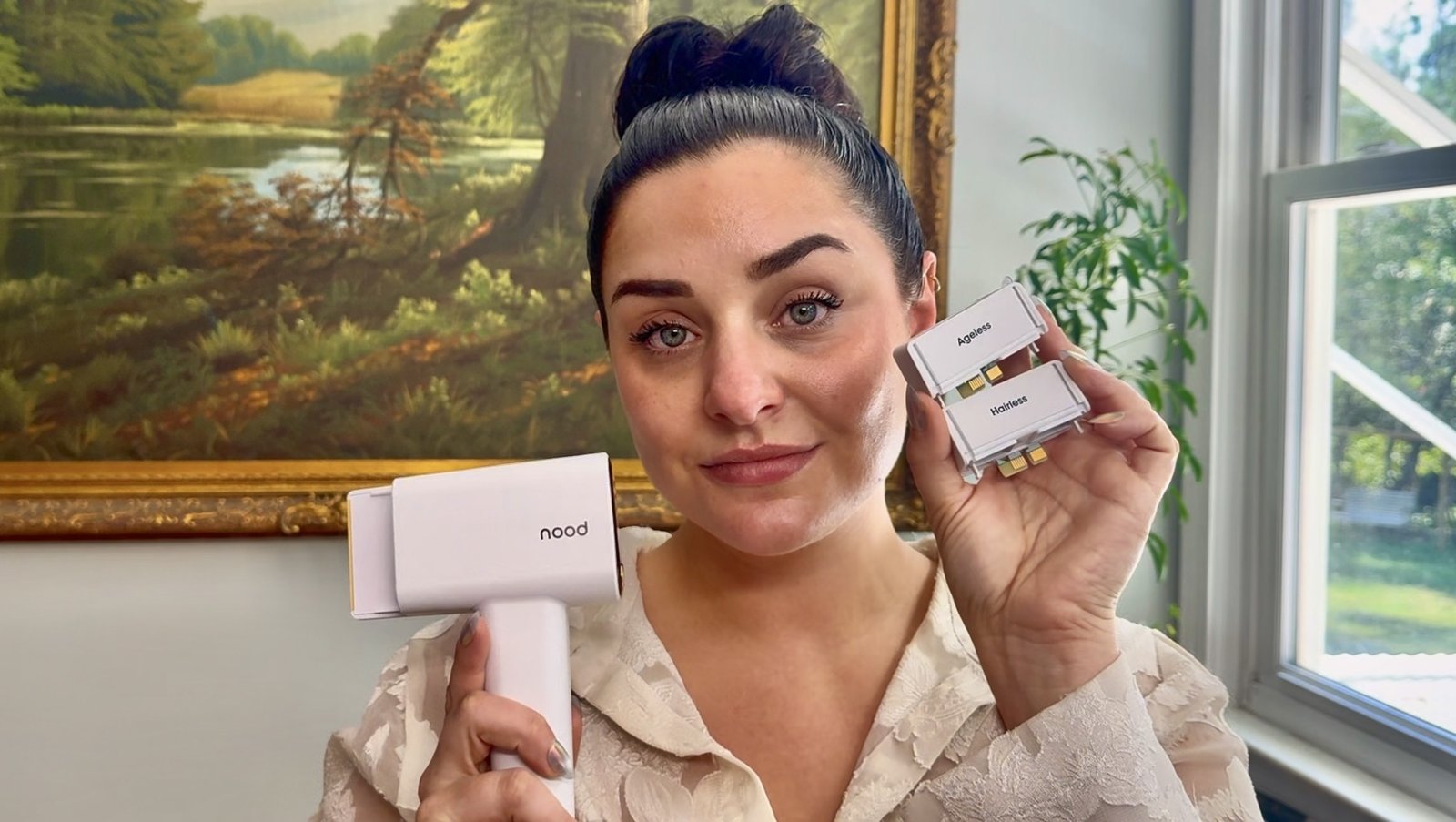
The Nood Flasher Pro ships with two lenses that look nearly identical and do opposite jobs. The Hairless lens is the hair removal lens. The Ageless lens is the skin lens. Same handset, same lamp, different filter in front of it. Here’s what each one does, which one to use for what, and the answer to the question people search most: whether you can buy one on its own.
The short version
Hairless lens: hair removal on body areas. Shave first. Filter passes 510 to 1200 nm.
Ageless lens: pigment, redness and tone on the face, neck, chest and hands. Never shave for it. Filter passes 560 to 1100 nm.
Replacement lens: not sold separately by Nood or on Amazon as of September 2026. Both lenses come in the Flasher Pro box. If you need one, Nood support.
The two lenses out of the box. The Hairless lens is the one you will use most; the Ageless lens swaps in for skin sessions.
Same lamp, different filter
Both lenses sit in front of the same flash lamp. The only thing that changes is the cutoff. The Hairless lens starts passing light at 510 nm, which is tuned to melanin in the hair shaft. The Ageless lens starts at 560 nm, which shifts the energy toward melanin in the skin and hemoglobin in the small surface vessels instead. That 560 figure is not a marketing number: it is the standard photorejuvenation cutoff that professional IPL platforms have used for years.
Because the lamp is the same, the energy range is the same. Nood’s FDA 510(k) clearance (K241106) covers hair removal and permanent hair reduction. The Ageless lens sits outside that clearance, and there are no published clinical trials of at-home IPL for skin. What the lens can and cannot do is worked through in the Ageless lens review and against clinic photofacials in this comparison.
Which lens for which job
Hairless lens
Ageless lens
Purpose
Hair removal and reduction
Pigment, redness, uneven tone
Filter
510 to 1200 nm
560 to 1100 nm
Areas
Legs, arms, underarms, bikini, body
Face below the eye area, neck, chest, hands
Prep
Shave, then clean dry skin
Do not shave; clean, dry, bare skin, nothing on it
Schedule (Nood)
Every 3 days for up to 12 weeks, then monthly
2 to 3 times a week, ongoing
Skin tones (Nood)
Fitzpatrick I to IV
Fitzpatrick I to IV, any hair color
Fits Flasher 2.0
The 2.0 has its own fixed window
No, Pro only
Sold separately
No
No
How to swap them
Nood’s instruction is three words long: power off, align, click. Turn the handset off, pull the lens straight out, seat the other one until it clicks, then power back on. Clean the lens with a dry cloth after each session. Never swap a lens on a powered device and never flash without a lens seated.
The replacement lens question
This is what most people searching “nood replacement lens” want to know, so plainly: as of September 2026, Nood’s store sells the Flasher Pro, the Flasher 2.0, kits, a razor, a serum and a few accessories, and no lens on its own. Amazon returns nothing for a Nood lens either. Both lenses ship in the Pro box, so a new buyer never needs to think about it.
If you own a Pro and a lens is lost or cracked, the route is Nood support. The handset carries a lifetime flash guarantee, and support is where a lens claim goes. If you own a Flasher 2.0 and were hoping to add the Ageless lens, that is not possible; the lens system is what the Pro changed.
Both lenses share the same skin tone limits. The Ageless lens does not care about hair color; the Hairless lens does.
Who should use which
Hairless only: anyone buying for hair. Most owners use the Ageless lens rarely or not at all, and that is fine.
Ageless too: anyone with sun spots, uneven tone or surface redness on fair to olive skin who wants a second use out of the same device. What it will not do is wrinkles; that is covered honestly in the review.
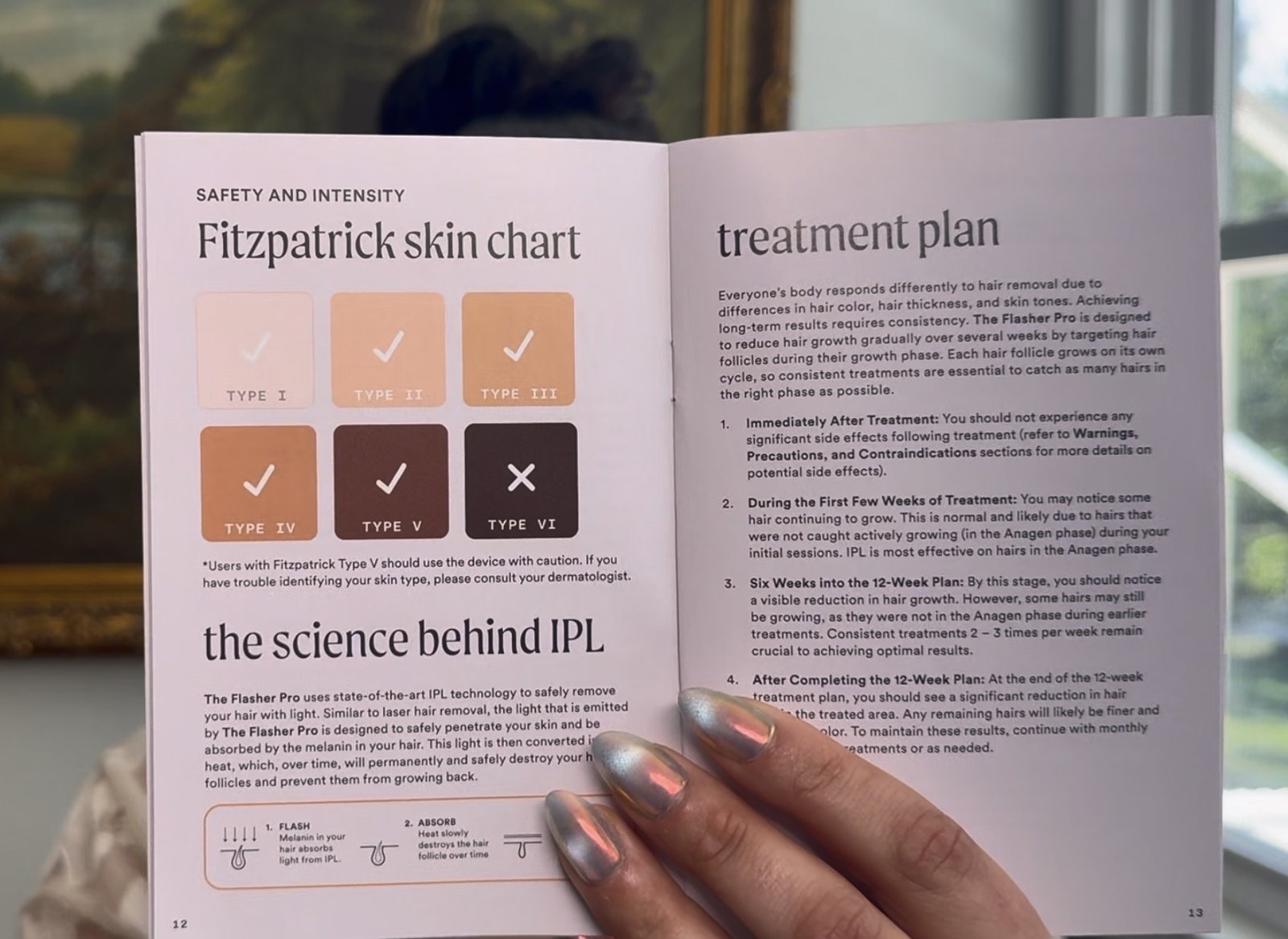
Neither lens: brown, dark brown or black skin tones. Nood lists both lenses as Fitzpatrick I to IV and says IPL is not safe for deeper tones.
Which lens comes with the Nood Flasher Pro?
Both. Nood lists the box contents as the Flasher Pro, two detachable lenses, a 6 ft power adapter and a printed manual. You do not buy the Ageless lens separately.
Can I buy a replacement Nood lens?
As of September 2026, Nood’s own store lists no standalone lens and Amazon has no listing for one. If a lens is lost or damaged, Nood support is the route. The device carries a lifetime flash guarantee, so ask about the lens under that.
Does the Ageless lens fit the Flasher 2.0?
No. The Ageless lens is Flasher Pro only. The 2.0 has one fixed window and no lens system.
Do I shave before the Ageless lens?
No. Shave for the Hairless lens, never for the Ageless lens. They do opposite jobs: one targets hair under the skin, the other targets pigment and redness in the skin.
Can I use both lenses in one session?
Yes, on different areas. Legs with the Hairless lens and face with the Ageless lens the same evening is fine. Do not run the Ageless lens over a patch just treated with the Hairless lens.
Checked September 2026 against Nood’s Flasher Pro product page, Getting Started page and store catalog, an Amazon search for standalone lenses, and FDA 510(k) K241106.
Clinic laser hair removal is stronger than the Nood Flasher Pro, and anyone who tells you otherwise is selling something. It is also priced per area, per session, in a way that adds up fast. Which one wins depends on how many areas you want treated, what your skin tone is, and whether you would rather pay in money or in evenings. Here’s what to look for.
The short version
Go to the clinic if you want one or two small areas done with the fewest sessions, or your skin tone is brown or darker. Clinic lasers put five to eight times the energy into the follicle, and an Nd:YAG laser can treat skin tones that no at-home IPL device can.
Buy the Nood Flasher Pro if you want three or more areas, your skin is fair to olive, your hair is dark blonde or darker, and you are fine with a longer course done at home. The device is one price for every area; the clinic is not. Check today’s Nood Flasher Pro price on Amazon.
Power: this is where the clinic wins
Professional diode lasers are cleared in the range of roughly 5 to 40 J/cm². The Flasher Pro’s FDA 510(k) clearance (K241106) states 1.84 to 5.23 J/cm². That is not a marketing gap. More energy into the follicle means more follicles that stop producing hair, and fewer sessions to get there.
The best head-to-head evidence is a 2023 randomized trial in PLOS ONE that ran a professional diode laser against a home IPL device over six sessions. Underarm hair reduction was 85 to 88 percent for the clinic laser and 46 to 52 percent for the home device. Two honest caveats: only 15 of 30 participants finished, and the home device tested was a Silk’n, not a Nood. The direction of the result is not in doubt; the exact numbers are softer than they look.
Within the at-home category, the Flasher Pro is the device with the highest cleared energy in a public FDA file, which is the whole argument of the full IPL comparison. But no home device closes the gap to a clinic laser. They are different tools.
Underarms respond fastest on either method. At home that means more sessions at lower energy; at the clinic, fewer sessions at higher energy.
Cost: this is where Nood wins
Clinic pricing is per area and per session, and it varies enormously by city. These are published six-session course prices from three US clinics.
Read the last row against the others. Underarms alone at the cheapest clinic in the table cost about the same as the device. Add a second area and the clinic is already behind. Add full legs and it is not close. The marginal cost of one more area is $270 to $1,920 at a clinic and zero on a device.
The clinic’s counter-argument is real: a course there is more likely to be the last one you buy for that area, and a home device needs maintenance sessions indefinitely. But maintenance on a device you already own is free. Maintenance at a clinic is another appointment.
Time: it depends what you count
A clinic course is six to eight visits over six months to a year, each one a few minutes on the table plus travel. Nood’s schedule for the Flasher Pro is every three days for up to twelve weeks, then monthly, with each session ten to twenty minutes depending on area. More sessions, more of your own time, no appointments and nobody else in the room.
Skin tone: the one deal-breaker
This decides it for some readers before price does. At-home IPL is broad-spectrum light, and on deeper skin tones the skin absorbs it before the hair does. Nood lists brown and dark brown to black skin as not recommended, and its FAQ goes further: IPL is not safe or suitable for those tones. That is not conservative wording. It is the physics.
Clinics have an answer that home devices do not: the Nd:YAG laser at 1064 nm, which passes through the surface pigment and is the standard choice for Fitzpatrick V and VI. If that is your skin tone, the clinic is the only option on this page.
Nood’s skin type chart. Types V and VI are where a clinic Nd:YAG laser is the answer and home IPL is not.
Hair color: neither one gets around it
Both methods target melanin in the hair. Light blonde, red, grey and white hair do not respond to clinic lasers either, whatever a clinic’s website implies. Electrolysis is the method for those; the detail is in does Nood work on blonde hair.
Who should choose which
Clinic laser: one or two small areas, deeper skin tone, fewest possible sessions, or a budget that can absorb per-area pricing.
Nood Flasher Pro: three or more areas, fair to olive skin, dark blonde or darker hair, and a preference for spending evenings over spending appointments. Which Nood handset, and how it stacks up against Ulike, Braun and Philips, is covered in the Pro vs 2.0 and Nood vs Ulike posts.
Both: plenty of people do clinic sessions on the face and bikini line, where precision and speed matter most, and use a home device for legs and arms, where the clinic price is highest. Check with the clinic before overlapping areas.
Is Nood as good as laser hair removal?
No, per session. Professional diode lasers are cleared at roughly 5 to 40 J/cm² and the Flasher Pro’s cleared ceiling is 5.23. A 2023 randomized trial reported 85 to 88 percent underarm reduction for a clinic diode against 46 to 52 percent for a home IPL device after six sessions. Nood wins on cost, not on power.
Is at-home IPL cheaper than laser hair removal?
Almost always, and the gap widens with every area. A clinic charges per area per session. A six-session underarm course alone runs $294 in Houston, $600 in Pasadena and $2,094 in Seattle. The Flasher Pro is one price for every area. Check today’s price on Amazon.
How many sessions does each one take?
Clinics typically book six to eight sessions spaced four to eight weeks apart, so six months to a year. Nood’s schedule for the Flasher Pro is a session every three days for up to twelve weeks, then monthly maintenance. More sessions, but each one is at home.
Does laser work on dark skin when IPL does not?
Some clinic lasers do. An Nd:YAG at 1064 nm is the standard choice for Fitzpatrick V and VI. At-home IPL is not: Nood lists brown and dark brown to black skin tones as not recommended, and its FAQ says IPL is not safe for them. For deeper skin tones the clinic is the only option.
Can I use Nood between laser sessions?
Ask the clinic first. Most advise against treating the same area with another light device during a course, because the follicles are already cycling and the skin needs the gap. Using Nood on areas the clinic is not treating is the usual compromise.
Sources: FDA 510(k) K241106 (Nood); published rate cards from clinics in Houston, Pasadena and Seattle, checked August 2026; randomized diode versus home IPL comparison, PLOS ONE, 2023; Nood Flasher Pro product page and FAQ, checked September 2026. Prices change often.
This post contains affiliate links. As an Amazon Associate, purchases made through these links may earn a commission at no extra cost to you.
Short answer: it depends on which blonde. Nood lists dark blonde as a good fit for the Flasher Pro and light blonde, red and grey as not recommended. That is not a Nood limitation. It is how IPL works, and no at-home device gets around it whatever the listing says. Here’s what to look for, and what to use instead if your hair is on the wrong side of the line.
The short version
Dark blonde, light brown, brown or black hair on fair to olive skin: IPL is a fit. The Nood Flasher Pro is the device with the strongest published energy figure in the category, and the reasons are in the full IPL comparison.
Light blonde, strawberry blonde, red, grey or white hair: IPL is not a fit, on any brand. Electrolysis is the method that works on every hair color. For facial peach fuzz, dermaplaning is the practical maintenance option.
Why hair color decides it
IPL is a flash of broad-spectrum light. It does nothing on its own. The result comes from pigment in the hair absorbing that light, converting it to heat, and that heat damaging the follicle enough to slow regrowth. The pigment doing the absorbing is melanin, and specifically eumelanin, the brown-black kind.
Dark hair has a lot of eumelanin, so it absorbs strongly and heats fast. Dark blonde has enough to work with. Light blonde has very little. Red hair is colored mainly by pheomelanin, a different pigment that absorbs poorly at the wavelengths IPL uses. Grey and white hair has lost its pigment altogether. In each of those cases the light passes through the hair and lands in the skin instead, which is why the manufacturers say not recommended rather than results may vary.
The same physics applies at the clinic. Diode and alexandrite lasers depend on melanin too. If a clinic tells you their laser works on blonde or grey hair, ask which wavelength and what the evidence is.
Nood’s skin type chart. Hair color is the other half of the same rule: the device needs pigment in the hair and contrast with the skin.
What Nood actually says
Nood’s product page for the Flasher Pro puts it plainly. Good fit for black, brown and dark blonde hair. Not recommended for light blonde, red and grey. Good fit for very fair, fair, white-olive and olive to light brown skin. Not recommended for brown and dark brown to black skin tones. The FAQ adds that IPL is not safe or suitable for the deeper skin tones, which is a stronger statement than the hair one, and worth taking at face value.
One useful detail: the Ageless skin lens is listed for Fitzpatrick I to IV regardless of hair color. If the reason for buying is sun spots or redness rather than hair, light hair does not rule the device out. That lens is covered in its own review.
Where the line falls, by hair color
Hair color
IPL at home
What works instead
Black or dark brown
Yes, best case
IPL
Medium brown
Yes
IPL
Dark blonde
Yes, per Nood’s chart
IPL
Light blonde
Not recommended
Electrolysis; dermaplaning for facial fuzz
Strawberry blonde or red
Not recommended
Electrolysis
Grey or white
Not recommended
Electrolysis
Do not trust a device that claims otherwise
Some listings on Amazon say their IPL works on blonde or grey hair. Look for how they say it. If the claim is a marketing line with no wavelength, no energy figure and no chart, treat it as a claim. A device with less energy than the Flasher Pro cannot heat pigment that is not there. The physics does not change with the brand.
What is true is that “blonde” covers a wide range, and plenty of people who describe themselves as blonde have hair that reads as dark blonde or light brown up close. The test is simple: look at the hair against the skin in daylight. If it is clearly darker than the skin, there is contrast to work with. If it disappears against the skin, there is not.
What to use instead
Electrolysis. A fine probe delivers current to each follicle individually, so it does not care about pigment. It is the only method the FDA allows to be marketed as permanent hair removal; lasers and IPL are cleared for permanent hair reduction, which is a different claim. It is slow and it is per-hair, so it suits small areas like the upper lip, chin and bikini line rather than full legs.
Dermaplaning for the face. It removes the fine vellus hair, the peach fuzz, along with dead surface skin, and it works on any color because it is mechanical. It is maintenance rather than reduction: the hair returns in a week or two, unchanged. The tools compared here and the step-by-step cover it.
Waxing or sugaring for body areas where electrolysis is impractical. Also maintenance, also color-blind.
Underarm hair is usually darker and coarser than hair elsewhere, which is why it is often the first area IPL shows results on, even for people whose leg hair is lighter.
If you are on the right side of the line
For dark blonde and darker, the choice comes down to energy, cooling and price, and the Flasher Pro is the one with a cleared energy range in a public FDA file. How it compares to Nood’s older handset is here, and against Ulike, Braun and Philips in the full comparison.
Does Nood work on blonde hair?
On dark blonde, yes. Nood lists dark blonde as a good fit for the Flasher Pro. On light blonde it says not recommended, and that is the honest answer for any IPL device, because there is not enough pigment in the hair for the light to target.
Does Nood work on red hair?
No. Red hair is colored mostly by pheomelanin, which absorbs IPL wavelengths poorly. Nood lists red as not recommended, and clinic lasers have the same problem.
Does Nood work on grey or white hair?
No. Grey and white hair has lost its pigment, so there is nothing for the light to heat. Electrolysis is the method that works regardless of hair color.
Can I make IPL work on blonde hair by turning the level up?
No, and it is a bad idea. A higher setting puts more energy into the skin, not into hair that has no pigment to absorb it. That raises the burn risk without improving the result.
What about a mix of dark and light hairs?
IPL will reduce the dark ones and leave the light ones. On legs or underarms that often still looks like a real improvement. On the face it can leave a fine blonde fuzz that dermaplaning handles better.
Checked September 2026 against Nood’s Flasher Pro product page and FAQ, and the FDA’s distinction between permanent hair removal (electrolysis) and permanent hair reduction (laser and IPL, including Nood’s 510(k) K241106).
This post contains affiliate links. As an Amazon Associate, purchases made through these links may earn a commission at no extra cost to you.
Nood sells two IPL handsets, and the names make them sound like a small step apart. They are not. The Flasher 2.0 is the older, cheaper device; the Flasher Pro replaced it with more energy per flash, built-in cooling, swappable lenses and a faster flash rate. Here’s what actually changed, and whether the extra hundred-and-something dollars is worth it.
The short version
Pick the Flasher Pro if you want the higher energy, the cooling plate that makes the top settings tolerable, quicker sessions on large areas, or the option of the Ageless skin lens.
Pick the Flasher 2.0 if the budget is firm, the target is a small area like underarms or upper lip, and you are fine buying direct from Nood, because it is no longer on Amazon.
Four things, and all four are the reasons the Pro costs more.
Energy per flash. Nood lists the Flasher 2.0 at 4.5 J/cm² on its product page (its own comparison table says 4.8). The Flasher Pro is marketed at 6, 7 and 7.2 J/cm² depending on where you look, and its FDA 510(k) clearance (K241106) states 1.84 to 5.23 J/cm². Take the most conservative reading and the Pro’s cleared ceiling still sits above the 2.0’s entire marketed number. More energy per flash is the whole point of upgrading.
Cooling. The 2.0 has none. The Pro adds a CryoSoothe plate that Nood rates at 60°F, which is what lets people run the higher settings without turning the level down. If IPL has stung before, this is the difference that matters most day to day.
Lenses. The 2.0 has one fixed window. The Pro ships with two detachable lenses: Hairless (510 to 1200 nm) for hair, and Ageless (560 to 1100 nm) for skin rejuvenation. The lens is covered in its own review.
Speed. Nood claims a 25% faster flash rate on the Pro and quotes a full treatment at about 10 minutes against 20 on the 2.0. That claim is Nood’s, not an independent test, but a faster flash rate on a corded device is a plausible reason for it.
The Flasher Pro with both lenses. The 2.0 has one fixed window and no second lens.
Side by side
Nood Flasher Pro
Nood Flasher 2.0
Energy per flash
1.84 to 5.23 J/cm² (FDA cleared); 6 to 7.2 marketed
4.5 J/cm² marketed (4.8 in Nood’s own table); no cleared figure published
Intensity settings
5
7
Cooling
Yes (CryoSoothe, 60°F)
No
Lenses
2 detachable: Hairless + Ageless
1 fixed window
Wavelength
510 to 1200 nm (Hairless)
510 to 1200 nm
Flash rate
25% faster (Nood’s claim)
0.7 to 1.2 seconds
Modes
Continuous Glide, Large Treatment
Continuous Glide, Large Treatment
Power
Corded, 6 ft adapter
Corded, 6 ft adapter
Guarantee
90-day money-back, lifetime flash guarantee
90-day money-back, lifetime flash guarantee
Where to buy
Amazon and Nood direct
Nood direct only (not on Amazon as of Sep 2026)
Typical price
$299 to $409 on Amazon; $379 direct
$179 to $199 direct
The seven levels are not a feature
The 2.0 has seven intensity steps and the Pro has five, and it is tempting to read that as the older device being more adjustable. It is the opposite. The 2.0’s seven steps divide a smaller energy range into finer slices. The Pro’s five steps cover a wider range. Level 7 on a 2.0 is still a weaker flash than the Pro’s top setting. Count the energy, not the buttons.
Where the 2.0 still makes sense
Small areas, firm budget. Underarms, upper lip and the bikini line are quick on any device, so the Pro’s speed advantage barely shows, and at a lower energy the lack of cooling is easier to live with. At $179 to $199 direct from Nood it is the cheapest way into the Nood ecosystem, and it carries the same 90-day money-back guarantee.
If you already own a 2.0 and it is working, there is no reason to replace it for hair removal alone. The upgrade case is cooling, full-leg sessions, or wanting the Ageless lens.
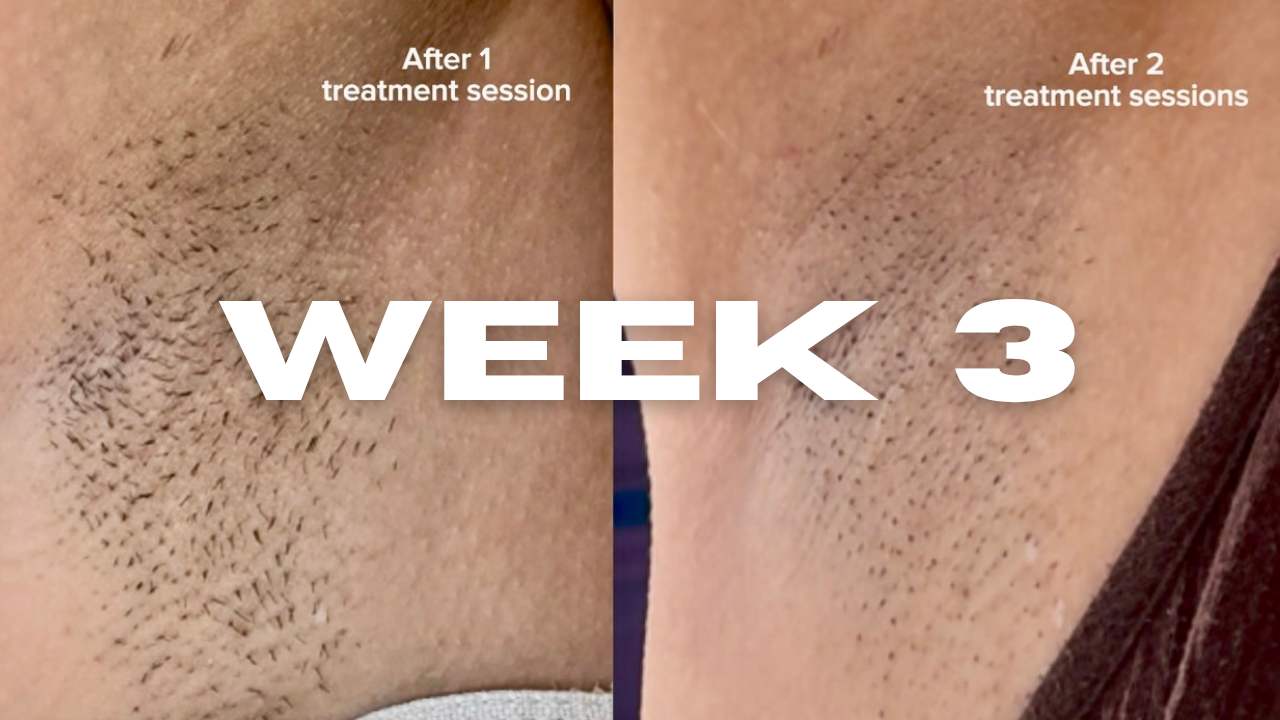
Underarm progress on the Flasher Pro at week three. Small areas are where the 2.0 keeps up; large areas are where the Pro pulls ahead.
Cost against the clinic
Both devices land well under a single course of professional treatment. Clinic pricing gathered across three US cities puts underarms alone at $294 to $2,094 and full legs at $1,800 to $3,992. Against those numbers the $100 to $120 between the two Nood handsets is not the decision. Whether you want cooling and a second lens is. The full clinic comparison, with course prices by city, is in Nood vs Laser Hair Removal.
The skin type chart from the Nood manual. It applies to both handsets: IPL needs pigment in the hair and contrast with the skin.
Who should buy which
Flasher Pro: anyone treating legs, arms or back, anyone who wants cooling at the higher settings, and anyone who might use the Ageless lens later.
Flasher 2.0: small areas only, tightest budget, and comfortable ordering from Nood’s site rather than Amazon.
Neither: very light blonde, red, grey or white hair, or the darkest skin tones. IPL needs pigment to target. Check the chart above before buying either.
Is the Nood Flasher Pro stronger than the Flasher 2.0?
Yes. Nood lists the 2.0 at 4.5 J/cm² and the Pro at 6 to 7 J/cm² depending on the page. The Pro’s FDA-cleared range tops out at 5.23 J/cm², which is above the 2.0’s entire marketed figure.
Does the Flasher 2.0 have cooling?
No. CryoSoothe cooling arrived with the Pro. The 2.0 relies on its seven intensity steps to manage discomfort.
Can I buy the Flasher 2.0 on Amazon?
As of September 2026 it is not listed there. Nood sells it direct for $179 to $199. The Flasher Pro is on Amazon, currently around $299.
Should I upgrade from the 2.0 to the Pro?
If the 2.0 is working and you only treat small areas, keep it. Upgrade if you want the cooling for higher settings, faster full-leg sessions, or the Ageless skin lens.
Specs checked September 2026 against Nood’s product pages for both handsets, Nood’s own Pro-versus-2.0 comparison table, and FDA 510(k) K241106. Prices are Nood direct and typical Amazon listing ranges and change often.
This post contains affiliate links. As an Amazon Associate, purchases made through these links may earn a commission at no extra cost to you.
The Philips Lumea 9000 is the premium name in at-home IPL and it is priced like one, at roughly twice the Nood Flasher Pro. The question is whether the extra money buys extra results, or a brand and a nicer case. Here’s what to look for.
The short version
Pick the Nood Flasher Pro if you want comparable energy for half the price, built-in cooling, and an FDA-cleared output figure.
Pick the Philips Lumea 9000 if you want the widest set of body-area attachments, a smart skin sensor, and you are not price sensitive.
Nood Flasher Pro: 1.84 to 5.23 J/cm² on its FDA 510(k) clearance (K241106), with 6, 7 and 7.2 J/cm² in marketing.
Philips Lumea 9000: roughly 2.5 to 6.5 J/cm², but Philips does not publish a J/cm² figure for the Lumea range at all. That number comes from an independent teardown.
Read that carefully. The most expensive device in the category is the one whose energy output you have to find from a third party. Philips almost certainly delivers in the same class as Nood, and the teardown figure suggests a slightly higher ceiling. But at twice the price, “almost certainly” is a lot to pay for.
The full audit of which brands publish what is here.
Side by side
Nood Flasher Pro
Philips Lumea 9000
Published energy
1.84 to 5.23 J/cm² (FDA cleared)
Not published by Philips; ~2.5 to 6.5 J/cm² per teardown
Intensity settings
5
5
Skin tone sensor
No
Yes (SmartSkin)
Built-in cooling
Yes (CryoSoothe)
No
Attachments
Single window, plus optional Ageless lens
Up to four: body, face, bikini, underarms (varies by kit)
Power
Corded
Cordless or corded
Skin rejuvenation option
Yes, swappable Ageless lens
No
Typical price
$299 to $409
~$550 to $700 depending on kit
Nood’s cooling plate is the practical difference on sensitive areas. The Lumea 9000 has no cooling.
What the Lumea’s price actually buys
Three things, and all of them are real.
The attachments. The Lumea 9000 ships with shaped heads for body, face, bikini and underarms depending on the kit, so the window sits flush on an awkward area. That is a comfort and coverage advantage on awkward areas, and it is the strongest argument for the device.
The sensor. SmartSkin reads tone and recommends a setting. Nood has no sensor, so the level is your call.
Cordless. The Lumea 9000 can run cordless or plugged in; the Nood Flasher Pro is corded only. For long sessions on legs or back, that is a real convenience the Nood does not have, and it belongs on the Philips side of the ledger.
What the price does not buy is cooling. The Lumea 9000 has none, which means higher settings on sensitive areas are managed by turning the intensity down. Nood’s CryoSoothe plate exists to avoid exactly that trade.
What Nood has that the Lumea doesn’t
Cooling, a published energy figure, and a second job. The swappable Ageless lens turns the same handset into a skin rejuvenation device. Philips sells hair removal only. For anyone considering a separate skin device, that is several hundred dollars of difference on top of the price gap. The lens is covered in its own review.
Cost against the clinic
Both devices cost less than a single course of professional sessions. Clinic pricing gathered across three US cities puts underarms at $294 to $2,094 and full legs at $1,800 to $3,992. Either device pays back on the first area. The difference is that Nood pays back roughly twice as fast, and the money saved covers the Ageless lens with room to spare. The full clinic comparison, with course prices by city, is in Nood vs Laser Hair Removal.
The skin type chart from the Nood manual. Check your own type before buying either device.
Who should buy which
Nood Flasher Pro: anyone who wants the same energy class at half the price, anyone treating sensitive areas, anyone who might want the skin lens.
Philips Lumea 9000: anyone who values shaped attachments and cordless use above everything else and is comfortable at the price.
Neither: very light blonde, red, grey or white hair. IPL needs pigment to work. Check the chart on the listing before buying either.
Is the Philips Lumea more powerful than Nood?
Teardown figures suggest a slightly higher ceiling, around 6.5 J/cm² against Nood’s cleared 5.23 and marketed 7.2. They are the same class. Philips does not publish its own number.
Does the Lumea 9000 have cooling?
No. Nood does. On sensitive areas that is the main practical difference.
Why is the Lumea so much more expensive?
Shaped attachments, a skin sensor, cordless operation, and the brand. Those are real features, but the energy delivery is not double.
Specs checked September 2026 against the Philips Lumea 9000 product pages, the Nood product page, and FDA 510(k) K241106. Philips publishes no J/cm² figure; the teardown range is third-party. Prices are typical Amazon listing ranges and change often.
This post contains affiliate links. As an Amazon Associate, purchases made through these links may earn a commission at no extra cost to you.
Ulike and Nood are the two at-home IPL devices most people end up choosing between, and both advertise ice cooling, both sit under $400, and both look like they publish an energy figure. Only one of those figures means what it appears to mean. Here’s what to look for.
The short version
Pick the Nood Flasher Pro if you want the higher per-flash energy, an FDA-cleared output figure, and the ability to add a skin rejuvenation lens later.
Pick the Ulike Air 10 if you are highly sensitive to discomfort and would rather trade some per-flash energy for a gentler multi-pulse delivery.
Ulike’s marketing for the Air 10 uses a figure of 6.67 J/cm². On its face that beats Nood’s cleared range. It doesn’t, and the reason is worth understanding before spending $300 on either device.
Ulike’s number is a four-pulse burst total. Ulike’s own specification lists 26 J per four-pulse burst in its SHR mode across a 3.9 cm² window, which works out to 6.67 J/cm² for the whole burst, or roughly 1.67 J/cm² per pulse. That is not the same as a single 6.67 J/cm² flash, because the follicle is heated in four smaller steps rather than one larger one.
Nood Flasher Pro delivers 1.84 to 5.23 J/cm² per single flash on its FDA 510(k) clearance (K241106), with 6, 7 and 7.2 J/cm² in its marketing.
So per flash, Nood’s cleared floor is higher than Ulike’s per-flash figure, and its cleared ceiling is roughly three times it. Whether a burst of four gentle pulses works as well as one strong one is a legitimate question, but the two numbers are not comparable on a spec sheet, and Ulike’s listing does not make that clear.
The full breakdown of what every IPL brand publishes is here.
Side by side
Nood Flasher Pro
Ulike Air 10
Energy per flash
1.84 to 5.23 J/cm² (FDA cleared)
~1.67 J/cm²
Marketed figure
6, 7, 7.2 J/cm²
6.67 J/cm² (four-pulse total)
Cooling
Yes (CryoSoothe)
Yes (Sapphire Ice-cooling, 65°F contact)
Skin sensor
No
Yes
Modes
5 intensity settings
Fast, Normal, High, SHR, AutoGlide
Power
Corded
Corded
Skin rejuvenation option
Yes, swappable Ageless lens
No
Typical price
$299 to $409
$259 to $369
Where Ulike genuinely wins
Ulike built the Air 10 around comfort, and it shows. The multi-pulse approach exists precisely because four small hits feel gentler than one big one, and the sapphire cooling plate is well regarded. For someone who has tried IPL before and stopped because it hurt, Ulike’s design philosophy is the more forgiving one.
It also has a skin tone sensor, which Nood does not. That removes one decision for a first-time user. Both devices are corded, so that is a wash.
The Flasher Pro handset with both lens cartridges. Ulike has no second lens.
Where Nood wins
Per-flash energy, and the fact that the number is on a regulatory filing rather than a marketing page. If the goal is fewer sessions to reach a result, the device putting more energy into each flash has the straightforward advantage.
The other thing Nood has that Ulike doesn’t is a second use. The Flasher Pro accepts a swappable Ageless lens for skin rejuvenation, so the same handset does two jobs. For anyone already looking at a separate device for skin texture, that changes the math. The lens is covered in its own review.
Cost against the clinic
Both devices land under a single course of professional treatment. Clinic pricing gathered across three US cities puts underarms alone at $294 to $2,094 and full legs at $1,800 to $3,992. At those numbers the $40 or so between these two devices is not the decision. Energy delivery and comfort are. The full clinic comparison, with course prices by city, is in Nood vs Laser Hair Removal.
The skin type chart from the Nood manual. Both devices need pigment in the hair to work.
Who should buy which
Nood Flasher Pro: anyone prioritising energy per flash, anyone who wants the number they’re buying to be one the FDA has seen, and anyone who might want the skin lens later.
Ulike Air 10: anyone who has found IPL too uncomfortable before, and anyone who wants a sensor to pick the level.
Neither: very light blonde, red, grey or white hair. IPL needs pigment to target, and no home device gets around that. Check the hair and skin chart on the listing first.
Is Ulike stronger than Nood?
Not per flash. Ulike’s 6.67 J/cm² is a four-pulse total; each pulse is around 1.67. Nood’s cleared range is 1.84 to 5.23 per single flash.
Which one hurts less?
Both have cooling. Ulike’s multi-pulse delivery is designed to feel gentler, and on that specific point it likely does. Nood’s cooling plate is what makes its higher settings tolerable.
Can Nood do skin treatments too?
Yes, with the swappable Ageless lens. Ulike Air 10 is hair removal only.
Specs checked September 2026 against the Ulike Air 10 manual and specification page, the Nood product page, and FDA 510(k) K241106. Prices are typical Amazon listing ranges and change often.
This post contains affiliate links. As an Amazon Associate, purchases made through these links may earn a commission at no extra cost to you.
Braun and Nood sit at the top of most at-home IPL shortlists, and they are priced close enough that the choice usually comes down to one question: which one actually publishes what it does. Here’s what to look for, and where each device lands.
The short version
Pick the Nood Flasher Pro if you want a device whose energy output is on file with the FDA, built-in cooling for sensitive areas, and the option to swap in a skin lens later.
Pick the Braun Silk-expert Pro 5 if you want a skin-tone sensor that adjusts intensity automatically and ten fine-grained levels instead of five.
Both are legitimate devices. The difference is in what each brand is willing to put in writing.
IPL works by delivering energy to the hair follicle, and that energy is measured in joules per square centimeter. It is the single most useful spec for comparing two devices, and it is the spec most brands avoid.
Nood Flasher Pro: 1.84 to 5.23 J/cm² on its FDA 510(k) clearance (K241106), with 6, 7 and 7.2 J/cm² figures in its marketing.
Braun Silk-expert Pro 5: roughly 3 to 6 J/cm², but that range comes from independent reviews. Braun’s own US product pages list “10 intensity levels” and no joules at all.
What works here is reading that gap for what it is. Braun’s device is almost certainly in the same energy class. The difference is that Nood’s number is a regulatory filing and Braun’s is a third-party estimate. For a device you are pointing at your skin, a published figure is worth something.
For the full audit of what every major IPL brand does and does not disclose, the longer comparison is here.
Side by side
Nood Flasher Pro
Braun Silk-expert Pro 5
Published energy
1.84 to 5.23 J/cm² (FDA cleared)
Not published by Braun; ~3 to 6 J/cm² per reviews
Intensity settings
5
10
Skin tone sensor
No
Yes (SkinPro 2.0 SensoAdapt)
Built-in cooling
Yes (CryoSoothe)
No
Power
Corded
Corded
Skin rejuvenation option
Yes, swappable Ageless lens
No
Typical price
$299 to $409
$350 to $430 depending on kit
Cooling is what makes underarms tolerable on higher settings, and Braun has none.
Cooling versus a sensor: the real trade
These two devices solve comfort in opposite ways.
Braun’s answer is the sensor. SensoAdapt reads your skin tone before each flash and adjusts intensity down on darker areas. That removes guesswork, and for someone who has never used IPL it is a genuine safety net.
Nood’s answer is cooling. The CryoSoothe plate chills the contact surface, which is what makes underarms and bikini line tolerable on higher settings. Braun has no cooling, so on sensitive areas the practical fix is dropping the intensity, which also drops the result.
Here’s what to look for in your own situation: if your main worry is choosing the wrong setting, the sensor wins. If your main worry is whether you’ll stick with it because it stings, cooling wins. Most people who quit IPL quit because of discomfort, not because they picked the wrong level.
Both devices are corded, so neither has a battery to degrade and neither limits where you can do a long session more than the other. That one is a wash.
Cost against the clinic
Both devices cost less than a handful of professional sessions. Using clinic pricing gathered across three US cities, underarms alone run $294 to $2,094 for a course, and full legs $1,800 to $3,992. Either device pays for itself on the first area. The gap between roughly $300 and $400 is small next to that, so the move is choosing on features, not price.
The full clinic pricing table and the five and ten year cost comparison are in the longer post. The full clinic comparison, with course prices by city, is in Nood vs Laser Hair Removal.
The skin type chart from the Nood manual. IPL needs pigment in the hair and works on types one through five.
Who should buy which
Nood Flasher Pro: anyone treating sensitive areas, anyone who wants published energy figures, anyone who might want the Ageless skin lens later without buying a second device.
Braun Silk-expert Pro 5: anyone who wants the device to choose the setting for them, and who wants finer control across ten levels.
Neither: anyone with very light blonde, red, grey or white hair. IPL needs pigment in the hair to work, and no consumer device changes that. Check the hair colour and skin tone chart on the listing before buying either one.
Is Braun or Nood stronger?
Independent reviews put Braun’s top output around 6 J/cm² and Nood’s cleared range tops out at 5.23 J/cm², with higher marketed figures. In practice they are the same class. Nood’s figure is on an FDA filing; Braun’s is not published by Braun.
Does the Nood Flasher Pro have a skin tone sensor?
No. It relies on you choosing the level and on its cooling plate for comfort. Braun’s SensoAdapt sensor is the main reason to choose the Braun.
Can you use either on your face?
Both allow facial use, Braun with its precision cap. Neither is intended for use near the eyes, and Braun’s manual excludes men’s beards. Follow each listing’s facial guidance.
Specs checked September 2026 against the Braun and Nood product pages, the Braun Silk-expert Pro 5 manual, and FDA 510(k) K241106. Prices are typical Amazon listing ranges and change often.
The RealReal takes between 15% and 80% of what your item sells for, depending on the sale price and the category. You keep the rest.
On a typical piece of designer clothing that sells for $300, you keep 60%, or $180. On a handbag that sells for $2,000, you keep 70%, or $1,400. On a blouse that sells for $80, you keep 20%, or $16.
That last number is the one that surprises people, and it is the reason this page exists. The commission is not a flat rate. It is a sliding scale that punishes cheap items hard, and knowing where the breakpoints sit is the difference between a consignment check that feels fair and one that feels insulting.
Rates below are current as of September 2026, taken from The RealReal’s published earnings guide.
The RealReal commission rates by category
Clothing, shoes, and accessories
Covers women’s and men’s clothing, shoes, accessories, unbranded jewelry, home, art, and kids.
Sale price
You keep
Your payout
Over $5,000
70%
Over $3,500
$750 to $4,999
65%
$487 to $3,249
$300 to $749
60%
$180 to $449
$200 to $299
55%
$110 to $164
$150 to $199
45%
$67 to $89
$100 to $149
30%
$30 to $44
$0 to $99
20%
$0 to $19
Handbags
Sale price
You keep
Your payout
Over $7,500
80%
Over $6,000
$5,000 to $7,499
75%
$3,750 to $5,624
$1,500 to $4,999
70%
$1,050 to $3,499
$750 to $1,499
65%
$487 to $974
$300 to $749
60%
$180 to $449
$200 to $299
55%
$110 to $164
$150 to $199
45%
$67 to $89
$100 to $149
30%
$30 to $44
$0 to $99
20%
$0 to $19
Watches
Watches carry the most generous top rate of any category.
Sale price
You keep
Your payout
Over $7,500
85%
Over $6,375
$5,000 to $7,499
80%
$4,000 to $5,999
$2,000 to $4,999
75%
$1,500 to $3,749
$500 to $1,999
70%
$350 to $1,399
$300 to $499
60%
$180 to $299
$200 to $299
55%
$110 to $164
$150 to $199
45%
$67 to $89
$100 to $149
30%
$30 to $44
$0 to $99
20%
$0 to $19
Men’s sneakers and collectibles
This category hits its top rate faster than any other, at just over $1,000.
Look at the bottom four rows of any table above. They are identical across every category, and the jumps between them are brutal.
Item sells for
You keep
Difference
$99
$19.80
$100
$30.00
+$10.20 for one more dollar
$149
$44.70
$150
$67.50
+$22.80 for one more dollar
$199
$89.55
$200
$110.00
+$20.45 for one more dollar
A single dollar of sale price can be worth more than $20 to you. That is not a rounding error, it is the structure working exactly as designed.
Here is the catch, and it is important: you do not set the price. The RealReal prices your items based on its own sales data. You can request a price adjustment after listing, but you cannot choose the starting number. So the cliffs are not something you can game on the way in.
What they are useful for is deciding what to send in the first place. Which brings us to the only real question.
What is actually worth consigning
Run the numbers against the alternatives and a clean rule falls out.
Under $150: sell it somewhere else. At 20% to 30%, a $90 item nets you $18 and a $120 item nets you $36. On Poshmark you would keep about 80% of that same sale, and on Facebook Marketplace you keep all of it. The RealReal’s convenience is not worth a 70% haircut.
$150 to $300: it depends on your time. At 45% to 55%, you are giving up roughly half. That is a fair trade only if you genuinely will not get around to photographing, listing, answering questions, and shipping the item yourself. Many people will not, and there is no shame in that. Just be honest about it.
Over $300: consign it. At 60% and up, the calculus flips. You are getting authentication, professional photography, and access to a buyer base of over 40 million shoppers, and the percentage you keep is competitive with what you would net after fees and hours of your own work elsewhere.
Over $1,500 in handbags, watches, or sneakers: definitely consign it. These are the categories where The RealReal’s authentication is worth real money, because buyers pay a premium for a guarantee they trust. At 70% to 85%, this is the best deal on the platform.
The loyalty bonus, and why it is smaller than it looks
The RealReal layers a loyalty bonus on top of the base rate, based on your cumulative net sales.
Tier
Your net sales
Bonus
Trendsetter
Under $1,499
None
Influencer
$1,500 to $4,999
+1%
Tastemaker
$5,000 to $9,999
+2%
VIP
$10,000 and up
+5%
Two things to know. First, the bonus only applies to items that sell for $200 or more, so it does nothing for the low-value inventory where you need help most. Second, reaching VIP requires $10,000 in net sales, and the reward for getting there is five percentage points. Useful at volume, not a reason to change what you consign.
The higher tiers do unlock service perks that have real value if you consign regularly: in-home appointments, van pickup where available, a dedicated concierge, and a complimentary First Look subscription at the top tier.
Fees, timing, and the fine print
There is no listing fee. Shipping your items in is free with a prepaid label, and anything they decline is returned to you at no charge.
Commission is calculated on net selling price. That means the price after any promotion or discount The RealReal applies, excluding tax and shipping. If your item sells during a site-wide sale, your payout is based on the discounted number, not the original list price.
Expect up to four weeks before your items go live. Authentication, photography, measurements, copywriting, and pricing all happen on their end.
You are paid the month after the sale. Direct deposit, check, or site credit. Site credit pays 5% extra, which is a genuinely good deal if you shop the platform anyway and a bad one if you do not.
You need a US address and a US bank account to consign, and you have to maintain both.
Current promotions worth knowing about
Through the end of September 2026, first-time consignors get $100 in site credit for consigning one or more accepted items priced at $200 or more. There are additional credits for consigning multiple jewelry pieces or fifteen or more items.
Read that carefully: it is site credit, not cash. It also expires quickly, so treat it as a discount on a future purchase rather than part of your payout.
Frequently asked questions
What percent does The RealReal take?
Between 15% and 80% of the sale price, depending on price and category. On items under $100 they take 80% and you keep 20%. On watches over $7,500 they take just 15% and you keep 85%.
How much do you make selling on The RealReal?
On a $300 dress you keep $180. On a $1,000 handbag you keep $650. On a $2,500 watch you keep $1,875. On an $80 top you keep $16.
Does The RealReal charge fees?
No separate fees. There is no listing fee, no shipping cost to send items in, and no charge for returned items. The commission is the entire cost.
How long does it take to get paid?
You are paid the month following the sale, by direct deposit, check, or site credit.
What is the highest commission on The RealReal?
85%, on watches over $7,500 and on men’s sneakers and collectibles over $1,000. Handbags top out at 80%.
Is it better to sell on The RealReal or Poshmark?
Poshmark for anything under about $150, because you keep roughly 80% there versus 20% to 30% on The RealReal. The RealReal for authenticated luxury over $300, where the buyer base and the authentication guarantee earn a higher sale price.
Do commission rates reset?
The base rate is set per item based on that item’s sale price, so it does not reset. Your loyalty tier is based on cumulative net sales and determines the bonus applied to items priced at $200 and up at the time of sale.
Bottom line
The RealReal’s commission structure is generous at the top and punishing at the bottom. Send them your handbags, watches, sneakers, and anything you expect to clear $300. Sell the rest yourself, because handing over 70% to 80% of a $90 sale is not convenience, it is a donation.
Buy the Michael Todd Sonicsmooth if you plan to dermaplane every week. Buy the Dermaflash LUXE+ if you dermaplane occasionally and want the gentler, more forgiving device.
The reason has almost nothing to do with the devices themselves. Both work. Both use a single-use stainless edge and sonic vibration, and both will leave your skin smooth. The difference that actually matters is what the blades cost you every year after the purchase, and that gap is much wider than the sticker prices suggest.
Here is the part most comparisons skip: the Dermaflash costs about $80 more up front, but roughly $200 more per year to keep running.
Dermaflash LUXE+ vs Michael Todd Sonicsmooth at a glance
Dermaplaning tools are razor-and-blade businesses in the literal sense. The device is the cheap part. The edges are where the money goes, because every manufacturer recommends a fresh one for every session, and every session is once a week.
Run the math on a year of weekly dermaplaning and the picture flips:
Dermaflash: a 12-week replenishment kit runs $87, so a full year needs roughly four and a third kits. That is about $377 in edges.
Michael Todd: an 8-week refill pack runs $25, so a year needs about six and a half packs. That is about $163 in edges.
The gap is around $214 a year. Over three years the Dermaflash costs roughly double the Sonicsmooth in total, and the device price accounts for almost none of that difference.
What works here is thinking about the purchase the way you would a printer. The number on the box is not the number you are actually committing to.
Where the Dermaflash earns its price
None of the above means the Dermaflash is a bad buy. It is the more refined device, and there are real reasons people stay with it.
It is gentler. The LUXE+ runs at a lower, more diffuse vibration and the edge is set at a shallower angle. For anyone with reactive skin, rosacea-prone skin, or a history of irritation after exfoliating, that matters more than the annual cost. Dermatologists generally advise the lightest-contact tool you can tolerate when you are new to at-home exfoliation.
The kit includes prep. The replenishment kits ship with a PREFLASH cleanser, which removes the guesswork about what to put on your face beforehand. Small thing, but a real one if you are starting from zero.
It is more forgiving of bad technique. The guard geometry makes it harder to press too hard, which is the single most common beginner mistake. If you are worried about nicking yourself, this is the safer starting point.
The move is: buy the Dermaflash if you plan to dermaplane every two or three weeks rather than every week. At that cadence the blade math narrows considerably and you get the gentler device for a manageable running cost.
Where the Sonicsmooth wins
Running cost, obviously. Covered above, and it is the main event.
More power for coarse hair. The Sonicsmooth vibrates faster and the edge sits at a steeper angle. On denser vellus hair it clears in fewer passes. Fewer passes over the same patch of skin is genuinely better for your barrier, so this is not only a speed benefit.
Wider availability. The refill tips are stocked at Ulta, Amazon, Macy’s and Best Buy in addition to the brand site. The Dermaflash edges are harder to find outside the brand’s own channels, which matters when you run out mid-routine.
There are two versions. The standard Sonicsmooth runs about $121 and the Pro+ about $172. The Pro+ adds microdermabrasion tips. Both take the same $25 refill tips, so the running cost is identical either way. If budget is the constraint, the standard model plus the same refills is the cheapest legitimate entry into dermaplaning. The full buyer guide is in the Michael Todd Sonicsmooth Pro+ Review.
What both devices get wrong
Neither brand is straight with you about how long an edge actually lasts, and both benefit from you replacing them faster than you need to.
The honest version: an edge dulls based on how much hair and dead skin it moves, not on the calendar. Someone with fine, sparse vellus hair will get noticeably more life out of an edge than someone with dense growth. Here is what to look for. A sharp edge glides. A dull one tugs, skips, or requires a second pass over the same spot. When you feel tugging, replace it, whether that is at week one or week three.
Both brands also quietly assume weekly use in their supply math. Most dermatologists suggest every two to three weeks is plenty for the majority of skin types, and more frequent than weekly is where irritation starts. If you follow that advice, both devices get cheaper to run, and the Dermaflash gets cheaper faster because its edges cost more per unit.
How to choose, in one paragraph
If you have sensitive skin and dermaplane every two or three weeks, the Dermaflash LUXE+ is the better device and the cost difference mostly disappears at that cadence. If you dermaplane weekly, have coarser vellus hair, or simply do not want a $377 annual blade habit, the Michael Todd Sonicsmooth is the better buy and it is not close. If you are not sure you will stick with dermaplaning at all, start with the standard Sonicsmooth, because it is the cheapest way to find out.
Before you buy either one
Two things matter more than which device you pick.
The first is aftercare. Dermaplaning removes the outer layer of dead skin, which means whatever you apply next absorbs far more deeply than usual. That is an advantage with a hydrating serum and a problem with an active. Read what to use after dermaplaning before your first session.
Also looking at hair removal? Dermaplaning clears peach fuzz for a week or two. For hair that keeps coming back on legs, underarms or the bikini line, at-home IPL is the next step up, and the one to look at is the Nood Flasher Pro, the only at-home IPL device with an energy figure in a public FDA file.
Michael Todd is better for weekly use because the replacement edges cost roughly a quarter of what Dermaflash charges per edge. Dermaflash is better for sensitive skin because it runs gentler and is more forgiving of technique errors.
Is the Dermaflash worth the money?
It is worth it if you have reactive skin or dermaplane every two to three weeks rather than weekly. At weekly use the blade cost is around $377 a year, which is where most people decide it is not.
Are Dermaflash and Michael Todd blades interchangeable?
No. The edges are shaped to each device’s housing and will not seat correctly in the other. Buy the refills made for the device you own.
Is Sonicsmooth the same as Michael Todd?
Yes. Sonicsmooth is the product name and Michael Todd Beauty is the brand. People search both ways, which is why you will see them used interchangeably.
What is the difference between the Sonicsmooth and the Sonicsmooth Pro+?
The Pro+ adds microdermabrasion tips. Both versions list three speeds on the brand’s pages and take the same blade refills.
How often should you replace the blade?
Replace it when it starts tugging or skipping rather than on a fixed schedule. Both brands assume weekly replacement, which is more often than many people actually need.
Bottom line
The Michael Todd Sonicsmooth is the better buy for most people, and the reason is the roughly $200 a year you do not spend on edges. The Dermaflash LUXE+ is the better device for sensitive skin used every two to three weeks, where that gap narrows enough to justify the gentler experience.