Disclosure
This post contains affiliate links, which means I may earn a small commission if you make a purchase through my links, at no extra cost to you.
This post contains affiliate links. As an Amazon Associate, purchases made through these links may earn a commission at no extra cost to you.
Nood sells two IPL handsets, and the names make them sound like a small step apart. They are not. The Flasher 2.0 is the older, cheaper device; the Flasher Pro replaced it with more energy per flash, built-in cooling, swappable lenses and a faster flash rate. Here’s what actually changed, and whether the extra hundred-and-something dollars is worth it.
The short version
Pick the Flasher Pro if you want the higher energy, the cooling plate that makes the top settings tolerable, quicker sessions on large areas, or the option of the Ageless skin lens.
Pick the Flasher 2.0 if the budget is firm, the target is a small area like underarms or upper lip, and you are fine buying direct from Nood, because it is no longer on Amazon.
Four things, and all four are the reasons the Pro costs more.
Energy per flash. Nood lists the Flasher 2.0 at 4.5 J/cm² on its product page (its own comparison table says 4.8). The Flasher Pro is marketed at 6, 7 and 7.2 J/cm² depending on where you look, and its FDA 510(k) clearance (K241106) states 1.84 to 5.23 J/cm². Take the most conservative reading and the Pro’s cleared ceiling still sits above the 2.0’s entire marketed number. More energy per flash is the whole point of upgrading.
Cooling. The 2.0 has none. The Pro adds a CryoSoothe plate that Nood rates at 60°F, which is what lets people run the higher settings without turning the level down. If IPL has stung before, this is the difference that matters most day to day.
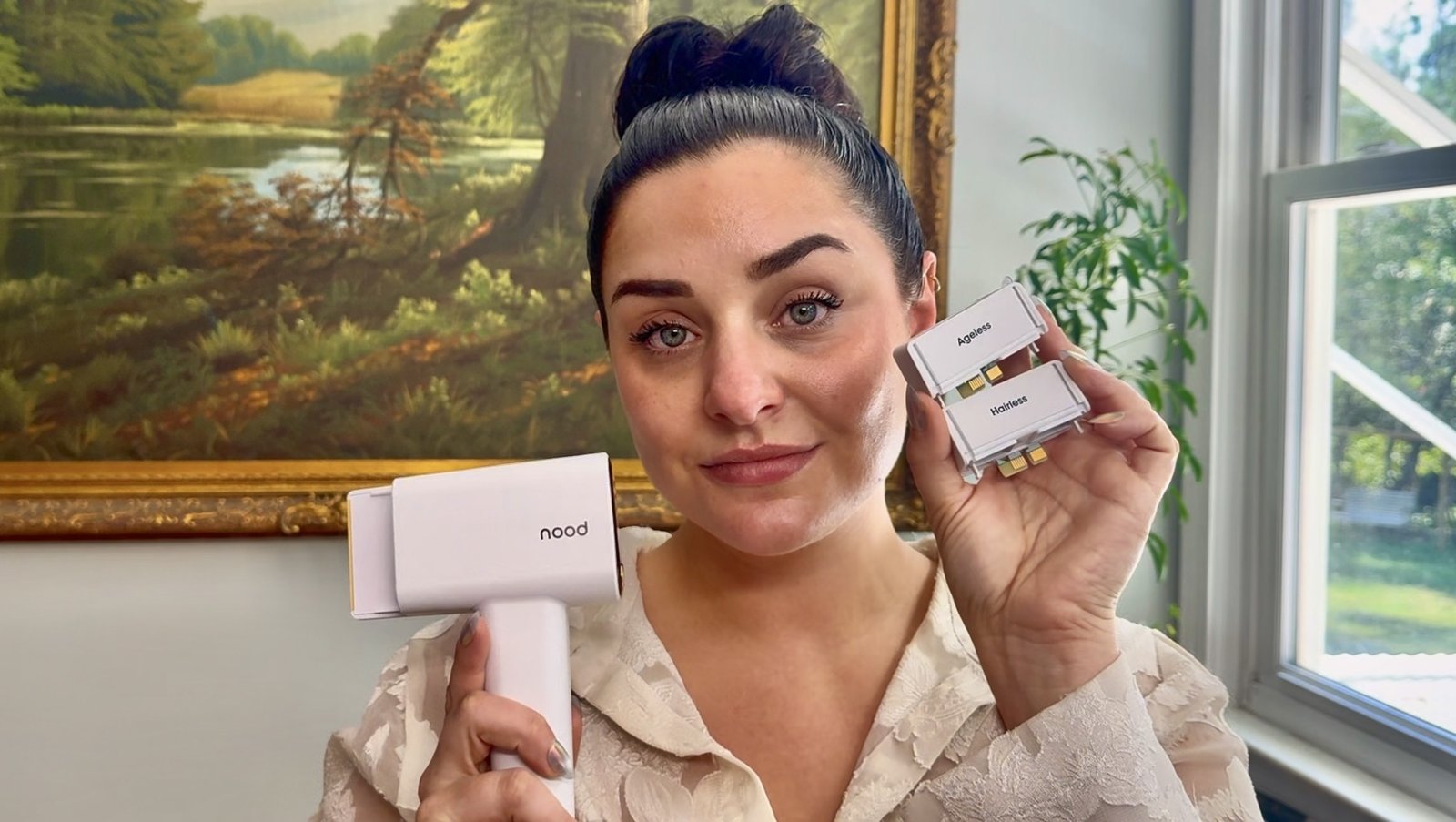
Lenses. The 2.0 has one fixed window. The Pro ships with two detachable lenses: Hairless (510 to 1200 nm) for hair, and Ageless (560 to 1100 nm) for skin rejuvenation. The lens is covered in its own review.
Speed. Nood claims a 25% faster flash rate on the Pro and quotes a full treatment at about 10 minutes against 20 on the 2.0. That claim is Nood’s, not an independent test, but a faster flash rate on a corded device is a plausible reason for it.
The Flasher Pro with both lenses. The 2.0 has one fixed window and no second lens.
Side by side
Nood Flasher Pro
Nood Flasher 2.0
Energy per flash
1.84 to 5.23 J/cm² (FDA cleared); 6 to 7.2 marketed
4.5 J/cm² marketed (4.8 in Nood’s own table); no cleared figure published
Intensity settings
5
7
Cooling
Yes (CryoSoothe, 60°F)
No
Lenses
2 detachable: Hairless + Ageless
1 fixed window
Wavelength
510 to 1200 nm (Hairless)
510 to 1200 nm
Flash rate
25% faster (Nood’s claim)
0.7 to 1.2 seconds
Modes
Continuous Glide, Large Treatment
Continuous Glide, Large Treatment
Power
Corded, 6 ft adapter
Corded, 6 ft adapter
Guarantee
90-day money-back, lifetime flash guarantee
90-day money-back, lifetime flash guarantee
Where to buy
Amazon and Nood direct
Nood direct only (not on Amazon as of Sep 2026)
Typical price
$299 to $409 on Amazon; $379 direct
$179 to $199 direct
The seven levels are not a feature
The 2.0 has seven intensity steps and the Pro has five, and it is tempting to read that as the older device being more adjustable. It is the opposite. The 2.0’s seven steps divide a smaller energy range into finer slices. The Pro’s five steps cover a wider range. Level 7 on a 2.0 is still a weaker flash than the Pro’s top setting. Count the energy, not the buttons.
Where the 2.0 still makes sense
Small areas, firm budget. Underarms, upper lip and the bikini line are quick on any device, so the Pro’s speed advantage barely shows, and at a lower energy the lack of cooling is easier to live with. At $179 to $199 direct from Nood it is the cheapest way into the Nood ecosystem, and it carries the same 90-day money-back guarantee.
If you already own a 2.0 and it is working, there is no reason to replace it for hair removal alone. The upgrade case is cooling, full-leg sessions, or wanting the Ageless lens.
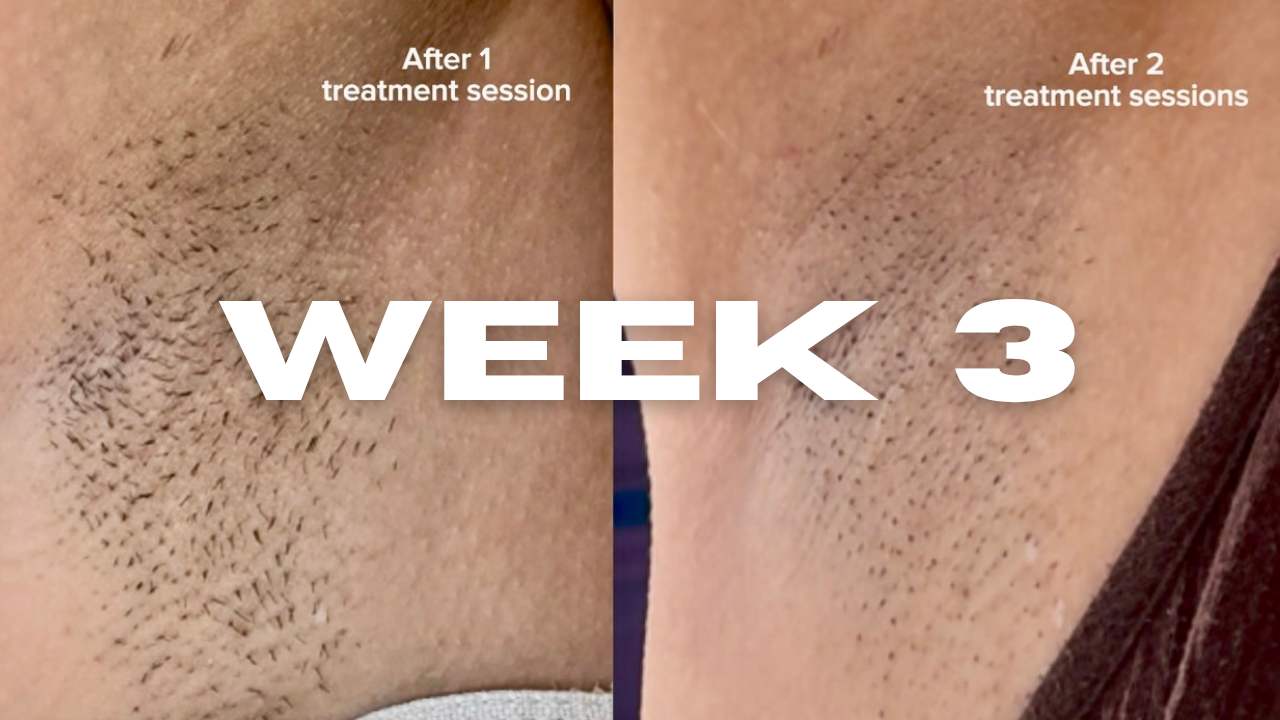
Underarm progress on the Flasher Pro at week three. Small areas are where the 2.0 keeps up; large areas are where the Pro pulls ahead.
Cost against the clinic
Both devices land well under a single course of professional treatment. Clinic pricing gathered across three US cities puts underarms alone at $294 to $2,094 and full legs at $1,800 to $3,992. Against those numbers the $100 to $120 between the two Nood handsets is not the decision. Whether you want cooling and a second lens is. The full clinic comparison, with course prices by city, is in Nood vs Laser Hair Removal.
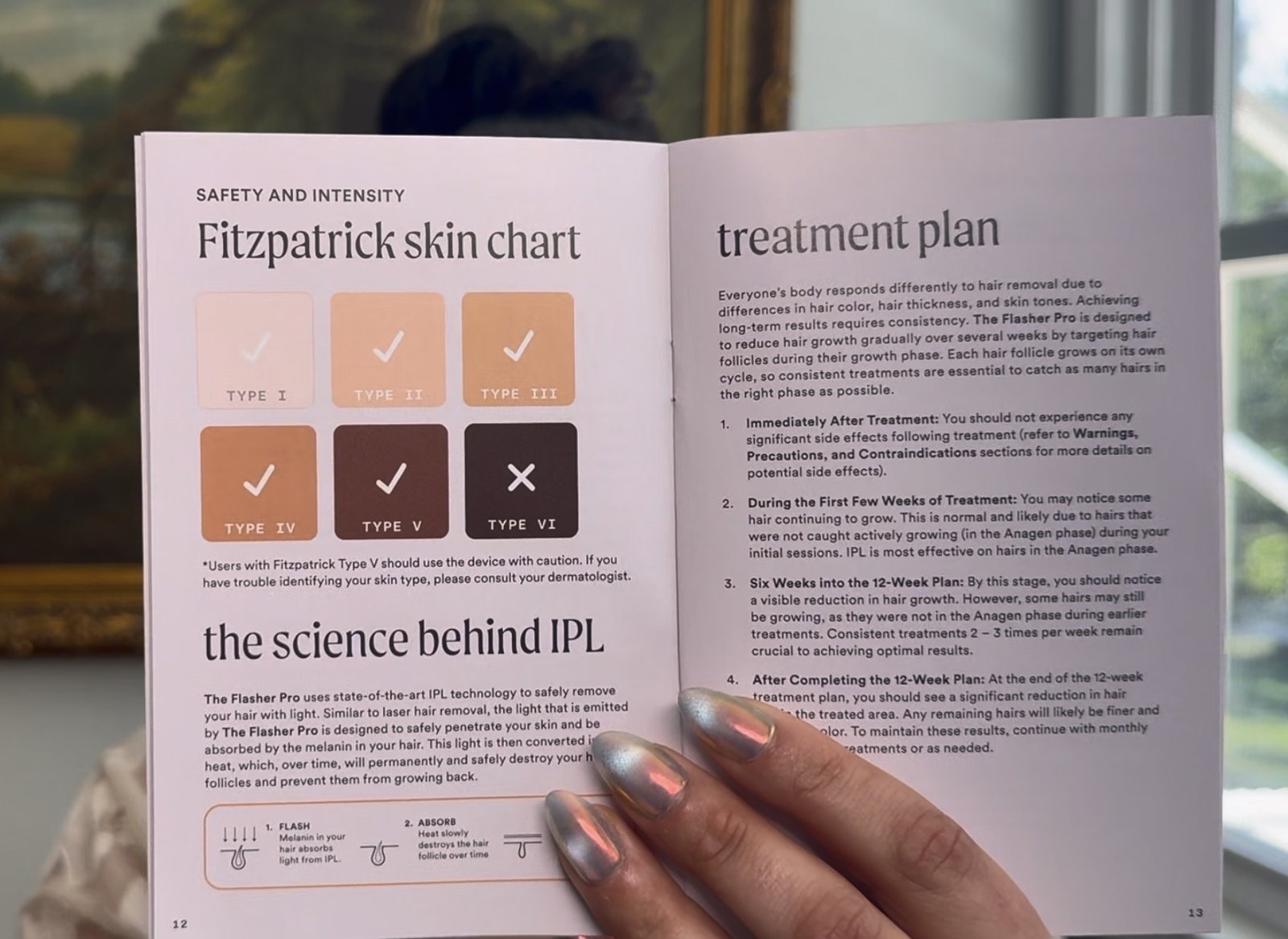
The skin type chart from the Nood manual. It applies to both handsets: IPL needs pigment in the hair and contrast with the skin.
Who should buy which
Flasher Pro: anyone treating legs, arms or back, anyone who wants cooling at the higher settings, and anyone who might use the Ageless lens later.
Flasher 2.0: small areas only, tightest budget, and comfortable ordering from Nood’s site rather than Amazon.
Neither: very light blonde, red, grey or white hair, or the darkest skin tones. IPL needs pigment to target. Check the chart above before buying either.
Is the Nood Flasher Pro stronger than the Flasher 2.0?
Yes. Nood lists the 2.0 at 4.5 J/cm² and the Pro at 6 to 7 J/cm² depending on the page. The Pro’s FDA-cleared range tops out at 5.23 J/cm², which is above the 2.0’s entire marketed figure.
Does the Flasher 2.0 have cooling?
No. CryoSoothe cooling arrived with the Pro. The 2.0 relies on its seven intensity steps to manage discomfort.
Can I buy the Flasher 2.0 on Amazon?
As of September 2026 it is not listed there. Nood sells it direct for $179 to $199. The Flasher Pro is on Amazon, currently around $299.
Should I upgrade from the 2.0 to the Pro?
If the 2.0 is working and you only treat small areas, keep it. Upgrade if you want the cooling for higher settings, faster full-leg sessions, or the Ageless skin lens.
Specs checked September 2026 against Nood’s product pages for both handsets, Nood’s own Pro-versus-2.0 comparison table, and FDA 510(k) K241106. Prices are Nood direct and typical Amazon listing ranges and change often.
Leave a Reply