(function(){try{var q=window.location.search;var m=q.match(/[?&]akp_notrack=([01])/);if(m){document.cookie='akp_notrack='+m[1]+';path=/;max-age='+(m[1]==='1'?15552000:0)+';SameSite=Lax';}var armed=/(^|; )akp_notrack=1(;|$)/.test(document.cookie)||(m&&m[1]==='1');if(armed&&!window.fbq){var n=function(){};n.queue=[];n.loaded=true;n.version='2.0';n.callMethod=function(){};window.fbq=n;window._fbq=n;}}catch(e){}})();
https://annakatherinepage.com/wp-content/plugins/burst-statistics/assets/js/timeme/timeme.min.js
var breeze_prefetch = {"local_url":"https://annakatherinepage.com","ignore_remote_prefetch":"1","ignore_list":["/?wc-api=wc_facebook_get_feed_data&secret=1760aef9e5a5d06e2a1f0f642c457ce5","/cart/","/checkout/","/my-account/","wp-admin","wp-login.php"]};
//# sourceURL=breeze-prefetch-js-extra
https://annakatherinepage.com/wp-content/plugins/breeze/assets/js/js-front-end/breeze-prefetch-links.min.js
https://annakatherinepage.com/wp-includes/js/jquery/jquery.min.js
https://annakatherinepage.com/wp-includes/js/jquery/jquery-migrate.min.js
https://annakatherinepage.com/wp-content/plugins/woocommerce/assets/js/jquery-blockui/jquery.blockUI.min.js
var wc_add_to_cart_params = {"ajax_url":"/wp-admin/admin-ajax.php","wc_ajax_url":"/?wc-ajax=%%endpoint%%","i18n_view_cart":"View cart","cart_url":"https://annakatherinepage.com/checkout/","is_cart":"","cart_redirect_after_add":"no"};
//# sourceURL=wc-add-to-cart-js-extra
https://annakatherinepage.com/wp-content/plugins/woocommerce/assets/js/frontend/add-to-cart.min.js
https://annakatherinepage.com/wp-content/plugins/woocommerce/assets/js/js-cookie/js.cookie.min.js
var woocommerce_params = {"ajax_url":"/wp-admin/admin-ajax.php","wc_ajax_url":"/?wc-ajax=%%endpoint%%","i18n_password_show":"Show password","i18n_password_hide":"Hide password"};
//# sourceURL=woocommerce-js-extra
https://annakatherinepage.com/wp-content/plugins/woocommerce/assets/js/frontend/woocommerce.min.js
window.__wc_fb_page_generated = 1792955366;
!function(f,b,e,v,n,t,s){if(f.fbq)return;n=f.fbq=function(){n.callMethod?
n.callMethod.apply(n,arguments):n.queue.push(arguments)};if(!f._fbq)f._fbq=n;
n.push=n;n.loaded=!0;n.version='2.0';n.queue=[];t=b.createElement(e);t.async=!0;
t.src=v;s=b.getElementsByTagName(e)[0];s.parentNode.insertBefore(t,s)}(window,
document,'script','https://connect.facebook.net/en_US/fbevents.js');
window.FacebookSignals = window.FacebookSignals || {
_held: false,
_releasing: false,
_pixelInitialized: false,
_pixelId: null,
_pixelUserInfo: {},
_pixelOptions: {},
_pendingPixelEvents: [],
_queue: [],
_config: {},
_attribution: {},
_seenEventIds: {},
_fbclid: (function() {
try {
var m = window.location.search.match(/[?&]fbclid=([^&]*)/);
return m ? decodeURIComponent(m[1]) : null;
} catch(e) { return null; }
})(),
init: function(config) {
config = config || {};
this._config = config;
this._attribution = config.attribution || {};
var cookieState = this._getCookie('wc_facebook_signals_state');
this._held = cookieState ? cookieState === 'held' : !!config.held;
this._fbclid = this._fbclid || null;
if (typeof fbq === 'function') {
fbq('consent', this._held ? 'revoke' : 'grant');
}
try {
var raw = window.sessionStorage.getItem('wc_facebook_signals_seen_event_ids');
this._seenEventIds = raw ? JSON.parse(raw) : {};
} catch (e) {
this._seenEventIds = this._seenEventIds || {};
}
},
initPixel: function(pixelId, userInfo, options) {
this._pixelId = pixelId;
this._pixelUserInfo = userInfo && typeof userInfo === 'object' && !Array.isArray(userInfo) ? userInfo : {};
this._pixelOptions = options || {};
if (!this._held) {
this._runPixelInit();
}
},
_runPixelInit: function() {
if (this._pixelInitialized || !this._pixelId || typeof fbq !== 'function') return;
fbq('init', this._pixelId, this._pixelUserInfo, this._pixelOptions);
this._pixelInitialized = true;
this._flushPendingPixelEvents();
},
_flushPendingPixelEvents: function() {
var pending = this._pendingPixelEvents;
this._pendingPixelEvents = [];
for (var i = 0; i < pending.length; i++) {
var ev = pending[i];
this._firePixelEvent(ev.name, ev.params, ev.method, ev.eventId);
}
},
_fireOrQueuePixelEvent: function(name, params, method, eventId) {
if (!this._pixelInitialized) {
this._pendingPixelEvents.push({
name: name, params: params || {}, method: method || 'track', eventId: eventId || null
});
return;
}
this._firePixelEvent(name, params || {}, method || 'track', eventId || null);
},
_firePixelEvent: function(name, params, method, eventId) {
method = method || 'track';
if (eventId) {
fbq(method, name, params || {}, { eventID: eventId });
} else {
fbq(method, name, params || {});
}
},
queueEvent: function(eventData) {
if (!eventData || !eventData.event_name) return;
var originalId = eventData.event_id || null;
if (originalId && this._seenEventIds[originalId]) return;
if (!this._held) {
this._fireOrQueuePixelEvent(eventData.event_name, eventData.custom_data || {}, eventData.method || 'track', originalId);
return;
}
eventData = this._cloneEventData(eventData);
eventData.event_id = this._generateEventId();
eventData.event_time = eventData.event_time || Math.floor(Date.now() / 1000);
this._queue.push(eventData);
var idToMark = originalId || eventData.event_id;
if (idToMark) {
this._seenEventIds[idToMark] = 1;
try {
window.sessionStorage.setItem(
'wc_facebook_signals_seen_event_ids',
JSON.stringify(this._seenEventIds)
);
} catch (e) {}
}
},
trackEvent: function(name, params, userData, method, eventId) {
method = method || 'track';
eventId = eventId || (params && params.eventID) || null;
if (this._held) {
this.queueEvent({
event_name: name,
custom_data: params || {},
event_id: eventId,
event_time: Math.floor(Date.now() / 1000),
method: method
});
} else {
this._fireOrQueuePixelEvent(name, params || {}, method, eventId);
}
},
release: function() {
var self = this;
if (!self._held || self._releasing || !self._config.ajaxUrl) {
return Promise.resolve({ success: true, data: { sent_count: 0 } });
}
self._releasing = true;
var attribution = self._collectAttribution();
var payload = JSON.stringify({
events: self._queue,
attribution: {
fbp: attribution.fbp || null,
fbc: attribution.fbc || null
},
fbclid: self._fbclid || null
});
var url = self._config.ajaxUrl +
(self._config.ajaxUrl.indexOf('?') === -1 ? '?' : '&') +
'action=' + encodeURIComponent(self._config.action);
return new Promise(function(resolve, reject) {
var xhr = new XMLHttpRequest();
xhr.open('POST', url, true);
xhr.setRequestHeader('Content-Type', 'application/json');
xhr.onload = function() {
if (xhr.status >= 200 && xhr.status < 300) {
try {
var resp = JSON.parse(xhr.responseText);
self._handleReleaseResponse(resp.data || {}, attribution);
resolve(resp);
} catch(e) { self._releasing = false; reject(e); }
} else {
self._releasing = false;
reject(new Error('Signal release AJAX failed: ' + xhr.status));
}
};
xhr.onerror = function() { self._releasing = false; reject(new Error('Network error')); };
xhr.send(payload);
});
},
_handleReleaseResponse: function(data, attribution) {
this._syncAttributionCookies(data || {}, attribution);
// Override cached user_info with fresh data from the release response.
if (data.user_info && typeof data.user_info === 'object' && !Array.isArray(data.user_info)) {
this._pixelUserInfo = data.user_info;
}
this._held = false;
this._releasing = false;
fbq('consent', 'grant');
this._runPixelInit();
var queue = this._queue;
for (var i = 0; i < queue.length; i++) {
var ev = queue[i];
this._fireOrQueuePixelEvent(ev.event_name, ev.custom_data || {}, ev.method || 'track', ev.event_id || null);
}
this._queue = [];
},
_collectAttribution: function() {
var clientParams = {};
if (typeof clientParamBuilder !== 'undefined') {
try {
clientParams = clientParamBuilder.processAndCollectParams(this._getAttributionUrl()) || {};
} catch (e) {}
}
var fbp = this._getCookie('_fbp') || clientParams._fbp || (typeof clientParamBuilder !== 'undefined' ? clientParamBuilder.getFbp() : null);
var fbc = this._getCookie('_fbc') || clientParams._fbc || (typeof clientParamBuilder !== 'undefined' ? clientParamBuilder.getFbc() : null);
if (!fbc && this._fbclid) {
fbc = 'fb.1.' + Date.now() + '.' + this._fbclid;
}
return { fbp: fbp || null, fbc: fbc || null };
},
_syncAttributionCookies: function(data, attribution) {
var fbp = data.fbp || (attribution && attribution.fbp) || null;
var fbc = data.fbc || (attribution && attribution.fbc) || null;
if (fbp) {
this._setAttributionCookie('_fbp', fbp, data.fbp_domain || null);
}
if (fbc) {
this._setAttributionCookie('_fbc', fbc, data.fbc_domain || null);
}
},
_setAttributionCookie: function(name, value, domain) {
if (!value) return;
var domainAttr = domain ? ';domain=' + domain : '';
document.cookie = name + '=' + encodeURIComponent(value) + ';path=/;max-age=7776000' + domainAttr + ';SameSite=Lax';
},
_getCookie: function(name) {
var match = document.cookie.match(new RegExp('(?:^|;\\s*)' + name.replace(/[.*+?^${}()|[\]\\]/g, '\\$&') + '=([^;]*)'));
if (!match) return null;
try { return decodeURIComponent(match[1]); } catch(e) { return null; }
},
_cloneEventData: function(eventData) {
var clone = {};
for (var key in eventData) {
if (Object.prototype.hasOwnProperty.call(eventData, key)) {
clone[key] = eventData[key];
}
}
return clone;
},
_generateEventId: function() {
if (window.crypto && typeof window.crypto.randomUUID === 'function') {
return window.crypto.randomUUID();
}
return 'xxxxxxxx-xxxx-4xxx-yxxx-xxxxxxxxxxxx'.replace(/[xy]/g, function(c) {
var r = Math.random() * 16 | 0;
return (c === 'x' ? r : (r & 0x3 | 0x8)).toString(16);
});
},
_getAttributionUrl: function() {
if (!this._fbclid) return window.location.href;
try {
var url = new URL(window.location.href);
if (!url.searchParams.get('fbclid')) {
url.searchParams.set('fbclid', this._fbclid);
}
return url.toString();
} catch (e) {
return window.location.href;
}
}
};
FacebookSignals.init({
held: false,
ajaxUrl: "https:\/\/annakatherinepage.com\/wp-admin\/admin-ajax.php",
action: 'facebook_release_signals',
pixelId: "5552345558112956",
attribution: {}
});
FacebookSignals.initPixel(
"5552345558112956",
{},
{"agent":"woocommerce_0-11.2.1-3.7.8"} );
document.addEventListener( 'DOMContentLoaded', function() {
document.body.insertAdjacentHTML( 'beforeend', '<div class=\"wc-facebook-pixel-event-placeholder\"></div>' );
}, false );
Skip to content
Nood Flasher Pro vs Philips Lumea 9000: Is the Lumea Worth Double the Price
Disclosure
This post contains affiliate links, which means I may earn a small commission if you make a purchase through my links, at no extra cost to you.
This post contains affiliate links. As an Amazon Associate, purchases made through these links may earn a commission at no extra cost to you.
The Philips Lumea 9000 is the premium name in at-home IPL and it is priced like one, at roughly twice the Nood Flasher Pro. The question is whether the extra money buys extra results, or a brand and a nicer case. Here’s what to look for.
The short version
Pick the Nood Flasher Pro if you want comparable energy for half the price, built-in cooling, and an FDA-cleared output figure.
Pick the Philips Lumea 9000 if you want the widest set of body-area attachments, a smart skin sensor, and you are not price sensitive.
Check the Nood Flasher Pro on Amazon here · See the Philips Lumea 9000 on Amazon
The energy figures, and who published them
Nood Flasher Pro: 1.84 to 5.23 J/cm² on its FDA 510(k) clearance (K241106), with 6, 7 and 7.2 J/cm² in marketing.
Philips Lumea 9000: roughly 2.5 to 6.5 J/cm², but Philips does not publish a J/cm² figure for the Lumea range at all. That number comes from an independent teardown.
Read that carefully. The most expensive device in the category is the one whose energy output you have to find from a third party. Philips almost certainly delivers in the same class as Nood, and the teardown figure suggests a slightly higher ceiling. But at twice the price, “almost certainly” is a lot to pay for.
The full audit of which brands publish what is here .
Side by side
Nood Flasher Pro
Philips Lumea 9000
Published energy
1.84 to 5.23 J/cm² (FDA cleared)
Not published by Philips; ~2.5 to 6.5 J/cm² per teardown
Intensity settings
5
5
Skin tone sensor
No
Yes (SmartSkin)
Built-in cooling
Yes (CryoSoothe)
No
Attachments
Single window, plus optional Ageless lens
Up to four: body, face, bikini, underarms (varies by kit)
Power
Corded
Cordless or corded
Skin rejuvenation option
Yes, swappable Ageless lens
No
Typical price
$299 to $409
~$550 to $700 depending on kit
Nood’s cooling plate is the practical difference on sensitive areas. The Lumea 9000 has no cooling. What the Lumea’s price actually buys
Three things, and all of them are real.
The attachments. The Lumea 9000 ships with shaped heads for body, face, bikini and underarms depending on the kit, so the window sits flush on an awkward area. That is a comfort and coverage advantage on awkward areas, and it is the strongest argument for the device.
The sensor. SmartSkin reads tone and recommends a setting. Nood has no sensor, so the level is your call.
Cordless. The Lumea 9000 can run cordless or plugged in; the Nood Flasher Pro is corded only. For long sessions on legs or back, that is a real convenience the Nood does not have, and it belongs on the Philips side of the ledger.
What the price does not buy is cooling. The Lumea 9000 has none, which means higher settings on sensitive areas are managed by turning the intensity down. Nood’s CryoSoothe plate exists to avoid exactly that trade.
What Nood has that the Lumea doesn’t
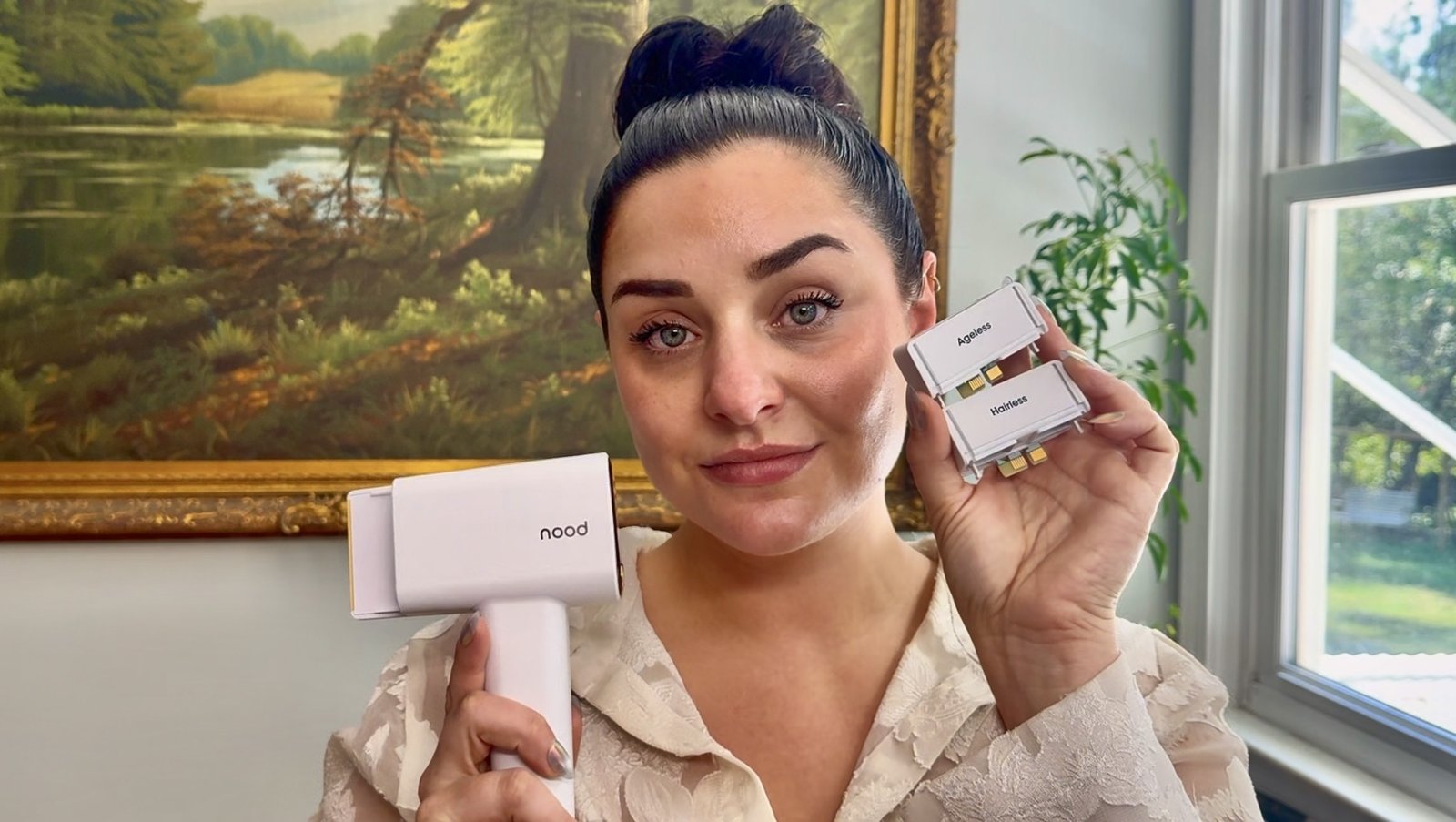
Cooling, a published energy figure, and a second job. The swappable Ageless lens turns the same handset into a skin rejuvenation device. Philips sells hair removal only. For anyone considering a separate skin device, that is several hundred dollars of difference on top of the price gap. The lens is covered in its own review .
Cost against the clinic
Both devices cost less than a single course of professional sessions. Clinic pricing gathered across three US cities puts underarms at $294 to $2,094 and full legs at $1,800 to $3,992. Either device pays back on the first area. The difference is that Nood pays back roughly twice as fast, and the money saved covers the Ageless lens with room to spare. The full clinic comparison, with course prices by city, is in Nood vs Laser Hair Removal .
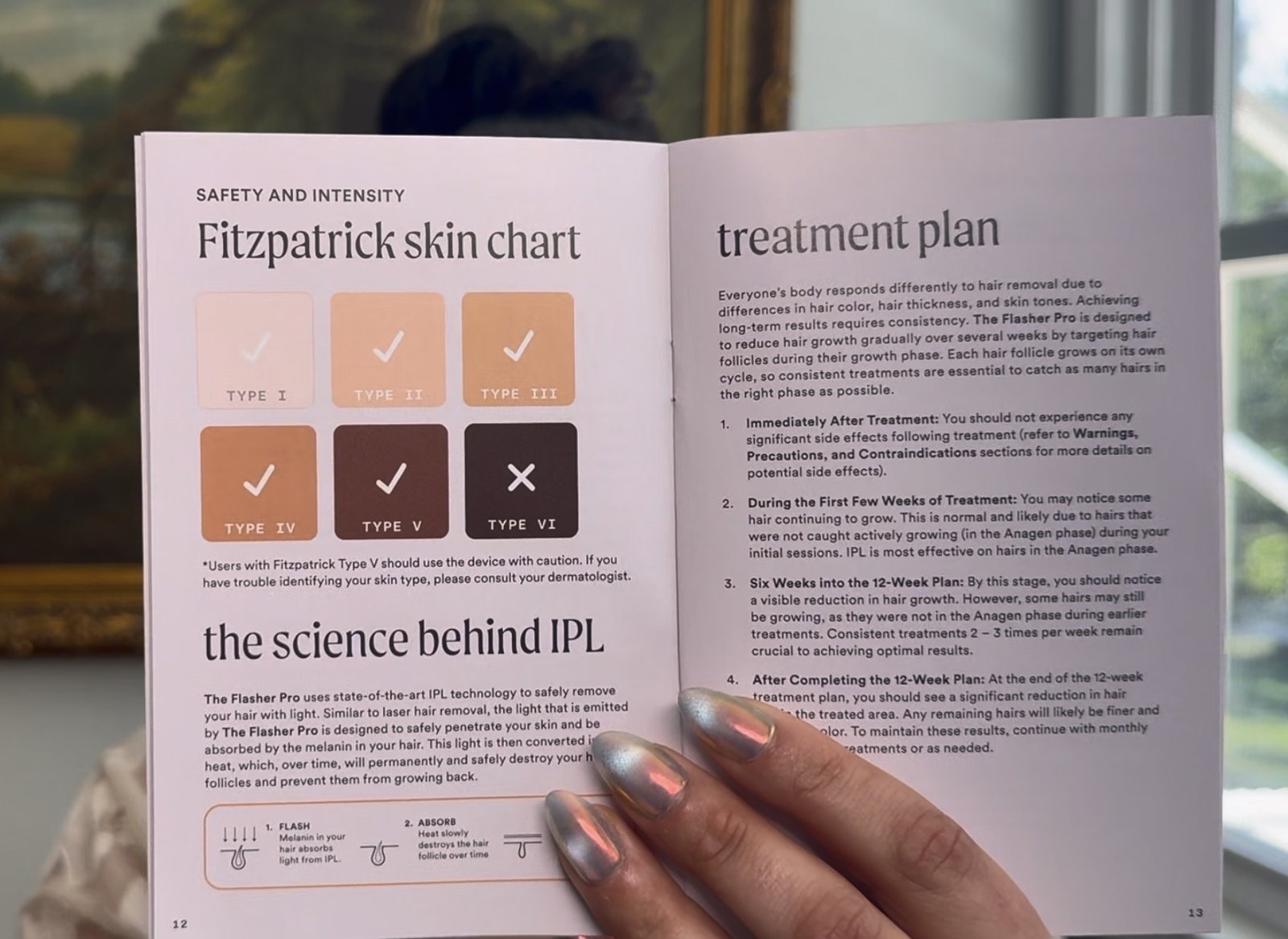
The skin type chart from the Nood manual. Check your own type before buying either device. Who should buy which
Nood Flasher Pro: anyone who wants the same energy class at half the price, anyone treating sensitive areas, anyone who might want the skin lens.
Philips Lumea 9000: anyone who values shaped attachments and cordless use above everything else and is comfortable at the price.
Neither: very light blonde, red, grey or white hair. IPL needs pigment to work. Check the chart on the listing before buying either.
See the Nood Flasher Pro on Amazon · See the Philips Lumea 9000 on Amazon
Frequently asked
Is the Philips Lumea more powerful than Nood?
Teardown figures suggest a slightly higher ceiling, around 6.5 J/cm² against Nood’s cleared 5.23 and marketed 7.2. They are the same class. Philips does not publish its own number.
Does the Lumea 9000 have cooling?
No. Nood does. On sensitive areas that is the main practical difference.
Why is the Lumea so much more expensive?
Shaped attachments, a skin sensor, cordless operation, and the brand. Those are real features, but the energy delivery is not double.
Specs checked September 2026 against the Philips Lumea 9000 product pages, the Nood product page, and FDA 510(k) K241106. Philips publishes no J/cm² figure; the teardown range is third-party. Prices are typical Amazon listing ranges and change often.
Related: Nood Flasher Pro vs Other IPL Devices · Nood Ageless Lens Review
Your cart
(items: 0)
Products in cart
Available on backorder
Previous price:
Discounted price:
Your shopping cart is empty
(function () {
var c = document.body.className;
c = c.replace(/woocommerce-no-js/, 'woocommerce-js');
document.body.className = c;
})();
https://annakatherinepage.com/wp-includes/js/comment-reply.min.js
https://annakatherinepage.com/wp-includes/js/dist/hooks.min.js
https://annakatherinepage.com/wp-includes/js/dist/i18n.min.js
wp.i18n.setLocaleData( { 'text direction\u0004ltr': [ 'ltr' ] } );
//# sourceURL=wp-i18n-js-after
https://annakatherinepage.com/wp-includes/js/dist/private-apis.min.js
https://annakatherinepage.com/wp-includes/js/dist/url.min.js
https://annakatherinepage.com/wp-includes/js/dist/api-fetch.min.js
wp.apiFetch.use( wp.apiFetch.createRootURLMiddleware( "https://annakatherinepage.com/wp-json/" ) );
wp.apiFetch.nonceMiddleware = wp.apiFetch.createNonceMiddleware( "0d85342746" );
wp.apiFetch.use( wp.apiFetch.nonceMiddleware );
wp.apiFetch.use( wp.apiFetch.mediaUploadMiddleware );
wp.apiFetch.nonceEndpoint = "https://annakatherinepage.com/wp-admin/admin-ajax.php?action=rest-nonce";
//# sourceURL=wp-api-fetch-js-after
https://annakatherinepage.com/wp-content/uploads/burst/js/burst.min.js
var wc_facebook_signals_params = {"ajax_url":"https://annakatherinepage.com/wp-admin/admin-ajax.php","nonce":"10c47ff36d","action":"wc_facebook_update_signals_state"};
//# sourceURL=wc-facebook-signals-js-extra
https://annakatherinepage.com/wp-content/plugins/facebook-for-woocommerce/assets/js/facebook-for-woocommerce-signals.js
https://annakatherinepage.com/wp-content/plugins/woocommerce/assets/js/sourcebuster/sourcebuster.min.js
var wc_order_attribution = {"params":{"lifetime":1.0e-5,"session":30,"base64":false,"ajaxurl":"https://annakatherinepage.com/wp-admin/admin-ajax.php","prefix":"wc_order_attribution_","allowTracking":true},"fields":{"source_type":"current.typ","referrer":"current_add.rf","utm_campaign":"current.cmp","utm_source":"current.src","utm_medium":"current.mdm","utm_content":"current.cnt","utm_id":"current.id","utm_term":"current.trm","utm_source_platform":"current.plt","utm_creative_format":"current.fmt","utm_marketing_tactic":"current.tct","session_entry":"current_add.ep","session_start_time":"current_add.fd","session_pages":"session.pgs","session_count":"udata.vst","user_agent":"udata.uag"}};
//# sourceURL=wc-order-attribution-js-extra
https://annakatherinepage.com/wp-content/plugins/woocommerce/assets/js/frontend/order-attribution.min.js
https://annakatherinepage.com/wp-content/plugins/facebook-for-woocommerce/assets/js/frontend/pixel-events.js
(function() {
var processParams = function() {
if (typeof clientParamBuilder !== "undefined" && !/(?:^|;\s*)wc_facebook_signals_state=held(?:;|$)/.test(document.cookie)) {
clientParamBuilder.processAndCollectAllParams(window.location.href);
}
};
if (typeof clientParamBuilder !== "undefined") {
processParams();
return;
}
var fallbackScript = document.createElement("script");
fallbackScript.src = "https:\/\/unpkg.com\/meta-capi-param-builder-clientjs@1.3.2\/dist\/clientParamBuilder.bundle.js";
fallbackScript.onload = processParams;
document.head.appendChild(fallbackScript);
}());
//# sourceURL=facebook-capi-param-builder-js-after
/* WooCommerce Facebook Integration Event Tracking */
fbq('set', 'agent', (function(){var a='woocommerce_0-11.2.1-3.7.8';if(window.__wc_fb_page_generated&&(Math.floor(Date.now()/1000)-window.__wc_fb_page_generated)>1800){a=a.replace(/(\d+\.\d+\.\d+)/,'$1_c');}return a;})(), '5552345558112956');
window.wcFacebookPixelFiredEvents = window.wcFacebookPixelFiredEvents || {};
if (!window.wcFacebookPixelFiredEvents["9276afb7-66ad-4433-9eb7-1e8fb93fb75f"]) {
window.wcFacebookPixelFiredEvents["9276afb7-66ad-4433-9eb7-1e8fb93fb75f"] = true;
var isStale = window.__wc_fb_page_generated && (Math.floor(Date.now()/1000) - window.__wc_fb_page_generated) > 1800;
if (window.FacebookSignals && typeof window.FacebookSignals.trackEvent === 'function') {
window.FacebookSignals.trackEvent('PageView', {
"source": "woocommerce_0",
"version": "11.2.1",
"pluginVersion": "3.7.8"
}, null, 'track', isStale ? null : "9276afb7-66ad-4433-9eb7-1e8fb93fb75f");
} else if (isStale) {
fbq('track', 'PageView', {
"source": "woocommerce_0",
"version": "11.2.1",
"pluginVersion": "3.7.8"
});
} else {
fbq('track', 'PageView', {
"source": "woocommerce_0",
"version": "11.2.1",
"pluginVersion": "3.7.8"
}, {
"eventID": "9276afb7-66ad-4433-9eb7-1e8fb93fb75f"
});
}
}
//# sourceURL=facebook-for-woocommerce-inline-js-after
(function(){
function rgb(c){var m=(c||"").match(/[0-9.]+/g);return m?m.map(Number):null;}
function lum(a){return (0.299*a[0]+0.587*a[1]+0.114*a[2])/255;}
function effbg(el){var n=el;while(n){var c=rgb(getComputedStyle(n).backgroundColor);if(c&&(c.length<4||c[3]>0.5))return c;n=n.parentElement;}return null;}
var sel="main h1,main h2,main h3,main h4,main p,main li,main span,#frc h1,#frc h2,#frc h3,#frc p,#frc span,#frc li";
document.querySelectorAll(sel).forEach(function(t){
var bg=effbg(t);
if(!bg) return;
if(lum(bg)<0.30){
var fc=rgb(getComputedStyle(t).color);
if(fc && lum(fc)<0.5){ t.style.setProperty("color","#f7f1e6","important"); }
}
});
})();
Leave a Reply