(function(){try{var q=window.location.search;var m=q.match(/[?&]akp_notrack=([01])/);if(m){document.cookie='akp_notrack='+m[1]+';path=/;max-age='+(m[1]==='1'?15552000:0)+';SameSite=Lax';}var armed=/(^|; )akp_notrack=1(;|$)/.test(document.cookie)||(m&&m[1]==='1');if(armed&&!window.fbq){var n=function(){};n.queue=[];n.loaded=true;n.version='2.0';n.callMethod=function(){};window.fbq=n;window._fbq=n;}}catch(e){}})();
https://annakatherinepage.com/wp-content/plugins/burst-statistics/assets/js/timeme/timeme.min.js
var breeze_prefetch = {"local_url":"https://annakatherinepage.com","ignore_remote_prefetch":"1","ignore_list":["/?wc-api=wc_facebook_get_feed_data&secret=1760aef9e5a5d06e2a1f0f642c457ce5","/cart/","/checkout/","/my-account/","wp-admin","wp-login.php"]};
//# sourceURL=breeze-prefetch-js-extra
https://annakatherinepage.com/wp-content/plugins/breeze/assets/js/js-front-end/breeze-prefetch-links.min.js
https://annakatherinepage.com/wp-includes/js/jquery/jquery.min.js
https://annakatherinepage.com/wp-includes/js/jquery/jquery-migrate.min.js
https://annakatherinepage.com/wp-content/plugins/woocommerce/assets/js/jquery-blockui/jquery.blockUI.min.js
var wc_add_to_cart_params = {"ajax_url":"/wp-admin/admin-ajax.php","wc_ajax_url":"/?wc-ajax=%%endpoint%%","i18n_view_cart":"View cart","cart_url":"https://annakatherinepage.com/checkout/","is_cart":"","cart_redirect_after_add":"no"};
//# sourceURL=wc-add-to-cart-js-extra
https://annakatherinepage.com/wp-content/plugins/woocommerce/assets/js/frontend/add-to-cart.min.js
https://annakatherinepage.com/wp-content/plugins/woocommerce/assets/js/js-cookie/js.cookie.min.js
var woocommerce_params = {"ajax_url":"/wp-admin/admin-ajax.php","wc_ajax_url":"/?wc-ajax=%%endpoint%%","i18n_password_show":"Show password","i18n_password_hide":"Hide password"};
//# sourceURL=woocommerce-js-extra
https://annakatherinepage.com/wp-content/plugins/woocommerce/assets/js/frontend/woocommerce.min.js
window.__wc_fb_page_generated = 1792955363;
!function(f,b,e,v,n,t,s){if(f.fbq)return;n=f.fbq=function(){n.callMethod?
n.callMethod.apply(n,arguments):n.queue.push(arguments)};if(!f._fbq)f._fbq=n;
n.push=n;n.loaded=!0;n.version='2.0';n.queue=[];t=b.createElement(e);t.async=!0;
t.src=v;s=b.getElementsByTagName(e)[0];s.parentNode.insertBefore(t,s)}(window,
document,'script','https://connect.facebook.net/en_US/fbevents.js');
window.FacebookSignals = window.FacebookSignals || {
_held: false,
_releasing: false,
_pixelInitialized: false,
_pixelId: null,
_pixelUserInfo: {},
_pixelOptions: {},
_pendingPixelEvents: [],
_queue: [],
_config: {},
_attribution: {},
_seenEventIds: {},
_fbclid: (function() {
try {
var m = window.location.search.match(/[?&]fbclid=([^&]*)/);
return m ? decodeURIComponent(m[1]) : null;
} catch(e) { return null; }
})(),
init: function(config) {
config = config || {};
this._config = config;
this._attribution = config.attribution || {};
var cookieState = this._getCookie('wc_facebook_signals_state');
this._held = cookieState ? cookieState === 'held' : !!config.held;
this._fbclid = this._fbclid || null;
if (typeof fbq === 'function') {
fbq('consent', this._held ? 'revoke' : 'grant');
}
try {
var raw = window.sessionStorage.getItem('wc_facebook_signals_seen_event_ids');
this._seenEventIds = raw ? JSON.parse(raw) : {};
} catch (e) {
this._seenEventIds = this._seenEventIds || {};
}
},
initPixel: function(pixelId, userInfo, options) {
this._pixelId = pixelId;
this._pixelUserInfo = userInfo && typeof userInfo === 'object' && !Array.isArray(userInfo) ? userInfo : {};
this._pixelOptions = options || {};
if (!this._held) {
this._runPixelInit();
}
},
_runPixelInit: function() {
if (this._pixelInitialized || !this._pixelId || typeof fbq !== 'function') return;
fbq('init', this._pixelId, this._pixelUserInfo, this._pixelOptions);
this._pixelInitialized = true;
this._flushPendingPixelEvents();
},
_flushPendingPixelEvents: function() {
var pending = this._pendingPixelEvents;
this._pendingPixelEvents = [];
for (var i = 0; i < pending.length; i++) {
var ev = pending[i];
this._firePixelEvent(ev.name, ev.params, ev.method, ev.eventId);
}
},
_fireOrQueuePixelEvent: function(name, params, method, eventId) {
if (!this._pixelInitialized) {
this._pendingPixelEvents.push({
name: name, params: params || {}, method: method || 'track', eventId: eventId || null
});
return;
}
this._firePixelEvent(name, params || {}, method || 'track', eventId || null);
},
_firePixelEvent: function(name, params, method, eventId) {
method = method || 'track';
if (eventId) {
fbq(method, name, params || {}, { eventID: eventId });
} else {
fbq(method, name, params || {});
}
},
queueEvent: function(eventData) {
if (!eventData || !eventData.event_name) return;
var originalId = eventData.event_id || null;
if (originalId && this._seenEventIds[originalId]) return;
if (!this._held) {
this._fireOrQueuePixelEvent(eventData.event_name, eventData.custom_data || {}, eventData.method || 'track', originalId);
return;
}
eventData = this._cloneEventData(eventData);
eventData.event_id = this._generateEventId();
eventData.event_time = eventData.event_time || Math.floor(Date.now() / 1000);
this._queue.push(eventData);
var idToMark = originalId || eventData.event_id;
if (idToMark) {
this._seenEventIds[idToMark] = 1;
try {
window.sessionStorage.setItem(
'wc_facebook_signals_seen_event_ids',
JSON.stringify(this._seenEventIds)
);
} catch (e) {}
}
},
trackEvent: function(name, params, userData, method, eventId) {
method = method || 'track';
eventId = eventId || (params && params.eventID) || null;
if (this._held) {
this.queueEvent({
event_name: name,
custom_data: params || {},
event_id: eventId,
event_time: Math.floor(Date.now() / 1000),
method: method
});
} else {
this._fireOrQueuePixelEvent(name, params || {}, method, eventId);
}
},
release: function() {
var self = this;
if (!self._held || self._releasing || !self._config.ajaxUrl) {
return Promise.resolve({ success: true, data: { sent_count: 0 } });
}
self._releasing = true;
var attribution = self._collectAttribution();
var payload = JSON.stringify({
events: self._queue,
attribution: {
fbp: attribution.fbp || null,
fbc: attribution.fbc || null
},
fbclid: self._fbclid || null
});
var url = self._config.ajaxUrl +
(self._config.ajaxUrl.indexOf('?') === -1 ? '?' : '&') +
'action=' + encodeURIComponent(self._config.action);
return new Promise(function(resolve, reject) {
var xhr = new XMLHttpRequest();
xhr.open('POST', url, true);
xhr.setRequestHeader('Content-Type', 'application/json');
xhr.onload = function() {
if (xhr.status >= 200 && xhr.status < 300) {
try {
var resp = JSON.parse(xhr.responseText);
self._handleReleaseResponse(resp.data || {}, attribution);
resolve(resp);
} catch(e) { self._releasing = false; reject(e); }
} else {
self._releasing = false;
reject(new Error('Signal release AJAX failed: ' + xhr.status));
}
};
xhr.onerror = function() { self._releasing = false; reject(new Error('Network error')); };
xhr.send(payload);
});
},
_handleReleaseResponse: function(data, attribution) {
this._syncAttributionCookies(data || {}, attribution);
// Override cached user_info with fresh data from the release response.
if (data.user_info && typeof data.user_info === 'object' && !Array.isArray(data.user_info)) {
this._pixelUserInfo = data.user_info;
}
this._held = false;
this._releasing = false;
fbq('consent', 'grant');
this._runPixelInit();
var queue = this._queue;
for (var i = 0; i < queue.length; i++) {
var ev = queue[i];
this._fireOrQueuePixelEvent(ev.event_name, ev.custom_data || {}, ev.method || 'track', ev.event_id || null);
}
this._queue = [];
},
_collectAttribution: function() {
var clientParams = {};
if (typeof clientParamBuilder !== 'undefined') {
try {
clientParams = clientParamBuilder.processAndCollectParams(this._getAttributionUrl()) || {};
} catch (e) {}
}
var fbp = this._getCookie('_fbp') || clientParams._fbp || (typeof clientParamBuilder !== 'undefined' ? clientParamBuilder.getFbp() : null);
var fbc = this._getCookie('_fbc') || clientParams._fbc || (typeof clientParamBuilder !== 'undefined' ? clientParamBuilder.getFbc() : null);
if (!fbc && this._fbclid) {
fbc = 'fb.1.' + Date.now() + '.' + this._fbclid;
}
return { fbp: fbp || null, fbc: fbc || null };
},
_syncAttributionCookies: function(data, attribution) {
var fbp = data.fbp || (attribution && attribution.fbp) || null;
var fbc = data.fbc || (attribution && attribution.fbc) || null;
if (fbp) {
this._setAttributionCookie('_fbp', fbp, data.fbp_domain || null);
}
if (fbc) {
this._setAttributionCookie('_fbc', fbc, data.fbc_domain || null);
}
},
_setAttributionCookie: function(name, value, domain) {
if (!value) return;
var domainAttr = domain ? ';domain=' + domain : '';
document.cookie = name + '=' + encodeURIComponent(value) + ';path=/;max-age=7776000' + domainAttr + ';SameSite=Lax';
},
_getCookie: function(name) {
var match = document.cookie.match(new RegExp('(?:^|;\\s*)' + name.replace(/[.*+?^${}()|[\]\\]/g, '\\$&') + '=([^;]*)'));
if (!match) return null;
try { return decodeURIComponent(match[1]); } catch(e) { return null; }
},
_cloneEventData: function(eventData) {
var clone = {};
for (var key in eventData) {
if (Object.prototype.hasOwnProperty.call(eventData, key)) {
clone[key] = eventData[key];
}
}
return clone;
},
_generateEventId: function() {
if (window.crypto && typeof window.crypto.randomUUID === 'function') {
return window.crypto.randomUUID();
}
return 'xxxxxxxx-xxxx-4xxx-yxxx-xxxxxxxxxxxx'.replace(/[xy]/g, function(c) {
var r = Math.random() * 16 | 0;
return (c === 'x' ? r : (r & 0x3 | 0x8)).toString(16);
});
},
_getAttributionUrl: function() {
if (!this._fbclid) return window.location.href;
try {
var url = new URL(window.location.href);
if (!url.searchParams.get('fbclid')) {
url.searchParams.set('fbclid', this._fbclid);
}
return url.toString();
} catch (e) {
return window.location.href;
}
}
};
FacebookSignals.init({
held: false,
ajaxUrl: "https:\/\/annakatherinepage.com\/wp-admin\/admin-ajax.php",
action: 'facebook_release_signals',
pixelId: "5552345558112956",
attribution: {}
});
FacebookSignals.initPixel(
"5552345558112956",
{},
{"agent":"woocommerce_0-11.2.1-3.7.8"} );
document.addEventListener( 'DOMContentLoaded', function() {
document.body.insertAdjacentHTML( 'beforeend', '<div class=\"wc-facebook-pixel-event-placeholder\"></div>' );
}, false );
Skip to content
Nood Flasher Pro vs Ulike Air 10: The Energy Number Ulike Doesn’t Explain
Disclosure
This post contains affiliate links, which means I may earn a small commission if you make a purchase through my links, at no extra cost to you.
This post contains affiliate links. As an Amazon Associate, purchases made through these links may earn a commission at no extra cost to you.
Ulike and Nood are the two at-home IPL devices most people end up choosing between, and both advertise ice cooling, both sit under $400, and both look like they publish an energy figure. Only one of those figures means what it appears to mean. Here’s what to look for.
The short version
Pick the Nood Flasher Pro if you want the higher per-flash energy, an FDA-cleared output figure, and the ability to add a skin rejuvenation lens later.
Pick the Ulike Air 10 if you are highly sensitive to discomfort and would rather trade some per-flash energy for a gentler multi-pulse delivery.
Check the Nood Flasher Pro on Amazon here · See the Ulike Air 10 on Amazon
The 6.67 that isn’t 6.67
Ulike’s marketing for the Air 10 uses a figure of 6.67 J/cm². On its face that beats Nood’s cleared range. It doesn’t, and the reason is worth understanding before spending $300 on either device.
Ulike’s number is a four-pulse burst total . Ulike’s own specification lists 26 J per four-pulse burst in its SHR mode across a 3.9 cm² window, which works out to 6.67 J/cm² for the whole burst, or roughly 1.67 J/cm² per pulse. That is not the same as a single 6.67 J/cm² flash, because the follicle is heated in four smaller steps rather than one larger one.
Nood Flasher Pro delivers 1.84 to 5.23 J/cm² per single flash on its FDA 510(k) clearance (K241106), with 6, 7 and 7.2 J/cm² in its marketing.
So per flash, Nood’s cleared floor is higher than Ulike’s per-flash figure, and its cleared ceiling is roughly three times it. Whether a burst of four gentle pulses works as well as one strong one is a legitimate question, but the two numbers are not comparable on a spec sheet, and Ulike’s listing does not make that clear.
The full breakdown of what every IPL brand publishes is here .
Side by side
Nood Flasher Pro
Ulike Air 10
Energy per flash
1.84 to 5.23 J/cm² (FDA cleared)
~1.67 J/cm²
Marketed figure
6, 7, 7.2 J/cm²
6.67 J/cm² (four-pulse total)
Cooling
Yes (CryoSoothe)
Yes (Sapphire Ice-cooling, 65°F contact)
Skin sensor
No
Yes
Modes
5 intensity settings
Fast, Normal, High, SHR, AutoGlide
Power
Corded
Corded
Skin rejuvenation option
Yes, swappable Ageless lens
No
Typical price
$299 to $409
$259 to $369
Where Ulike genuinely wins
Ulike built the Air 10 around comfort, and it shows. The multi-pulse approach exists precisely because four small hits feel gentler than one big one, and the sapphire cooling plate is well regarded. For someone who has tried IPL before and stopped because it hurt, Ulike’s design philosophy is the more forgiving one.
It also has a skin tone sensor, which Nood does not. That removes one decision for a first-time user. Both devices are corded, so that is a wash.
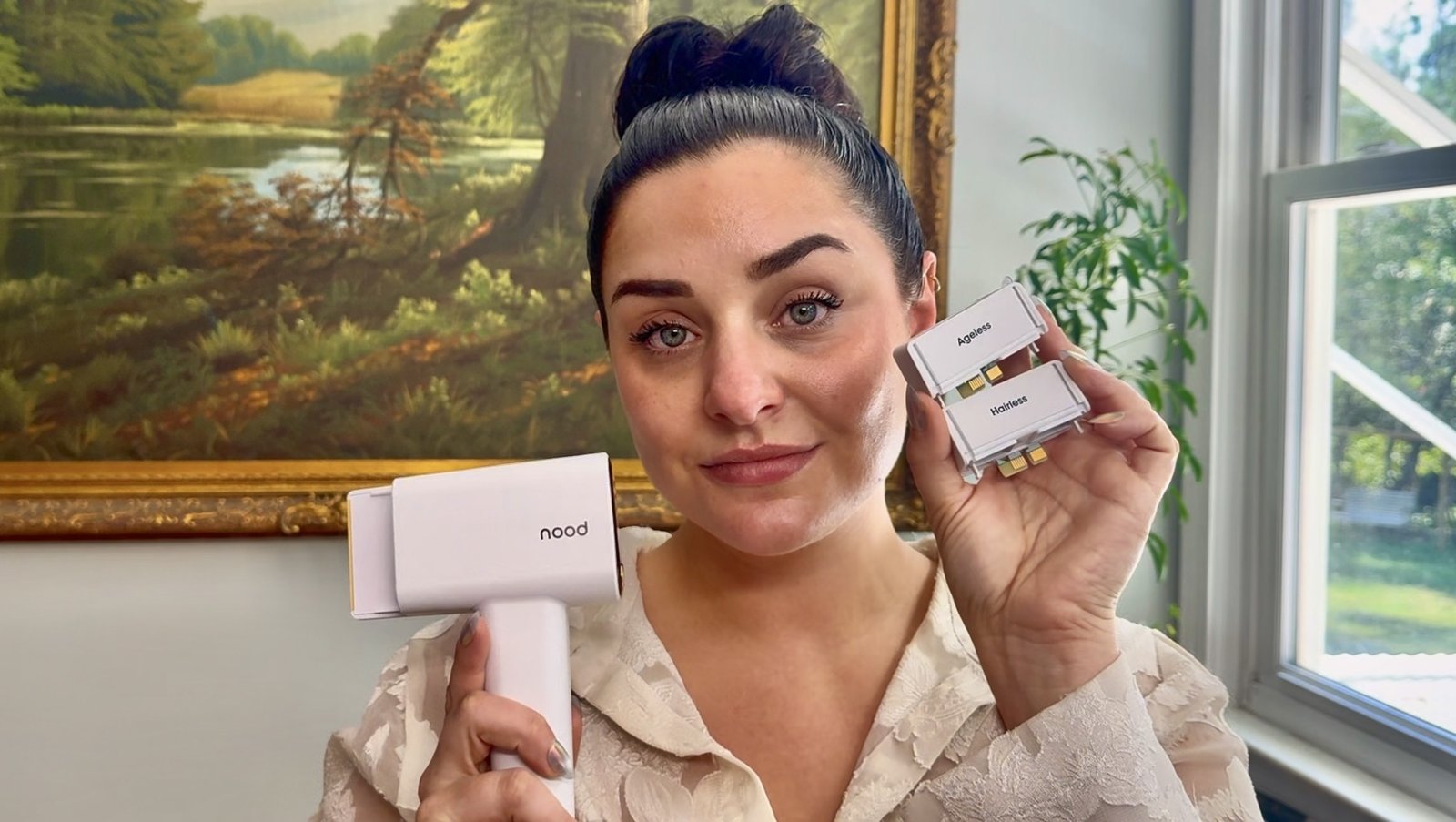
The Flasher Pro handset with both lens cartridges. Ulike has no second lens. Where Nood wins
Per-flash energy, and the fact that the number is on a regulatory filing rather than a marketing page. If the goal is fewer sessions to reach a result, the device putting more energy into each flash has the straightforward advantage.
The other thing Nood has that Ulike doesn’t is a second use. The Flasher Pro accepts a swappable Ageless lens for skin rejuvenation, so the same handset does two jobs. For anyone already looking at a separate device for skin texture, that changes the math. The lens is covered in its own review .
Cost against the clinic
Both devices land under a single course of professional treatment. Clinic pricing gathered across three US cities puts underarms alone at $294 to $2,094 and full legs at $1,800 to $3,992. At those numbers the $40 or so between these two devices is not the decision. Energy delivery and comfort are. The full clinic comparison, with course prices by city, is in Nood vs Laser Hair Removal .
The skin type chart from the Nood manual. Both devices need pigment in the hair to work. Who should buy which
Nood Flasher Pro: anyone prioritising energy per flash, anyone who wants the number they’re buying to be one the FDA has seen, and anyone who might want the skin lens later.
Ulike Air 10: anyone who has found IPL too uncomfortable before, and anyone who wants a sensor to pick the level.
Neither: very light blonde, red, grey or white hair. IPL needs pigment to target, and no home device gets around that. Check the hair and skin chart on the listing first.
See the Nood Flasher Pro on Amazon · See the Ulike Air 10 on Amazon
Frequently asked
Is Ulike stronger than Nood?
Not per flash. Ulike’s 6.67 J/cm² is a four-pulse total; each pulse is around 1.67. Nood’s cleared range is 1.84 to 5.23 per single flash.
Which one hurts less?
Both have cooling. Ulike’s multi-pulse delivery is designed to feel gentler, and on that specific point it likely does. Nood’s cooling plate is what makes its higher settings tolerable.
Can Nood do skin treatments too?
Yes, with the swappable Ageless lens. Ulike Air 10 is hair removal only.
Specs checked September 2026 against the Ulike Air 10 manual and specification page, the Nood product page, and FDA 510(k) K241106. Prices are typical Amazon listing ranges and change often.
Related: Nood Flasher Pro vs Other IPL Devices · Nood Ageless Lens Review
Your cart
(items: 0)
Products in cart
Available on backorder
Previous price:
Discounted price:
Your shopping cart is empty
(function () {
var c = document.body.className;
c = c.replace(/woocommerce-no-js/, 'woocommerce-js');
document.body.className = c;
})();
https://annakatherinepage.com/wp-includes/js/comment-reply.min.js
https://annakatherinepage.com/wp-includes/js/dist/hooks.min.js
https://annakatherinepage.com/wp-includes/js/dist/i18n.min.js
wp.i18n.setLocaleData( { 'text direction\u0004ltr': [ 'ltr' ] } );
//# sourceURL=wp-i18n-js-after
https://annakatherinepage.com/wp-includes/js/dist/private-apis.min.js
https://annakatherinepage.com/wp-includes/js/dist/url.min.js
https://annakatherinepage.com/wp-includes/js/dist/api-fetch.min.js
wp.apiFetch.use( wp.apiFetch.createRootURLMiddleware( "https://annakatherinepage.com/wp-json/" ) );
wp.apiFetch.nonceMiddleware = wp.apiFetch.createNonceMiddleware( "0d85342746" );
wp.apiFetch.use( wp.apiFetch.nonceMiddleware );
wp.apiFetch.use( wp.apiFetch.mediaUploadMiddleware );
wp.apiFetch.nonceEndpoint = "https://annakatherinepage.com/wp-admin/admin-ajax.php?action=rest-nonce";
//# sourceURL=wp-api-fetch-js-after
https://annakatherinepage.com/wp-content/uploads/burst/js/burst.min.js
var wc_facebook_signals_params = {"ajax_url":"https://annakatherinepage.com/wp-admin/admin-ajax.php","nonce":"10c47ff36d","action":"wc_facebook_update_signals_state"};
//# sourceURL=wc-facebook-signals-js-extra
https://annakatherinepage.com/wp-content/plugins/facebook-for-woocommerce/assets/js/facebook-for-woocommerce-signals.js
https://annakatherinepage.com/wp-content/plugins/woocommerce/assets/js/sourcebuster/sourcebuster.min.js
var wc_order_attribution = {"params":{"lifetime":1.0e-5,"session":30,"base64":false,"ajaxurl":"https://annakatherinepage.com/wp-admin/admin-ajax.php","prefix":"wc_order_attribution_","allowTracking":true},"fields":{"source_type":"current.typ","referrer":"current_add.rf","utm_campaign":"current.cmp","utm_source":"current.src","utm_medium":"current.mdm","utm_content":"current.cnt","utm_id":"current.id","utm_term":"current.trm","utm_source_platform":"current.plt","utm_creative_format":"current.fmt","utm_marketing_tactic":"current.tct","session_entry":"current_add.ep","session_start_time":"current_add.fd","session_pages":"session.pgs","session_count":"udata.vst","user_agent":"udata.uag"}};
//# sourceURL=wc-order-attribution-js-extra
https://annakatherinepage.com/wp-content/plugins/woocommerce/assets/js/frontend/order-attribution.min.js
https://annakatherinepage.com/wp-content/plugins/facebook-for-woocommerce/assets/js/frontend/pixel-events.js
(function() {
var processParams = function() {
if (typeof clientParamBuilder !== "undefined" && !/(?:^|;\s*)wc_facebook_signals_state=held(?:;|$)/.test(document.cookie)) {
clientParamBuilder.processAndCollectAllParams(window.location.href);
}
};
if (typeof clientParamBuilder !== "undefined") {
processParams();
return;
}
var fallbackScript = document.createElement("script");
fallbackScript.src = "https:\/\/unpkg.com\/meta-capi-param-builder-clientjs@1.3.2\/dist\/clientParamBuilder.bundle.js";
fallbackScript.onload = processParams;
document.head.appendChild(fallbackScript);
}());
//# sourceURL=facebook-capi-param-builder-js-after
/* WooCommerce Facebook Integration Event Tracking */
fbq('set', 'agent', (function(){var a='woocommerce_0-11.2.1-3.7.8';if(window.__wc_fb_page_generated&&(Math.floor(Date.now()/1000)-window.__wc_fb_page_generated)>1800){a=a.replace(/(\d+\.\d+\.\d+)/,'$1_c');}return a;})(), '5552345558112956');
window.wcFacebookPixelFiredEvents = window.wcFacebookPixelFiredEvents || {};
if (!window.wcFacebookPixelFiredEvents["d3fd831d-2806-4734-adf0-01dbe6b53c0f"]) {
window.wcFacebookPixelFiredEvents["d3fd831d-2806-4734-adf0-01dbe6b53c0f"] = true;
var isStale = window.__wc_fb_page_generated && (Math.floor(Date.now()/1000) - window.__wc_fb_page_generated) > 1800;
if (window.FacebookSignals && typeof window.FacebookSignals.trackEvent === 'function') {
window.FacebookSignals.trackEvent('PageView', {
"source": "woocommerce_0",
"version": "11.2.1",
"pluginVersion": "3.7.8"
}, null, 'track', isStale ? null : "d3fd831d-2806-4734-adf0-01dbe6b53c0f");
} else if (isStale) {
fbq('track', 'PageView', {
"source": "woocommerce_0",
"version": "11.2.1",
"pluginVersion": "3.7.8"
});
} else {
fbq('track', 'PageView', {
"source": "woocommerce_0",
"version": "11.2.1",
"pluginVersion": "3.7.8"
}, {
"eventID": "d3fd831d-2806-4734-adf0-01dbe6b53c0f"
});
}
}
//# sourceURL=facebook-for-woocommerce-inline-js-after
(function(){
function rgb(c){var m=(c||"").match(/[0-9.]+/g);return m?m.map(Number):null;}
function lum(a){return (0.299*a[0]+0.587*a[1]+0.114*a[2])/255;}
function effbg(el){var n=el;while(n){var c=rgb(getComputedStyle(n).backgroundColor);if(c&&(c.length<4||c[3]>0.5))return c;n=n.parentElement;}return null;}
var sel="main h1,main h2,main h3,main h4,main p,main li,main span,#frc h1,#frc h2,#frc h3,#frc p,#frc span,#frc li";
document.querySelectorAll(sel).forEach(function(t){
var bg=effbg(t);
if(!bg) return;
if(lum(bg)<0.30){
var fc=rgb(getComputedStyle(t).color);
if(fc && lum(fc)<0.5){ t.style.setProperty("color","#f7f1e6","important"); }
}
});
})();


Leave a Reply