This post contains affiliate links, which means I may earn a small commission if you make a purchase through my links, at no extra cost to you.
An in-office IPL photofacial delivers roughly 8 to 40 J/cm² through swappable filters, stacked pulses and contact cooling, set by an operator. The Nood Ageless lens is marketed at 6 J/cm² on a device whose FDA-cleared ceiling is 5.23. Clinic IPL has decades of published evidence for pigment and redness. At-home IPL for skin has none.
I bought this device with my own money. Some links in this post are affiliate links, which means I earn a commission if you buy through them at no extra cost to you. I am not a doctor and nothing here is medical advice.
Key takeaways
- Published clinic photorejuvenation protocols run about 8 to 40 J/cm². The Nood Ageless lens is marketed at 6, on a device cleared to 5.23. The clinic is roughly two to seven times the energy.
- Lumenis, Sciton and Alma publish no fluence or pulse duration for their IPL platforms. Every real number below comes from peer-reviewed papers reporting the settings researchers actually used.
- The strongest study in the field is a blinded split-face randomised trial. It found significant improvement in texture, telangiectasia and pigmentation, and no significant effect on wrinkles.
- The biopsy study most often cited as proof IPL builds collagen is a negative study. Six volunteers, six sessions, no significant change in collagen I, III or VII, elastin or tropoelastin.
- Going to a clinic does not solve the skin tone limit. Every published efficacy cohort is Fitzpatrick I to IV, and one FDA clearance lists Type VI as not applicable. For deeper skin the standard of care shifts to a 1064nm laser.
- A systematic review of home devices found four randomised trials of home IPL. All four were hair removal. There are no published trials of at-home IPL for skin.
- One clinic photofacial session costs roughly what the whole Nood device costs.
What does an in-office IPL photofacial actually do?
Intense pulsed light is not a laser. It is a flashlamp emitting a broad band, roughly 400 to 1400nm, with a filter deciding where the band starts. Cut off below 515nm and you bias toward pigment. Cut off below 560 and you bias toward pigment plus surface vessels. Cut off at 640 or 695 and you spare the epidermis, which is what a clinician does when the patient has more melanin in their skin.
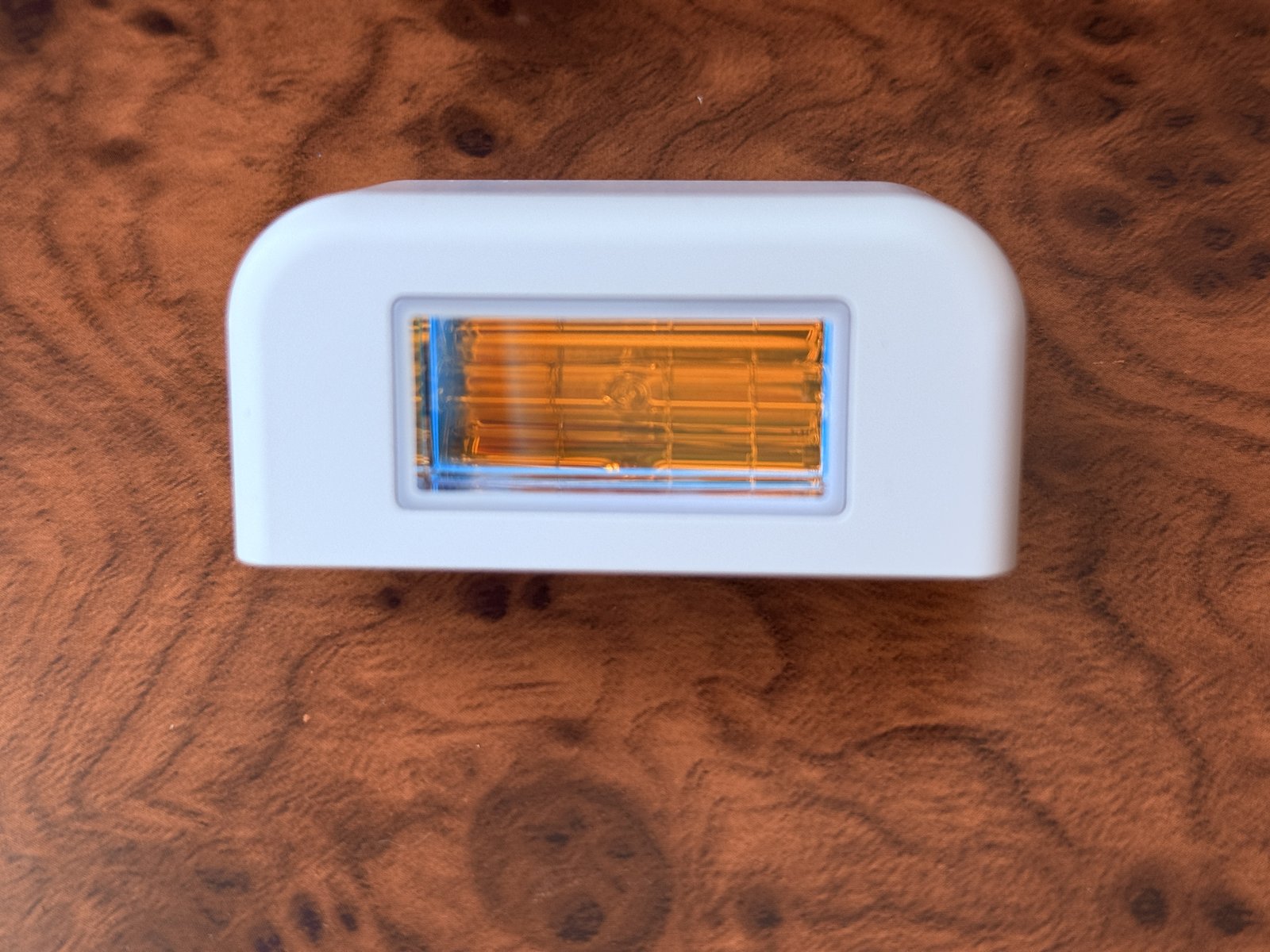
That filter swap is the whole craft, and it is the first thing a home device gives up. The Nood Ageless lens is a single fixed 560nm filter. A clinic platform carries five or six.
How much energy does a clinic actually use?
Here is the part that took the longest to answer, and the answer is itself the story: the manufacturers do not publish it.
Lumenis publishes nine “ExpertFilters” and three “SapphireCool lightguides” for the M22 and no fluence, no pulse duration, no pulse delay. Sciton publishes no technical specification at all for BBL. Alma’s official brochure gives a wavelength range and one spot size per handpiece and no fluence or pulse duration for any of them. That is the same pattern I found across the at-home brands in my comparison of the Nood Flasher Pro against other IPL devices, and it runs all the way up the price ladder.
So the figures below come from peer-reviewed papers where researchers reported the settings they actually used, plus one FDA regulatory file. Those are the only sources that hold.
| Protocol | Fluence | Pulse | Sessions | Source |
|---|---|---|---|---|
| M22, narrow-spectrum vascular | 20 to 22 J/cm² | 4 to 6 ms, delay 20 to 30 ms | 4, monthly | Al-Quran, CCID 2023 |
| M22, broad spectrum | 17 to 19 J/cm² | 3 to 3.5 ms, delay 20 to 40 ms | 4, monthly | Al-Quran, CCID 2023 |
| Narrow-band IPL, rosacea | 8.4 to 11.6 J/cm² | 10 to 12 ms | 3, monthly | Tang and He, 2025 |
| Broad-band IPL, rosacea | 14 to 19 J/cm² | Dual pulses, 3 to 4.5 ms | 3, monthly | Tang and He, 2025 |
| DEKA Luxea, telangiectasia | 13 to 39 J/cm² | 15 to 50 ms | 3, monthly | Piccolo, J Clin Med 2024 |
| General pigmented lesions | 16 to 20 J/cm², max 40 | 1.5 to 25 ms | 3 to 6, every 2 to 4 weeks | StatPearls |
| Nood Ageless lens | 6 J/cm² marketed | Not published | 2 to 3 per week | Nood marketing. Not in the FDA file |
| Nood Flasher Pro, cleared | 1.84 to 5.23 J/cm² | 0.5 to 2.5 ms | Hair indication only | FDA 510(k) K241106, model T16A |
Read the bottom two rows against the rest. Clinic photorejuvenation runs somewhere between two and seven times the energy, with pulses five to twenty times longer, often stacked in trains with programmable delays so the epidermis can shed heat between them. The Nood’s cleared pulse is 0.5 to 2.5 ms, single. These are not the same treatment at different intensities. They are different treatments.
The Ageless lens ships in the box with the device, so none of this costs extra. If you want to look at it, it is on Amazon here.
What does the research say clinic IPL improves?
Three things, with real numbers behind them, and one thing it has never done.
The strongest single study
Hedelund and colleagues ran a randomised controlled split-face trial at a university dermatology department, published in Archives of Dermatology in 2006. Thirty-two women, Fitzpatrick I to III, three IPL treatments a month apart, one side treated and the other left alone, with blinded clinical and photographic evaluation and follow-up out to nine months.
Skin texture improved significantly (P<0.006). Telangiectasia improved significantly (P<0.001). Irregular pigmentation improved significantly (P<0.03). Eighty-two percent of participants said the treated side looked better.
Wrinkles showed no significant treatment effect. And three of the thirty-two withdrew because of treatment pain, which is the most honest tolerability figure in this entire literature.
Pigment
A 2025 systematic review in the Journal of Cosmetic Dermatology pooled 41 trials and 3,234 participants on solar lentigines. IPL success rates ran 74.6 to 90 percent, comparable to picosecond lasers and ahead of Q-switched lasers, cryotherapy and TCA peels. IPL also produced fewer cases of post-inflammatory hyperpigmentation than cryotherapy.
One important qualifier. A study of 18 Japanese women using a Lumenis platform over three to five sessions reported only 28 percent marked improvement and 39 percent slight improvement. Same technology, darker skin types, dramatically weaker result. Hold onto that, because it comes back.
Redness and vessels
A 2024 systematic review in IJDVL covering 14 studies and about 550 rosacea patients found telangiectasia clearance up to 87 percent, with one cohort at 77.8 percent, and one study reporting 80 percent of patients with reduced redness. The authors are blunt that the included studies are of poor methodological quality, and that caveat belongs with the number.
Does IPL build collagen or treat wrinkles?
No, and the study most often cited as proof that it does is a negative study that gets quoted backwards.
El-Domyati and colleagues, publishing in the Journal of Drugs in Dermatology in 2011, took periocular biopsies from six volunteers of Fitzpatrick type III to IV with Glogau class I to III wrinkles. Six IPL sessions at two-week intervals over three months. Biopsies at baseline, at the end of treatment, and three months after. They quantified collagen types I, III and VII, newly synthesised collagen, total elastin and tropoelastin using immunostaining and computerised morphometry.
Half the volunteers showed mild texture improvement. None reported skin tightening or wrinkle improvement. That result converges neatly with Hedelund’s blinded RCT finding no wrinkle effect five years earlier.
It is a small study, six people, and I would not hang a conclusion on it alone. I do not have to. The blinded randomised trial and the quantitative biopsy study say the same thing from opposite methodological directions. If lines are your problem, a retinoid is the higher-evidence option, and I use the one in my PRMR Youth Radiance Vitatinol serum review.
Does going to a clinic solve the skin tone problem?
This is the question I most wanted answered, and the honest answer surprised me. Mostly no.
A clinic buys you longer cutoff filters at 640 and 695nm, lower fluence with longer stacked pulses, real contact cooling, and a practitioner who can test-spot before committing. What it does not buy you is an IPL that is safe and evidence-backed at Fitzpatrick V to VI.
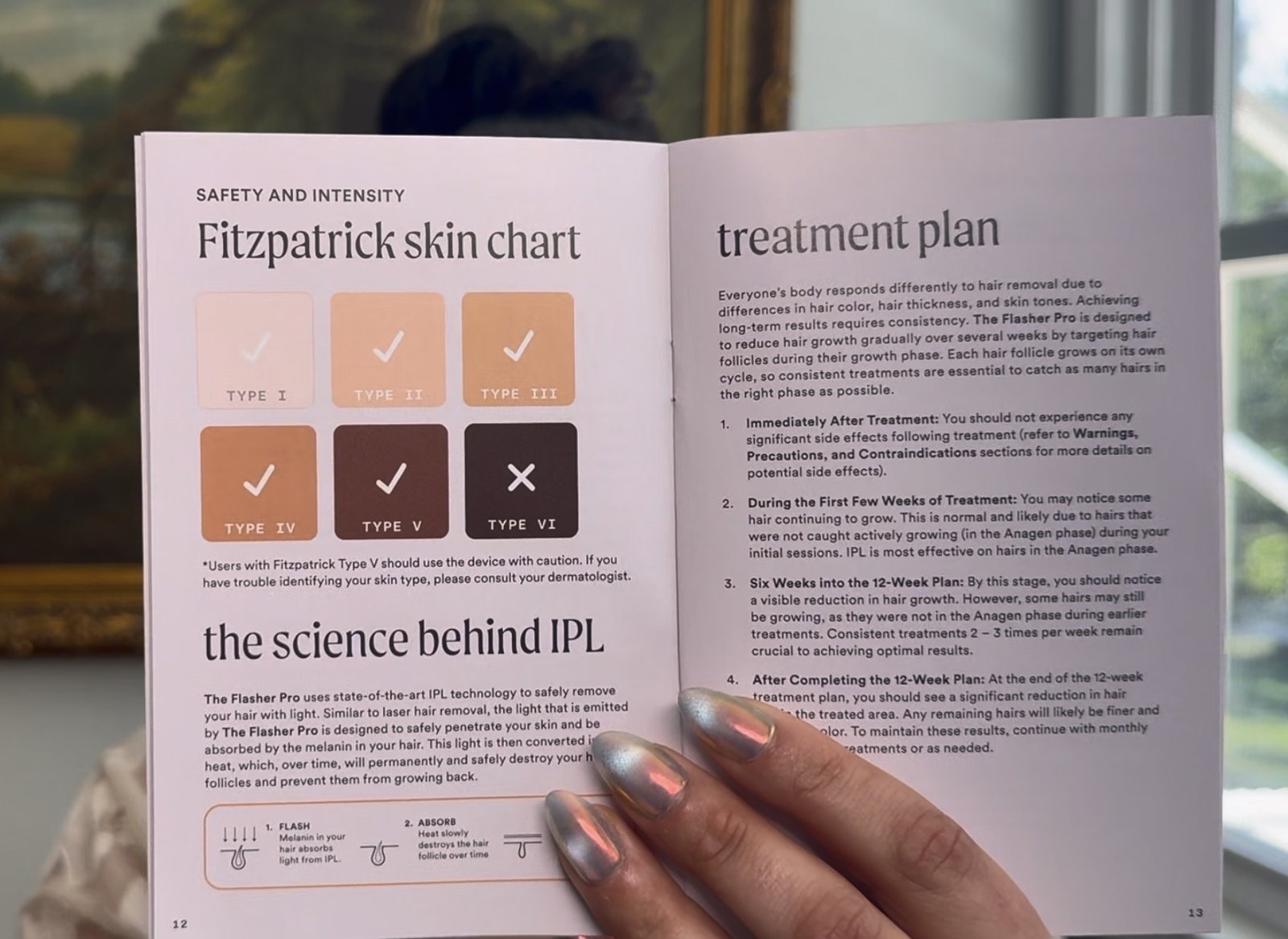
The regulatory files cap out below VI. Lumenis Stellar M22 is cleared for Fitzpatrick I to IV. One representative IPL clearance publishes a fluence-by-skin-type table that runs 35 to 45 J/cm² for Type I down to 20 to 25 for Type V, and simply lists Type VI as not applicable. Where a platform does claim I to VI, that claim usually rides on a 1064nm laser handpiece rather than the IPL.
The literature has the same shape. The 2022 systematic review of IPL for skin rejuvenation covered 637 participants, Fitzpatrick I to IV. The rosacea review, I to IV. I found no photorejuvenation efficacy cohort in Fitzpatrick V to VI at all.
For those patients the standard of care shifts to longer wavelengths, principally the 1064nm Nd:YAG. That is not a limitation of home devices. It is a limitation of the physics, and it applies in the clinic too.
What are the risks of IPL on skin?
Real, quantified, and higher than the marketing suggests.
The most useful modern figures come from a 2025 retrospective of 112 rosacea patients, Fitzpatrick II to IV, comparing pulsed dye laser against narrow-band and broad-band IPL. Pigmentation change occurred in 2.63 percent of the narrow-band group and 21.05 percent of the broad-band group. Blistering ran 2.63 percent against 10.53 percent. Broad-band IPL carried roughly eight times the pigmentation risk of narrow-band in that cohort.
On melasma specifically, IPL can make it worse. A retrospective of 675 patients of Fitzpatrick III to IV found that about 3 percent developed melasma-like hyperpigmentation within three months of IPL treatment. Every one of them had a pigmentary disorder before treatment. If you have melasma, this is a conversation for a dermatologist, not a device.
Typical downtime for an uncomplicated session is short, described as skin reactions lasting roughly 2 to 48 hours.
What does the research say about at-home IPL for skin?
Nothing. Not weak evidence. None.
A 2022 systematic review in Archives of Dermatological Research examined home-based dermatology devices across 37 clinical trials including 19 randomised controlled trials. It identified four RCTs of home IPL. All four were hair removal. Adhoute 2010, Alster and Tanzi 2009, Mulholland 2009, Trelles 2014. Hair count reduction, every one.
The only home-IPL-on-skin study I could find is a safety study, not an efficacy one: sixteen participants, Fitzpatrick II to V, buttock test zones at 0, 7, 8 and 10 J/cm², checking whether low-fluence home IPL amplified UV damage. It did not. It also had no efficacy endpoint for any indication.
There is a 2025 split-body trial comparing a home IPL device against Sciton BBL with 78 completers that gets cited in this context, and I want to flag it because I nearly used it myself. It is a hair removal trial. Axilla, calf and forearm. No pigment, redness or photorejuvenation endpoint. It cannot support a claim about skin.
So the entire at-home IPL evidence base is a hair removal evidence base. That is why the Nood’s FDA clearance, K241106, covers hair removal and nothing else, and why the Ageless lens sits outside it. Nobody has reviewed evidence that it works on skin, because none was ever submitted.
What does a photofacial cost compared to the device?
A single IPL photofacial on the face commonly runs $300 to $600, with a typical course of three to five sessions landing somewhere around $900 to $3,000. Those are aggregator ranges rather than clinic rate cards, so treat them as a band and not a quote.
Against that, the arithmetic is stark and simple. One clinic photofacial session costs roughly what the entire Nood Flasher Pro costs, and the Ageless lens comes in the box at no extra charge on a device you would be buying for hair removal anyway.
But a cheaper thing that has never been tested for the job is not a bargain. The honest framing is the one I keep landing on: buy the device for hair removal, where the clearance and the published evidence actually are, and treat the second lens as a free extra with no expectations attached.
Nood The Flasher Pro
IPL handset with two cartridges. The Ageless skin lens ships in the box. FDA cleared under K241106 for hair removal and permanent hair reduction.
Around $299 to $409
Who should skip the at-home version entirely?
Anyone with melasma. IPL can worsen it, at a measured rate of about 3 percent in a 675-patient series, and that was under clinical supervision. See a dermatologist.
Anyone at Fitzpatrick V or VI. There is no efficacy evidence for IPL photorejuvenation at those skin types anywhere in the literature, one FDA clearance lists Type VI as not applicable, and the appropriate modality is a different wavelength entirely.
Anyone whose actual concern is wrinkles. A blinded RCT and a quantitative biopsy study both say no. Spend the money on a retinoid and sunscreen.
Anyone expecting clinic results. Two to seven times the energy, five to twenty times the pulse duration, swappable filters, contact cooling and an operator who can test-spot. That gap is not marketing. It is the treatment.
If you want the practical side rather than the research, the full walkthrough with video is in my Nood Ageless lens review, including whether to shave first, how to prep, and what level to run. And if you get one, it is on Amazon here.
Frequently asked questions
Is an at-home IPL as strong as a clinic photofacial?
No. Published clinic photorejuvenation protocols run roughly 8 to 40 J/cm² with pulses of 3 to 50 ms, often stacked with programmable delays. The Nood Ageless lens is marketed at 6 J/cm² on a device whose FDA-cleared ceiling is 5.23 with pulses of 0.5 to 2.5 ms. The clinic delivers roughly two to seven times the energy.
Does IPL stimulate collagen?
The evidence says no. A quantitative biopsy study of six volunteers after six clinic IPL sessions measured collagen types I, III and VII plus elastin and tropoelastin and found no statistically significant change in any of them. A blinded split-face randomised trial of 32 women separately found no significant effect on wrinkles.
What is IPL genuinely good at?
Pigment and vessels. A 2025 systematic review of 41 trials and 3,234 participants reported IPL success rates of 74.6 to 90 percent on solar lentigines. A 2024 review of rosacea studies reported telangiectasia clearance up to 87 percent. A blinded split-face trial found significant improvement in texture, telangiectasia and irregular pigmentation.
Is IPL safe for dark skin?
No, and going to a clinic does not fix this. Every published photorejuvenation efficacy cohort is Fitzpatrick I to IV. One FDA clearance publishes a fluence table by skin type that lists Type VI as not applicable. Where a platform claims types I to VI, that claim usually attaches to a 1064nm laser handpiece, not the IPL. For deeper skin tones the appropriate modality is a longer wavelength laser.
Can IPL make melasma worse?
Yes. A retrospective study of 675 patients of Fitzpatrick type III to IV found about 3 percent developed melasma-like hyperpigmentation within three months of IPL treatment, and all of them had a pre-existing pigmentary disorder. If you have melasma, talk to a dermatologist before any light treatment.
Are there any studies on at-home IPL for skin?
No. A 2022 systematic review of home-based dermatology devices covering 37 trials including 19 randomised controlled trials identified four RCTs of home IPL, and all four were hair removal. The only home-IPL-on-skin study is a safety trial with no efficacy endpoint. The at-home IPL evidence base is entirely a hair removal evidence base.
How many photofacial sessions do you need?
Three to six, every two to four weeks, is the range in the clinical literature, and one systematic review of 16 studies put the mean at 4.29 sessions. Note that the same review concluded there is no consensus on the treatment parameters, which is unusual for a technology this established.
How much does an IPL photofacial cost?
Related comparisons: Nood Flasher Pro vs Braun Silk-expert Pro 5 · Nood Flasher Pro vs Ulike Air 10 · Nood Flasher Pro vs Philips Lumea 9000 · Nood Flasher Pro vs Flasher 2.0 · Does Nood Work on Blonde Hair? · Nood vs Laser Hair Removal · Hairless vs Ageless Lens
A single facial session commonly runs $300 to $600, with a three to five session course around $900 to $3,000. Those are aggregator ranges rather than published clinic rate cards. Practically, one clinic session costs roughly what the entire Nood device costs.
Related reading
- Nood Ageless Lens Review, the hands-on walkthrough with video, including the four questions buyers keep asking on the listing.
- Nood Flasher Pro vs Other IPL Devices, the documentation audit of the hair removal side and the multi-area cost model.
- PRMR Youth Radiance Vitatinol Serum Review, the retinoid I use, and the higher-evidence answer if lines are your actual concern.
Sources. Hedelund L et al., “Skin rejuvenation using intense pulsed light: a randomized controlled split-face trial with blinded response evaluation,” Arch Dermatol 2006;142:985-990. El-Domyati M et al., “Intense pulsed light photorejuvenation: a histological and immunohistochemical evaluation,” J Drugs Dermatol 2011;10(11):1246-52. Mardani et al., J Cosmet Dermatol 2025 (41 trials, 3,234 participants). Sales AFS et al., “Intense Pulsed Light on skin rejuvenation: a systematic review,” Arch Dermatol Res 2022;314:823-838. Martignago et al., IJDVL 2024 (rosacea, 14 studies). Piccolo et al., J Clin Med 2024. Al-Quran, CCID 2023. Tang and He, Am J Transl Res 2025;17(7):5530-5543. Fang L, Gold MH, Huang L., J Cosmet Laser Ther 2014;16(6):296-302. Konishi et al., Arch Dermatol Res 2008;300(Suppl 1):65-67. Alexis AF, Br J Dermatol 2013;169(s3):91-97. Jagdeo et al., “Home-based devices in dermatology: a systematic review,” Arch Dermatol Res 2022. Thaysen-Petersen D et al., Lasers Med Sci 2015;30:2171-2177. StatPearls, Intense Pulsed Light. FDA 510(k) K241106 and K123435, FDA De Novo DEN200028. Manufacturer specification pages for Lumenis, Sciton and Alma, checked September 2026.
Leave a Reply