Blog

  • How to Choose a Red Light Therapy Mask on Amazon

    Buyer’s guide

    Quick answer: Ignore the LED count, which is inflated by counting chips instead of emitters. Check five things instead: the wavelengths in nanometres, whether the brand publishes an irradiance figure in mW/cm², whether a real FDA 510(k) K-number exists, whether it is wireless, and whether it ships with eye protection. Only one major brand publishes irradiance at all, and almost every mask sold is white-labelled from the same handful of Chinese factories.

    Some links in this post are affiliate links. If you buy through them I earn a commission at no extra cost to you. I bought the mask I own with my own money before any brand relationship existed. I am not a doctor and nothing here is medical advice.

    Key takeaways

    • LED counts are close to meaningless. A “272 LED” mask typically has 68 physical emitters, each a package of four chips. Both numbers are true. Only one describes the device.
    • Irradiance in mW/cm² is the number that matters, and of the major brands only Omnilux publishes one.
    • An FDA 510(k) clearance has a K-number. If a brand will not tell you theirs, you can search the FDA database yourself in about a minute.
    • “FDA registered” is not clearance. FDA’s own consumer page says such wording “may be used to mislead you.”
    • A single clearance can cover a family of masks with a fivefold spread in output, so “covered by a 510(k)” is compatible with shipping the weakest unit in the family.
    • Almost every LED mask is white-labelled. Even CurrentBody’s clearance is held by a Shenzhen manufacturer, not CurrentBody.
    • Wireless is the feature that determines whether you actually keep using it. Everything else is spec sheet.

    Why is it so hard to compare LED masks?

    Because the numbers on the box are chosen to be impressive rather than comparable, and the one number that would let you compare devices is the one most brands do not publish.

    I spent a year and a half choosing my first mask. Here is what I said on camera when I finally bought one:

    “I even went into ChatGPT and compared a couple of the very top masks on the market, including the Dr Dennis Gross and the Omnilux, to this one. It has a higher number of LED lights than either of those masks.”

    That was true, and it was also the wrong thing to be comparing. I want to walk you through what I would check now.

    1. Do not compare LED counts

    Modern LED masks use multi-chip packages. One physical emitter on the inside of the mask contains three or four separate light-emitting dies, often of different colours. A brand can honestly describe that as four LEDs.

    So the mask I own is advertised as 272 LEDs on Amazon and 276 in one of the brand’s own images, while the brand’s own FAQ says “69 pieces.” An independent spectrometer review counted 68 quad-chip packages. All of those numbers describe the same mask.

    Once you know this, the arms race reads differently. A “480 light source” mask with 160 tri-wick emitters and a “432 LED” mask with 108 quad-wick emitters are not obviously different products.

    What LED count does tell you. One useful thing: coverage. More emitters spread over the same area means fewer dead zones. Look at the listing photos of the mask lit up and see where the light actually is. Most masks are dense on the forehead and cheeks and sparse on the jaw and chin, and if your concern is along the jawline that matters more than any headline figure.

    2. Look for irradiance, and notice who will not tell you

    Irradiance is the power density hitting your skin, in milliwatts per square centimetre. Multiply it by seconds and you get fluence, the dose, in joules per square centimetre. That is the number every study in this field reports and it is the number that determines whether a device is delivering anything.

    Here is what the major brands publish.

    Prices as of September 2026. “Published” means the manufacturer states the figure themselves. Figures in parentheses are independent reviewer measurements, not manufacturer claims.
    Mask Price Wavelengths Publishes irradiance? Power
    Omnilux Contour Face $350 to $395 633 + 830 Yes, ~30 mW/cm² Wireless
    Dr Dennis Gross FaceWare Pro ~$455 630 + 415 No Corded
    CurrentBody Skin Series 2 ~$469 633 + 830 + 1072 No (~30 measured) Corded
    Shark CryoGlow ~$350 630 + 830 + 415 No Corded
    Nanoleaf $199 to $249 640 + 525 + 460 + 850 No Wireless
    INIA GLOW ~$120 to $150 630 + 610 + 850, plus a “blue” that measures green Claims 105. Measures ~30. Wireless

    One brand out of six publishes a real figure. That is the finding, and it is not unique to LED masks: when I compared at-home IPL hair removal devices, not one competing brand published an energy figure anywhere on its own website, and neither did the clinic platforms costing tens of thousands.

    The mask I own is the odd one out for publishing a number at all, and it published one that does not survive checking. Its listing claims 105 mW/cm². Independent measurement put it near 30. The FDA filing from the factory that builds INIA masks lists 3.5 to 27 mW/cm² depending on model and mode.

    So my practical advice is uncomfortable but honest: a published irradiance figure is only useful if it is true, and you usually cannot tell. What you can do is treat a suspiciously large number as a warning rather than a feature. Real cleared consumer masks measure around 30 mW/cm². A claim of 100-plus is either a different measurement method or marketing.

    The useful half of that story is what the measurement found rather than what the box claimed. At roughly 30 mW/cm², the mask I bought for about $130 is delivering the same measured output that Omnilux publishes for a mask at $395. That is the thing worth knowing when you are standing in front of a wall of options wondering whether the price gap buys you anything.

    3. Ask for the K-number

    This is the check almost nobody does and it takes sixty seconds.

    Consumer LED face masks are Class II devices that require FDA 510(k) premarket notification. There are two relevant product codes: OHS for over-the-counter light-based wrinkle reduction, and OLP for over-the-counter light-based acne treatment. There are roughly 162 clearances under OHS and 51 under OLP.

    A real clearance has a K-number, like K250966. You can search any brand or manufacturer name in FDA’s 510(k) database and see for yourself.

    Three things to know before you do:

    “FDA registered” is not clearance. FDA’s own consumer page is unusually blunt about this. On phrases like “FDA registered” and “FDA certified” it says: “Such words may be used to mislead you. Is that the same thing as FDA approved, FDA cleared, or FDA authorized? The short answer is NO.” Registration means a facility paid a fee and told FDA it exists. FDA does not issue registration certificates, and companies using fake ones “misbrand the device.”

    Clearance is not a finding that it works. A 510(k) demonstrates substantial equivalence to a device already on the market. The pathway that requires evidence of safety and effectiveness is PMA, and no consumer LED mask goes through it. Nothing in this category is “FDA approved.”

    One clearance can cover many masks. This is the detail that surprised me most. Clearance K243040 covers nine model numbers, eight of them the factory’s house codes and one a customer’s. The irradiance table in that single filing spans 3.5 to 27 mW/cm² across the models it covers. A brand can accurately say “covered by a 510(k)” while shipping the weakest variant in the family.

    4. Understand that you are probably buying a white-label product

    This is not a scandal. It is how the category works, and knowing it will save you money.

    Most LED masks are designed and built by a small number of contract manufacturers in Guangdong province and sold under many brand names. The clearance for the CurrentBody Skin LED Mask Series 2, K250966, is held by Shenzhen Kaiyan Medical Equipment, not by CurrentBody. The mask I own is linked in FDA’s device identifier database to Guangdong Newdermo Biotech, and its current models are listed by a different manufacturer again, Shenzhen Siken 3D.

    The practical consequence: a large part of what separates a $450 mask from a $130 mask is the brand, not the hardware. Not all of it. Fit, build quality, silicone grade, timer behaviour, battery engineering and customer support are real and they do differ. But the emitters and the wavelengths often come from the same supply chain.

    This is exactly why the irradiance question matters more than the price. When my $130 mask measures the same 30 mW/cm² that Omnilux publishes for its $395 mask, that is the white-label reality showing through.

    5. Check wireless, timer, and eye protection

    Wireless is the feature that decides whether you keep using it. I will die on this hill. A corded mask means you have to be near an outlet, sitting still, for ten minutes, three times a week, forever. A wireless mask with a swappable battery means you can do it while doing something else. Two years in, that is the single reason I still use mine, and adherence is the only variable in this whole category that is fully in your control.

    A built-in timer is a dose control, not a convenience. Photobiomodulation has a biphasic dose response, meaning past an optimal dose the effect diminishes and can reverse. Ten minutes at 30 mW/cm² delivers about 18 J/cm², at the top of the standard stimulation range. A mask that shuts itself off is protecting you from yourself. I go into this in how often you should actually use red light therapy on your face.

    Eye protection should be included and you should use it. FDA’s adverse event database holds 100 reports under the OHS product code, and 25 of them mention the eyes, including reports of blurred vision, severe eye irritation and light sensitivity. These are unverified passive reports and causality is not established, but the pattern is worth knowing. Johnson & Johnson recalled the Neutrogena Light Therapy Acne Mask in July 2019 over risk of eye injury. Some brands claim clearance means goggles are unnecessary. Clearance is not an eye-safety certification. The relevant standard is IEC 62471, and very few brands claim conformance to it.

    What should you actually buy?

    Work backwards from your concern.

    General texture and tone: red around 630 to 660nm plus near-infrared at 830 to 850nm. This is the mainstream combination and where such evidence as exists sits. Any mask with those two wavelengths, a ten minute timer, and eye pads will do the job as well as any other.

    Acne: you want true blue at 415 to 460nm, and you should know the evidence is not what the marketing suggests. The meta-analysis of 14 randomised trials and 698 participants found no significant effect on either inflammatory or non-inflammatory lesion counts. Blue light’s real advantage in the data is tolerability, not superiority. In one head-to-head, benzoyl peroxide outperformed it on lesion reduction, 31 percent against 22, with side effects in 93 percent of the benzoyl peroxide group against 23 percent for light.

    Dark spots: do not buy an LED mask. There is no controlled evidence and there is a real argument it is the wrong direction. I wrote that up in full in does red light therapy work for dark spots.

    Wrinkles specifically: know that the best-designed sham-controlled facial trial, 95 women, double-blind, found no significant difference from sham on its blinded clinician-rated outcome. A retinoid has a much stronger evidence base for the same problem. Buy the mask as an addition, not a replacement.

    The one I bought, and why

    INIA GLOW Wireless. 630nm red, 610nm amber, 850nm near-infrared, silicone, dual magnetic batteries, ten minute timer. Measures about 30 mW/cm² independently, the same as a mask costing three times more. Around $120 to $150.

    Its blue channel is the weak point and its published output figure does not hold up, both of which I go through in my full two-year review.

    Check the current price on Amazon

    The sixty-second checklist

    Check What good looks like Walk away if
    Wavelengths Stated in nm. 630 to 660 red, 830 to 850 near-infrared, 415 to 460 if you want blue. Only colours named, no numbers.
    Irradiance Stated, and in the region of 30 mW/cm². A number over 100, or a unit that is watts rather than milliwatts.
    FDA A K-number you can look up. “FDA registered,” “FDA certified,” or “FDA approved.”
    Timer Auto shut-off around 10 minutes. Runs until you stop it.
    Eyes Eye shields or pads included. “No goggles needed because it is FDA cleared.”
    Power Wireless with a rechargeable pack. Corded, if you know yourself.
    Claims Wrinkles, texture, mild to moderate acne. Dark spots, melasma, rosacea, “no side effects.”

    Frequently asked questions

    How do you choose a red light therapy device on Amazon?

    Check five things: wavelengths stated in nanometres, a published irradiance figure in mW/cm2, a real FDA 510(k) K-number you can look up, a built-in timer with auto shut-off, and included eye protection. Ignore the LED count, which is inflated by counting individual chips rather than physical emitters.

    Does the number of LEDs in a face mask matter?

    Barely. Modern masks use multi-chip packages, so a mask advertised as 272 LEDs typically has about 68 physical emitters of four chips each. The only useful thing LED count tells you is coverage, meaning how few dead zones there are, and you can assess that better by looking at a photo of the mask lit up.

    What irradiance should a red light therapy mask have?

    Around 30 mW/cm2 is what cleared consumer masks actually measure, and ten minutes at that output delivers roughly 18 J/cm2, at the top of the standard stimulation range in the photobiomodulation literature. Treat a claimed figure over 100 mW/cm2 as a warning sign rather than a feature.

    How do I check if an LED mask is really FDA cleared?

    Search the brand or manufacturer name in FDA’s 510(k) database. A real clearance has a K-number such as K250966. Consumer LED masks fall under product code OHS for wrinkles or OLP for acne. Be aware that a single clearance can cover many model numbers with very different outputs, so a clearance existing does not tell you which unit you are getting.

    Is FDA registered the same as FDA cleared?

    No. FDA’s own consumer page says wording like “FDA registered” and “FDA certified” “may be used to mislead you” and that it is not the same as approved, cleared or authorized. Registration means a facility notified FDA that it exists. FDA does not issue device registration certificates at all.

    Are cheap LED masks on Amazon any good?

    Some are. Most masks across all price points are built by the same handful of contract manufacturers in Guangdong province, including the ones behind premium brands, so a large part of the price gap is brand rather than hardware. What genuinely differs is fit, build quality, battery engineering, timer behaviour and support. Verify the wavelengths and the clearance rather than the price.

    Should I get a wireless or corded LED mask?

    Wireless, if the choice is available to you. It is the feature that determines whether you keep using the device, and adherence over six or more weeks is the only variable in this category fully within your control. A corded mask requires you to sit near an outlet for ten minutes at a time, indefinitely.

    Do LED face masks actually work?

    Modestly, for texture and tone, and less than the marketing implies. The best-designed sham-controlled facial trial, 95 women, double-blind, found no significant difference from sham on its blinded clinician-rated wrinkle scale. Across 59 red light studies covering 1,882 patients, patient satisfaction for photoaging ran 59 to 91 percent while objective clinically significant change ran 0 to 52 percent. Buy one as an addition to a routine, not as the routine.

    About the author. Anna Katherine Page reviews beauty devices, home tools and garden equipment at annakatherinepage.com and on YouTube at @ak_page. She buys the products she reviews, reads the FDA filings, and tells you when the spec sheet does not match. She lives in Seneca, South Carolina.

    Related reading: my two-year INIA mask review · how often to use red light therapy on your face · does red light therapy work for dark spots · the same spec problem in at-home IPL
  • Does Red Light Therapy Work for Dark Spots? What the Research Shows

    What the research says

    Quick answer: No. There are no controlled human trials showing red LED light fades dark spots, and the only randomised double-blind trial of LED for melasma found no significant change in pigment score. Visible light is an established cause of pigmentation, blue light most of all, and melasma and post-inflammatory hyperpigmentation are both recognised as being made worse by it. If dark spots are your main concern, an LED mask is the wrong purchase.

    Some links in this post are affiliate links. If you buy through them I earn a commission at no extra cost to you. I bought the LED mask I own with my own money, partly for this exact reason, and it did not do what I hoped. I am not a doctor and nothing here is medical advice.

    Key takeaways

    • I could not find a single randomised controlled trial showing red LED light reduces hyperpigmentation, dark spots or post-inflammatory hyperpigmentation.
    • A 2025 narrative review of 59 red light dermatology studies covering 1,882 patients lists the indications with evidence. Pigmentary disorders are not among them.
    • The one randomised, double-blind LED melasma trial compared amber light against tranexamic acid cream. Neither the MASI score nor the global assessment moved, in either group.
    • Visible light causes pigmentation. Blue is the most potent inducer, at 40 to 80 J/cm². Red needs roughly 150 J/cm².
    • Light-induced pigmentation lasts longer and goes deeper in Fitzpatrick IV to VI, and melasma and post-inflammatory hyperpigmentation are both specifically listed as exacerbated by visible light.
    • The blue mode sold for acne is the wavelength with the strongest evidence for causing pigment, and acne patients with deeper skin tones are exactly the group most prone to post-inflammatory hyperpigmentation.
    • What does have evidence for dark spots: sunscreen that blocks visible light, topical tyrosinase inhibitors, retinoids, and in-office IPL. Not a home LED mask.

    Why I went looking for this

    I bought my LED mask in late 2024 after a year and a half of research, and I said this on camera at the time:

    “I have a lot of concerns with hyperpigmentation in my skin, and also acne.”

    Those were my two reasons. Two years later, having gone through the actual literature for this post, I have to tell you that I picked a device for two jobs it has almost no evidence of doing. I still use the mask, and I still think it is a reasonable purchase for other reasons, which I go through in my full review. But I was wrong about why I was buying it, and if you are about to make the same purchase for the same reason, I would rather you heard it here.

    Is there any evidence red light therapy fades dark spots?

    I searched for randomised controlled trials of red LED for hyperpigmentation, dark spots and post-inflammatory hyperpigmentation. Every result on the first pages was a device retailer or a content farm. No primary trial surfaced.

    The most useful negative evidence is a 2025 narrative review in Bratislava Medical Journal covering 59 red light studies and 1,882 patients. It enumerates the dermatological indications where red light has been studied: acne, basal cell carcinoma, squamous cell carcinoma, actinic keratosis, rosacea, psoriasis, hidradenitis suppurativa, mycosis fungoides, warts, vitiligo, necrobiosis lipoidica, granuloma annulare and photoaging.

    Pigmentary disorders are not on that list. Not as a weak indication. Not at all.

    What happened when someone actually tested LED on melasma?

    Somebody did run the trial, and the result is worth knowing about.

    Galache and colleagues, publishing in Lasers in Medical Science in 2025, ran a randomised, double-blind non-inferiority trial in 21 women with melasma over twelve weeks. One group got amber LED photobiomodulation plus a placebo cream. The other got a sham LED device plus 5 percent liposomal tranexamic acid cream, which is a real melasma treatment.

    The finding: “No significant differences were observed in the MASI or PGA scores, within or between groups.” MASI is the standard melasma severity index. Neither treatment moved it.

    But quality of life scores improved in both arms. That combination, a subjective measure improving while the objective measure sits still, in both the active and the control group, is close to a textbook picture of placebo response.

    The trial was small and underpowered at 51 percent and terminated early, so it does not prove LED does nothing. What it does is remove the excuse that nobody has looked.

    Can red light therapy make pigmentation worse?

    This is the part that changed how I think about the whole category.

    Visible light causes pigmentation. This is well established and it is why visible-light-blocking sunscreens exist. A 2026 review in Dermatology and Therapy puts the numbers on it: blue light “is the most potent inducer of pigmentation at fluences of 40 to 80 J/cm², while red light requires much higher fluences, approximately 150 J/cm².”

    The same review states that visible-light-induced pigmentation “is more sustained, persisting 10 to 22 days, is deeper in higher skin phototypes, and increases with increased exposure,” and that “conditions such as melasma and post-inflammatory hyperpigmentation are exacerbated by” visible light. The mechanism is Opsin-3, a receptor in melanocytes that responds to blue light by driving melanin production.

    Now do the arithmetic on a mask.

    Fluence thresholds from Visser et al. 2026 compared against typical consumer LED mask output. A mask measuring 30 mW/cm2 delivers about 18 J/cm2 in a ten minute session.
    Threshold to induce pigment One 10-min mask session Cumulative over a course
    Red light ~150 J/cm² ~18 J/cm² Well under, per session
    Blue light 40 to 80 J/cm² Varies by device A daily acne protocol in the published literature accumulated about 320 J/cm²

    Red light in a single mask session sits comfortably below the threshold. That is reassuring and I want to say it clearly.

    Blue is a different conversation. Its threshold is roughly half of red’s, and the acne protocols that produced results in the literature ran daily for twelve weeks. Papageorgiou’s landmark blue and red acne trial accumulated around 320 J/cm².

    The gap nobody has looked at. The wavelength sold for acne is the wavelength with the strongest evidence for inducing hyperpigmentation. Acne patients with Fitzpatrick IV to VI skin are precisely the population most prone to post-inflammatory hyperpigmentation. I could not find a single trial that has systematically looked for blue-light-induced pigmentation as an adverse outcome in acne phototherapy. That is not me claiming harm. It is me telling you that a question that obviously should have been asked has not been.

    There is also real-world signal. FDA’s adverse event database holds a report from July 2026 describing “burn marks or hyperpigmentation” following prolonged use of an LED face mask, and another describing “dark discoloration and bruising” on a user’s face after using a different mask. Those are unverified passive reports and causality is not established, which is exactly how they should be read. They are not nothing either.

    And a 2026 review specifically records a lupus-like reaction following red LED mask therapy, while a melasma-focused review states that “recent professional opinions warn against the uncontrolled application of red and blue LED mask devices in melasma-prone individuals, as the stimulation of melanocytes with a subsequent increase of heat is possible.”

    Does skin tone change the answer?

    Yes, in two directions, and both matter.

    On safety: light-induced pigmentation is deeper and longer-lasting in Fitzpatrick IV to VI. If you have a deeper skin tone and a pigmentary concern, an unsupervised home light device is a worse bet for you than for someone with fair skin, not a better one.

    On effectiveness: melanin absorbs light that was aimed at something else. The 2025 review notes a differential efficacy signal, with one study finding a lower clearance rate in individuals with pigmented skin even after accounting for other lesion characteristics. Equal device output is not equal delivered dose across skin types, and no facial trial has adjusted dose for this.

    The claim you will see everywhere is “safe for all skin types.” What the literature actually supports is narrower: LED photobiomodulation is non-ablative and athermal by design, so it does not carry the burn and post-inflammatory hyperpigmentation risk that IPL and ablative lasers do. That is a real and defensible advantage. It is not the same as a documented finding of safety across all phototypes, and the reviews themselves describe skin-type reporting in this literature as limited.

    This is one place where the at-home device genuinely does beat the clinic. I have written about the other side of it, where going to a clinic does not solve the skin tone limit either, in my comparison of at-home IPL against an in-office photofacial.

    What actually works on dark spots?

    I am not going to leave you with only a no.

    Sunscreen that blocks visible light. This is the single highest-return move and the most skipped. Because visible light drives pigmentation, a standard UV-only sunscreen is not enough for melasma. Trials of sunscreens combining UV protection with visible-light protection have shown benefit in preventing melasma relapse. Tinted formulas containing iron oxides are the practical version of this.

    Topical tyrosinase inhibitors. Tranexamic acid, azelaic acid, and the prescription options your dermatologist will discuss. These act on the pigment pathway itself, which is the part an LED mask never touches.

    Retinoids. Topical tretinoin for photodamage has a systematic review and meta-analysis of randomised trials behind it, which is more than anything in the LED literature can say. I use the PRMR Youth Radiance serum.

    In-office IPL, with caveats. A 2025 systematic review pooling 41 trials and 3,234 participants found IPL success rates of 74.6 to 90 percent on solar lentigines, comparable to picosecond lasers. That is a real, large evidence base. It comes with genuine risk in deeper skin tones and it is a clinic procedure, not a device you buy.

    What to do if you have melasma specifically: see a dermatologist rather than buying a device. Melasma is the one pigmentary condition where the wrong light treatment can set you back months.

    So should you buy an LED mask at all?

    Maybe, but not for this.

    The honest case for a home LED mask is red and near-infrared light on general skin texture and tone, where the evidence is modest and mixed but not absent. Buy it knowing the ceiling is low, the timeline is six weeks minimum, and the best-designed sham-controlled facial trial found nothing on its blinded primary outcome.

    Do not buy it as a dark spot treatment. That purchase has no evidence behind it, and if you have melasma it may be actively the wrong move.

    The mask I own and use is the INIA GLOW. It measures about 30 mW/cm² independently, the same as a mask that costs three times more, and it is wireless, which is the reason I have kept using it for two years. I bought it for my hyperpigmentation. I keep it for other reasons.

    If you want the mask anyway, buy it for the right reason

    Red and near-infrared on texture and tone. Not dark spots. Ten minutes, three times a week, six weeks before you judge it.

    See the mask I use on Amazon

    Frequently asked questions

    Does red light therapy work for dark spots?

    No. There are no controlled human trials showing red LED light reduces hyperpigmentation or dark spots, and a 2025 review of 59 red light dermatology studies covering 1,882 patients does not list pigmentary disorders among the indications with evidence.

    Does red light therapy help melasma?

    The one randomised double-blind trial found no significant change in MASI or global assessment scores, in either the LED group or the tranexamic acid comparison group. Separately, visible light is an established melasma aggravator and professional opinion warns against uncontrolled use of LED masks in melasma-prone individuals. If you have melasma, see a dermatologist rather than buying a device.

    Can an LED face mask cause hyperpigmentation?

    Visible light induces pigmentation at known thresholds: about 40 to 80 J/cm2 for blue light and roughly 150 J/cm2 for red. A single ten minute red session at typical mask output delivers about 18 J/cm2, well under the red threshold. Blue is the concern, because its threshold is lower and published acne protocols accumulate far more. FDA’s adverse event database contains user reports of hyperpigmentation and discoloration after LED mask use, though these are unverified and causality is not established.

    Is red light therapy safe for darker skin tones?

    LED photobiomodulation is non-ablative and athermal, so it does not carry the burn and post-inflammatory hyperpigmentation risk that IPL and ablative lasers do in Fitzpatrick IV to VI. That advantage is real. But skin-type reporting in the LED literature is limited, light-induced pigmentation is deeper and longer-lasting in higher phototypes, and melanin absorbs light meant for other targets so the delivered dose differs. “Safe for all skin types” overstates what has been shown.

    What wavelength is best for hyperpigmentation?

    None of them have controlled evidence for it. The amber and yellow band, around 570 to 590nm, is the weakest of the four in the literature overall, with a documented failed replication for wrinkles and a null result for melasma. Wavelength is not the variable to optimise here, because the indication itself lacks support.

    What actually fades dark spots?

    Sunscreen that blocks visible light as well as UV, which for melasma means tinted formulas with iron oxides. Topical tyrosinase inhibitors such as tranexamic acid and azelaic acid. Retinoids, which have a systematic review and meta-analysis of randomised trials behind them for photodamage. And in-office IPL, which a 2025 review of 41 trials and 3,234 participants found clears solar lentigines at rates of 74.6 to 90 percent.

    Why do so many LED masks advertise dark spot benefits then?

    Because the claims are largely unpoliced. In November 2025 the UK Advertising Standards Authority upheld four complaints against LED face mask sellers for making unauthorised medicinal claims. The FDA clearances that do exist for this device class cover wrinkles and mild to moderate acne, and nothing about pigment. Anyone selling an LED mask for dark spots is ahead of the evidence and, in some markets, ahead of the regulator.

    I already bought an LED mask for dark spots. Should I return it?

    Not necessarily. If you have melasma or a pigmentary disorder, stop and speak to a dermatologist first. Otherwise, keep it and use it for what it does have modest evidence for, which is general texture and tone with red and near-infrared light, at ten minutes two or three times a week. Just add a visible-light-blocking sunscreen, which is the thing that will actually move your pigment.

    About the author. Anna Katherine Page reviews beauty devices, home tools and garden equipment at annakatherinepage.com and on YouTube at @ak_page. She buys the products she reviews and reads the underlying research before she writes about them, including when it contradicts a purchase she has already made. She lives in Seneca, South Carolina.

    Related reading: my two-year INIA mask review · how often to use red light therapy on your face · at-home IPL versus an in-office photofacial · the retinol serum I use

  • How Often Should You Use Red Light Therapy on Your Face for Wrinkles?

    How to use it

    Quick answer: Published red light therapy protocols for facial wrinkles run 10 to 21 minutes per session, two to three times per week, for four to six weeks before any objective change appears. The single sham-controlled trial that compared frequencies found three sessions a week performed no better than two. Daily use is not supported by the evidence and photobiomodulation has a documented biphasic dose response, meaning more can work against you.

    Some links in this post are affiliate links. If you buy through them I earn a commission at no extra cost to you. I bought the mask I use with my own money. I am not a doctor and nothing here is medical advice.

    Key takeaways

    • Two to three sessions a week is what the published protocols actually use. Not daily.
    • Bragato 2025, the best-designed trial in this area, randomised 95 women to three sessions a week, two sessions a week, or sham. Two was not worse than three.
    • Session length in published facial studies runs 10 to 21 minutes. Ten is the standard for consumer masks.
    • Four weeks is the shortest trial duration that showed any objective change. The FDA-cleared indication for this device class assumes six.
    • Photobiomodulation is biphasic. In laboratory work, doses past the optimum reduce the effect and can reverse it. “More does not necessarily mean better” is a direct quote from the researchers who defined the dose curve.
    • Total joules is not a complete description of a dose. The same energy delivered at a higher intensity over a shorter time can produce a different result.

    How often should you use red light therapy on your face?

    Two to three times a week. That is what nearly every published protocol uses, and it is the number I would give a friend without hesitation.

    The reason this question is confusing is that device manufacturers recommend more. INIA suggests three to five times a week. Some brands say daily. Meanwhile the FDA clearance filed by the factory that builds INIA’s masks recommends “10 minutes a day, 3 times per week,” which is more conservative than the brand’s own marketing.

    Here is what the research actually used.

    Facial photobiomodulation protocols from published studies and one FDA clearance. Fluence is the energy delivered per session in joules per square centimetre.
    Study or source Session length Frequency Duration Fluence
    Bragato 2025, sham-controlled RCT, 95 women 21 min 2 or 3 ×/week 4 weeks 8.05 J/cm²
    Wunsch 2014, 128 completers 12 to 25 min 2 ×/week 30 sessions ~9 J/cm²
    Lee 2007, double-blind split-face, 76 subjects Not stated 2 ×/week 4 weeks 66 to 126 J/cm²
    Mota 2023, 137 women Not stated 10 sessions 4 weeks 3.8 J/cm²
    FDA 510(k) K250966, consumer mask 10 min 5 ×/week 6 weeks ~18 J/cm²
    FDA 510(k) K243040, consumer mask 10 min 3 ×/week Not stated Not stated

    Notice how narrow the real range is. Ten to twenty-one minutes, two or three times a week. Nothing in that table supports twice a day, and only one row supports five times a week.

    Does three times a week work better than twice?

    No, and this is the most useful single finding in the literature for anyone who owns a mask.

    Bragato and colleagues, publishing in Lasers in Medical Science in 2025, randomised 95 women aged 45 to 60 into three arms: a red LED mask three times a week, the same mask twice a week, and a sham mask twice a week. Double-blind, sham-controlled, four weeks.

    On the blinded specialist-rated Wrinkle Assessment Scale, there were no significant differences among any of the groups. Software-measured wrinkle length improved at the glabella and right periorbital sites. Satisfaction was high in both treated groups. The authors concluded that two weekly sessions appear sufficient.

    I want to be straight about what that study shows, because it cuts both ways. The blinded human assessors could not see a difference between the treated women and the sham group at all. That is the best-designed facial trial in this field and its primary blinded outcome was null. It is also the trial that tells you three sessions buy you nothing over two.

    The pattern to watch for. A 2025 narrative review covering 59 red light studies and 1,882 patients found that for photoaging, patient satisfaction ran 59 to 91 percent while objective clinically significant change ran 0 to 52 percent. People consistently feel better about their skin than blinded assessors can measure. That gap is the size of the expectation effect in this category, and it is why uncontrolled before-and-after photos are close to worthless here.

    How long should each session be?

    Ten minutes for a consumer mask. That is what the devices are timed for and it is inside the published range.

    The arithmetic matters more than the minutes. A mask putting out 30 mW/cm² for ten minutes delivers about 18 J/cm², which sits at the top of the 1 to 20 J/cm² band that Huang and Hamblin describe as standard for stimulation in photobiomodulation. Doubling the session to twenty minutes puts you at 36, which is outside it.

    Most masks have a built-in ten minute timer and shut themselves off. That timer is not a limitation to work around. It is the dose.

    Can you do red light therapy twice a day?

    You can physically do it. I would not, and here is the specific reason.

    Photobiomodulation follows what researchers call a biphasic dose response. Huang, Sharma, Carroll and Hamblin laid this out in Dose-Response in 2011, and their summary is blunt: “Within a decade of the introduction of LLLT in the 1970s it was realized that more does not necessarily mean better.”

    The laboratory numbers behind that are striking. Fibroblasts irradiated at 632.8nm showed maximum proliferation at 2.5 J/cm² and cell damage at 10. Mouse fibroblasts at 810nm showed ATP production rising at 3 J/cm² and falling at 30. In a mouse traumatic brain injury model, the dose that worked as a single treatment, repeated daily for fourteen days, produced benefit for four days, nothing by day five, and by day fourteen the treated animals performed worse than untreated controls.

    Two honest caveats. Every one of those inversion points comes from cells or rodents. There is no published human facial dose-ranging study establishing where the down-slope begins in skin, and the 2025 review says so directly: “at present, no consensus exists on optimal dosing parameters, including frequency and duration of use.”

    So the case against twice a day is not that somebody proved it harmful in human faces. It is that nobody has established an upper bound, the underlying dose curve is known to invert, and the one trial that compared two frequencies found the lower one was enough. Doubling your exposure buys you no demonstrated benefit against an uncharacterised risk. That trade is bad.

    Why doesn’t more red light therapy mean better results?

    Because intensity is a separate variable from total energy, and this is the part that almost never gets explained.

    Two experiments in the Huang and Hamblin review make the point cleanly. In a hamster oral mucositis model, 0.9 J/cm² delivered at 55 mW/cm² over 16 seconds reduced severity. The identical 0.9 J/cm² delivered at 155 mW/cm² over 6 seconds did nothing. In a rat wound model, 5 J/cm² at 4 mW/cm² improved tensile strength, and the same 5 J/cm² at 15 mW/cm² lost the benefit entirely.

    Same joules. Different result. Which means “total joules” is not a sufficient description of a dose, and a brighter panel used for a shorter time is not equivalent to a dimmer one used for longer.

    This is also why the LED mask marketing arms race over output figures is not the straightforward good thing it looks like. A higher irradiance number is not automatically better. It changes where you sit on a curve that nobody has mapped for human faces.

    How long before you see results?

    Four weeks at the absolute earliest. Six is more realistic, and that is what the FDA-cleared indication for this device class assumes.

    Nothing credible in the published literature reports meaningful objective change before about four weeks. Bragato ran four. Lee ran four. Wunsch ran thirty sessions across roughly fifteen weeks. The acne literature, where blue light separates from comparators, shows that separation emerging at weeks four to eight with peak effect at twelve.

    If you see a two-week before-and-after on social media, you are looking at lighting, hydration and camera angle. I say that as someone who posts before-and-afters. It is genuinely hard to shoot an honest one and almost nobody does.

    There is one more gap worth knowing: durability after you stop is essentially unstudied. Cochrane’s criticism of the acne light literature was that fewer than half the trials assessed anything beyond eight weeks. Nobody can tell you what happens three months after you put the mask in a drawer.

    What does a realistic routine look like?

    Here is mine, after two years.

    Three nights a week, ten minutes, on clean dry bare skin with nothing underneath. No serum, no oil, no SPF, no makeup, because anything on your face is between the light and your skin. Eye pads in. I do it lying down before bed, though the wireless mask I use means I have also done it while answering emails, which is the honest reason I have kept it up rather than any discipline on my part.

    Moisturiser goes on a few minutes afterwards. I do not layer a retinoid on the same night, which is a caution based on barrier irritation rather than a documented interaction, and I explain the reasoning in whether you can use retinol or tretinoin with red light therapy.

    The mask I use is the INIA GLOW, which measures about 30 mW/cm² independently, the same as a mask costing three times more. I wrote up what does and does not verify about it in my full two-year review.

    The mask I use three nights a week

    Wireless, silicone, ten minute timer, two swappable batteries so it is always charged.

    Check the current price on Amazon

    Who should skip red light therapy for wrinkles?

    Anyone who has not tried a retinoid first. Topical tretinoin for photodamage has a systematic review and meta-analysis of randomised trials behind it. LED has nothing of comparable weight for wrinkles. If your budget only stretches to one thing, the evidence points at the retinoid.

    Anyone with melasma or a pigmentary disorder. Visible light is an established melasma aggravator and heat-generating devices are a recognised risk. This is a dermatologist conversation.

    Anyone on photosensitising medication, or with a photosensitive dermatosis. The LED literature specifically flags screening for this.

    Anyone who wants a result in two weeks. It does not happen in two weeks and a device that promises it is lying to you.

    Frequently asked questions

    How often should you use red light therapy on your face for wrinkles?

    Two to three times a week. That is the frequency used in almost every published facial protocol, and the one sham-controlled trial that directly compared two sessions a week against three found no advantage to the higher frequency.

    How long should a red light therapy session be?

    Ten minutes for a consumer LED mask. Published facial studies run 10 to 21 minutes. At a typical 30 mW/cm2 output, ten minutes delivers about 18 J/cm2, which is at the top of the standard stimulation range described in the photobiomodulation literature.

    Can you do red light therapy twice a day?

    The evidence does not support it. Photobiomodulation has a biphasic dose response where benefit falls away and can reverse past an optimal dose, no human facial study has established where that upper bound sits, and the one trial comparing frequencies found the lower frequency was sufficient. There is no demonstrated benefit to weigh against an uncharacterised risk.

    Why doesn’t more red light therapy work better?

    Because intensity is an independent variable from total energy. In published animal work, the identical dose in joules produced a benefit at one intensity and no effect at another. Total joules alone does not describe a dose, and past an optimum the effect diminishes and can invert.

    How long before you see results from red light therapy on your face?

    Four weeks at the earliest and six is more realistic. That is the shortest duration at which published trials showed any objective change, and six weeks is what the FDA-cleared indication for consumer LED masks assumes. A two-week before-and-after is showing you lighting.

    Should you use red light therapy in the morning or at night?

    No study has compared them. Choose whichever you will actually do consistently, on clean bare skin with nothing between the light and your face. Consistency over weeks is the only variable in your control that the evidence supports.

    Do you need to take days off between red light therapy sessions?

    Published protocols space sessions out rather than running them consecutively, typically every two to three days. There is no trial establishing an optimal rest interval, but every protocol that produced a measurable result used gaps rather than daily use.

    Does red light therapy work under the eyes?

    The periocular area is where the strongest measured effects appear. Mota 2023 found periocular wrinkle volume reduced by about 30 percent, and Bragato found improvement at the periorbital site. Both come with a caveat: Mota treated both sides of every face actively with no sham comparator, so the 30 percent figure is an uncontrolled before-and-after. Keep the mask’s eye pads in regardless.

    About the author. Anna Katherine Page reviews beauty devices, home tools and garden equipment at annakatherinepage.com and on YouTube at @ak_page. She buys the products she reviews and reads the underlying research and FDA filings before she writes. She lives in Seneca, South Carolina.

    Related reading: my two-year INIA mask review · does red light therapy work for dark spots · how to choose an LED mask on Amazon · the retinol serum I use

  • Can You Use Retinol or Tretinoin With Red Light Therapy?

    Routine building

    Quick answer: There are no clinical trials and no dermatology guideline on combining topical retinoids with LED red light therapy. Tretinoin’s FDA label warns specifically about ultraviolet light, and LED masks emit no UV, so the label does not prohibit it. The real concern is barrier irritation rather than a photosensitivity reaction. I use them on alternate nights, and any confident “use retinol at night, LED in the morning” advice you read online is invented rather than evidenced.

    Some links in this post are affiliate links. If you buy through them I earn a commission at no extra cost to you. I bought both the mask and the serum I use with my own money. I am not a doctor and nothing here is medical advice. If you are on prescription tretinoin, your dermatologist’s instruction beats anything on this page.

    Key takeaways

    • I searched for clinical trials on retinoids combined with LED photobiomodulation. There are none. There is also no professional society guidance.
    • Tretinoin’s prescribing information warns about ultraviolet light: sunlight, sunlamps, tanning beds. LED masks emit visible and near-infrared light, not UV.
    • The mechanism worth respecting is not photosensitivity. It is that retinised skin has a compromised barrier and reacts to more things.
    • The tretinoin label does warn that using other topical actives at the same time “may increase the risk for local skin irritation.”
    • The LED literature’s one concrete caution is to screen people taking photosensitising medication, which mostly means systemic drugs like doxycycline, not topical tretinoin.
    • If you only have money or patience for one of them, the evidence points at the retinoid. Tretinoin for photodamage has a systematic review and meta-analysis of randomised trials behind it. LED has nothing of that weight for wrinkles.

    Is there any research on using retinol with red light therapy?

    No. I want to be direct about that, because the internet will tell you otherwise with great confidence.

    I searched for clinical trials combining topical retinoids with LED photobiomodulation and found none. I searched for dermatology guidance and found none. What I found instead was device retailer blog content, all of it stating rules in a confident tone, none of it citing anything.

    That means the sequencing advice circulating online, “retinol at night, LED in the morning,” “wait twenty minutes between them,” “never on the same day,” is not a finding. Somebody wrote it, it got copied, and now it reads like consensus. It might well be sensible. It is not evidence, and you should know which one you are getting.

    Does tretinoin make you photosensitive to LED light?

    This is where the confusion comes from, and the answer turns on one word: ultraviolet.

    The RETIN-A MICRO prescribing information says, in the photosensitivity section: “RETIN-A MICRO can cause photosensitivity. Advise patients to avoid or minimize unnecessary exposure to ultraviolet (UV) light, including sunlight and sunlamps.” The patient section adds: “You should avoid sunlamps, tanning beds, and ultraviolet light during treatment.”

    Every one of those warnings names UV.

    LED face masks emit in roughly 415 to 850nm. That is visible light and near-infrared. There is no UV in it. So on a plain reading, the label’s photosensitivity warning does not apply to an LED mask.

    What “does not apply” does not mean. The absence of a prohibition is not a demonstration of safety. Nobody has run the study. What the label tells us is that the specific mechanism it warns about, UV photosensitisation, is not the mechanism at play here. That is genuinely useful, and it is narrower than “it’s fine.”

    So what is the actual risk?

    Barrier irritation. It is a much more ordinary concern than photosensitivity and it is the one I would actually plan around.

    Retinised skin is more reactive. The tretinoin label warns that concomitant use of other topical products “may increase the risk for local skin irritation,” and that “weather extremes, such as severe wind or cold, may increase the risk of skin irritation.” A face that reacts badly to wind is a face that may react to ten minutes of light and gentle warmth from a silicone mask pressed against it.

    There is some real-world signal on the irritation side. FDA’s adverse event database for this device class contains a report from June 2026 describing a “painful, itching, burning bright red rash” on the cheeks after LED mask use, requiring high-dose antihistamines and steroids and taking two weeks to resolve, with a photosensitivity investigation noted. Those reports are unverified and causality is not established, which is exactly how they should be read. But irritation is clearly the failure mode people actually experience.

    The one concrete caution in the LED literature itself is about screening. A review in the Journal of Clinical and Aesthetic Dermatology says it is “prudent to screen individuals with photosensitive dermatoses, or those taking photosensitizing medications.” That mostly means systemic drugs, doxycycline, some diuretics, St John’s wort, rather than a topical retinoid. If you are on any of those, that is a doctor conversation.

    How do you actually combine them?

    Here is what I do, offered as a reasonable routine rather than a rule, because there is no rule to give you.

    My routine. This is a sequencing choice based on barrier irritation, not a finding from any trial.
    Night What happens Why
    LED night Cleanse. Nothing on the skin. Ten minutes with the mask, eye pads in. Wait a few minutes, then a plain moisturiser. Anything on your face sits between the light and your skin. No actives afterwards so the barrier gets the night off.
    Retinoid night Cleanse, retinol serum, moisturiser. No mask. One active at a time. This is the whole strategy.
    Next morning, always Sunscreen, properly, and for several days after any light session. The step people skip, and the one that undoes everything if you skip it.

    Three sessions a week with the mask and retinoid on the nights in between fits neatly, because the published protocols for facial LED are two to three sessions a week rather than daily. I explain why more is not better in how often you should use red light therapy on your face.

    The serum I use is the PRMR Youth Radiance Vitatinol serum, which I chose because it is approved by the brand for the under-eye area, and the mask is the INIA GLOW, which I have used for two years.

    If you can only do one, which should it be?

    The retinoid, and it is not close.

    This is the comparison that nobody selling a light device wants to make, so let me make it.

    Topical retinoid LED red light mask
    Evidence for photodamage and wrinkles Systematic review and meta-analysis of randomised trials Best-designed sham-controlled facial trial found no significant difference from sham on its blinded clinician outcome
    Cost $20 to $60 for months of use, or a prescription $120 to $470 up front
    Time cost Seconds 10 minutes, 3 times a week, indefinitely
    Downside Real irritation, a genuine adjustment period, UV sensitivity Mild, mostly fit and pressure marks

    The retinoid is harder to tolerate and much better supported. The mask is pleasant, easy and modest. If your budget stretches to one, the evidence points at the serum. If it stretches to both, the routine above is how I run them.

    The two I actually use

    A retinol serum on alternate nights, and a wireless LED mask three times a week. Neither replaces sunscreen.

    See the LED mask on Amazon

    Who should not combine them?

    Anyone in the first few weeks of a retinoid. The adjustment period is when your barrier is most compromised. Get stable on the retinoid first, then add the mask.

    Anyone currently peeling, stinging or visibly irritated. Stop both, repair, reintroduce one at a time.

    Anyone on isotretinoin. That is a dermatologist conversation, not a blog one.

    Anyone on a systemic photosensitising medication. Doxycycline and its relatives, some diuretics, St John’s wort. This is the caution the LED literature actually names.

    Anyone with melasma. Visible light is an established melasma aggravator regardless of what else is in your routine. I wrote that up in does red light therapy work for dark spots.

    Frequently asked questions

    Can you use tretinoin with red light therapy?

    There are no trials and no guideline either way. Tretinoin’s FDA label warns specifically about ultraviolet light, and LED masks emit visible and near-infrared light with no UV, so the label’s photosensitivity warning does not apply. The realistic concern is barrier irritation from stacking actives, not a photosensitivity reaction. Alternating nights is a reasonable approach.

    Should you use red light therapy before or after retinol?

    If you use them on the same night, the mask goes on clean bare skin first, because anything sitting on your face blocks the light. Then wait until any warmth has faded before applying anything. My own preference is to keep them on separate nights entirely, so the barrier only handles one active at a time.

    Does red light therapy make retinol more effective?

    No study has tested that. Claims that light “boosts absorption” of a retinoid are not supported by any trial I could find, and given that the mask should be used on bare skin with nothing underneath, the mechanism does not have an obvious route anyway.

    Is red light therapy safe if you are photosensitive?

    Speak to a doctor first. The LED literature specifically recommends screening people with photosensitive dermatoses or on photosensitising medications, which mainly means systemic drugs such as doxycycline rather than topical retinoids. There are user reports in FDA’s adverse event database of significant rashes after LED mask use with photosensitivity noted as an investigated cause.

    Can you use vitamin C with red light therapy?

    No trial has looked at it. The same principle applies as for retinoids: the mask should be on clean bare skin, so any serum goes on afterwards, and stacking two actives around a light session is more likely to irritate than to help. There is no evidence of a specific interaction in either direction.

    How long should you wait after red light therapy to apply skincare?

    A few minutes, until any warmth has faded. There is no research establishing an interval, so this is a comfort recommendation rather than a rule. Keep it gentle and unfragranced, and skip actives on the same night if your skin is at all reactive.

    Which works better for wrinkles, retinol or red light therapy?

    Topical retinoids have far stronger evidence. Tretinoin for photodamage has a systematic review and meta-analysis of randomised controlled trials behind it. The best-designed sham-controlled facial LED trial, 95 women, double-blind, found no significant difference from sham on its blinded clinician-rated wrinkle scale. If you can only do one, do the retinoid.

    Do you need sunscreen after using an LED mask?

    Yes, the next morning and for several days after, and this matters more if you are also using a retinoid, which does increase UV sensitivity. Sunscreen is the step most people skip and the one that undoes the rest of the routine. If pigment is any part of your concern, choose a tinted formula with iron oxides, which blocks visible light as well as UV.

    About the author. Anna Katherine Page reviews beauty devices, home tools and garden equipment at annakatherinepage.com and on YouTube at @ak_page. She buys the products she reviews and reads the labels and the research before she writes about them. She lives in Seneca, South Carolina.

    Related reading: the retinol serum I use · my two-year INIA mask review · how often to use red light therapy on your face · does red light therapy work for dark spots

  • Nood Ageless Lens vs an In-Office IPL Photofacial: What the Research Says

    Nood Ageless Lens vs an In-Office IPL Photofacial: What the Research Says

    Quick answer

    An in-office IPL photofacial delivers roughly 8 to 40 J/cm² through swappable filters, stacked pulses and contact cooling, set by an operator. The Nood Ageless lens is marketed at 6 J/cm² on a device whose FDA-cleared ceiling is 5.23. Clinic IPL has decades of published evidence for pigment and redness. At-home IPL for skin has none.

    I bought this device with my own money. Some links in this post are affiliate links, which means I earn a commission if you buy through them at no extra cost to you. I am not a doctor and nothing here is medical advice.

    Key takeaways

    • Published clinic photorejuvenation protocols run about 8 to 40 J/cm². The Nood Ageless lens is marketed at 6, on a device cleared to 5.23. The clinic is roughly two to seven times the energy.
    • Lumenis, Sciton and Alma publish no fluence or pulse duration for their IPL platforms. Every real number below comes from peer-reviewed papers reporting the settings researchers actually used.
    • The strongest study in the field is a blinded split-face randomised trial. It found significant improvement in texture, telangiectasia and pigmentation, and no significant effect on wrinkles.
    • The biopsy study most often cited as proof IPL builds collagen is a negative study. Six volunteers, six sessions, no significant change in collagen I, III or VII, elastin or tropoelastin.
    • Going to a clinic does not solve the skin tone limit. Every published efficacy cohort is Fitzpatrick I to IV, and one FDA clearance lists Type VI as not applicable. For deeper skin the standard of care shifts to a 1064nm laser.
    • A systematic review of home devices found four randomised trials of home IPL. All four were hair removal. There are no published trials of at-home IPL for skin.
    • One clinic photofacial session costs roughly what the whole Nood device costs.

    What does an in-office IPL photofacial actually do?

    Intense pulsed light is not a laser. It is a flashlamp emitting a broad band, roughly 400 to 1400nm, with a filter deciding where the band starts. Cut off below 515nm and you bias toward pigment. Cut off below 560 and you bias toward pigment plus surface vessels. Cut off at 640 or 695 and you spare the epidermis, which is what a clinician does when the patient has more melanin in their skin.

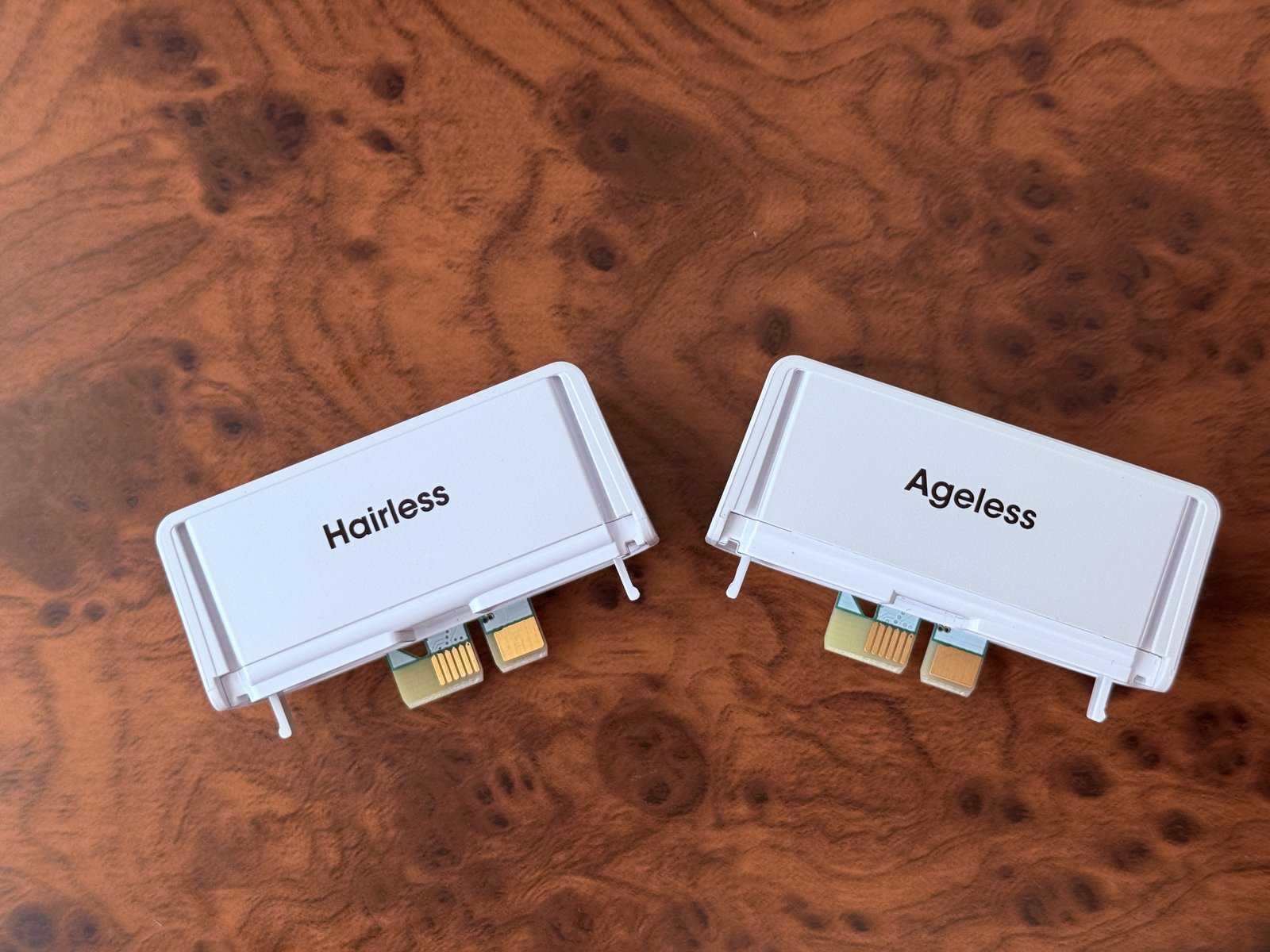
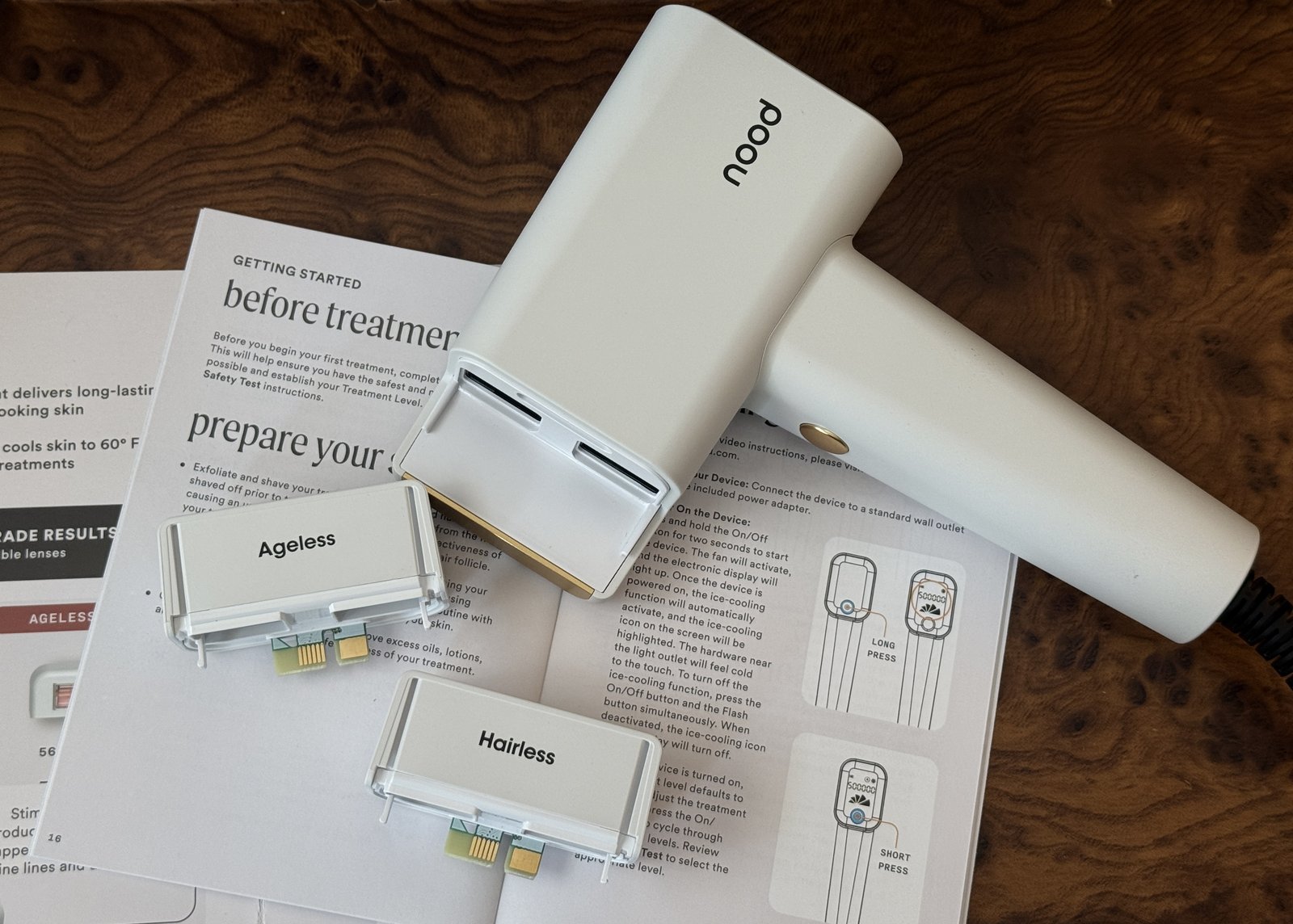
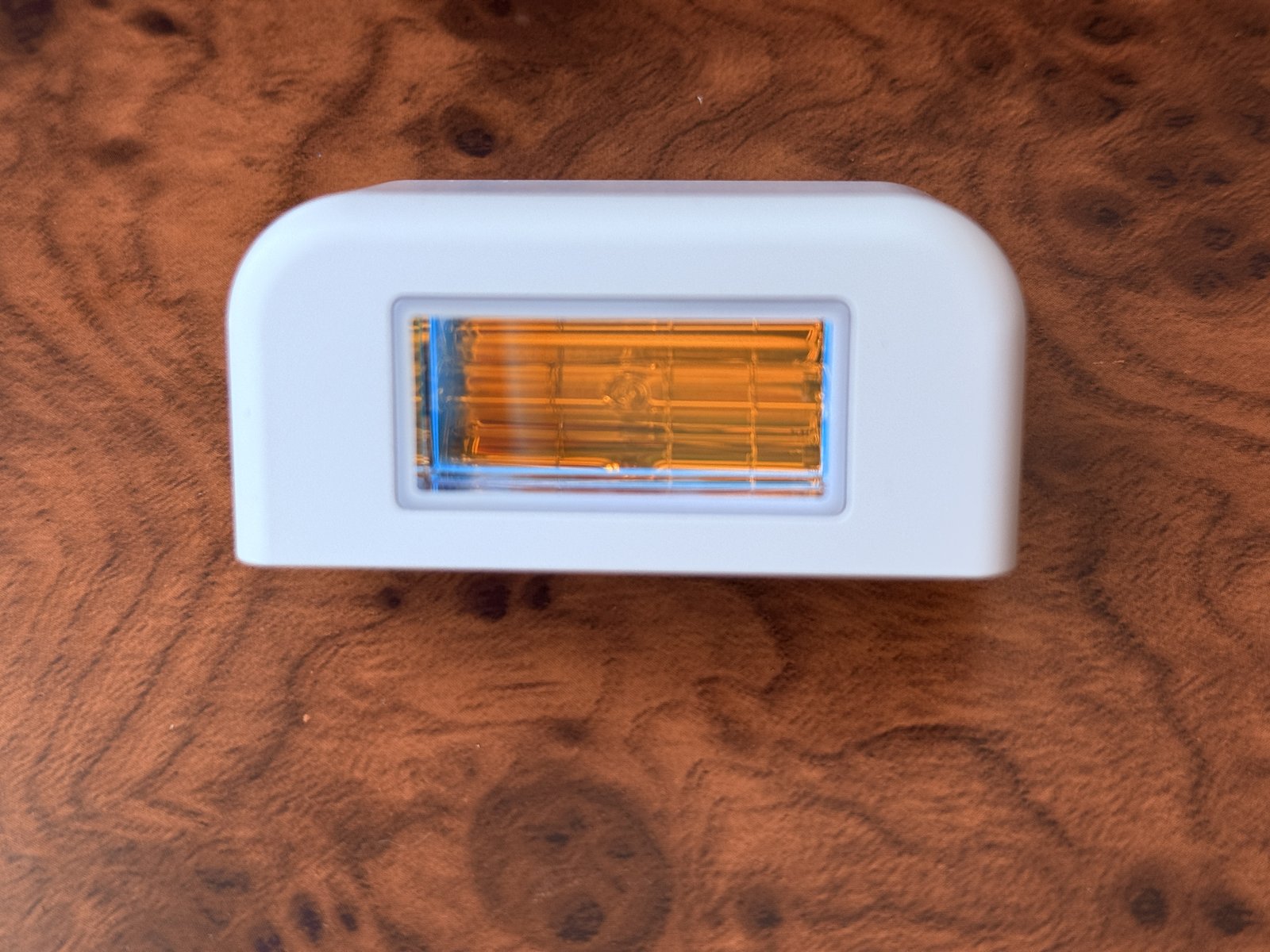
    That filter swap is the whole craft, and it is the first thing a home device gives up. The Nood Ageless lens is a single fixed 560nm filter. A clinic platform carries five or six.

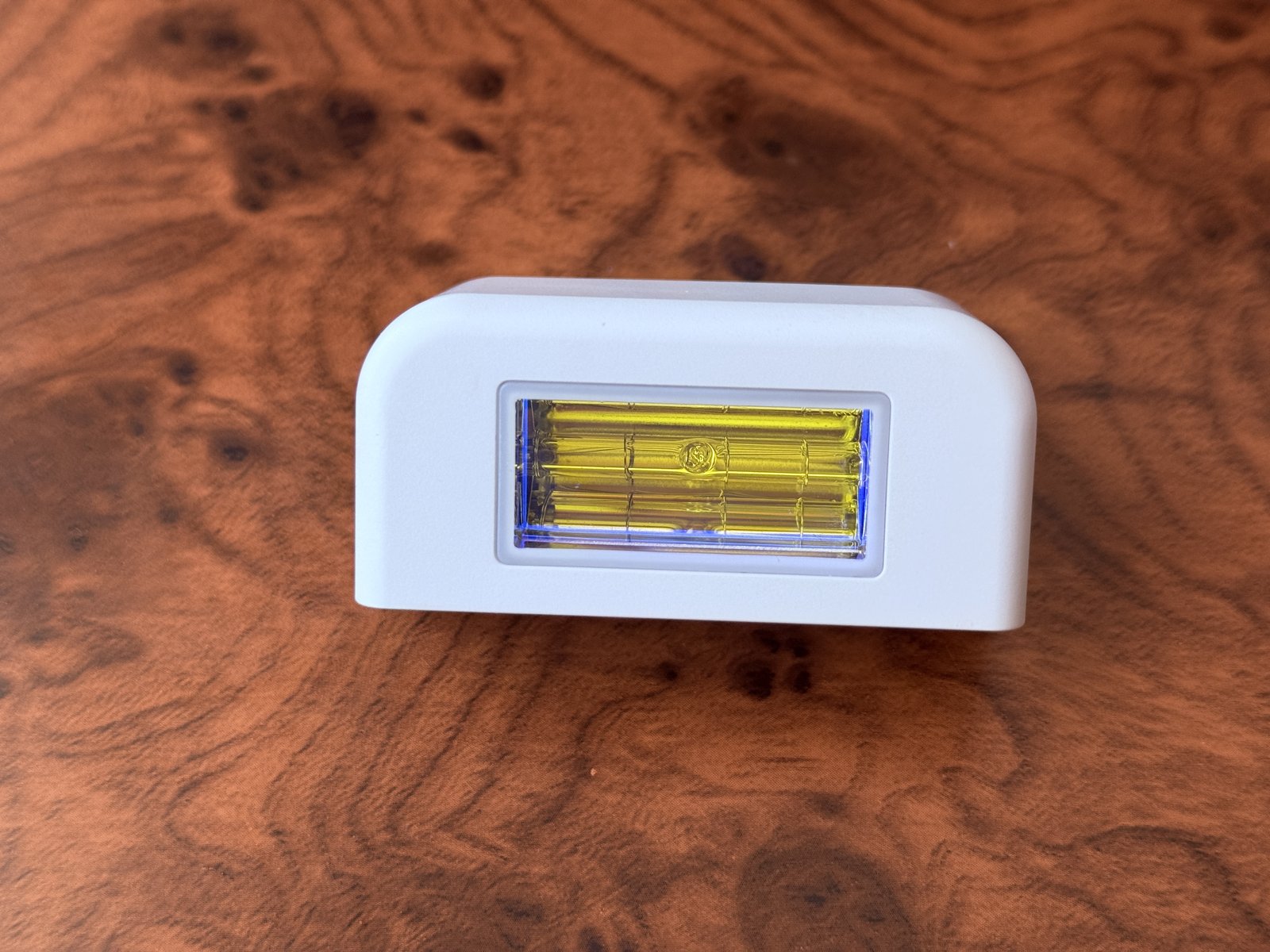
    Close-up of the Nood Ageless lens cartridge showing its orange 560nm photorejuvenation filter window
    The Ageless lens, a fixed 560nm cutoff. A clinic platform swaps between five or six filters depending on the target and the skin type.

    How much energy does a clinic actually use?

    Here is the part that took the longest to answer, and the answer is itself the story: the manufacturers do not publish it.

    Lumenis publishes nine “ExpertFilters” and three “SapphireCool lightguides” for the M22 and no fluence, no pulse duration, no pulse delay. Sciton publishes no technical specification at all for BBL. Alma’s official brochure gives a wavelength range and one spot size per handpiece and no fluence or pulse duration for any of them. That is the same pattern I found across the at-home brands in my comparison of the Nood Flasher Pro against other IPL devices, and it runs all the way up the price ladder.

    So the figures below come from peer-reviewed papers where researchers reported the settings they actually used, plus one FDA regulatory file. Those are the only sources that hold.

    Protocol Fluence Pulse Sessions Source
    M22, narrow-spectrum vascular 20 to 22 J/cm² 4 to 6 ms, delay 20 to 30 ms 4, monthly Al-Quran, CCID 2023
    M22, broad spectrum 17 to 19 J/cm² 3 to 3.5 ms, delay 20 to 40 ms 4, monthly Al-Quran, CCID 2023
    Narrow-band IPL, rosacea 8.4 to 11.6 J/cm² 10 to 12 ms 3, monthly Tang and He, 2025
    Broad-band IPL, rosacea 14 to 19 J/cm² Dual pulses, 3 to 4.5 ms 3, monthly Tang and He, 2025
    DEKA Luxea, telangiectasia 13 to 39 J/cm² 15 to 50 ms 3, monthly Piccolo, J Clin Med 2024
    General pigmented lesions 16 to 20 J/cm², max 40 1.5 to 25 ms 3 to 6, every 2 to 4 weeks StatPearls
    Nood Ageless lens 6 J/cm² marketed Not published 2 to 3 per week Nood marketing. Not in the FDA file
    Nood Flasher Pro, cleared 1.84 to 5.23 J/cm² 0.5 to 2.5 ms Hair indication only FDA 510(k) K241106, model T16A

    Read the bottom two rows against the rest. Clinic photorejuvenation runs somewhere between two and seven times the energy, with pulses five to twenty times longer, often stacked in trains with programmable delays so the epidermis can shed heat between them. The Nood’s cleared pulse is 0.5 to 2.5 ms, single. These are not the same treatment at different intensities. They are different treatments.

    The Ageless lens ships in the box with the device, so none of this costs extra. If you want to look at it, it is on Amazon here.

    What does the research say clinic IPL improves?

    Three things, with real numbers behind them, and one thing it has never done.

    The strongest single study

    Hedelund and colleagues ran a randomised controlled split-face trial at a university dermatology department, published in Archives of Dermatology in 2006. Thirty-two women, Fitzpatrick I to III, three IPL treatments a month apart, one side treated and the other left alone, with blinded clinical and photographic evaluation and follow-up out to nine months.

    Skin texture improved significantly (P<0.006). Telangiectasia improved significantly (P<0.001). Irregular pigmentation improved significantly (P<0.03). Eighty-two percent of participants said the treated side looked better.

    Wrinkles showed no significant treatment effect. And three of the thirty-two withdrew because of treatment pain, which is the most honest tolerability figure in this entire literature.

    Pigment

    A 2025 systematic review in the Journal of Cosmetic Dermatology pooled 41 trials and 3,234 participants on solar lentigines. IPL success rates ran 74.6 to 90 percent, comparable to picosecond lasers and ahead of Q-switched lasers, cryotherapy and TCA peels. IPL also produced fewer cases of post-inflammatory hyperpigmentation than cryotherapy.

    One important qualifier. A study of 18 Japanese women using a Lumenis platform over three to five sessions reported only 28 percent marked improvement and 39 percent slight improvement. Same technology, darker skin types, dramatically weaker result. Hold onto that, because it comes back.

    Redness and vessels

    A 2024 systematic review in IJDVL covering 14 studies and about 550 rosacea patients found telangiectasia clearance up to 87 percent, with one cohort at 77.8 percent, and one study reporting 80 percent of patients with reduced redness. The authors are blunt that the included studies are of poor methodological quality, and that caveat belongs with the number.

    Does IPL build collagen or treat wrinkles?

    No, and the study most often cited as proof that it does is a negative study that gets quoted backwards.

    El-Domyati and colleagues, publishing in the Journal of Drugs in Dermatology in 2011, took periocular biopsies from six volunteers of Fitzpatrick type III to IV with Glogau class I to III wrinkles. Six IPL sessions at two-week intervals over three months. Biopsies at baseline, at the end of treatment, and three months after. They quantified collagen types I, III and VII, newly synthesised collagen, total elastin and tropoelastin using immunostaining and computerised morphometry.

    “Quantitative evaluation of extracellular matrix proteins showed no statistically significant changes (P>0.05) in response to IPL treatment.”

    Half the volunteers showed mild texture improvement. None reported skin tightening or wrinkle improvement. That result converges neatly with Hedelund’s blinded RCT finding no wrinkle effect five years earlier.

    It is a small study, six people, and I would not hang a conclusion on it alone. I do not have to. The blinded randomised trial and the quantitative biopsy study say the same thing from opposite methodological directions. If lines are your problem, a retinoid is the higher-evidence option, and I use the one in my PRMR Youth Radiance Vitatinol serum review.

    Does going to a clinic solve the skin tone problem?

    This is the question I most wanted answered, and the honest answer surprised me. Mostly no.

    A clinic buys you longer cutoff filters at 640 and 695nm, lower fluence with longer stacked pulses, real contact cooling, and a practitioner who can test-spot before committing. What it does not buy you is an IPL that is safe and evidence-backed at Fitzpatrick V to VI.

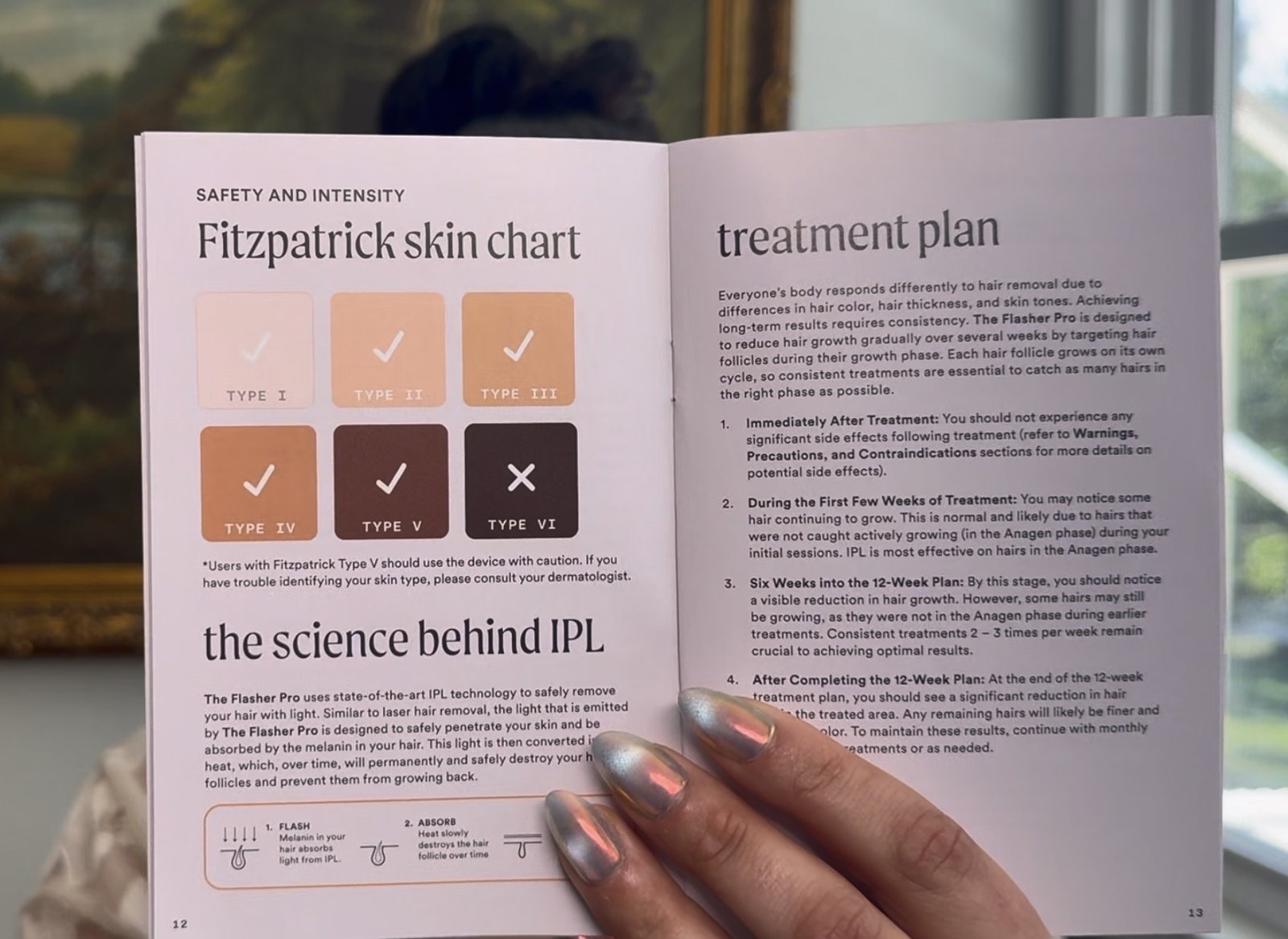
    The regulatory files cap out below VI. Lumenis Stellar M22 is cleared for Fitzpatrick I to IV. One representative IPL clearance publishes a fluence-by-skin-type table that runs 35 to 45 J/cm² for Type I down to 20 to 25 for Type V, and simply lists Type VI as not applicable. Where a platform does claim I to VI, that claim usually rides on a 1064nm laser handpiece rather than the IPL.

    The literature has the same shape. The 2022 systematic review of IPL for skin rejuvenation covered 637 participants, Fitzpatrick I to IV. The rosacea review, I to IV. I found no photorejuvenation efficacy cohort in Fitzpatrick V to VI at all.

    For those patients the standard of care shifts to longer wavelengths, principally the 1064nm Nd:YAG. That is not a limitation of home devices. It is a limitation of the physics, and it applies in the clinic too.

    The Fitzpatrick skin type chart in the Nood Flasher Pro manual, with types one through five checked and type six marked with an X
    Nood’s own chart. The clinic version of this restriction is less visible but it is still there.

    What are the risks of IPL on skin?

    Real, quantified, and higher than the marketing suggests.

    The most useful modern figures come from a 2025 retrospective of 112 rosacea patients, Fitzpatrick II to IV, comparing pulsed dye laser against narrow-band and broad-band IPL. Pigmentation change occurred in 2.63 percent of the narrow-band group and 21.05 percent of the broad-band group. Blistering ran 2.63 percent against 10.53 percent. Broad-band IPL carried roughly eight times the pigmentation risk of narrow-band in that cohort.

    On melasma specifically, IPL can make it worse. A retrospective of 675 patients of Fitzpatrick III to IV found that about 3 percent developed melasma-like hyperpigmentation within three months of IPL treatment. Every one of them had a pigmentary disorder before treatment. If you have melasma, this is a conversation for a dermatologist, not a device.

    Typical downtime for an uncomplicated session is short, described as skin reactions lasting roughly 2 to 48 hours.

    What does the research say about at-home IPL for skin?

    Nothing. Not weak evidence. None.

    A 2022 systematic review in Archives of Dermatological Research examined home-based dermatology devices across 37 clinical trials including 19 randomised controlled trials. It identified four RCTs of home IPL. All four were hair removal. Adhoute 2010, Alster and Tanzi 2009, Mulholland 2009, Trelles 2014. Hair count reduction, every one.

    The only home-IPL-on-skin study I could find is a safety study, not an efficacy one: sixteen participants, Fitzpatrick II to V, buttock test zones at 0, 7, 8 and 10 J/cm², checking whether low-fluence home IPL amplified UV damage. It did not. It also had no efficacy endpoint for any indication.

    There is a 2025 split-body trial comparing a home IPL device against Sciton BBL with 78 completers that gets cited in this context, and I want to flag it because I nearly used it myself. It is a hair removal trial. Axilla, calf and forearm. No pigment, redness or photorejuvenation endpoint. It cannot support a claim about skin.

    So the entire at-home IPL evidence base is a hair removal evidence base. That is why the Nood’s FDA clearance, K241106, covers hair removal and nothing else, and why the Ageless lens sits outside it. Nobody has reviewed evidence that it works on skin, because none was ever submitted.

    What does a photofacial cost compared to the device?

    A single IPL photofacial on the face commonly runs $300 to $600, with a typical course of three to five sessions landing somewhere around $900 to $3,000. Those are aggregator ranges rather than clinic rate cards, so treat them as a band and not a quote.

    Against that, the arithmetic is stark and simple. One clinic photofacial session costs roughly what the entire Nood Flasher Pro costs, and the Ageless lens comes in the box at no extra charge on a device you would be buying for hair removal anyway.

    But a cheaper thing that has never been tested for the job is not a bargain. The honest framing is the one I keep landing on: buy the device for hair removal, where the clearance and the published evidence actually are, and treat the second lens as a free extra with no expectations attached.

    The one I own

    Nood The Flasher Pro

    IPL handset with two cartridges. The Ageless skin lens ships in the box. FDA cleared under K241106 for hair removal and permanent hair reduction.

    Around $299 to $409

    Check price on Amazon

    Who should skip the at-home version entirely?

    Anyone with melasma. IPL can worsen it, at a measured rate of about 3 percent in a 675-patient series, and that was under clinical supervision. See a dermatologist.

    Anyone at Fitzpatrick V or VI. There is no efficacy evidence for IPL photorejuvenation at those skin types anywhere in the literature, one FDA clearance lists Type VI as not applicable, and the appropriate modality is a different wavelength entirely.

    Anyone whose actual concern is wrinkles. A blinded RCT and a quantitative biopsy study both say no. Spend the money on a retinoid and sunscreen.

    Anyone expecting clinic results. Two to seven times the energy, five to twenty times the pulse duration, swappable filters, contact cooling and an operator who can test-spot. That gap is not marketing. It is the treatment.

    If you want the practical side rather than the research, the full walkthrough with video is in my Nood Ageless lens review, including whether to shave first, how to prep, and what level to run. And if you get one, it is on Amazon here.

    Frequently asked questions

    Is an at-home IPL as strong as a clinic photofacial?

    No. Published clinic photorejuvenation protocols run roughly 8 to 40 J/cm² with pulses of 3 to 50 ms, often stacked with programmable delays. The Nood Ageless lens is marketed at 6 J/cm² on a device whose FDA-cleared ceiling is 5.23 with pulses of 0.5 to 2.5 ms. The clinic delivers roughly two to seven times the energy.

    Does IPL stimulate collagen?

    The evidence says no. A quantitative biopsy study of six volunteers after six clinic IPL sessions measured collagen types I, III and VII plus elastin and tropoelastin and found no statistically significant change in any of them. A blinded split-face randomised trial of 32 women separately found no significant effect on wrinkles.

    What is IPL genuinely good at?

    Pigment and vessels. A 2025 systematic review of 41 trials and 3,234 participants reported IPL success rates of 74.6 to 90 percent on solar lentigines. A 2024 review of rosacea studies reported telangiectasia clearance up to 87 percent. A blinded split-face trial found significant improvement in texture, telangiectasia and irregular pigmentation.

    Is IPL safe for dark skin?

    No, and going to a clinic does not fix this. Every published photorejuvenation efficacy cohort is Fitzpatrick I to IV. One FDA clearance publishes a fluence table by skin type that lists Type VI as not applicable. Where a platform claims types I to VI, that claim usually attaches to a 1064nm laser handpiece, not the IPL. For deeper skin tones the appropriate modality is a longer wavelength laser.

    Can IPL make melasma worse?

    Yes. A retrospective study of 675 patients of Fitzpatrick type III to IV found about 3 percent developed melasma-like hyperpigmentation within three months of IPL treatment, and all of them had a pre-existing pigmentary disorder. If you have melasma, talk to a dermatologist before any light treatment.

    Are there any studies on at-home IPL for skin?

    No. A 2022 systematic review of home-based dermatology devices covering 37 trials including 19 randomised controlled trials identified four RCTs of home IPL, and all four were hair removal. The only home-IPL-on-skin study is a safety trial with no efficacy endpoint. The at-home IPL evidence base is entirely a hair removal evidence base.

    How many photofacial sessions do you need?

    Three to six, every two to four weeks, is the range in the clinical literature, and one systematic review of 16 studies put the mean at 4.29 sessions. Note that the same review concluded there is no consensus on the treatment parameters, which is unusual for a technology this established.

    How much does an IPL photofacial cost?

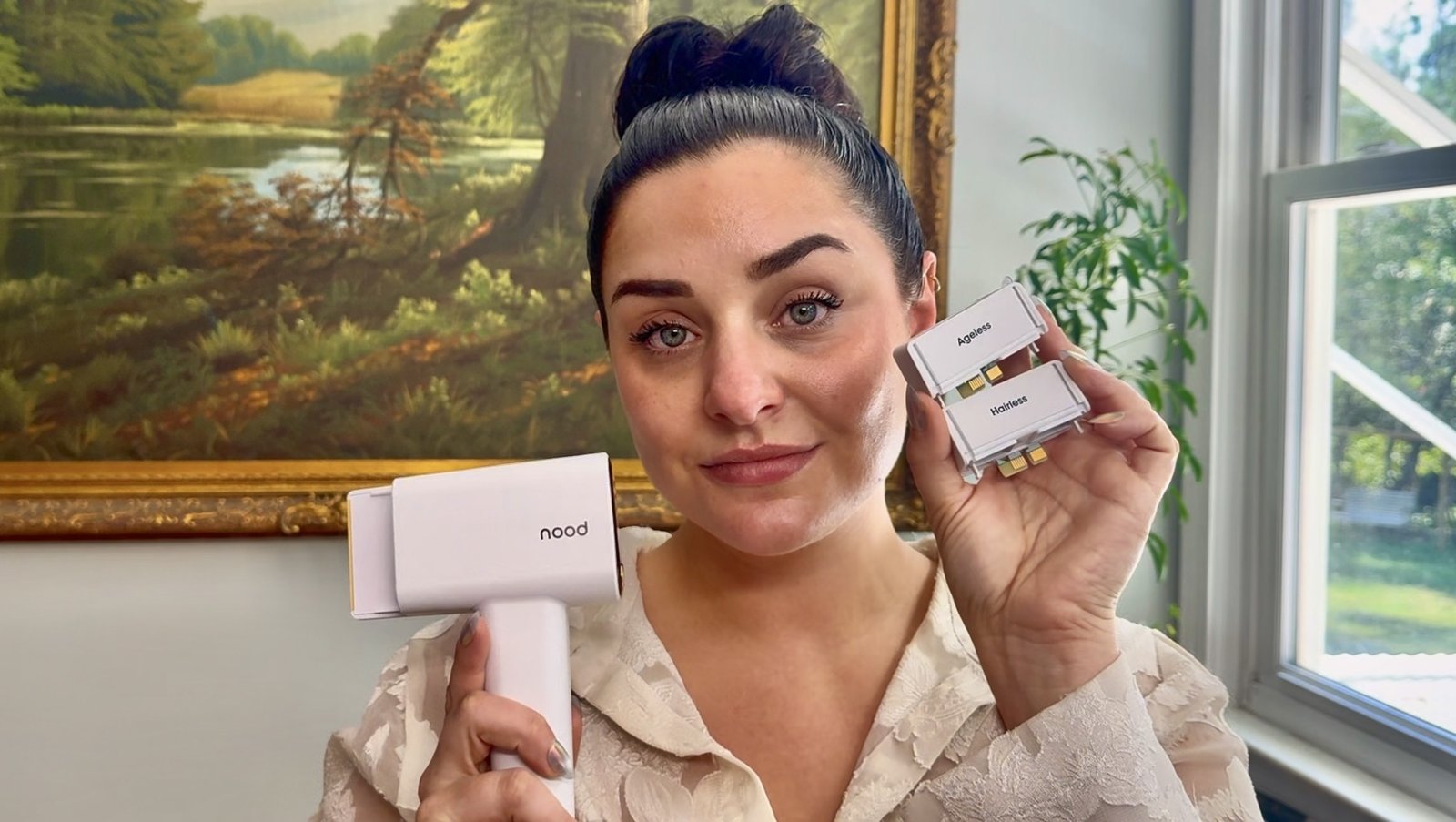
    Related comparisons: Nood Flasher Pro vs Braun Silk-expert Pro 5 · Nood Flasher Pro vs Ulike Air 10 · Nood Flasher Pro vs Philips Lumea 9000 · Nood Flasher Pro vs Flasher 2.0 · Does Nood Work on Blonde Hair? · Nood vs Laser Hair Removal · Hairless vs Ageless Lens

    A single facial session commonly runs $300 to $600, with a three to five session course around $900 to $3,000. Those are aggregator ranges rather than published clinic rate cards. Practically, one clinic session costs roughly what the entire Nood device costs.

    Related reading

    Sources. Hedelund L et al., “Skin rejuvenation using intense pulsed light: a randomized controlled split-face trial with blinded response evaluation,” Arch Dermatol 2006;142:985-990. El-Domyati M et al., “Intense pulsed light photorejuvenation: a histological and immunohistochemical evaluation,” J Drugs Dermatol 2011;10(11):1246-52. Mardani et al., J Cosmet Dermatol 2025 (41 trials, 3,234 participants). Sales AFS et al., “Intense Pulsed Light on skin rejuvenation: a systematic review,” Arch Dermatol Res 2022;314:823-838. Martignago et al., IJDVL 2024 (rosacea, 14 studies). Piccolo et al., J Clin Med 2024. Al-Quran, CCID 2023. Tang and He, Am J Transl Res 2025;17(7):5530-5543. Fang L, Gold MH, Huang L., J Cosmet Laser Ther 2014;16(6):296-302. Konishi et al., Arch Dermatol Res 2008;300(Suppl 1):65-67. Alexis AF, Br J Dermatol 2013;169(s3):91-97. Jagdeo et al., “Home-based devices in dermatology: a systematic review,” Arch Dermatol Res 2022. Thaysen-Petersen D et al., Lasers Med Sci 2015;30:2171-2177. StatPearls, Intense Pulsed Light. FDA 510(k) K241106 and K123435, FDA De Novo DEN200028. Manufacturer specification pages for Lumenis, Sciton and Alma, checked September 2026.

  • Nood Flasher Pro vs Other IPL Devices: What They Actually Publish

    Nood Flasher Pro vs Other IPL Devices: What They Actually Publish

    Quick answer

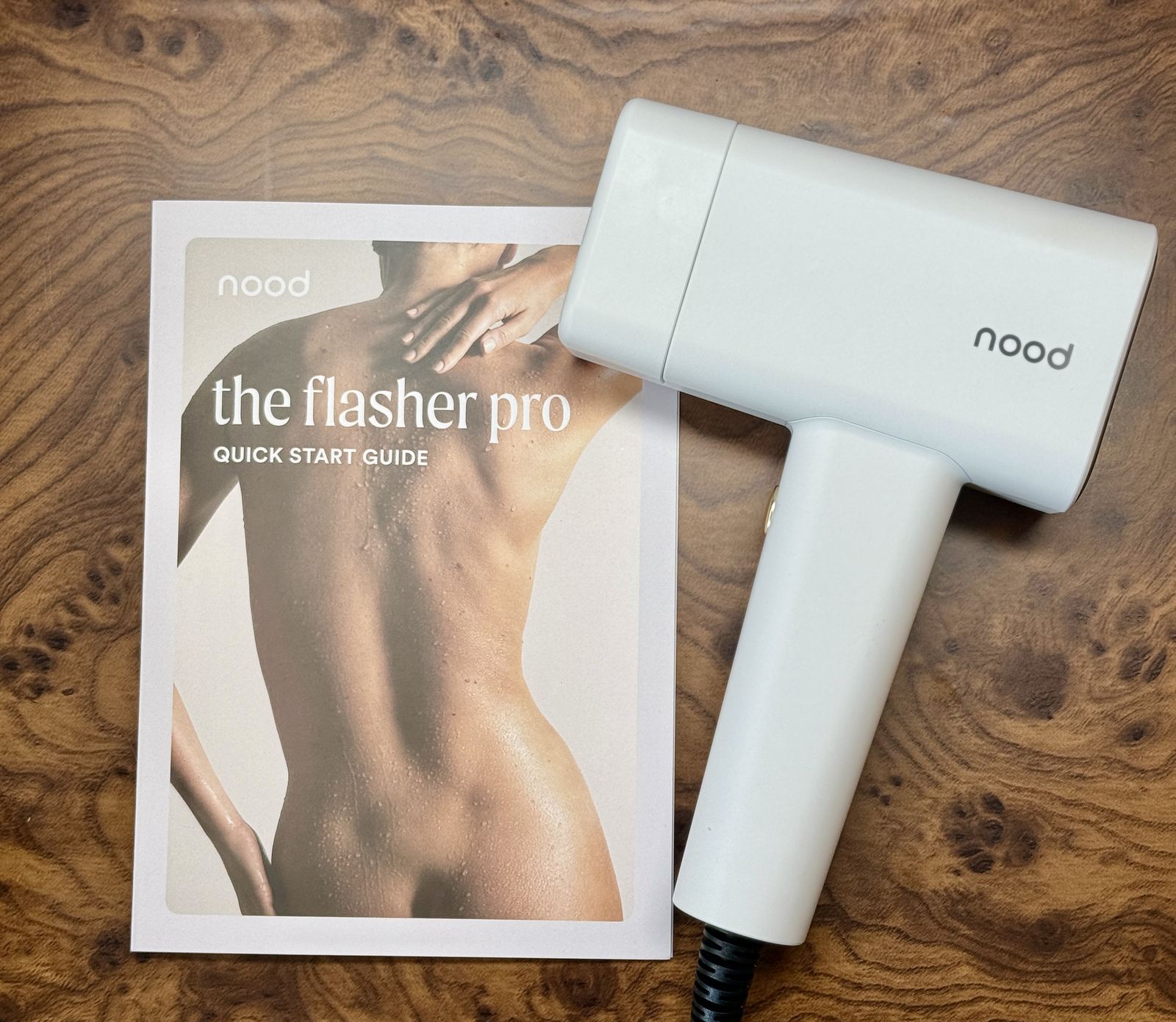
    The Nood Flasher Pro is an at-home IPL hair removal device from Nood Ventures LLC, cleared by the FDA under 510(k) K241106 for permanent hair reduction. It is the only device in its price bracket whose energy output can be looked up in a public regulatory document. Almost every competitor publishes no energy figure at all, which makes most spec comparisons in this category unverifiable.

    Some links in this post are affiliate links, which means I earn a commission if you buy through them at no extra cost to you. I bought my Nood Flasher Pro myself. I have not personally used the Braun, Philips, Ulike, JOVS, Silk’n or Kenzzi devices, so the comparison below is a documentation audit, not a hands-on test of those units. I say which is which throughout.

    Key takeaways

    • The Nood Flasher Pro is FDA cleared, not FDA approved. Clearance means substantial equivalence to an existing device, not proof that it works.
    • Its cleared energy range is 1.84 to 5.23 J/cm² for model T16A. Nood’s own marketing pages list 6, 7 and 7.2 J/cm². The lowest number is the one with a regulatory document behind it.
    • Braun, Philips, JOVS and Kenzzi publish no J/cm² figure on their own websites. Every competitor energy number circulating online traces back to independent teardowns, not to the manufacturer.
    • The brand name on the box is often not the company on the FDA file. Nood’s clearance is held by Shenzhen Mlay Intelligent Technology Co., Ltd. Ulike and Silk’n file under their own names.
    • The entire at-home IPL category has roughly 32 adverse event reports in FDA’s MAUDE database, all time. No brand stands out as unusually risky, and none has a clean sheet either.
    • IPL only works where there is contrast between dark hair and lighter skin. On blonde, red, grey or white hair it does nothing, and on deeper skin tones it is a burn risk rather than a treatment.

    Check today’s Nood Flasher Pro price on Amazon

    What is the Nood Flasher Pro?

    The Nood Flasher Pro is a handheld intense pulsed light device. Inside it is a filtered xenon flashlamp, which is the same class of light source clinics use in their IPL platforms, running at a small fraction of clinic energy. It ships with two interchangeable lenses: a Hairless lens filtered to 510 to 1200 nm for hair, and an Ageless lens filtered to 560 to 1100 nm marketed for skin.

    One thing worth clearing up straight away, because the Amazon listing muddies it. This is not a laser. A laser emits coherent light at a single wavelength. IPL emits a broad band of wavelengths from a flashlamp. The FDA classifies it under product code OHT, which is explicitly a non-laser category. Both can reduce hair, but they are different tools and they do not perform the same.

    Its clearance is 510(k) K241106, decided May 22, 2024. That file covers eight models across two specification tiers. The Flasher Pro is model T16A, cleared at 1.84 to 5.23 J/cm², pulse duration 0.5 to 2.5 ms, spot size 3.9 cm². If you take one number away from this article, take that one, because you are about to see how rare it is to be able to state a number like that at all.

    The Nood Flasher Pro handset beside its quick start guide booklet
    The Flasher Pro, model T16A under FDA clearance K241106.

    Current pricing sits on the Amazon listing. The eligibility chart is in the listing photos, which is worth checking before anything else here matters.

    Why is it so hard to compare at-home IPL devices?

    Because the number that determines whether a device works is the number almost nobody publishes.

    Hair reduction with light works by selective photothermolysis, described by Anderson and Parrish in Science in 1983. Melanin in the hair shaft absorbs light, converts it to heat, and damages the follicle. How much damage you get depends on fluence, which is energy delivered per unit area, measured in joules per square centimetre. Fluence is the whole ball game. Flash count, “ice cooling”, app connectivity and 999,999-flash lifetime guarantees are all downstream of it.

    So I went looking for the fluence of every major at-home IPL device, on the manufacturer’s own website. Here is what I found.

    Braun’s US Silk-expert Pro pages list “10 intensity levels” and no joules. Philips does not publish a J/cm² figure for the Lumea range. JOVS does not publish one, and one independent reviewer noted the printed manual contains no technical specifications whatsoever. Kenzzi publishes no joules, no wavelength, no spot size and no flash count, while describing itself as FDA cleared. Ulike does publish a number, 6.67 J/cm², but that figure is the total across a four-pulse burst rather than the energy of a single flash, which works out to roughly 1.67 J/cm² per pulse.

    And Nood publishes a fluence. Three of them, in fact: 6 J/cm² on one page, 7 on another, 7.2 on the comparison page. None of those match the 5.23 J/cm² ceiling in its own FDA file.

    That is the real story of this category. It is not that one device is secretly twice as powerful as another. It is that you are being asked to choose between products whose defining specification is either absent, inconsistent, or quietly measured in a way that flatters it.

    What does each brand actually publish?

    Read this table as a documentation audit rather than a performance ranking. The right-hand column is the point. Prices are US list or typical street price at the time of writing and move constantly.

    Device Fluence figure available Who published it Typical price
    Nood Flasher Pro 1.84 to 5.23 J/cm² (cleared)
    6, 7 and 7.2 J/cm² (marketed)
    FDA 510(k) K241106, model T16A. A primary regulatory document. The marketed figures come from three different pages of Nood’s own site. $299 to $409
    Philips Lumea 9000 2.5 to 6.5 J/cm² An independent teardown by WeAreBodyBeautiful. Philips publishes nothing. Around £539 RRP
    Braun Silk-expert Pro 5 3 to 6 J/cm² The same independent reviewer. Braun’s own page lists only “10 intensity levels”. $429.99
    JOVS Venus Pro II 1 to 6 J/cm² An independent review, which notes the manual contains no technical specifications at all. $299
    Ulike Air 10 Around 1.67 J/cm² per flash Ulike’s headline 6.67 J/cm² is a four-pulse burst total, not a single-flash figure. $259 to $369
    Kenzzi Not published No joules, no wavelength, no spot size, no flash count, while the brand describes itself as FDA cleared. Varies

    Check today’s Nood Flasher Pro price on Amazon

    One caveat on wavelength, since it is the other spec people quote at each other. The upper bound of an IPL range is a lamp emission tail and is not meaningfully comparable between brands. Only the lower cutoff, the point where the filter starts letting light through, tells you anything about what the device is aimed at.

    Who actually makes these devices?

    This was the part I did not expect. If you search FDA’s 510(k) database for product code OHT and count clearances by applicant, the names that come up are mostly not the names on the boxes.

    Shenzhen Ulike Smart Electronics Co., Ltd. holds 18 clearances under its own name. Cyden Limited, which makes Silk’n devices, holds 15. Home Skinovations, Ltd. holds four. Philips Consumer Lifestyle B.V. holds two.

    Nood does not appear at all. The Flasher Pro’s clearance is held by Shenzhen Mlay Intelligent Technology Co., Ltd., a contract manufacturer with three clearances under this product code, covering long lists of model numbers sold under many different brands. K241106 alone covers eight models. Its sibling clearance K240264 covers eleven.

    This is not a scandal and it is not unique to Nood. It is how most of the consumer beauty device market works, and it is worth understanding for two practical reasons. First, several brands you think of as competitors are the same hardware with different housings and different markups. Second, when the marketing on a brand’s website contradicts the numbers in its regulatory file, that is often because the brand did not generate those numbers and the file belongs to somebody else.

    How many safety reports has each brand received?

    FDA runs a public database of adverse event reports called MAUDE. I pulled every report filed under product code OHT, which is the at-home light-based hair removal category.

    The whole category has about 32 reports, all time. Nood Ventures LLC appears on one. Shenzhen Ulike Smart Electronics appears on two. Philips entities appear on two. Kenzzi Limited, Cyden Limited, Conair Corporation, Home Skinovations and Procter & Gamble Manufacturing Company each appear on one. Most of the rest are filed by manufacturers whose names never reach a consumer.

    Read that carefully, in both directions. Thirty-two reports across a category that has sold many millions of units is a very small number, and MAUDE reports are unverified, are not proof that a device caused anything, and are heavily under-reported for consumer products. So this is not a scare table and no brand here looks dangerous.

    The Nood report is worth knowing about anyway, because it is specific. A woman in her thirties reported a rash on her leg after two uses of the Flasher 2.0, the predecessor model, that led to an emergency room visit and did not clear for three weeks. A dermatologist later suggested eczema as an alternative explanation. That contradiction is exactly why MAUDE entries are not evidence of cause. It is still a useful reminder that “pain-free” and “risk-free” are different claims, and this device is neither.

    How does an at-home IPL device compare to a clinic laser? (short version)

    Not favourably, and anyone telling you otherwise is selling something. The honest version is that the gap is real and the price gap is also real, and you get to decide which one matters more to you. The full clinic comparison, with course prices by city, is in Nood vs Laser Hair Removal.

    Professional diode lasers are cleared in the range of roughly 5 to 40 J/cm². The Flasher Pro’s cleared ceiling is 5.23. That is not a marketing difference, it is the mechanism. More energy into the follicle means more follicles that do not come back.

    The published research lines up with that. A 2023 randomised head-to-head trial in PLOS ONE put a professional diode laser against a home IPL device over six sessions and reported 85 to 88 percent underarm hair reduction for the professional device against 46 to 52 percent for the home one. Worth stating the limits: only 15 of 30 enrolled participants completed it, follow-up was three weeks, and the home device tested was a Silk’n, not a Nood.

    The most useful study for setting expectations is an independent randomised trial by Thaysen-Petersen published in the British Journal of Dermatology in 2015. Eight weekly self-administered home treatments produced up to 59 percent reduction in growing hair, and the hair that remained was 38 percent thinner. Then treatment stopped, and three months later growing hair had returned to 29 percent above where it started. Every serious source in this field says the same thing in different words: this is maintenance, not a cure. The American Academy of Dermatology puts most patients at two to six laser treatments with maintenance sessions afterwards.

    Where the home device wins is arithmetic and privacy. A six-session underarm course at a clinic commonly runs $450 to $1,500, and a six-session bikini course $570 to $1,800. The device costs less than two mid-range clinic sessions and is not limited to one body area. If you have ever bought a package and not finished it, you already understand the appeal.

    How much do you save treating multiple areas?

    This is where the whole comparison actually turns, and almost nobody models it properly. Clinic pricing is charged per area. A device is charged once. So the question is not “is a device cheaper than a laser session”, it is “how many areas do you plan to treat”, and the answer changes the arithmetic by an order of magnitude.

    I built the numbers below from eleven real clinic rate cards rather than from aggregator averages, because the major aggregators model their state-level ranges from a cost of living index instead of surveying clinics. Every clinic in the set publishes a single-session price list on its own website: Laser and Glow in Houston, Texas Laser and Aesthetics in Austin, SKIN Las Vegas, Radiant Laser MD in Cambridge, Foxy Laser in Denver, Miami Skin Spa, Le Reve Med Spa in Pasadena, M. STUDIO in New York, ELLEMES in Atlanta, City Laser Clinic in San Francisco and Well Medical Arts in Seattle. Session counts follow NYC Laser’s published guidance of 6 to 8 sessions for face, underarms and bikini, and 8 to 10 for legs, arms, back and chest.

    The first thing that falls out of eleven price lists is that geography moves the number more than anything else in this comparison does. The same six session underarm course is $294 in Houston and $2,094 in Seattle. That is a 7x spread on identical treatment, and it is larger than any bundle discount, any package deal and any brand difference in the entire category.

    One area at a time

    At a single area, the device is not an automatic win. It beats the clinic comfortably on large areas and loses badly on small facial ones, and where you live decides the rest.

    Area Houston, TX Pasadena, CA Seattle, WA Pasadena sessions to equal $379
    Upper lip $150 $270 $1,194 8.4
    Underarms $294 $600 $2,094 3.8
    Bikini line $294 $570 $1,194 4.0
    Brazilian $534 $900 $2,994 2.5
    Full arms $840 $1,360 $3,992 2.2
    Back $1,032 $1,920 $3,992 1.6
    Full legs $1,800 $1,920 $3,992 1.6

    Read the last column as the honest headline for a single area: at mid-range California pricing it takes fewer than two clinic sessions on full legs to spend what the whole device costs, but more than eight sessions on an upper lip. If your only complaint is your upper lip and you live somewhere cheap, buy the clinic sessions. The device is not built for you.

    Stacking areas, over five and ten years

    Now add areas. Clinic totals below use the Pasadena rate card, a 6 to 8 session initial course, and one maintenance session per area per year after that, which is what the clinics themselves describe. The device column is one $379 purchase, and one replacement at year five for the ten year figure.

    What you treat Clinic, initial course Clinic, 5 years Clinic, 10 years Device, 10 years 10 year difference
    1 area. Underarms $600 $1,000 $1,500 $758 $742
    2 areas. Add bikini line $1,170 $1,950 $2,925 $758 $2,167
    3 areas. Add upper lip $1,440 $2,400 $3,600 $758 $2,842
    4 areas. Underarms, Brazilian, upper lip, full legs $3,690 $5,830 $8,505 $758 $7,747
    6 areas. Add full arms and chin $5,320 $8,320 $12,070 $758 $11,312
    9 areas. Add stomach, back, neck $8,800 $13,640 $19,690 $758 $18,932
    13 areas. Everything on the list $12,410 $19,310 $27,935 $758 $27,177

    The line that matters is not any single total. It is the marginal cost of adding one more area. At the Pasadena rate card that is $270 to $1,920 depending on the area, every time, forever. On the device it is zero. That is the entire economic argument for owning one, and it is the reason the gap widens from 1.6x at one area to roughly 33x at thirteen.

    If the arithmetic lands for you, the device is on Amazon here. It is one purchase and it covers every area on that list, which is the whole point of the table above.

    What it costs you in time

    The savings are not free. You are trading money for labour, and nobody selling these devices puts a number on that, so here is one.

    The cleared spot size is 3.9 cm². Working from that and an estimated 1.2 second flash cycle, a four-area routine covering underarms, Brazilian, upper lip and full legs runs roughly 1,400 flashes and about 28 minutes per session. Twice a week for eight weeks, then monthly maintenance, comes to roughly 34 hours over five years. Against $5,451 saved at the Pasadena rate card, that is about $162 an hour for your trouble. A thirteen area routine is around 76 minutes a session and 90 hours over five years, at roughly $211 an hour.

    Whether that is a good wage is your call. It is a real one, and it is a better way to think about the decision than a raw savings number.

    One more thing that falls out of the same maths: even the thirteen area, five year path uses roughly 269,000 flashes, comfortably inside the lamp’s 500,000 flash rating. The lamp is not the constraint. Your patience is.

    Where the savings argument breaks

    Three situations flatten the gap, and a model that ignores them is a sales pitch.

    Clinics discount multi-area buys, heavily. City Laser Clinic publishes a full body session at $1,800 against roughly $2,559 for the same areas bought separately, then takes another 15 percent off a package of six and adds three free sessions on top. Bundling roughly halves the a la carte number. Renova Laser in Houston sells any three areas for $799 against $1,197 separately. My tables use a la carte pricing, so read them as the ceiling, not the likely bill.

    The cheapest published full body package is far below my model. SEV Laser publishes an eight session full body package at $470 to $540 per session depending on region, and an 18 month unlimited membership at $340 to $400 a month with free annual touch-ups for life. Against a full body package at that price the device is still roughly a tenth of the cost, but the gap is nothing like 33x.

    Unlimited memberships erase the maintenance advantage entirely. Milan Laser sells a flat lifetime fee per area with free touch-ups for life, and publishes no price at all anywhere on its site. Against a Milan customer, every maintenance row in my tables goes to zero and the only remaining lever is the up front number, which you cannot see without a consultation.

    And the figure I deliberately left out: the $697 that gets quoted everywhere as “the average cost of laser hair removal”. That is the American Society of Plastic Surgeons number for skin treatments using combination lasers, which bundles hair removal with IPL, tattoo removal and leg vein treatment. It is a surgeon fee only and it is not a hair removal price. It should stop being used as one.

    How do you use the Nood Flasher Pro?

    Treating an underarm with the Nood Flasher Pro IPL hair removal device
    Underarms, shaved first, plate flat against the skin.

    Shave the area first. IPL targets pigment in the follicle, not the hair above the skin, and leaving stubble on the surface just burns it and wastes energy. Skip waxing and epilating entirely while you are using it, because both remove the follicle target the light needs.

    Nood’s FAQ says to start at level 3 of 5 and work up. The Pro’s genuine upgrade over the Flasher 2.0 is the sapphire contact plate, which the brand says reaches 60 °F and which is the reason the higher levels are tolerable at all. Describe it as a cooling plate rather than a breakthrough and you have it about right.

    On schedule, Nood publishes three different protocols across its own site: every three days for twelve weeks then monthly, twice weekly for two months then every three to six months, and twice weekly then every one to two months. The middle version is the one most reviewers describe and the one I would follow. Twice a week for eight weeks, then maintenance.

    The Ageless lens ships with almost no instruction, which is a genuine gap. It sits outside the hair removal clearance entirely, so treat it as an extra you experiment with rather than a second reason to buy. The step by step for that lens is in the Nood Ageless Lens Review. For upper lip and chin, see Can You Use Nood on Your Face.

    Who should skip the Nood Flasher Pro?

    Quite a lot of people, and this is the section most reviews leave out.

    Skip it if your hair is blonde, red, grey or white. There is no eumelanin for the light to absorb, so nothing happens. This is physics, not a defect, and it applies to every IPL device on this page equally.

    The Fitzpatrick skin type chart in the Nood Flasher Pro manual, with types one through five checked and type six marked with an X
    Nood’s own eligibility chart. Type VI is marked with an X.

    Skip it if you have a deeper skin tone. When the epidermis holds more melanin than the follicle, your skin absorbs the energy instead of the hair. That is a burn risk rather than a disappointing result. Nood markets the hair lens for fair to olive skin and the Ageless lens for Fitzpatrick types I to IV. Professional diode systems are cleared for types I to VI, including tanned skin, which is a real reason to go to a clinic instead.

    Skip it if you want facial hair on the lower face or neck removed and you have hormonal growth. The clearance’s facial permission stops at the chin line, and coarse hormonal hair is the case where electrolysis, at roughly $90 to $180 an hour, is the treatment that actually finishes the job.

    Skip it if you are buying it for wrinkles. IPL at clinic strength is a pigment and redness treatment. In a three-way periorbital comparison against fractional laser and radiofrequency, fractional laser performed best overall and IPL performed worst for wrinkles. There are no published clinical trials of at-home IPL for skin at all. If lines are your target, a retinoid has meta-analysis level evidence behind it and costs a fraction of this. I wrote about the one I use in my PRMR Youth Radiance Vitatinol serum review.

    And skip it if you cannot commit to twice a week for two months and then maintenance forever. The device does not fail people nearly as often as the schedule does.

    Which at-home IPL device should you buy?

    If you have decided you want one, here is how to choose, in order.

    Buy the one whose energy output you can verify. Right now that is the Nood Flasher Pro, not because it is the most powerful but because it is the only one in this comparison whose fluence appears in a document the manufacturer did not write. In a category this opaque, verifiability is worth more than a spec sheet you cannot check.

    Buy the one with a real cooling plate, because comfort determines whether you finish the protocol, and finishing the protocol is the only thing that produces a result.

    Buy it from a retailer with a return policy you trust. This matters more with Nood than with most brands. Nood Ventures LLC, based in Austin, Texas, is not BBB accredited and holds an F rating with the Better Business Bureau, with 41 complaints filed in three years and a failure to respond to 23 of them. The complaints cluster on fulfilment, subscription charges and refunds rather than on the device itself, and Nood’s own direct guarantee carries a $29.95 restocking fee and only applies to purchases made on its own site. Buying through Amazon sidesteps all of that.

    The one I own

    Nood The Flasher Pro

    IPL hair removal handset with two lenses and a sapphire cooling plate. FDA cleared under K241106 for permanent hair reduction.

    Around $299 to $409

    Check price on Amazon

    If you have read this far and none of the skip conditions are you, the device is on Amazon here. Buy it from Amazon rather than direct, for the reason in the section above.

    Frequently asked questions

    Is the Nood Flasher Pro FDA approved?

    No. It is FDA cleared, which is a different thing. Clearance under 510(k) K241106 means FDA agreed the device is substantially equivalent to one already on the market. It is not a finding that the device works, and many clearances in this category include no clinical study at all. “FDA approved” is not a claim any at-home IPL device can make.

    How does the Nood Flasher Pro compare to Braun, Philips and Ulike?

    On paper, you cannot say, and neither can anyone else. Braun and Philips publish no J/cm² figure on their own sites, Ulike’s published figure is a four-pulse burst total rather than a single flash, and Kenzzi publishes nothing at all. Nood is the only brand in this group with an energy range in a public FDA file, which is why it is the one I can describe precisely.

    Is the Nood Flasher Pro as strong as a clinic laser?

    No, and it is not designed to be. Its cleared ceiling is 5.23 J/cm². Professional diode lasers are cleared from roughly 5 to 40 J/cm². Home devices are deliberately limited because they are used without training, screening or supervision. In one randomised head-to-head, a professional diode reached 85 to 88 percent underarm reduction against 46 to 52 percent for a home IPL device.

    Does IPL work on blonde, red or grey hair?

    No. IPL needs melanin in the hair shaft to absorb the light and convert it to heat. Blonde, red, grey and white hair do not have enough of it, so there is nothing for the energy to target. No at-home device on the market solves this. Electrolysis is the only method that works regardless of hair colour. The full answer is in Does Nood Work on Blonde Hair?

    Does the Ageless lens get rid of wrinkles?

    No, and it is not cleared to. K241106 is a hair removal clearance with no skin, pigment or collagen indication in it. There are no published clinical trials of at-home IPL for skin. Clinic IPL is genuinely useful for pigment and redness, at roughly 10 to 35 J/cm², which is several times what this device delivers. Treat the second lens as an experiment, not a purchase reason. The clinic comparison is in Nood Ageless Lens vs an In-Office IPL Photofacial. What realistically changes week by week is in Nood Ageless Lens Before and After.

    How long before you see results from an at-home IPL device?

    Eight weeks is the realistic first checkpoint. The independent trial with the clearest data used eight weekly treatments and reported up to 59 percent reduction in growing hair, with remaining hair 38 percent thinner. Most people notice slower regrowth before they notice less hair. Anyone promising a visible change in two weeks is describing shaving.

    Is permanent hair removal possible with IPL?

    No. The cleared claim is permanent hair reduction, which FDA defines as a long term stable reduction in the amount of hair regrowing when measured at 6, 9 and 12 months after a treatment course. Only electrolysis carries a permanent hair removal claim in the US. In the one trial that followed people after they stopped, growing hair returned to 29 percent above baseline within three months.

    How much do you save doing multiple areas at home?

    It depends almost entirely on how many areas you treat and where you live. At Pasadena rate card prices, one area over five years is about $621 saved, four areas about $5,451, and thirteen areas about $18,931, because the clinic charges per area and the device does not. The marginal cost of adding one more area is $270 to $1,920 at a clinic and zero on a device. Multi-area bundles and unlimited memberships narrow the gap considerably.

    Should you buy Nood on Amazon or from Nood directly?

    Amazon. Nood Ventures LLC holds an F rating with the Better Business Bureau, is not accredited, and failed to respond to 23 of 41 complaints filed over three years, most of them about fulfilment, subscription charges and refunds. Nood’s own money-back guarantee carries a $29.95 restocking fee and applies only to purchases made on its own website, so it does not cover an Amazon or Walmart unit anyway. Check today’s Nood Flasher Pro price on Amazon.

    Is level 1 enough on the Nood Flasher Pro?

    Nood recommends starting at level 3 of 5 and working up or down based on your skin’s sensitivity, and using the highest level your skin can tolerate, because higher levels deliver more light per pulse. So level 1 is a setting for skin that cannot take more, not the place to start. The full protocol is in How do you use the Nood Flasher Pro? above.

    Related comparisons: Nood Flasher Pro vs Braun Silk-expert Pro 5 · Nood Flasher Pro vs Ulike Air 10 · Nood Flasher Pro vs Philips Lumea 9000 · Nood Flasher Pro vs Flasher 2.0 · Does Nood Work on Blonde Hair? · Nood vs Laser Hair Removal · Hairless vs Ageless Lens

    Related reading

    Sources. FDA 510(k) database, K241106 and K240264, applicant Shenzhen Mlay Intelligent Technology Co., Ltd. FDA MAUDE adverse event database, product code OHT. Anderson RR and Parrish JA, Science, 1983. Thaysen-Petersen D et al., British Journal of Dermatology, 2015. Randomised diode versus home device comparison, PLOS ONE, 2023. Periorbital three-way comparison, Lasers in Medical Science, 2021. American Academy of Dermatology. Better Business Bureau profile for Nood, Austin, Texas. Manufacturer specification pages for Nood, Braun, Philips, JOVS, Ulike and Kenzzi, checked August 2026.

  • Nood Ageless Lens Review: How To Use The IPL Photofacial Attachment

    Nood Ageless Lens Review: How To Use The IPL Photofacial Attachment

    Quick answer

    The Ageless lens is the skin filter that ships with the Nood Flasher Pro, cutting light off at 560nm instead of the hair lens’s 510nm. That 560 cutoff is the same photorejuvenation standard professional IPL platforms have used for 25 years. It sits outside the device’s FDA clearance, and it is a pigment and redness tool, not a wrinkle treatment.

    I bought this device with my own money. I am not a doctor and nothing here is medical advice.

    Key takeaways

    • The two lenses use the same lamp. The only physical difference is the filter: 510nm cutoff for hair, 560nm for skin.
    • 560nm is not a marketing number. It is the standard photorejuvenation cutoff professional IPL platforms have used for about 25 years.
    • IPL is genuinely good at pigment and redness. Published reviews of clinic IPL report roughly 20 to 60 percent redness reduction and 51 to 78 percent clearance of facial telangiectasia.
    • IPL is not a wrinkle treatment and never was. A biopsy study after six clinic sessions found no significant change in collagen I, III or VII, elastin or tropoelastin, and no measurable wrinkle reduction in any volunteer.
    • The device’s FDA clearance, K241106, covers hair removal only. The Ageless lens is not in it, and there are no published clinical trials on at-home IPL for skin.
    • You do not shave before using the skin lens. You do shave before using the hair lens. This trips almost everyone up.
    • Fitzpatrick I to IV only, fair through olive. On deeper skin tones this is a safety issue, not a weak result.

    Check today’s Nood Flasher Pro price on Amazon

    What is the Nood Ageless lens?

    The Nood Flasher Pro ships with two interchangeable cartridges. The Hairless lens is the one the device is built and cleared for. The Ageless lens is the skin one, and it is the reason I bought this particular device rather than a cheaper IPL handset.

    Here is the problem that made me film this. There are almost no instructions and almost no honest reviews of the Ageless filter anywhere on the internet. There is a review sitting on the Amazon listing right now where a buyer asks four straightforward questions about how to use it, and nobody has answered her. This post and the video below are the thing I wanted to exist when I bought it.

    Holding the Nood Flasher Pro handset in one hand and both lens cartridges in the other
    The Flasher Pro ships with two cartridges. Only one of them is what the device is cleared for.

    If you want to look at the device itself, it is on Amazon here, and the Ageless lens ships in the box with it. The full device comparison is in Nood Flasher Pro vs Other IPL Devices.

    How do you use the Ageless lens?

    Nood Flasher Pro Ageless Lens: How To Use It (And What It Won’t Do) · Watch on YouTube
    Using the Nood Ageless lens for an at-home IPL photofacial pass along the neck and jawline
    Keeping the plate flat against the skin along the jaw and neck.

    The full walkthrough is in the video, including the device sound and what a real pass looks like. Here is the written version.

    Turn it on and set the level. I run mine at three, which is mid range. The button cycles up to five and then loops back to one. There is no evidence a higher setting produces a better outcome here, and this is a technology with a biphasic dose response, meaning past a point more works against you rather than for you.

    Keep the plate completely flat against your skin. This matters more than people realise and it is the thing I would correct if I were watching over your shoulder. Tilt it and you lose contact with the cooling plate, which is the best part of the whole device and the only reason the higher levels are tolerable. You are also delivering the light at an angle, so less of it lands where you wanted it.

    Work in overlapping passes. Cheeks, jaw, forehead. Stay off the eyebrows and the eye area entirely. Do not get near it.

    Ten minutes, two to three times a week. That is the whole protocol.

    What is the difference between the Hairless and Ageless lenses?

    The filter. That is genuinely it.

    The lamp inside the device produces a broad spread of light. A filter’s job is to decide which wavelengths get out and which do not. The hair lens cuts off at 510nm. The skin lens cuts off at 560nm. That fifty nanometre difference is the entire physical distinction between the two cartridges.

    Close-up of the Nood Hairless lens cartridge showing its yellow 510nm filter window
    The Hairless lens, cutting off at 510nm. The filter window reads yellow.
    Close-up of the Nood Ageless lens cartridge showing its orange 560nm photorejuvenation filter window
    The Ageless lens, cutting off at 560nm. Same lamp behind it, and you can see the filter difference with your own eyes.

    So why is that worth being a separate product? Because 560nm is not a number somebody in marketing came up with because it sounded good on a sales page. It is the standard photorejuvenation cutoff, and professional IPL platforms have been running it for about 25 years. If you walk into a med spa for a photofacial, there is a very good chance the machine they use is operating behind a 560 filter.

    The logic underneath it: when you cut off everything below 560, you push the output away from the wavelengths hair pigment absorbs best, and toward the ones absorbed by two other things. Melanin sitting in your skin, and haemoglobin in the very small blood vessels near the surface. One lens is biased toward hair. The other is biased toward pigment and vessels. Same light, different window.

    Both cartridges come in the same box, so the 560nm filter costs nothing extra on top of the device. Current price is on the Amazon listing.

    I am going to be hard on this product in a minute, so I want to be fair here first. That is a legitimate engineering decision. Somebody looked at what clinics actually do and put the same filter on a home device. The concept is sound, and it is the strongest true thing about this lens.

    Spec Hairless lens Ageless lens
    Filter cutoff 510nm 560nm
    Biased toward Hair pigment Skin pigment and surface vessels
    Covered by FDA clearance K241106 Yes, hair removal and permanent hair reduction No
    Shave first Yes, always No, never
    Power levels 5 5, start at 3
    Session length Varies by area About 10 minutes
    Frequency Twice a week, then maintenance Two to three times a week
    Eligibility Dark hair, fair to olive skin Fitzpatrick I to IV

    Check today’s Nood Flasher Pro price on Amazon

    Which lens you need, and the replacement lens answer, is in Nood Hairless vs Ageless Lens.

    What is IPL actually good at?

    At clinic strength, two things, and they are not small things.

    Pigment. Brown spots, sun spots, discoloration, acne scars, the freckly uneven patches that show up on the cheekbones after a couple of decades of sun, the dark spots that start appearing on the backs of your hands. Clearing superficial pigmented lesions is IPL’s bread and butter and clinics have been doing it for a long time.

    Redness and small vessels. This is the one people underestimate. Telangiectasia, those tiny broken capillaries around the nose and on the cheeks and sometimes the chin, plus general facial flushing. Published reviews of clinic IPL report redness reductions of roughly 20 to 60 percent, and clearance of facial telangiectasia between about 51 and 78 percent. Those are real figures from real reviews of clinic devices, and they are what make IPL a legitimate technology rather than a trend. How a clinic session compares with this lens is in Nood Ageless Lens vs an In-Office IPL Photofacial.

    There is a third benefit that is about the product rather than the physics, and I think it is the most honest reason to be pleased this lens exists. You are already buying this device. If you are buying it, you are buying it for hair removal, where it has an actual clearance and actual published evidence. The second lens is not a second purchase. It comes in the box. Even at a modest effect, a bonus that costs nothing extra and takes ten minutes twice a week is a reasonable thing to have.

    Does the Ageless lens work on wrinkles?

    No, and this is the part every IPL device gets marketed on that the technology has never actually done.

    IPL is not a wrinkle treatment. It never was. That is not my opinion. Researchers took actual biopsies from volunteers after six clinic IPL sessions and measured collagen types I, III and VII plus elastin and tropoelastin, using immunostaining and computerised morphometry. The result was no statistically significant change in any of them, and not one volunteer showed measurable wrinkle reduction or skin tightening.

    There is also a three way comparison on the eye area: fractional laser versus radiofrequency versus IPL. Fractional laser won overall. IPL came last for wrinkles. Where IPL did best in that study was discoloration, which is exactly what we just said it is for.

    If your actual problem is fine lines, this filter is not going to help you, and I would rather tell you that now than have you disappointed by a tool failing at a job it was never doing. The highest evidence option available is a retinoid. I wrote about the one I use in my PRMR Youth Radiance Vitatinol serum review.

    Is the Nood Ageless lens FDA cleared?

    No. The device is, for one thing, and the skin lens is not that thing.

    The Nood Flasher Pro holds FDA 510(k) clearance K241106. The indication is hair removal and permanent hair reduction. That is the whole file. There is no skin, pigment, wrinkle or collagen indication anywhere in it, and the facial permission inside it stops at the chin line.

    So the entire skin side of this product sits outside what it is cleared for. That does not make it dangerous. It means nobody has reviewed evidence that it works for skin, because none was ever submitted. And when I went looking, there are no published clinical trials on at-home IPL for skin at all. Not weak evidence. None.

    Worth saying plainly too: FDA clearance is a finding of substantial equivalence to an existing device. It is not a finding that a device works, and it is never “FDA approved.”

    Do you shave before using the Ageless lens?

    No. And this one trips everyone up, because for the Hairless cartridge you absolutely do shave first, and it is the single most important prep step there is.

    Different lens, different job. The hair lens needs the light to reach the follicle under your skin, and hair sitting on top of your skin just soaks the energy up. The skin lens is not targeting hair at all, so there is nothing to shave.

    How do you prep your skin?

    The Nood Flasher Pro handset resting on its prepare your skin instruction card with both lens cartridges
    Nood’s own prep card. Clean, dry, bare skin.

    Clean, dry, completely bare skin. No serums, no lotions, no oils, no SPF, no makeup. Anything sitting on your face is sitting between the light and your skin.

    Do not exfoliate the same day, before or after. I cannot say that strongly enough. Exfoliating leaves skin more light sensitive, and light is exactly what you are about to put into it.

    And do not use it on skin that is freshly sunburnt or freshly tanned. Wait it out.

    Can you use both lenses in the same session?

    Yes, but on different areas. Legs with the Hairless lens and face with the Ageless lens the same evening is fine. What you do not do is run the skin lens over a patch you have just treated with the hair lens. Keep them separate.

    When do you moisturise?

    A couple of minutes after, once any warmth has faded, with something gentle and plain and not heavily fragranced. Not a retinol that night. Not an acid that night. Give your skin the evening off from anything active.

    And sunscreen the next day, properly, and for several days after. That is the rule with any light treatment and it is the step people skip, which reverses the whole reason you did it in the first place.

    Why I wanted an at-home option

    “That’s my PTSD from my in-clinic laser IPL treatment, where the lady literally burned my skin off and caused third degree burns, and I have severe scarring.”
    My own experience, in the video above

    I flinch when I press the button. That is a real reaction to a real thing that happened to me in a clinic, and it is a large part of why an at-home device that I control the settings on appealed to me in the first place.

    I want to be careful about what that does and does not mean, because it would be easy to turn my bad experience into a sales pitch. It is one person’s experience with one technician. It is not evidence that clinics are unsafe or that home devices are safer, and I am not going to claim either. Professional treatment is more powerful, and more powerful cuts both ways. What my experience genuinely does tell you is that light treatments are not nothing, that operator skill matters, and that “pain free” is a phrase I will never use about any of this.

    Who should skip the Ageless lens?

    The Fitzpatrick skin type chart in the Nood Flasher Pro manual, with types one through five checked and type six marked with an X
    The eligibility chart from the Nood manual. Type VI is marked with an X.

    Anyone with a deeper skin tone. Nood lists the skin lens as Fitzpatrick I to IV, fair through olive. This is physics rather than a slight: more melanin in your skin means your skin absorbs the light that is meant to be finding something else. That is a safety issue, not just a weak result. Check the chart before you buy, not after.

    Anyone buying it for lines. Covered above. This is not the tool and nothing at this price point is.

    Anyone buying this device for their face alone. This is the clearest thing I can tell you. Buy it for the hair removal, where the clearance and the evidence actually are. Then the skin lens is a bonus that came free in the box. If skin is your only goal, your money goes further on sessions with an actual aesthetician, or on a retinoid and sunscreen.

    Anyone who will not be consistent. Ten minutes, two to three times a week, for weeks. Like anything else, it needs a routine.

    My results so far

    I am at week one. I am running it two to three times a week and keeping a written schedule of exactly how many sessions, how many passes, and which areas, plus before and after photos in the same room with the same lighting at the same distance every time, because if the lighting changes between shots the photos are worthless.

    I will update this post at week eight with the unretouched comparison. I am genuinely curious myself. Treat the skin lens as a bonus with no expectations attached, be consistent, and we will both find out together.

    The one I own

    Nood The Flasher Pro

    IPL handset with two cartridges. The Ageless skin lens ships in the box. FDA cleared under K241106 for hair removal and permanent hair reduction.

    Check today’s price on Amazon

    Check price on Amazon

    If you want the device, it is on Amazon here. Buy it for the hair removal, where the clearance and the evidence actually are, and treat the second lens as the free bonus that it is.

    Frequently asked questions

    Is the Nood Ageless lens FDA cleared?

    No. The Nood Flasher Pro holds clearance K241106 for hair removal and permanent hair reduction, and the Ageless skin lens is not covered by it. There is no skin, pigment or collagen indication anywhere in that file, and no published clinical trials exist on at-home IPL for skin. Clearance is also a finding of substantial equivalence, not proof a device works.

    Do you shave before using the Ageless lens?

    No. You shave before the Hairless lens, never before the Ageless lens. The hair lens needs the light to reach the follicle, so surface hair wastes the energy. The skin lens is not targeting hair, so there is nothing to shave.

    What is the difference between the Hairless and Ageless lenses?

    The filter, and only the filter. Same lamp, same flash. The hair lens cuts off at 510nm and the skin lens at 560nm. That pushes the output away from what hair pigment absorbs and toward melanin in the skin and haemoglobin in surface vessels.

    Does the Ageless lens get rid of wrinkles?

    No. A biopsy study after six clinic IPL sessions found no statistically significant change in collagen I, III or VII, elastin or tropoelastin, and no volunteer showed measurable wrinkle reduction. In a three way periorbital comparison, fractional laser won overall and IPL came last for wrinkles. A retinoid is the higher evidence option for lines.

    Can you use both Nood lenses in one session?

    Yes, on different areas. Legs with the hair lens and face with the skin lens the same evening is fine. Do not run the skin lens over a patch you just treated with the hair lens.

    What level should you use on the Ageless lens?

    Three, which is mid range on a five level device. There is no evidence a higher setting produces a better outcome, and this technology has a biphasic dose response, meaning past a point more energy works against you. Keep the plate flat, work in overlapping passes, and stay entirely off the eye area and eyebrows.

    Does the Ageless lens work on dark skin?

    No. Nood lists the skin lens as Fitzpatrick I to IV, fair through olive. On deeper skin tones the epidermis absorbs the light instead of the intended target, which is a burn risk rather than just a weaker result. Check the chart before you buy.

    How long does an Ageless lens session take?

    About ten minutes, two to three times a week. Clean dry bare skin first, no exfoliating the same day, moisturise a couple of minutes afterwards with something plain, no retinol or acids that night, and sunscreen the next day.

    Related comparisons: Nood Flasher Pro vs Braun Silk-expert Pro 5 · Nood Flasher Pro vs Ulike Air 10 · Nood Flasher Pro vs Philips Lumea 9000 · Nood Flasher Pro vs Flasher 2.0 · Does Nood Work on Blonde Hair? · Nood vs Laser Hair Removal · Hairless vs Ageless Lens

    Related reading

    Sources. FDA 510(k) K241106, applicant Shenzhen Mlay Intelligent Technology Co., Ltd. Intense Pulsed Light Photorejuvenation, A Histological and Immunohistochemical Evaluation, J Drugs Dermatol 2011. Periorbital three way comparison of fractional laser, radiofrequency and IPL, Lasers in Medical Science 2021. IPL for rosacea, systematic review, IJDVL. Tretinoin for wrinkles, meta-analysis of 8 RCTs and 1,361 patients, Dermatology Practical & Conceptual. Huang, Sharma, Carroll and Hamblin, Biphasic Dose Response in Low Level Light Therapy, Dose-Response 2011. Nood product page, FAQ and anti-aging page, checked August 2026.

  • Create Creatine Gummies Review: Taste, Dosage, and Whether They Are Worth It

    Create Creatine Gummies Review: Taste, Dosage, and Whether They Are Worth It

    Review

    Create Creatine Gummies deliver 4.5 g of creatine monohydrate in three gummies, sealed in single-serve packets: no scoop, no shaker bottle, no measuring. The format is the actual product here. I bought the variety pack first so I could work out which of the five flavours I would repurchase, and it turned out to be sour peach.

    Tested and written by Anna Katherine, who reviews products on video before writing about them. Last updated 24 August 2026.

    Key takeaways

    • 4.5 g creatine monohydrate per packet, in three gummies
    • Single-serve packets: the real selling point, not the gummy format
    • Five flavours in the variety pack: orange, sour green apple, watermelon, sour peach, blue raspberry
    • 2 g sugar per serving, roughly 4% of daily value
    • Gluten-free, non-GMO, no artificial colours
    • No aftertaste: the failure mode of most gummy supplements

    What are Create Creatine Gummies?

    They are creatine monohydrate in gummy form, portioned into individually sealed daily packets rather than sold as a tub of powder. Each packet holds three gummies totalling 4.5 g of creatine monohydrate, and the directions are one packet per day.

    The variety pack ships as 30 single-serve packets, a month of daily servings, split across the five flavours.

    For context, 4.5 g sits inside the 3–5 g daily range most commonly cited for creatine monohydrate maintenance, so this is a standard serving rather than a token amount, which is not always true of supplement gummies.

    Product Create Creatine Monohydrate Gummies
    Brand Create
    Form Gummies, single-serve packets
    Per packet 3 gummies / 4.5 g creatine monohydrate
    Pack size 30 single-serve packets (variety pack)
    Price Check today’s price on Amazon
    Sugar 2 g per serving (~4% DV)
    Flavours Orange, sour green apple, watermelon, sour peach, blue raspberry
    Free from Gluten, GMO, artificial colours
    Directions One packet daily

    Shop Create Creatine Gummies on Amazon

    Do Create Creatine Gummies actually taste good?

    Create Creatine Gummies Variety Pack Review: Best Flavor? · Watch on YouTube
    Create Creatine Gummies: Legit Alternative to Powder Creatine? · Watch on YouTube

    This was my main question before buying, because a gummy is not automatically a nice gummy. Plenty of gummy supplements have a chalky or vitamin-ish aftertaste that puts you off taking them, which defeats the point.

    These do not have that. They are soft and chewy with a sour coating on the outside, and they are roughly the size of a quarter. I would call myself a gummy connoisseur and I genuinely could not tell there was creatine in them.

    My favourite is sour peach, with sour green apple a close second. The sour coating is what makes them work: it covers anything that might otherwise read as supplement.

    Why the packets matter more than the gummies

    The gummy format gets the attention, but the single-serve packet is the part that changed anything for me. No scooping, no measuring, no washing a shaker bottle, no tub taking up counter space.

    A packet goes in a handbag, a work bag, a gym bag, or the glovebox. I know myself well enough to know I stick with a routine when the routine is genuinely easy, and pre-portioned removes every step where I might not bother.

    That is the honest case for this product. If powder in a tub has never bothered you, the packets are a convenience you are paying extra for.

    Why buy the variety pack first?

    Because flavour preference is not predictable, and buying a single flavour first is a gamble. The variety pack let me try all five and work out which two I would actually repurchase.

    It also solves a smaller problem: taking the same flavour every day gets dull. Rotating five keeps it closer to a daily treat than a daily chore, which again is really a consistency argument.

    Who should skip these?

    • Anyone happy with creatine powder. Powder is substantially cheaper per gram. You are paying for portioning and taste, and if neither is a barrier for you, there is no reason to switch.
    • Anyone watching added sugar closely. 2 g per serving is small, but it is not zero, and powder is zero.
    • Anyone pregnant, breastfeeding, or on medication. Talk to your doctor before adding any supplement. That is a question for them, not for a blog.
    • Anyone who wants to adjust their dose. Packets are fixed at 4.5 g. Powder lets you change the amount; these do not.

    Frequently asked questions

    How much creatine is in Create Creatine Gummies?

    4.5 g of creatine monohydrate per packet, split across three gummies. That is one daily serving according to the directions.

    Do Create Creatine Gummies taste good?

    Yes. They are soft and chewy with a sour outer coating and no supplement aftertaste, which is the usual failure mode for gummy supplements. Sour peach and sour green apple are the two I repurchase.

    How many gummies are in a serving?

    Three gummies, sealed together in one single-serve packet. Each is roughly the size of a quarter.

    How much sugar is in Create Creatine Gummies?

    2 g per serving, about 4% of the daily recommended value. They are also gluten-free, non-GMO, and made without artificial colours.

    How many packets are in the Create variety pack?

    30 single-serve packets, which is a month of daily servings, split across the five flavours.

    What flavours does the variety pack come in?

    Five: orange, sour green apple, watermelon, sour peach, and blue raspberry.

    Are creatine gummies better than creatine powder?

    Not better, different. Powder is cheaper per gram and lets you adjust the dose. Gummies are pre-portioned and portable, which matters if the friction of scooping and washing a shaker is what stops you being consistent.

    When should you take creatine gummies?

    The directions say one packet per day. I take mine in the morning because attaching it to something I already do every day is what makes it stick.

    Is the variety pack worth it over a single flavour?

    For a first purchase, yes. You find out which flavours you actually want before committing to a box of one, and rotating them keeps it from getting monotonous.

    Other things in my daily rotation: the PRMR retinol serum I use at night, how I actually use frankincense oil, and my LED light therapy mask review.

    Shop Create Creatine Gummies on Amazon

  • PRMR Youth Radiance Vitatinol Serum Review: The Retinol I Use Around My Eyes

    PRMR Youth Radiance Vitatinol Serum Review: The Retinol I Use Around My Eyes

    Review

    The PRMR Youth Radiance Vitatinol Serum is a retinol serum from PRIMERA, a brand owned by Amorepacific, and it is approved by the brand for use on the face, neck and under-eye area, which almost no retinol is. That is the reason I use it daily instead of a stronger serum I would have to keep away from my eyes.

    Some links in this post are affiliate links. If you buy through them I earn a small commission at no extra cost to you. I only recommend things I have actually used.

    Tested and written by Anna Katherine, who has been reviewing skincare tools and formulas on video since 2023. Last updated 24 August 2026.

    Key takeaways

    • Approved for the eye area: face, neck and under-eyes, which is rare for a retinol
    • Made by Amorepacific, the Korean group behind Laneige and Sulwhasoo
    • Won the 2024 Olive Young Slow Aging award
    • Night use only, with sunscreen mandatory the following morning
    • Best for beginners and anyone who reacted badly to a stronger retinol
    • Not for anyone on prescription tretinoin, or anyone pregnant or breastfeeding

    What is the PRMR Youth Radiance Vitatinol Serum?

    It is a retinol serum from PRIMERA (PRMR), made by Amorepacific, the South Korean beauty group behind Laneige and Sulwhasoo. So this is not a random Amazon brand with a stock photo and no history. It took the 2024 Olive Young Slow Aging award, Olive Young being the largest beauty retailer in Korea.

    Product PRMR Youth Radiance Vitatinol Serum
    Brand PRIMERA (PRMR)
    Parent company Amorepacific
    Active Retinol, paired with vitamin C
    Size 0.7 oz (21 g) × 2
    Areas approved Face, neck, under-eye
    When to use Night only
    Award 2024 Olive Young Slow Aging winner

    If retinol scares you because you have heard the horror stories about peeling, raw patches, and a week of not being able to wear makeup, this is the product I would hand you first.

    Retinol is the gold standard for fine lines and skin renewal. That part is not marketing; it is the most evidence-backed anti-ageing ingredient you can buy without a prescription. The catch has always been that a lot of formulas are harsh enough that people quit before they ever see a result.

    Why does eye-area approval matter?

    Pick up almost any retinol and the box will tell you to avoid the eye area. Which is awkward, because that is exactly where most people want it. The skin there is thinnest, it creases first, and it is where fine lines show up years before anywhere else.

    A formula the brand clears for under-eye use is making a specific claim about how gentle it is. It also means one product covers three zones that would otherwise be three purchases: face, neck, and eyes. If you have been buying a separate eye cream on top of a retinol, that is worth doing the maths on.

    How do you use PRMR Vitatinol Serum?

    Retinol Without the Damage? This Serum Changes Everything · Watch on YouTube

    This is a night-time product. My routine, in order:

    • Clean skin first. Nothing else underneath it.
    • Pat it in. Do not rub. Rubbing is what causes irritation, not the retinol itself.
    • Bring it down onto your neck and décolleté. If you care about ageing, stopping at the jawline makes no sense. The neck gives it away first.
    • Ring finger only under the eyes. It is the weakest finger, so it is the one least likely to drag that skin. Every other finger presses too hard.
    • Moisturiser over the top.
    • Serious SPF the next morning. Non-negotiable with any retinol.

    That last one matters more than people think. Retinol increases sun sensitivity, so skipping sunscreen while using it is self-defeating: you are speeding up cell renewal and then exposing newer skin to the main cause of visible ageing. This product plus a good SPF is the actual combination. Either one alone is doing half a job.

    Who should use it?

    • Anyone who has wanted to try retinol and been too nervous to start
    • Anyone who wants coverage around the eyes without buying a separate eye product
    • Anyone who tried a stronger retinol, reacted badly, and wrote the whole ingredient off

    Who should skip it?

    • Anyone already using prescription tretinoin. This is a step sideways, not up.
    • Anyone expecting dramatic results in two weeks. Gentle means gradual. Texture at eight to twelve weeks, fine lines at six months. That is true of every retinol, not just this one.
    • Anyone pregnant or breastfeeding. Retinoids are generally avoided. Ask your doctor, not the internet.

    Can you use retinol and dermaplaning together?

    Not on the same night. Dermaplaning removes the top layer of dead skin, so retinol applied straight after sinks in far harder than your skin is used to. I skip retinol the night before, the day of, and the two nights after. That is four nights out of about thirty, and it is the difference between smooth skin and a week of flaking.

    Frequently asked questions

    Can you use PRMR Vitatinol Serum on the eye area?

    Yes. The brand formulates and approves it for face, neck and under-eyes, which is unusual for a retinol. Apply it with your ring finger and pat rather than rub.

    Is PRMR a good retinol for beginners?

    Yes. It is aimed at exactly that group: people who have been put off retinol by irritation. Gentleness is what keeps beginners consistent, and consistency is what actually produces results.

    Who makes PRIMERA skincare?

    Amorepacific, the South Korean beauty group behind brands including Laneige and Sulwhasoo. The Vitatinol serum won the 2024 Olive Young Slow Aging award.

    Do you use PRMR retinol serum in the morning or at night?

    At night, on clean skin, with moisturiser over the top. Sunscreen the following morning is essential, because retinol increases sun sensitivity.

    Do you still need a separate eye cream with it?

    Not necessarily, and that is part of the appeal. It covers face, neck and eye area, so it can replace a separate eye product rather than sit alongside one.

    How long before you see results from retinol?

    Smoother texture and more even tone at roughly eight to twelve weeks. Fine lines take six months and beyond. Anything promising a visible difference in two weeks is describing hydration, not retinol.

    What is the difference between a retinol serum and a retinol cream?

    A serum is lighter and absorbs faster, which is why it suits the eye area and layering. A cream is richer and more cushioned, which can suit dry skin better but is usually not approved for use around the eyes.

    Is PRMR Vitatinol Serum worth it?

    If you want retinol you can use around your eyes without buying a separate eye product, yes. That combination is rare. If you are already on prescription tretinoin, or you want the fastest possible results rather than the gentlest, it is not the right pick.

    Already dermaplaning at home? See my tested dermaplaning tool picks and my full Michael Todd Sonicsmooth review.

    Shop the PRMR Youth Radiance Vitatinol Serum on Amazon

  • Whirlpool Duet Sport Washer Will Not Drain? The 3-Minute Fix

    If your Whirlpool Duet Sport washer will not drain and you are standing in front of a tub full of water, you are in the right place. This is the exact fix, and it is faster than you think. No repair call, no new machine, just a clogged drain filter that almost anyone can clean out.

    Quick answer: A Duet Sport that will not drain is almost always a clogged drain pump filter, also called the coin trap. Open the small access panel at the bottom front, put a low-profile pan under the filter, slowly twist it off to drain the water, pull out the coins and gunk, clean it, and reinstall. That is it.

    What you will need

    • A low-profile bucket or a shallow pan that fits under the filter
    • A second bucket, since a full undrained cycle can be a lot of water
    • Towels, because water will come out faster than you expect
    • An extra set of hands if you can grab one, it really helps

    How to fix a Whirlpool Duet Sport that will not drain

    1. Open the small access panel at the bottom front of the washer
    2. Locate the round drain pump filter, also called the coin trap
    3. Slide your low-profile pan underneath it and have your towels ready
    4. Slowly twist the filter off. Water will start pouring out, so let it drain into your pan and swap in the second bucket as needed
    5. Once the water is out, pull the filter the rest of the way. Do not be surprised by what is in there, mine was clogged with coins, screws, lint, and black gunk
    6. Take the filter to the sink, wash it thoroughly, and sanitize it. I bleached mine
    7. Here is the tip most people miss: the top of the filter comes off. Remove it and clean inside, because there is more black gunk hiding in there that you will not see otherwise
    8. Reinstall the filter, close the panel, and run a quick cycle to confirm it drains

    Why this happens

    The drain filter is designed to catch small items and debris before they reach the pump, coins, screws, hair pins, lint. Over time it clogs, and the machine cannot push water out. Cleaning it every few months keeps your washer draining and can save you from a flooded laundry room.

    Frequently asked questions

    Why will my Whirlpool Duet Sport not drain?

    The most common cause is a clogged drain pump filter, or coin trap. It catches coins, lint, and debris, and once it clogs the washer cannot drain until you clean it out.

    Where is the drain filter on a Whirlpool Duet Sport?

    Behind the small access panel at the bottom front of the washer. Open the panel and you will see the round filter you twist off.

    Will water come out when I open the filter?

    Yes, often a lot of it, especially if a cycle did not drain. Have a low-profile pan, a second bucket, and towels ready before you twist it off.

    How often should I clean the washer drain filter?

    Every few months is a good habit, and any time you notice slow or incomplete draining.

    More home fixes: why your home smells like mold and how to fix it.