Updated October 30, 2026 · Prices checked on ulta.com
This post contains affiliate links. If you buy through them, Anna Katherine may earn a commission at no extra cost to you. Prices and availability change; the links always open the live product page.
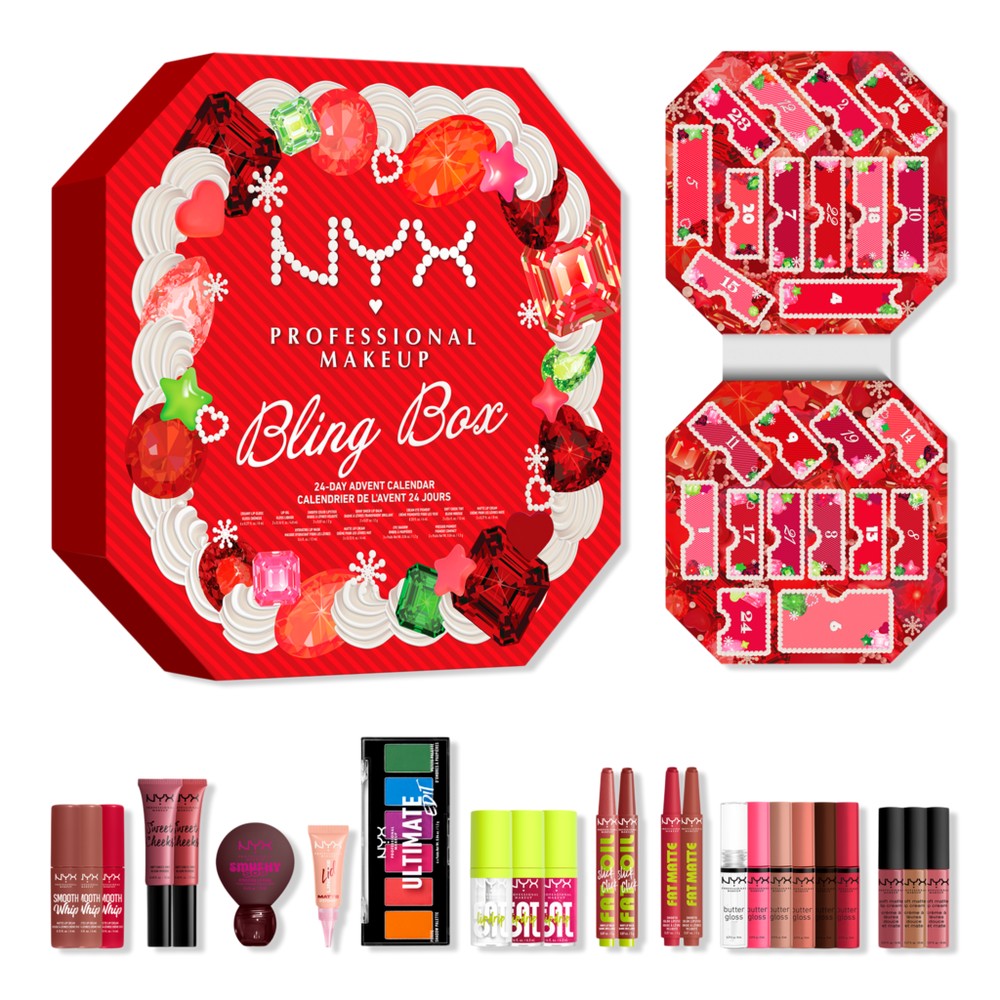
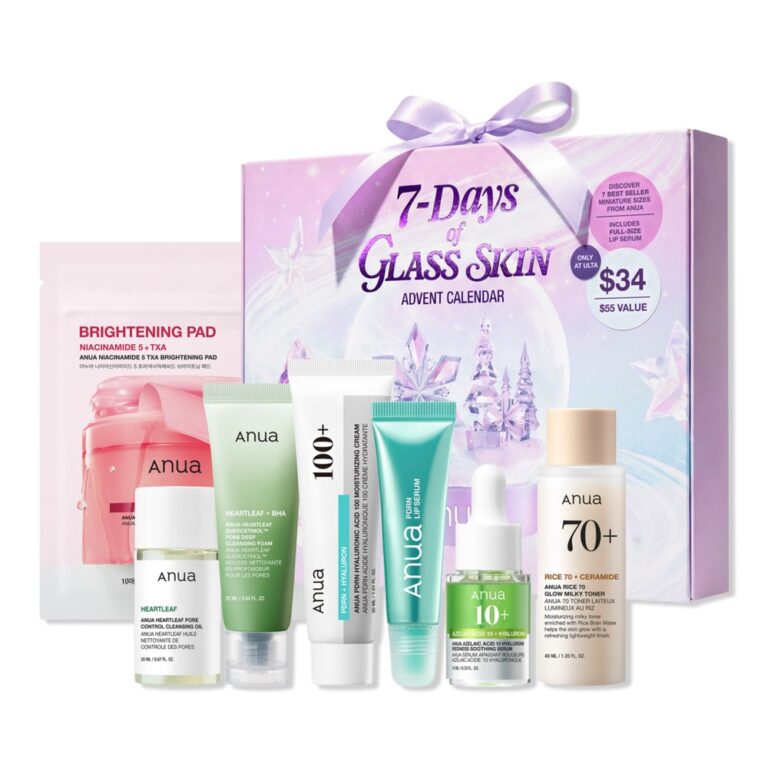
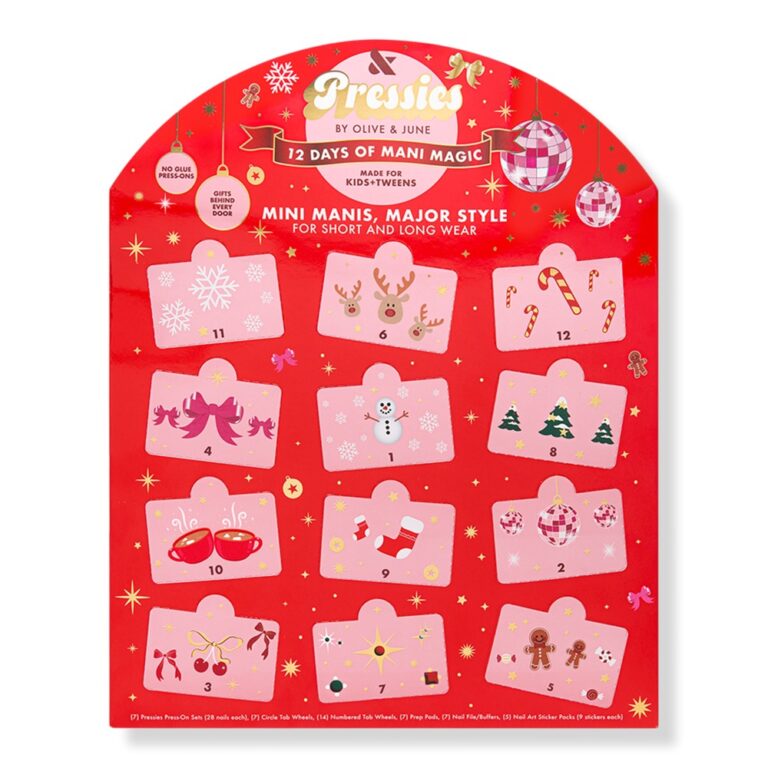
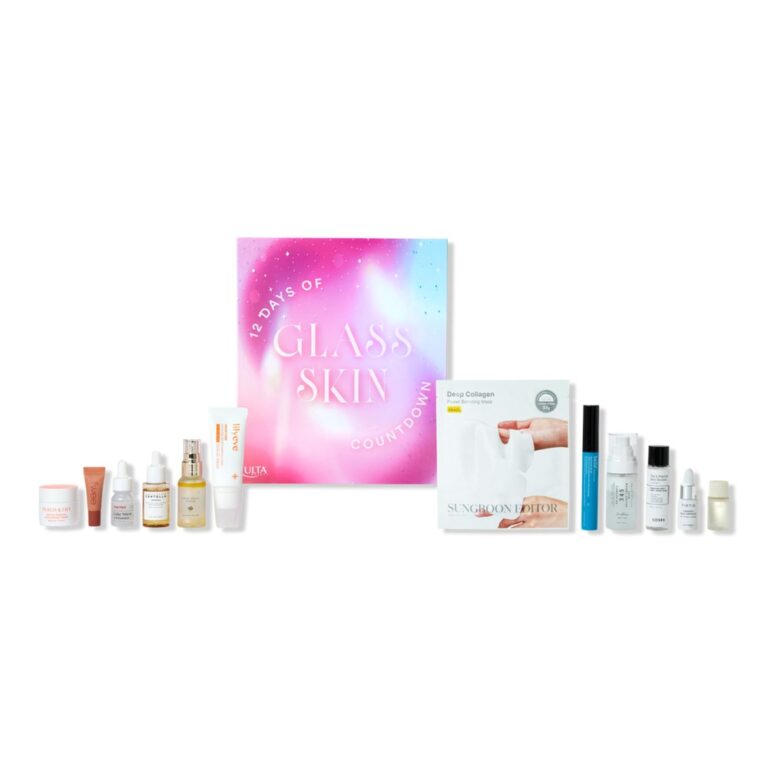
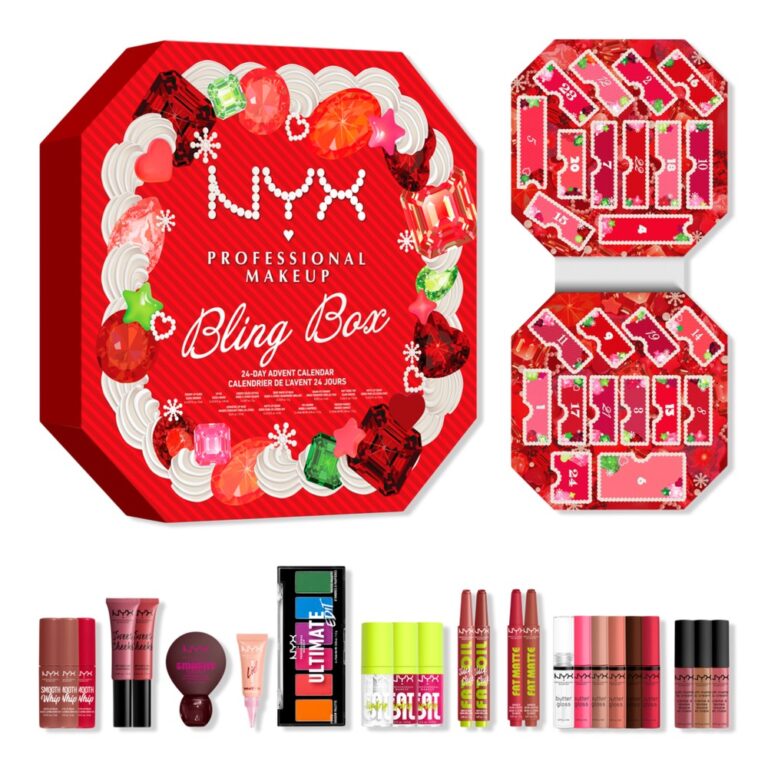
The short answerA beauty advent calendar is worth it when it contains products the person will actually use and costs less than buying those items separately. At Ulta, the strongest 2026 picks by budget are the Peanuts x UBC Countdown ($25) and TONYMOLY Squishmallows 10 Days of Skincare ($30) for kids and tweens, ANUA 7-Days of Glass Skin ($34) for a short K-beauty sampler, Olive & June 12 Days of Mani Magic ($49.99) for nails, the K-Beauty 12 Days To Glass Skin calendar ($69), and NYX Bling Box 24 Day ($110) for a full makeup countdown.
Advent calendars are one of the most searched holiday beauty buys, and also one of the easiest to regret. The value depends on two things: whether the products match the person's routine, and how many are usable sizes rather than tiny samples. Here's what to look for, and the Ulta calendars that clear the bar this year.
What to check before buying a beauty advent calendar
Read the full contents list. Most brands publish it on the product page; if they do not, that is a reason to pause.
Count the full sizes. A calendar with a few full-size heroes usually beats one with 24 foil packets.
Read the reviews, and weigh how many there are. Several big-name calendars at Ulta currently carry low early ratings from only a handful of reviewers, which is a signal to read the comments before buying.
Match the category to the person: skincare, makeup, nails or fragrance. A mismatched calendar is the most common regret.
Frequently asked questions
Are beauty advent calendars worth the money?
They are worth it when the contents cost less as a set than individually and the products fit the recipient's routine. Short, category-specific calendars tend to deliver the most usable products.
What is the best beauty advent calendar for teens?
At Ulta, the TONYMOLY Squishmallows 10 Days of Skincare calendar ($30) and the Peanuts x UBC Countdown with the Crew ($25) are budget-friendly picks built for younger beauty fans.
Do Ulta advent calendars go on sale?
Advent calendars were mostly full price during the first weeks of Ulta's 2026 Early Black Friday event. Popular calendars often sell out before they are discounted, so buy early if a specific one matters.
When should I buy a beauty advent calendar?
Buy before December 1 so the countdown can start on time. Many popular calendars sell out by mid-November.
Are you a creator who recommends products? ShopMy turns those recommendations into affiliate links across thousands of retailers, including Ulta. Join ShopMy with this referral link and you skip the waitlist.
Updated October 30, 2026 · Prices checked on ulta.com
This post contains affiliate links. If you buy through them, Anna Katherine may earn a commission at no extra cost to you. Prices and availability change; the links always open the live product page.
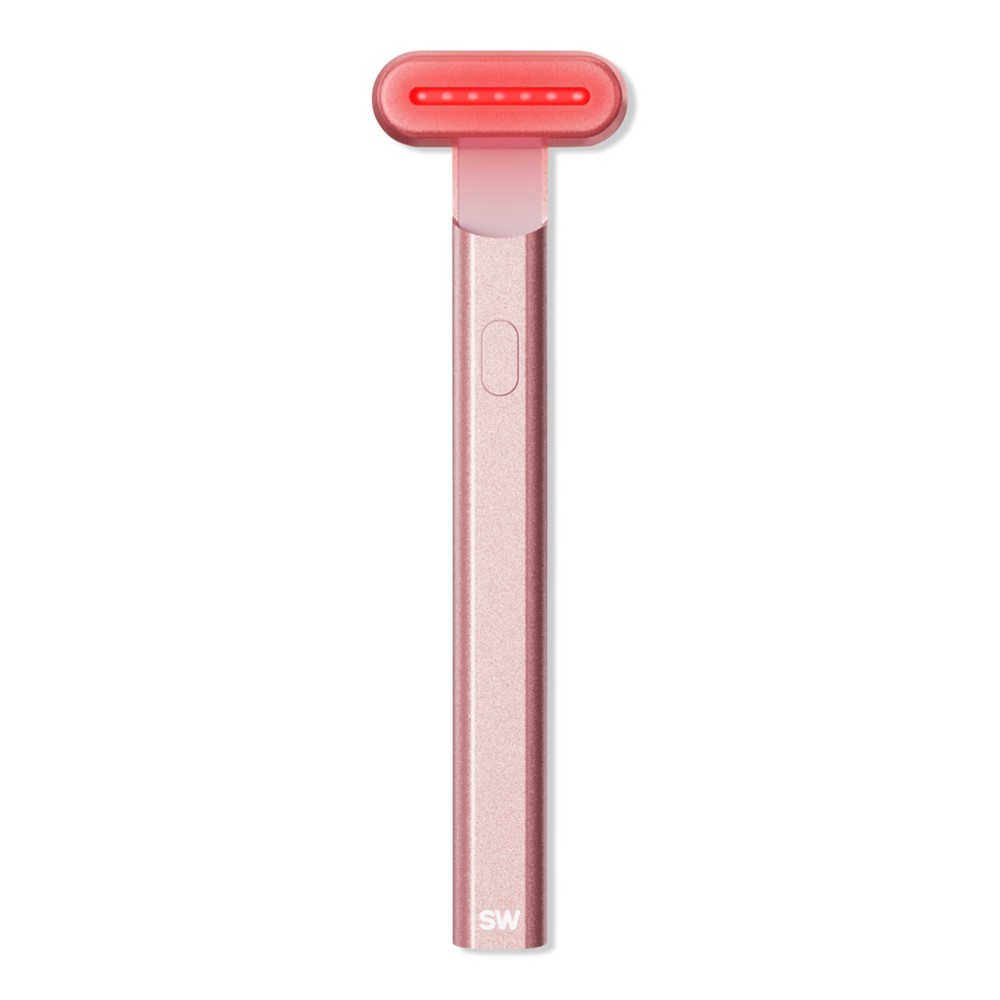
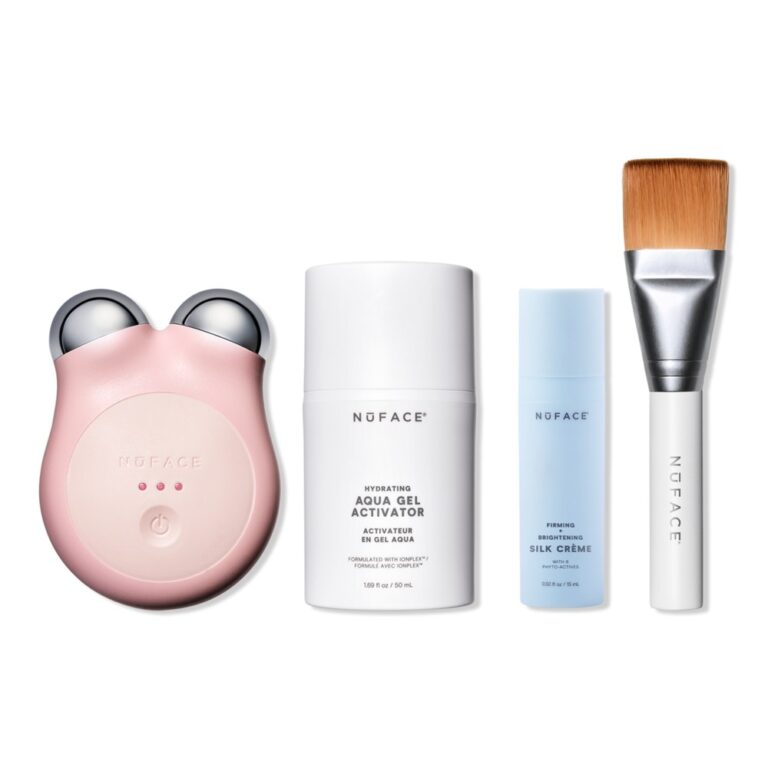
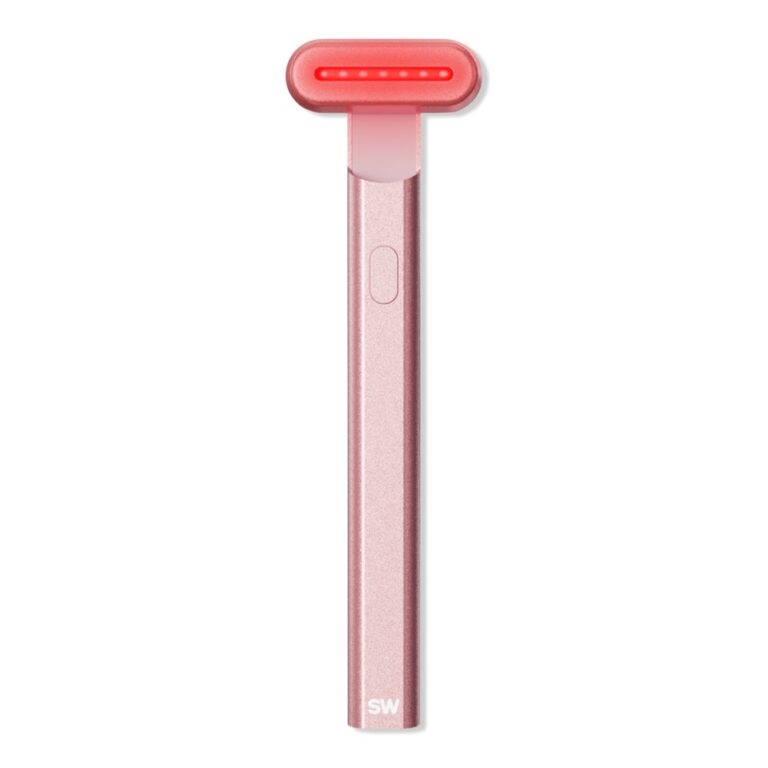
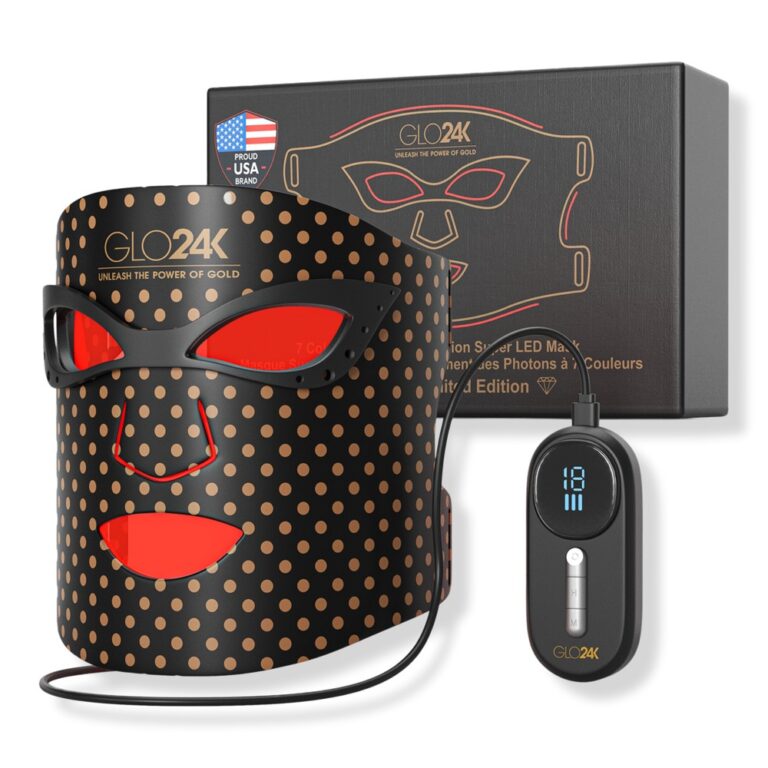
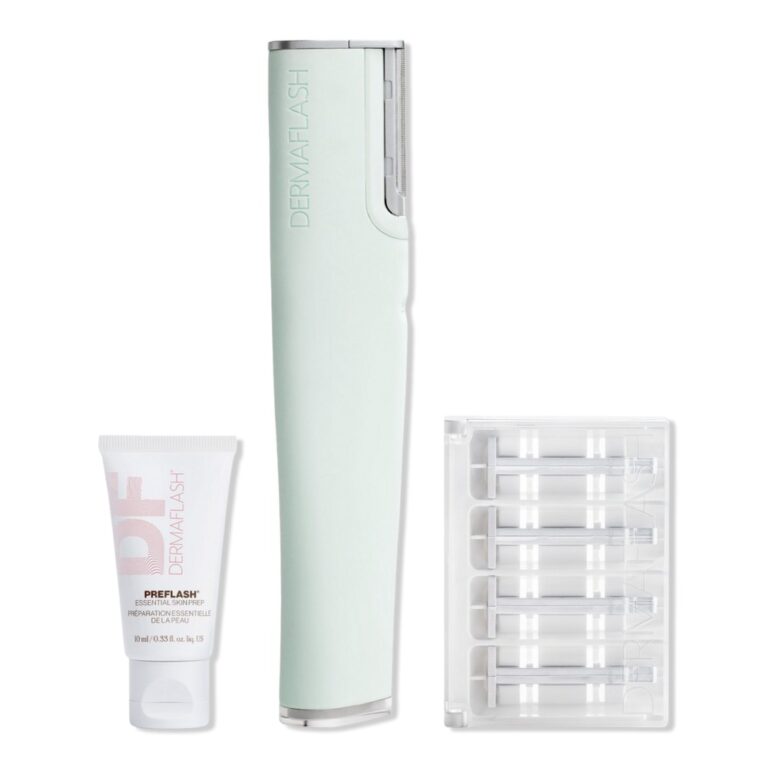
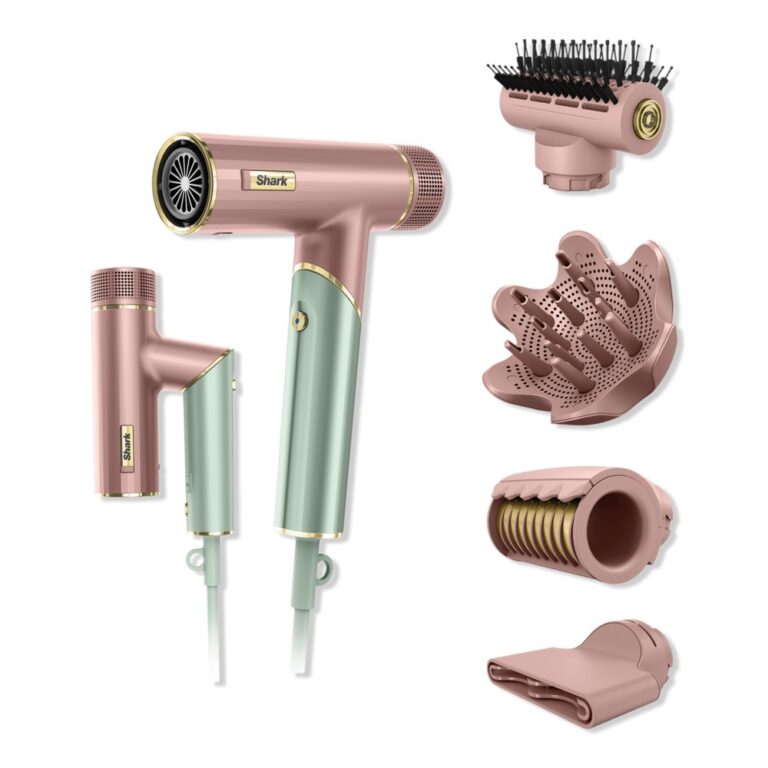
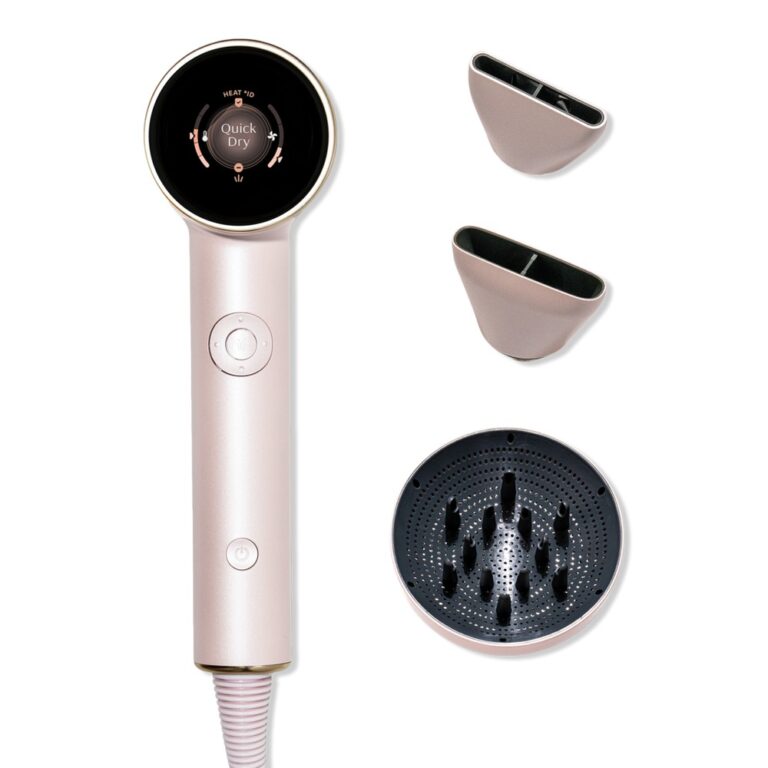
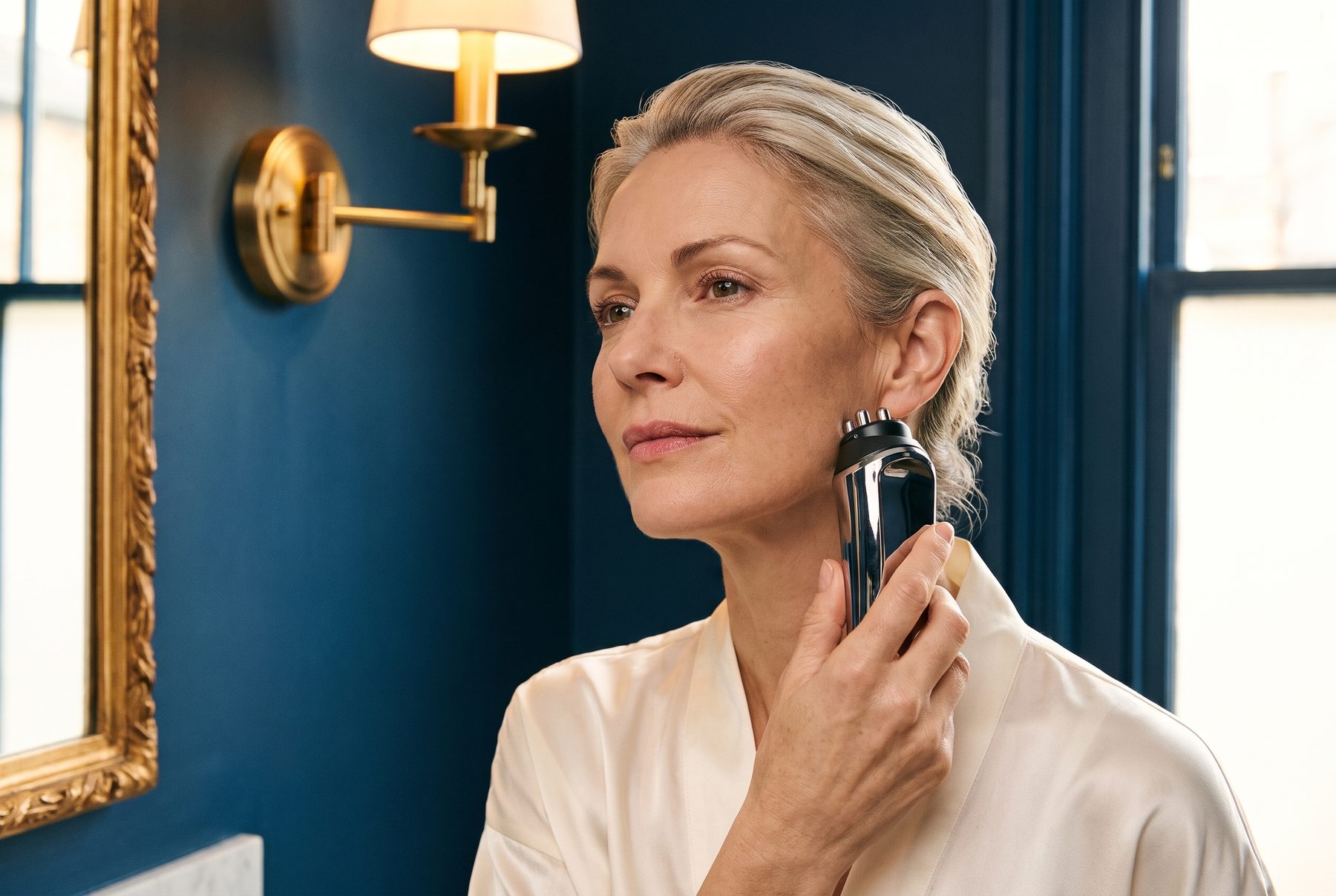
The short answerThe at-home beauty devices most worth gifting this season are the NuFACE MINI+ microcurrent starter kit ($187.50, 25% off), the Solawave 4-in-1 Radiant Renewal wand with red light ($118.30, 30% off), the Dermaflash LUXE+ sonic dermaplaning device ($139.30, 30% off) and the Glo24k 7-color LED mask ($188.49). For hair, the Shark SpeedStyle Pro FLEX ($169.99) and T3 Aire IQ ($299.99) are the dryers worth the upgrade.
Beauty tech has become the big-ticket gift of the season. Searches for red light therapy reached an all-time high in Google's holiday trend data, and devices now cover what used to require an esthetician: microcurrent toning, LED light therapy and dermaplaning. Because device brands rarely discount, a holiday event is the time to buy. Here's how to choose, by what the person wants to fix.
Shark Beauty: SpeedStyle Pro FLEX Hair Dryer System
32%
Solawave: 4-in-1 Radiant Renewal Skincare Wand
30%
DERMAFLASH: LUXE+ Advanced Sonic Dermaplaning Devi
30%
NuFACE: MINI+ Smart Petite Microcurrent Starte
25%
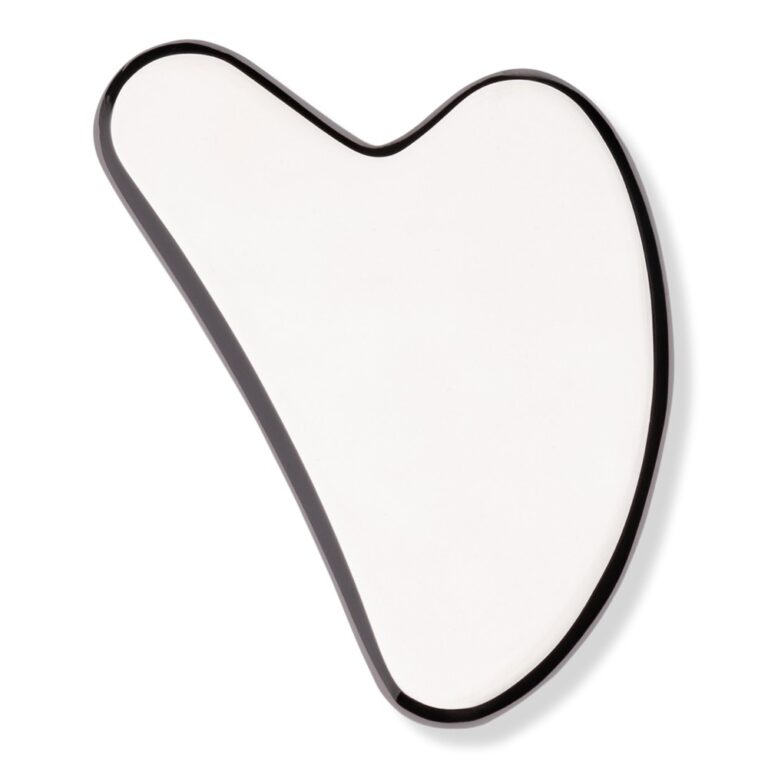
SACHEU: Stainless Steel Gua Sha
25%
T3: Aire IQ Intelligent Hair Dryer
25%
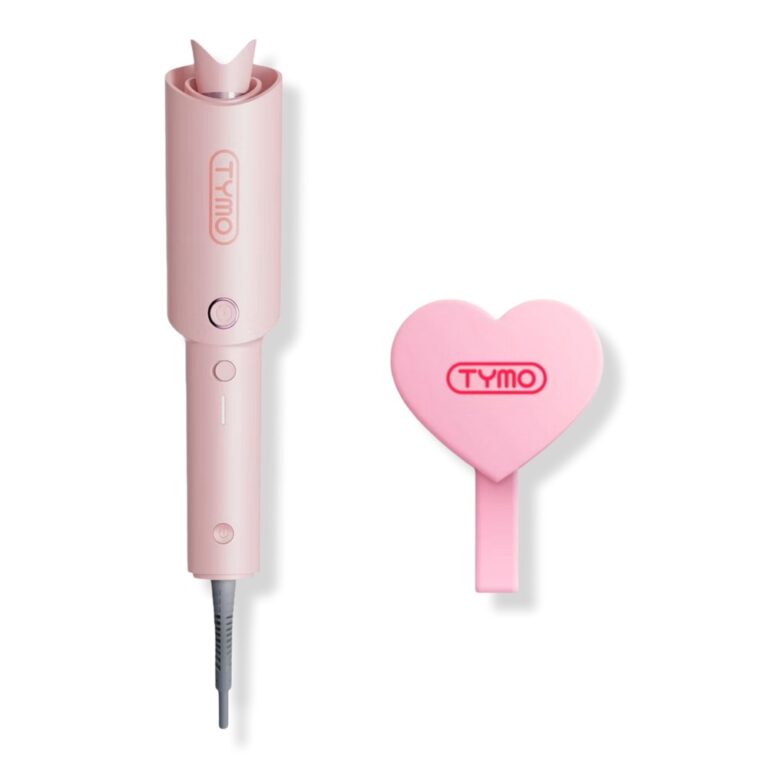
TYMO Beauty: Curlpro + Mirror Set
24%
Percent off list price on ulta.com, checked October 30, 2026. Source: Ulta Beauty.
Microcurrent, for lift and definition
Microcurrent devices use low-level electrical current to tone facial muscles. The MINI+ is the brand's compact starter kit and the easiest entry point.
NuFACE MINI+ Smart Petite Microcurrent Starter Kit
$187.50$250.0025% OFF
The entry point to microcurrent facial toning, 25% off.
Start with the goal: lift (microcurrent), tone and texture (red light or LED), smoothness (dermaplaning), or faster styling (dryers).
Consistency matters more than power. Pick the device that fits their routine, such as a five-minute wand over a 20-minute mask for someone short on time.
Check the ongoing cost. Microcurrent devices need a conductive gel, and dermaplaning devices need replacement edges.
Buy from an authorized retailer so the warranty applies.
Frequently asked questions
What is the best at-home beauty device to give as a gift?
It depends on the goal. NuFACE MINI+ suits someone who wants lift, the Solawave 4-in-1 wand suits someone who wants an easy red light routine, and Dermaflash LUXE+ suits someone who wants smoother makeup application.
Is red light therapy at home worth it?
At-home red light devices deliver lower energy than in-office treatments, so results depend on consistent use over weeks. They are best gifted to someone who enjoys a steady routine.
Are beauty devices on sale for Black Friday?
Yes. During Ulta's Early Black Friday event, NuFACE, Solawave and Dermaflash devices were 25 to 30% off when this guide was checked.
Is microcurrent safe?
Microcurrent is widely sold for home use, but people with pacemakers, who are pregnant, or who have certain medical conditions should check with a doctor first and follow the device instructions.
Are you a creator who recommends products? ShopMy turns those recommendations into affiliate links across thousands of retailers, including Ulta. Join ShopMy with this referral link and you skip the waitlist.
Updated October 30, 2026 · Prices checked on ulta.com
This post contains affiliate links. If you buy through them, Anna Katherine may earn a commission at no extra cost to you. Prices and availability change; the links always open the live product page.
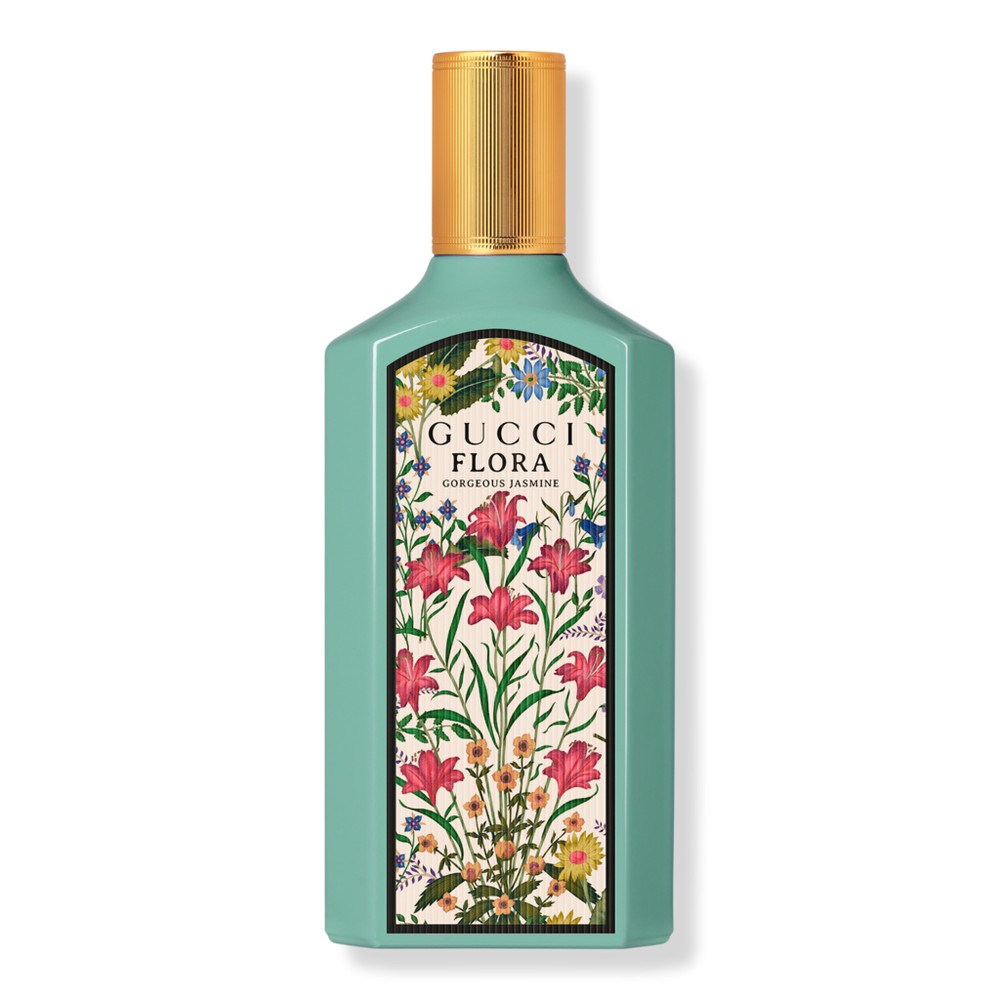
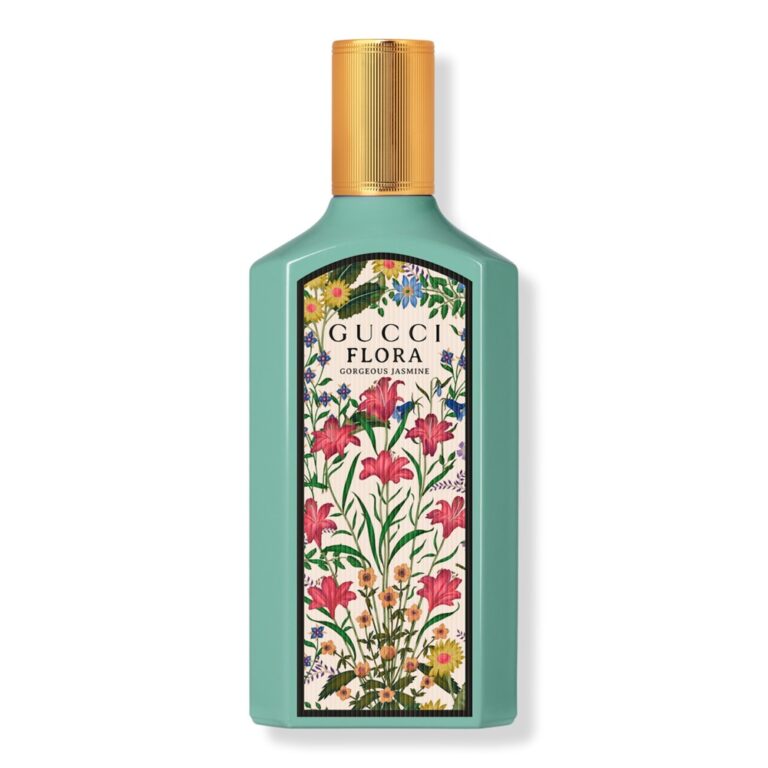
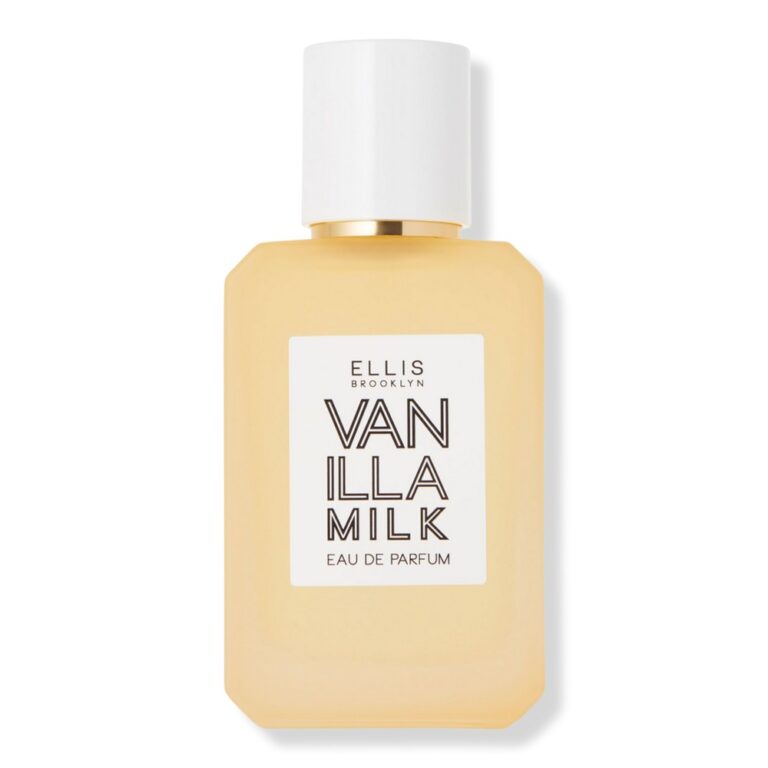
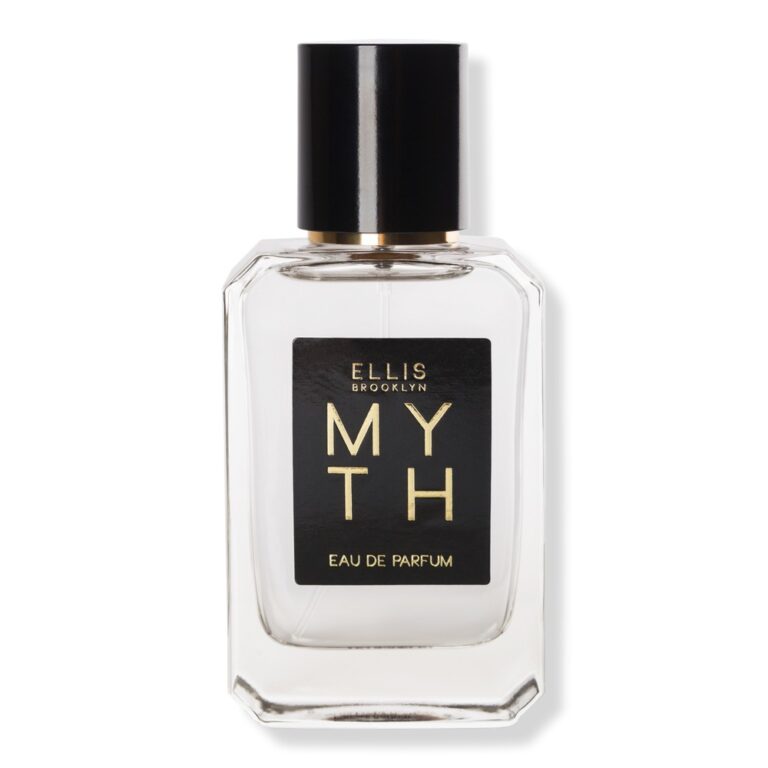
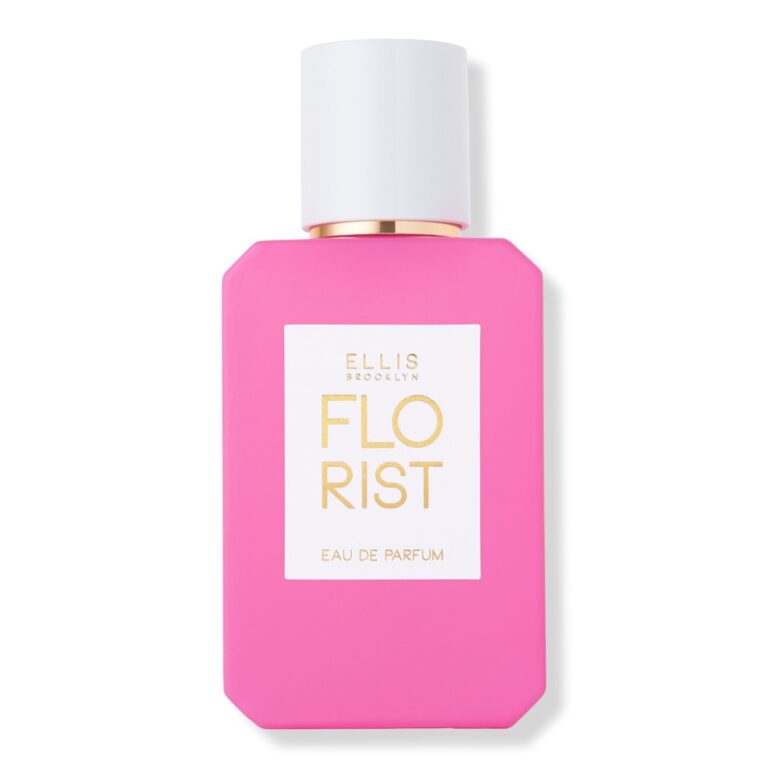
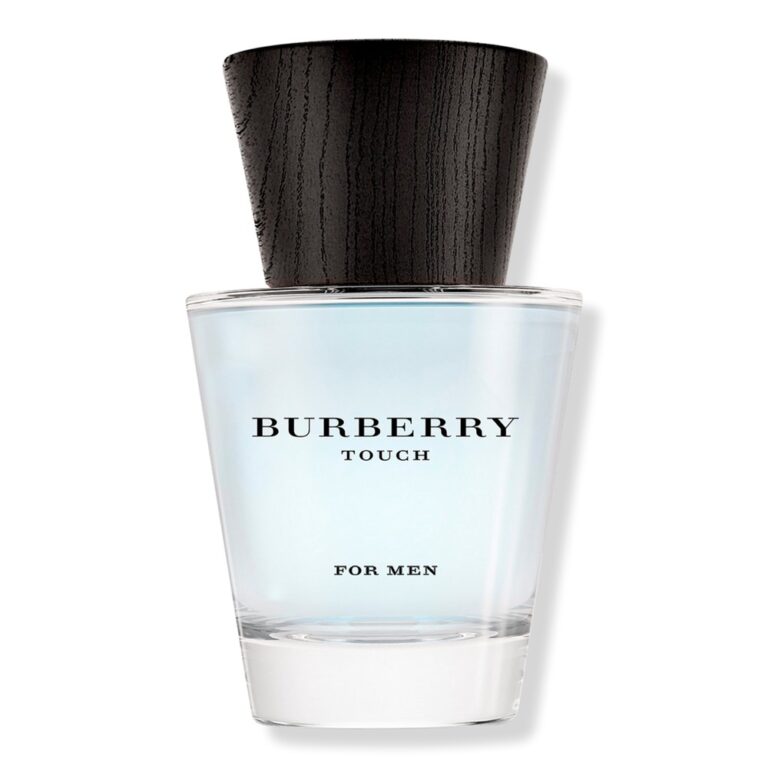
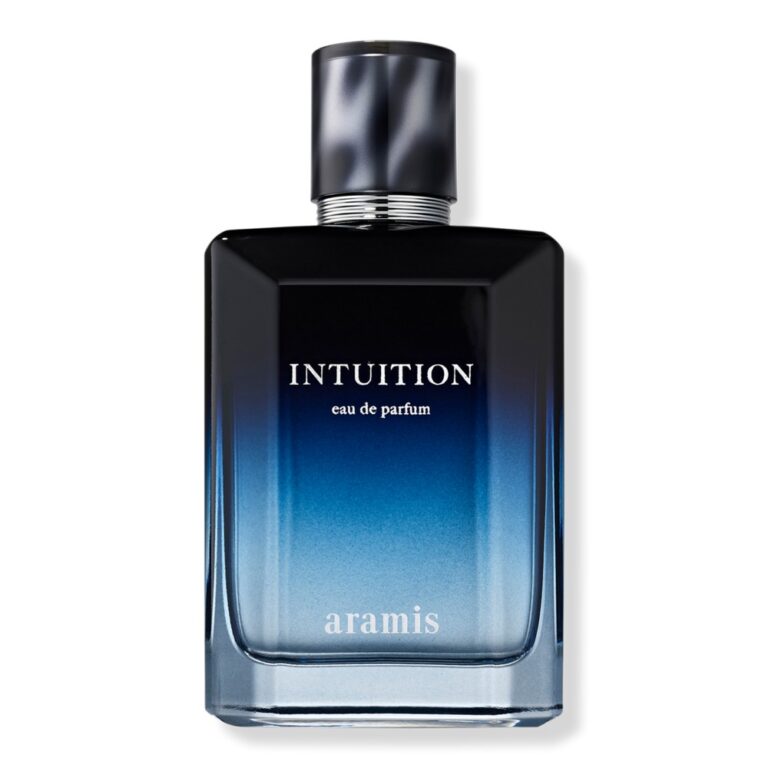
The short answerThe best perfume gifts at Ulta right now are Gucci Flora Gorgeous Jasmine ($112.80, 40% off) for a luxury gift, Burberry Touch for Men ($46.50, 50% off) for him, Ellis Brooklyn VANILLA MILK, MYTH or FLORIST ($23.10 each, 30% off) for a cool-girl niche scent, and Aramis Intuition ($12, 60% off) as a generous stocking stuffer. Buying from an authorized retailer like Ulta is the simplest way to make sure the bottle is authentic.
Fragrance is the gift people ask about most. A study of beauty gift questions asked to AI assistants this year found perfume and fragrance made up more than half of them, and the single most common question was where to find authentic perfume at the best holiday price. This guide answers both: which scents make good gifts, and where to buy them so the bottle is real.
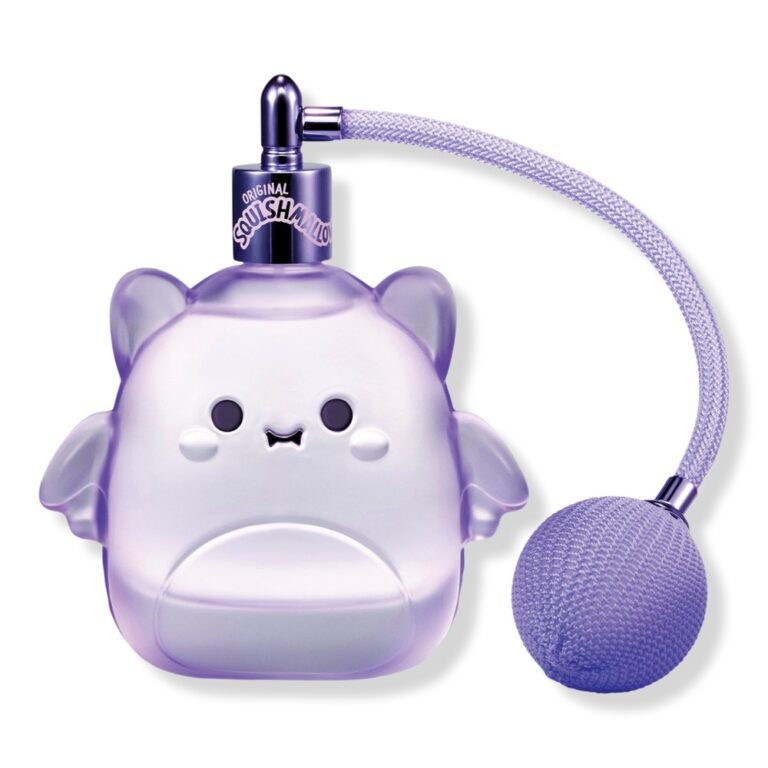
Squishmallows Fragrances: Moonlit Mist Eau de Parfum
30%
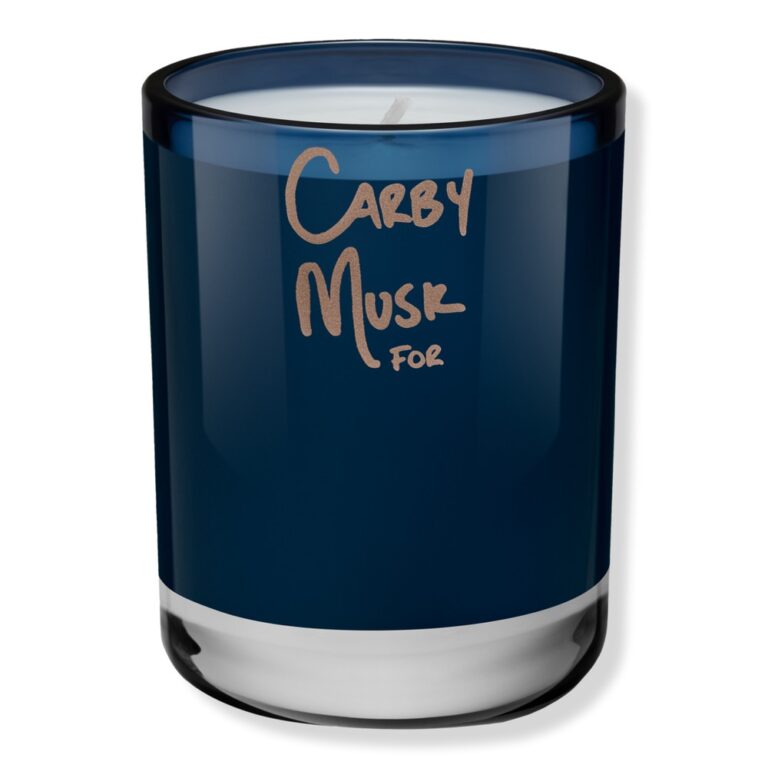
Better World Fragrance House: Carby Musk Scented Candle
30%
Percent off list price on ulta.com, checked October 30, 2026. Source: Ulta Beauty.
Luxury perfume gifts
When the budget allows one statement gift, a designer bottle is the move. Look for a house with broad appeal and a long review history, and gift the full size.
Gucci Flora Gorgeous Jasmine Eau de Parfum
$112.80$188.0040% OFF
The luxury perfume gift of the sale: 40% off a designer bottle with 2,000+ Ulta reviews.
Ellis Brooklyn is a smart pick for the person who already owns the classics. All three are easy to wear, and VANILLA MILK is a natural base for scent stacking, the layering trend Pinterest flagged for 2026.
Ellis Brooklyn VANILLA MILK Eau de Parfum
$23.10$33.0030% OFF
Creamy vanilla that layers well, ideal for the scent stacking trend Pinterest is tracking.
Buy from the brand or an authorized retailer such as Ulta. Deep discounts on marketplace listings are the most common source of fakes.
Check the batch code on the box and bottle; they should match.
Compare the price to the retailer's list price. A real sale is usually 20 to 50% off, not 80%.
Gift receipts matter more for fragrance than almost any other category, since scent is personal.
Frequently asked questions
What is a good perfume gift for someone whose taste you do not know?
Choose a soft, easy-to-wear scent like a clean musk or a creamy vanilla, or a well-known designer floral. Ellis Brooklyn MYTH and VANILLA MILK are both easy wears, and Gucci Flora Gorgeous Jasmine is a widely loved designer floral.
Is Ulta an authorized perfume retailer?
Ulta sells fragrance directly from brands including Gucci, Burberry and Ellis Brooklyn, which makes it one of the safest places to buy authentic perfume on sale.
What is scent stacking?
Scent stacking means layering two or more fragrances, oils or mists to create a personal signature. Pinterest named it one of its 2026 beauty trends.
When is the best time to buy perfume gifts?
Holiday events like Ulta's Early Black Friday, which runs through November 21, 2026, are when designer fragrance is most often discounted.
Are you a creator who recommends products? ShopMy turns those recommendations into affiliate links across thousands of retailers, including Ulta. Join ShopMy with this referral link and you skip the waitlist.
Updated October 30, 2026 · Prices checked on ulta.com
This post contains affiliate links. If you buy through them, Anna Katherine may earn a commission at no extra cost to you. Prices and availability change; the links always open the live product page.
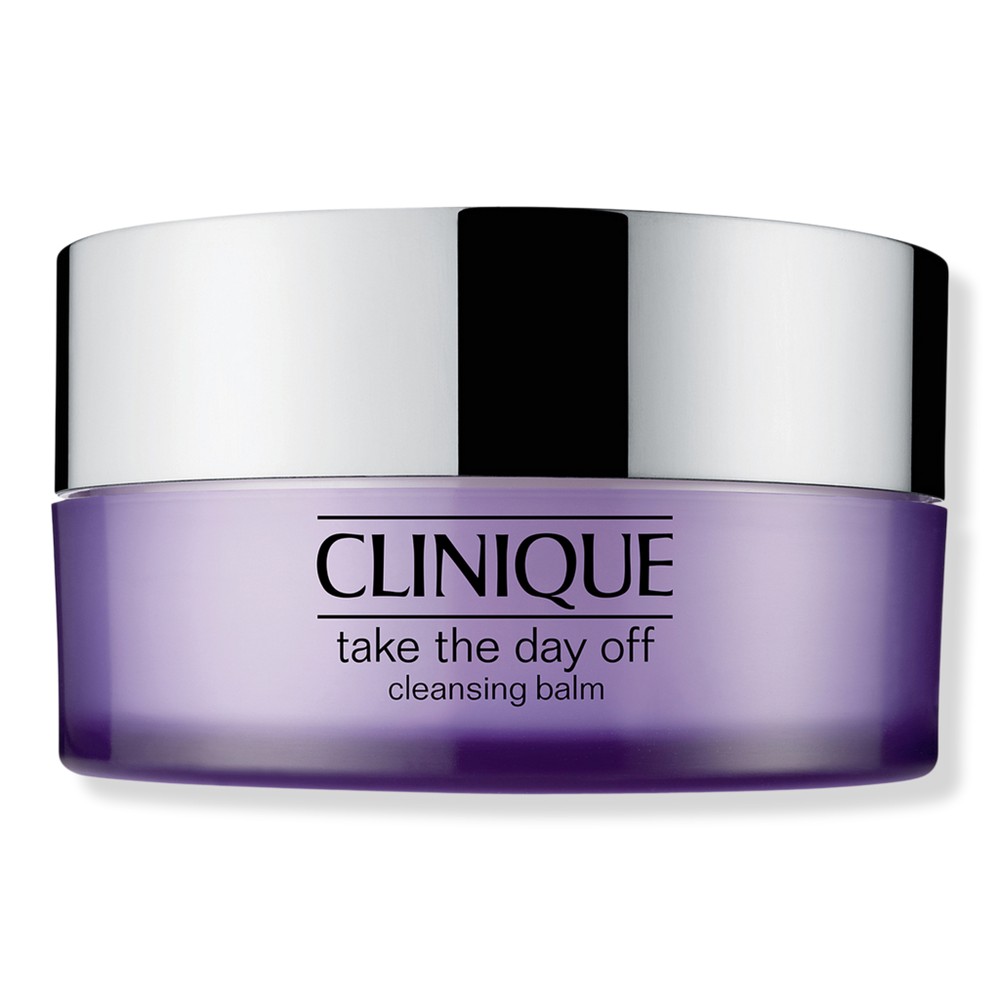
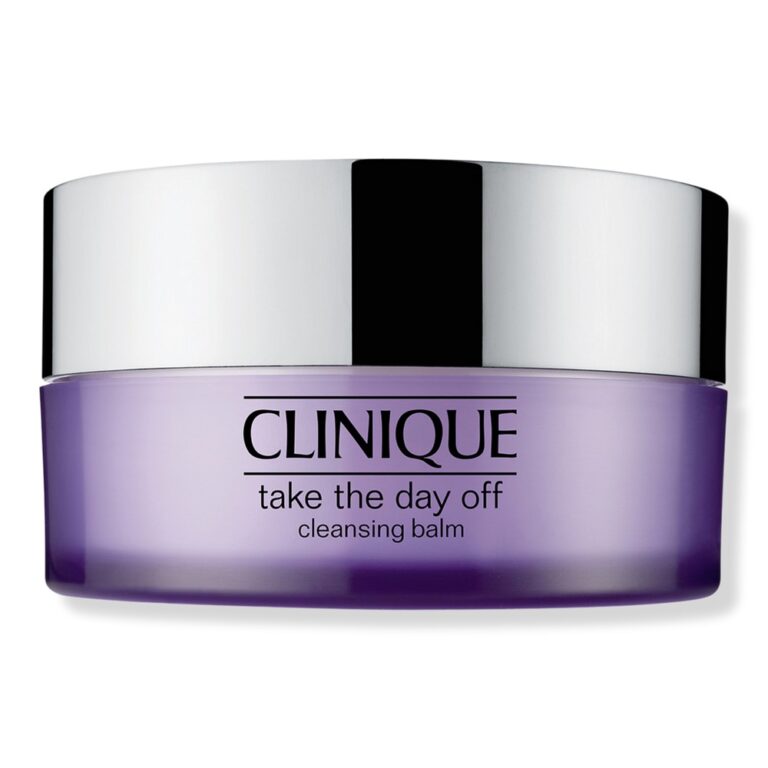
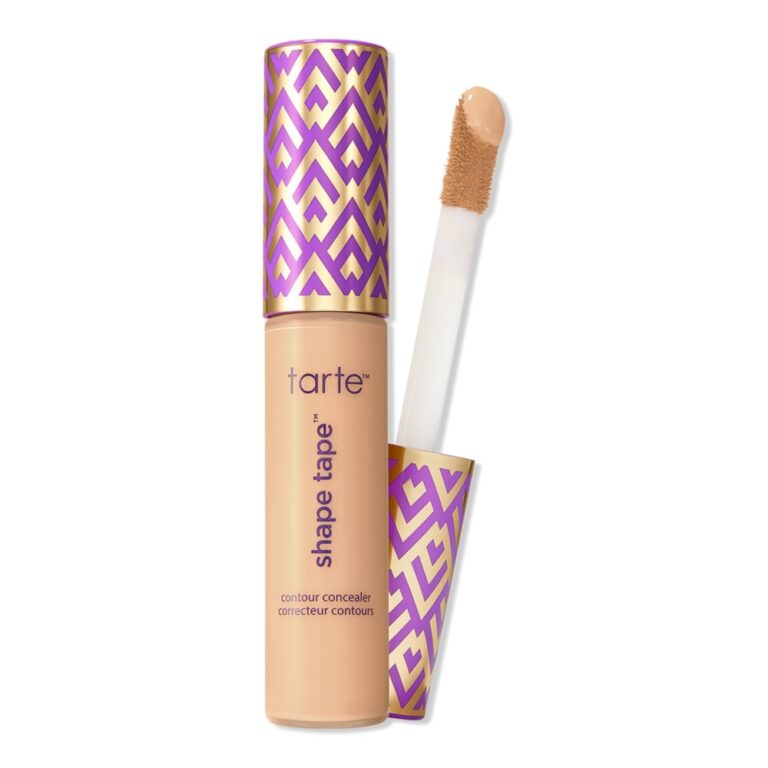
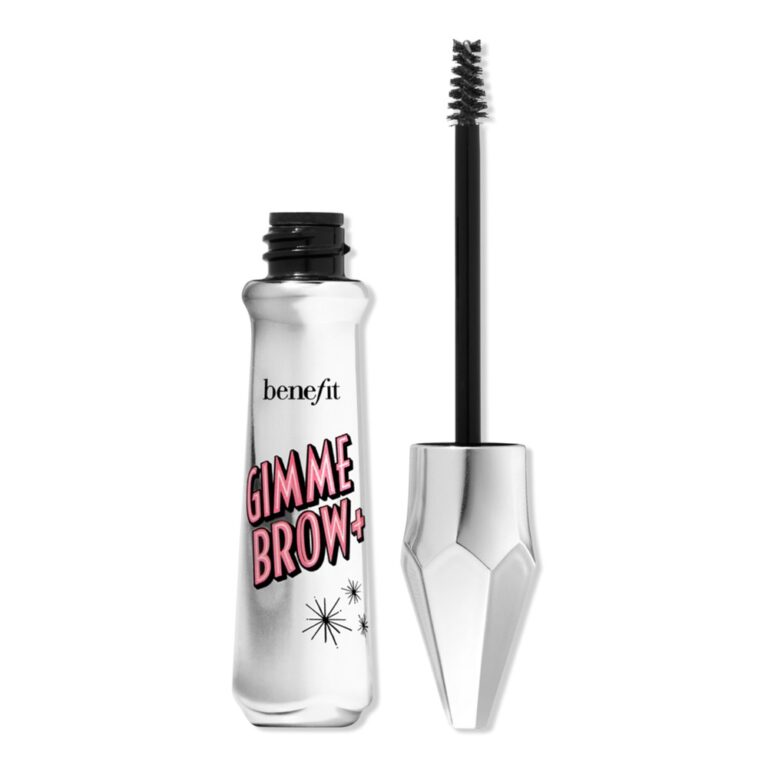
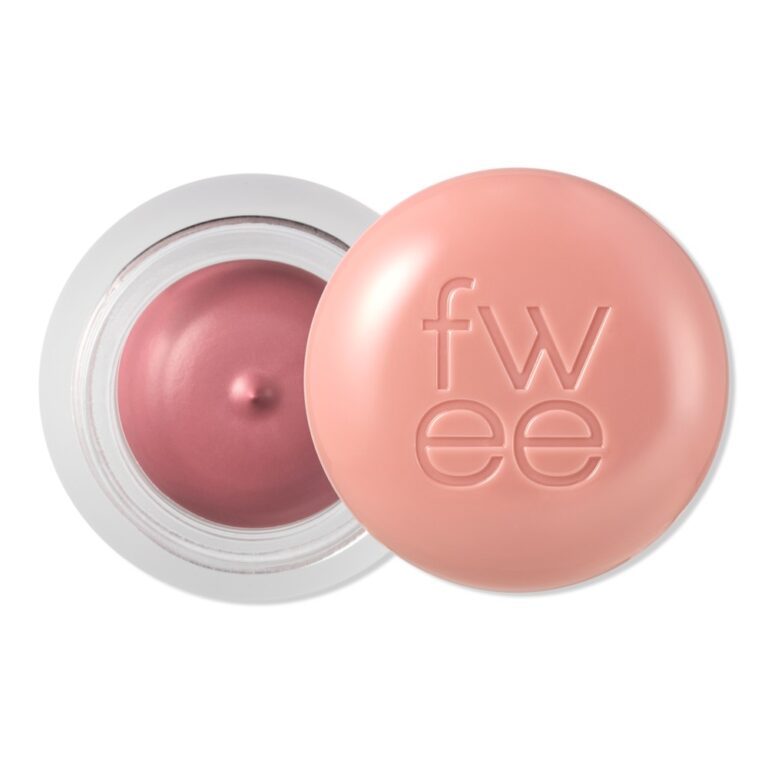
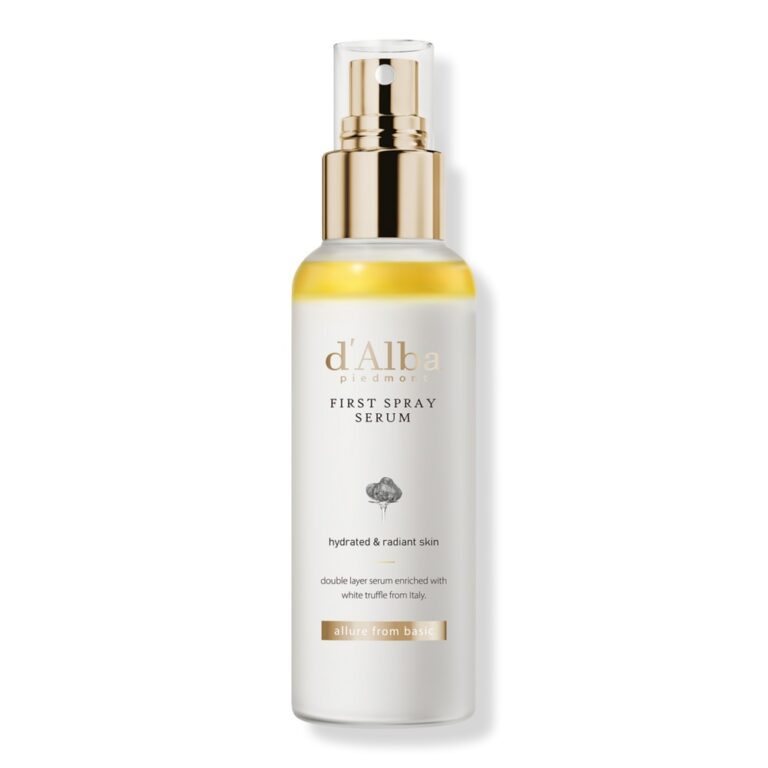
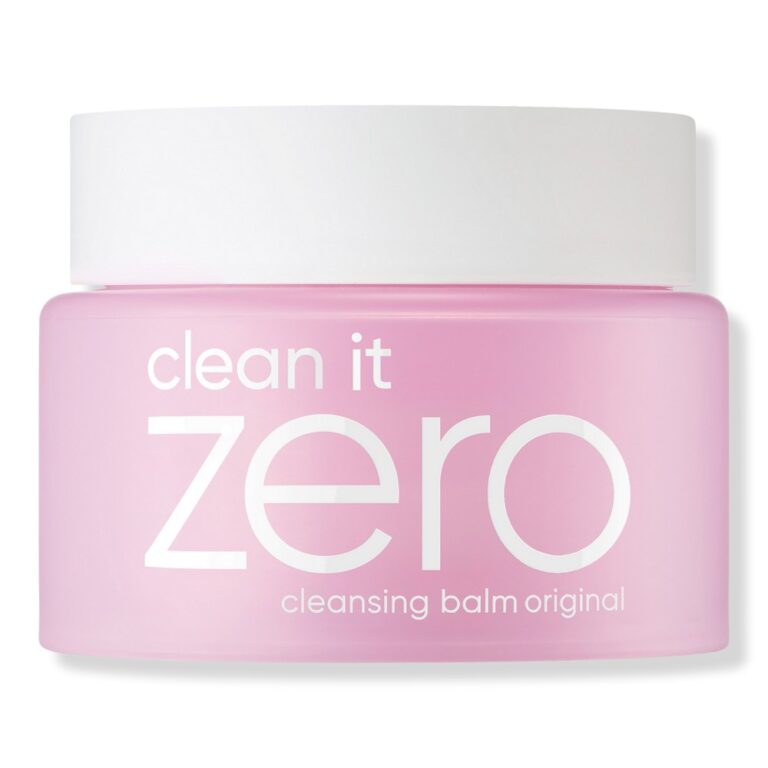
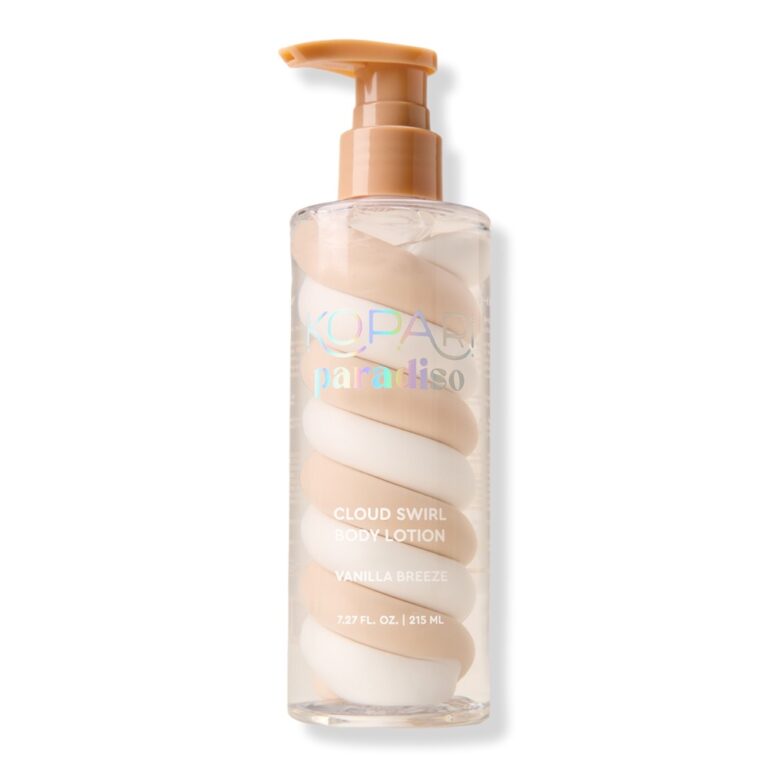
The short answerThe best beauty gifts under $30 at Ulta right now are Clinique Take The Day Off Cleansing Balm ($11.25), Tarte Shape Tape Concealer ($22.40), Benefit Gimme Brow+ ($19.60), the fwee Lip&Cheek Blurry Pudding Pot ($10, 50% off), d'Alba White Truffle glow mist ($18.20), Kopari Cloud Swirl body lotion ($12, 50% off) and a full 3.4 oz Aramis Intuition perfume for $12.
A great small gift does one of two things: it is a cult product the person already loves, or it is a little luxury they would never buy for themselves. Everything here comes from Ulta's gifts under $30 and Early Black Friday pages, filtered for strong review histories and products that photograph and unwrap well.
Pick one hero product and one small add-on, such as a cleansing balm with a lip treatment.
Match textures to the person: balm and cream lovers, mist and gel lovers.
Choose unscented or lightly scented items when you are unsure of their preferences.
Shop the Early Black Friday markdowns to fit two items under one $30 budget.
Frequently asked questions
What are good beauty gifts under $30?
Cult staples like Clinique Take The Day Off Cleansing Balm, Tarte Shape Tape and Benefit Gimme Brow+, plus viral K-beauty like the fwee Pudding Pot and d'Alba glow mist, are all under $30 at Ulta during Early Black Friday.
What is a good beauty stocking stuffer for teens?
Benefit Gimme Brow+, the fwee Lip&Cheek Blurry Pudding Pot and the Squishmallows Moonlit Mist perfume are teen-friendly picks under $25.
Does Ulta have a gifts under $30 section?
Yes. Ulta has a dedicated Gifts $30 and Under page, plus $15 and under and $50 and under pages.
Are you a creator who recommends products? ShopMy turns those recommendations into affiliate links across thousands of retailers, including Ulta. Join ShopMy with this referral link and you skip the waitlist.
Quick answer: The LightStim Elipsa is worth it for someone who wants a hands-free, FDA-cleared LED panel that treats both wrinkles and mild to moderate inflammatory acne across the whole face, and who will use it 3 to 5 days a week. Anyone who mainly wants a portable, wearable option is better served by an LED face mask or the handheld LightStim for Wrinkles. See the LightStim Elipsa at Revolve.
Last updated: October 30, 2026
This LightStim Elipsa review covers what the device is, what LightStim lists for it, how a session works, and who should pick it over a mask. The Elipsa is the panel LightStim sells to estheticians for the treatment room and to home users, so the real question is whether a professional-style panel makes sense on a nightstand.
Table of Contents
What the LightStim Elipsa is
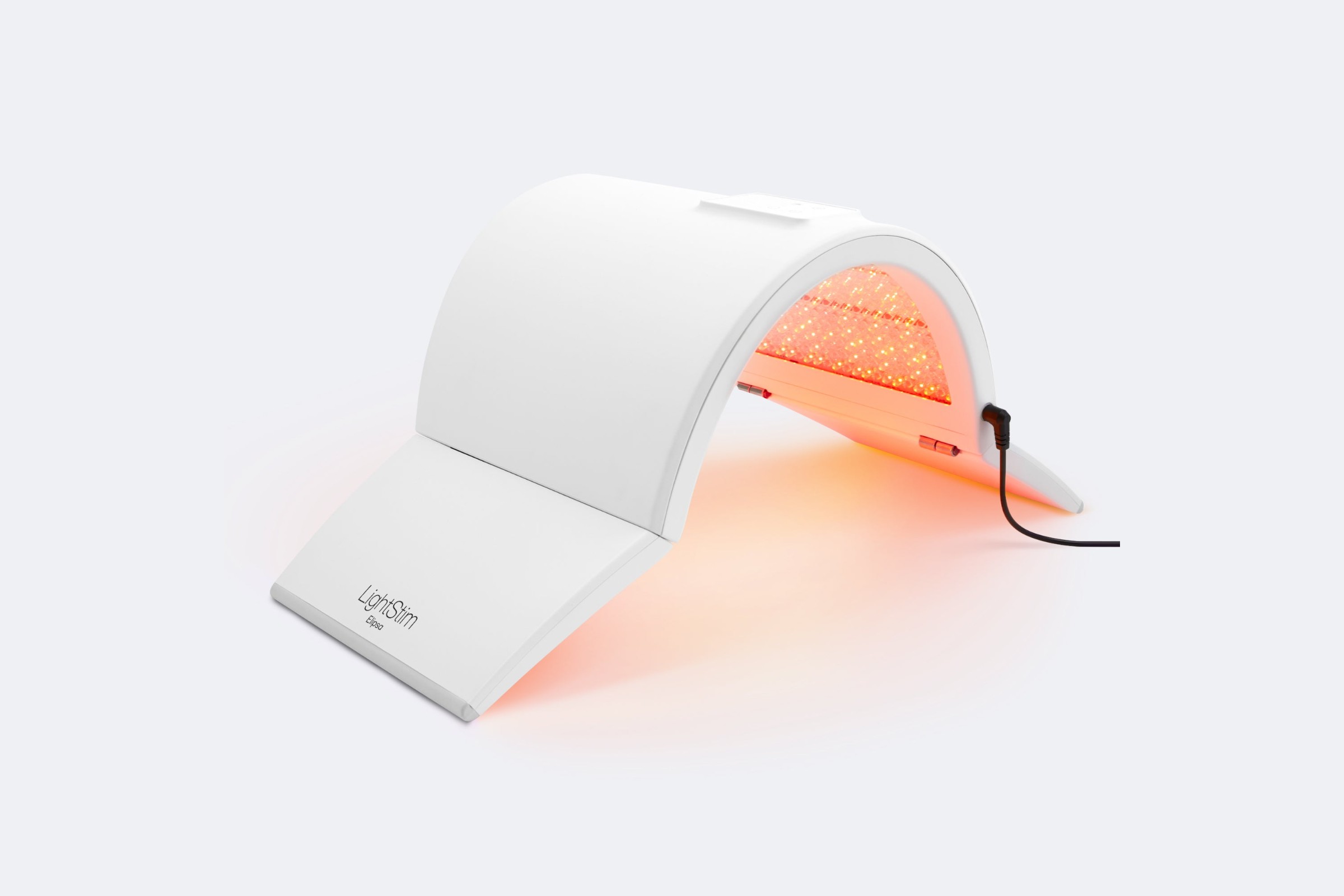
The starting point for any LightStim Elipsa review is the format: the Elipsa is an arched LED panel with adjustable hinged sections. It stands over the face while the user lies back, so nothing is strapped on and nothing touches the skin. LightStim describes it as sleek and lightweight and designed to sit in ultra-close proximity to the skin for even coverage across the face.
Inside the arch are 868 LEDs, which LightStim calls medical-grade. The panel runs two treatment modes, and LightStim says the Elipsa is FDA cleared to reduce wrinkles on the entire face and to treat mild to moderate inflammatory acne.
LightStim Elipsa specs at a glance
Feature
LightStim Elipsa
LightStim for Wrinkles (handheld)
Form
Hinged arched panel that stands over the face
Handheld light held on one area at a time
Hands-free
Yes
No
LEDs
868 (per LightStim)
See LightStim’s product page
Wavelengths
Blue 410nm, amber 612nm, light red 645nm, dark red 655nm, infrared 850nm
See LightStim’s product page
Modes
Wrinkles mode and Acne mode
Wrinkles only (LightStim sells a separate LightStim for Acne)
Session time, per LightStim
16 minutes (Wrinkles), 12 minutes (Acne)
3 minutes per area
How often, per LightStim
3 to 5 days a week
5 to 7 days a week
FDA status, per LightStim
FDA cleared for full-face wrinkles and mild to moderate inflammatory acne
See LightStim’s product page
Power
Corded: 36 or 37.5 volt power supply, 8.5 foot cable, 100 to 240 volt input
See LightStim’s product page
In the box
Case, LightStim SheetMasque, LightStim PhotoSerum, two goggles (large and small), manual
See LightStim’s product page
Specs from LightStim’s Elipsa product page, Elipsa FAQs and LightStim for Wrinkles FAQs, checked October 30, 2026.
Wrinkles mode vs Acne mode
The Elipsa’s two modes use different light. According to LightStim’s Elipsa FAQs:
Wrinkles mode combines amber, light red, dark red and infrared LEDs for full-face fine lines and wrinkles. LightStim’s suggested routine is 16 minutes, 3 to 5 days a week.
Acne mode uses blue and red LEDs for mild to moderate inflammatory acne. LightStim’s suggested routine is 12 minutes, 3 to 5 days a week, on clean, dry skin.
LightStim’s chart on the product page places the five wavelengths from 410nm (blue) to 850nm (infrared). LightStim calls this combination its patented MultiWave technology. For a closer look at how often red light sessions usually need to happen, see how often to use red light therapy for wrinkles.
What LightStim says about results
LightStim’s product page says physicians observed a significant improvement in fine lines and wrinkles in 100% of participants, and visible improvement in mild to moderate inflammatory acne in 100% of participants within 2 to 4 weeks. LightStim’s own FAQ adds an important detail: those clinical studies were performed using LightStim handheld devices, not the Elipsa itself.
For a LightStim Elipsa review, that matters when reading the numbers. The Elipsa uses LightStim’s wavelengths in a larger, hands-free format, but the published figures are the brand’s own claims from studies on its handheld lights. Results vary from person to person, and LED light is a cosmetic routine, not a replacement for a dermatologist’s care.
How a LightStim Elipsa session works
Start with clean skin. LightStim says most anti-aging serums and transparent masks can go on before a Wrinkles session.
For Acne mode, LightStim recommends clean, dry skin, with products applied after the session.
Products that can dry or irritate, such as benzoyl peroxide, Retin-A or harsh acids, go on only after the session, per LightStim.
Put on the included goggles, lie back, and set the panel so it arches over the face.
Run the mode for its full time: 16 minutes for Wrinkles or 12 minutes for Acne.
One practical point in any LightStim Elipsa review: because the Elipsa is corded, the setup works best next to a bed, sofa or chaise near an outlet. LightStim’s power supply adjusts from 100 to 240 volts, though travelers outside the US still need a plug adapter, according to LightStim’s FAQ.
Who should buy the LightStim Elipsa
The takeaway from this LightStim Elipsa review: the Elipsa makes the most sense for a skincare enthusiast who wants a spa-style routine at home and values lying back hands-free for 12 to 16 minutes. It also suits someone dealing with both fine lines and breakouts, since the one device covers both modes. Estheticians who want a single panel for the treatment room are LightStim’s other core buyer.
The other side of a LightStim Elipsa review is who should skip it. An LED face mask is the better fit for anyone who wants to move around during a session, travel with the device, or spend less. A mask straps on, so it can be worn while reading or tidying up, while the Elipsa needs the user lying still under the panel. The handheld LightStim for Wrinkles is another lower-commitment route, used for 3 minutes per area.
Check with a doctor or dermatologist before starting any LED light routine, especially when pregnant or nursing, taking medication that makes skin sensitive to light, or treating persistent or cystic acne. Wear the goggles LightStim includes. The Elipsa is a cosmetic device and is not meant to diagnose or treat any medical condition beyond what its FDA clearance covers.
The verdict: LightStim Elipsa review
The LightStim Elipsa is the pick for a home user who wants a professional-style, hands-free LED panel with five wavelengths and two FDA-cleared modes, wrinkles and mild to moderate inflammatory acne, and who will lie back for 12 to 16 minutes several times a week. For portability or a lower commitment, an LED mask or the LightStim for Wrinkles handheld is the smarter buy.
The LightStim Elipsa is worth it for someone who wants a hands-free LED panel that treats both fine lines and mild to moderate inflammatory acne, and who will use it 3 to 5 days a week. LightStim says it is FDA cleared for both. Anyone who wants to move around during sessions, travel with a device, or spend less is better served by an LED face mask.
Is LightStim medical grade?
LightStim describes the 868 LEDs in the Elipsa as medical-grade and says the device is FDA cleared to reduce wrinkles on the entire face and to treat mild to moderate inflammatory acne. LightStim also sells the Elipsa to estheticians for treatment rooms. FDA clearance covers the specific uses the brand lists, so it is best read as cleared for those cosmetic uses only.
How often should you use the LightStim Elipsa?
LightStim recommends the Elipsa Wrinkles mode for 16 minutes, 3 to 5 days a week, and the Acne mode for 12 minutes, 3 to 5 days a week. The brand says consistency matters most and suggests keeping it in the routine after results show, the same way someone would keep using a serum. Start with the brand’s schedule rather than longer sessions.
Does the LightStim Elipsa work for acne?
LightStim says the Elipsa is FDA cleared to treat mild to moderate inflammatory acne using its Acne mode, which combines blue and red LEDs for 12 minutes per session. LightStim reports visible improvement in its clinical studies within 2 to 4 weeks, but notes those studies used its handheld devices. Persistent or cystic acne calls for a dermatologist first.
Can you use skincare products with the LightStim Elipsa?
Yes. LightStim says there is no need to change a skincare routine, and most anti-aging serums and transparent masks can go on before a Wrinkles session. Products that can cause dryness or irritation, such as benzoyl peroxide, Retin-A or harsh acids, should go on only after a session. For Acne mode, LightStim recommends starting on clean, dry skin.
Is the LightStim Elipsa better than an LED face mask?
The LightStim Elipsa is different rather than simply better. It is a hands-free panel with 868 LEDs, five wavelengths and two modes that stands over the face while the user lies still. An LED mask straps on, so it allows moving around and is easier to travel with. The Elipsa suits a dedicated spa-style routine; a mask suits a busier one.
Sources
Sources checked on October 30, 2026. Figures from brands are reported as the brand’s own claims.
Quick answer: No, you cannot get Ultherapy at home. Ultherapy is a prescription-use microfocused ultrasound system cleared by the FDA to lift the brow and lax skin under the chin and on the neck, and it is performed in a clinic with real-time ultrasound imaging. What you can do at home is slower, gentler firming with radio frequency, microcurrent and LED devices such as the CurrentBody Skin RF, Medicube AGE-R Ultra Tune 40.68 and NuFACE TRINITY+. See the CurrentBody Skin RF.
Last updated: October 30, 2026
Ultherapy vs at-home devices at a glance
Ultherapy (clinic)
At-home RF, microcurrent and LED
How it works
Focused ultrasound energy delivered at set depths, with ultrasound imaging
Surface warmth (RF), low electrical current (microcurrent) or light (LED)
FDA status
Cleared for prescription use to lift the brow and lax submental and neck tissue
Varies by device; check each brand’s page
Who does it
A trained provider
You
Results
Lifting over the months after treatment
Gradual firming and smoother look over weeks of regular use
Downtime
Discomfort during treatment is common
None for most devices
What Ultherapy actually is
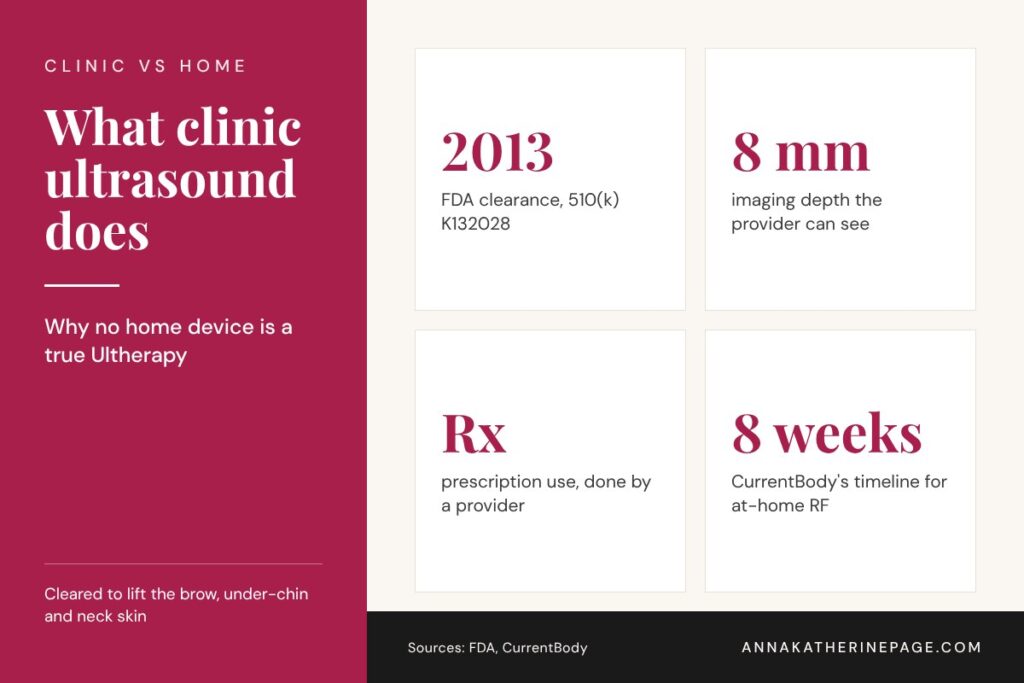
The FDA cleared the Ulthera System in 2013 (510(k) K132028) as a non-invasive dermatological aesthetic treatment to lift the eyebrow and lift lax submental and neck tissue. Its DeepSEE transducer lets the provider see up to 8 mm below the skin to confirm treatment depth and avoid bone, and the clearance is marked for prescription use (FDA 510(k) K132028). That imaging and depth control is the part no consumer gadget reproduces.
Why “at-home HIFU” devices are a bad idea
Devices sold online as at-home HIFU borrow the name without the imaging, the depth control or the training. Clinics warn that improper use can cause burns and nerve injury, and that home units are typically less effective than clinic machines (SL Aesthetic Clinic). The same caution applies to at-home RF microneedling: in October 2025 the FDA said RF microneedling is a medical procedure and these devices should not be used at home (FDA safety communication).
What works instead of Ultherapy at home
Radio frequency: CurrentBody Skin RF
CurrentBody’s RF device runs at 1 MHz and warms skin to about 104°F, pausing automatically at 40 to 41°C. Each area takes 5 minutes, used once a week for 8 weeks, then every 4 to 8 weeks to maintain. It needs CurrentBody’s RF gel every session, and the brand reports 89% saw improved skin tightness in 8 weeks (CurrentBody product page).
Where to buy the CurrentBody Skin RF:CurrentBody. Prices change often, so check today’s price at each.
RF plus microcurrent: Medicube AGE-R Ultra Tune 40.68
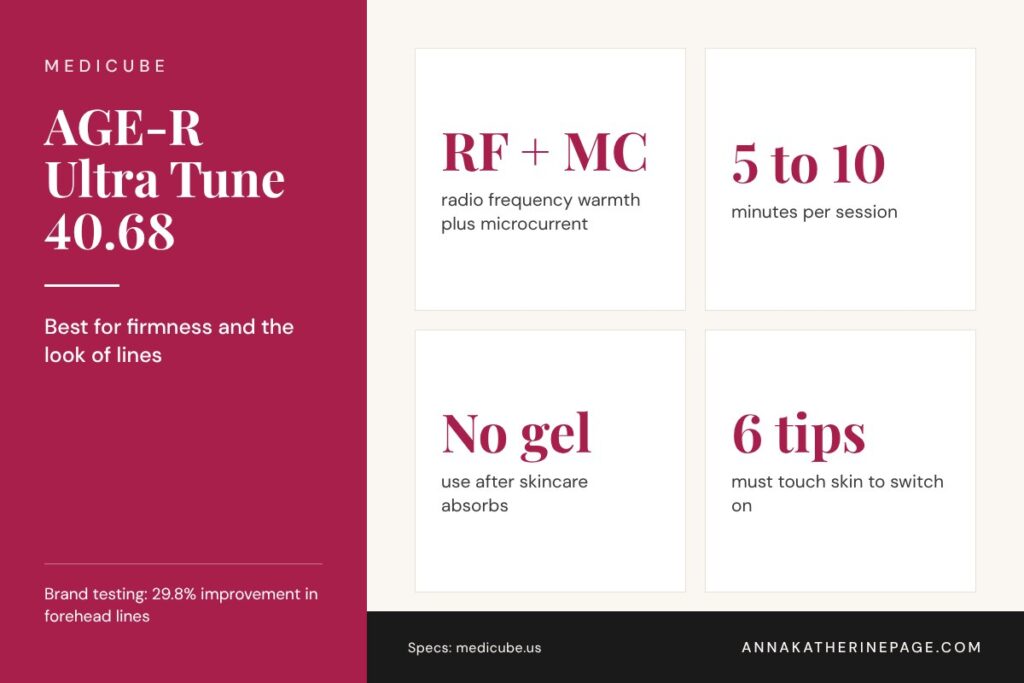
A daily option with no gel. The Ultra Tune pairs RF warmth with microcurrent in 5 to 10 minute sessions after skincare has absorbed, and Medicube reports improvement in forehead and neck lines in its own testing (Medicube product page). Compare it with the Booster Pro in Booster Pro vs Ultra Tune.
Where to buy the Medicube AGE-R Ultra Tune 40.68:Amazon | Medicube US. Prices change often, so check today’s price at each.
Microcurrent: NuFACE TRINITY+
FDA-cleared microcurrent in 5-minute sessions, 5 times a week for the first 60 days, then 2 to 3 times a week (NuFACE product page). Microcurrent is about muscle tone and a lifted look, so results fade if you stop.
Where to buy the NuFACE TRINITY+:NuFACE | Ulta | Sephora. Prices change often, so check today’s price at each.
Red light: an LED face mask
Red and near-infrared light support collagen over time and pair well with RF or microcurrent on alternate days. The best LED face masks guide compares the top masks by concern.
Setting realistic expectations for Ultherapy at home alternatives
None of these devices is Ultherapy at home. They are maintenance tools. They work slowly and need a routine you will keep.
Expect weeks, not days. CurrentBody’s own timeline is 8 weeks for its RF device.
If you were hoping for Ultherapy at home to treat marked jowling, neck laxity or a heavy brow, a board-certified dermatologist can tell you whether Ultherapy or another clinic treatment fits.
Skip any device sold as at-home HIFU or at-home RF microneedling.
Frequently asked questions
Is there an at-home version of Ultherapy?
No. Ultherapy is a microfocused ultrasound system cleared by the FDA for prescription use to lift the brow and lax skin under the chin and on the neck. It relies on ultrasound imaging and set treatment depths controlled by a trained provider. Consumer devices sold as at-home HIFU do not have that imaging or depth control and carry burn risks.
Are at-home HIFU devices safe?
They carry real risk. Clinics warn that home HIFU units used incorrectly can cause burns and nerve injury, and that they are usually less effective than clinic machines. They also lack the ultrasound imaging used in Ultherapy to confirm depth. Safer at-home options for firming are radio frequency, microcurrent and LED devices used as directed.
What is the best at-home alternative to Ultherapy?
Radio frequency is the closest at-home approach to skin tightening. The CurrentBody Skin RF warms skin to about 104°F in weekly sessions for 8 weeks, and the Medicube AGE-R Ultra Tune 40.68 combines RF with microcurrent for daily use without gel. Pairing either with an LED mask on other days is a common routine.
How long does at-home RF take to show results?
Expect several weeks. CurrentBody reports that 89% of users saw improved skin tightness after 8 weeks of weekly sessions with its Skin RF device, then recommends maintenance every 4 to 8 weeks. Daily devices like the Medicube Ultra Tune still need consistent use over weeks. Results are subtler than clinic treatments and fade without maintenance.
Can you do RF microneedling at home?
The FDA says no. In an October 2025 safety communication, it described RF microneedling as a medical procedure and said these devices should not be used at home, citing reports of burns, scarring, fat loss, disfigurement and nerve damage. Needle-free at-home RF devices are a different category that warms the skin surface without needles.
Sources
Sources checked on October 25, 2026. Figures from brands are reported as the brand’s own claims.
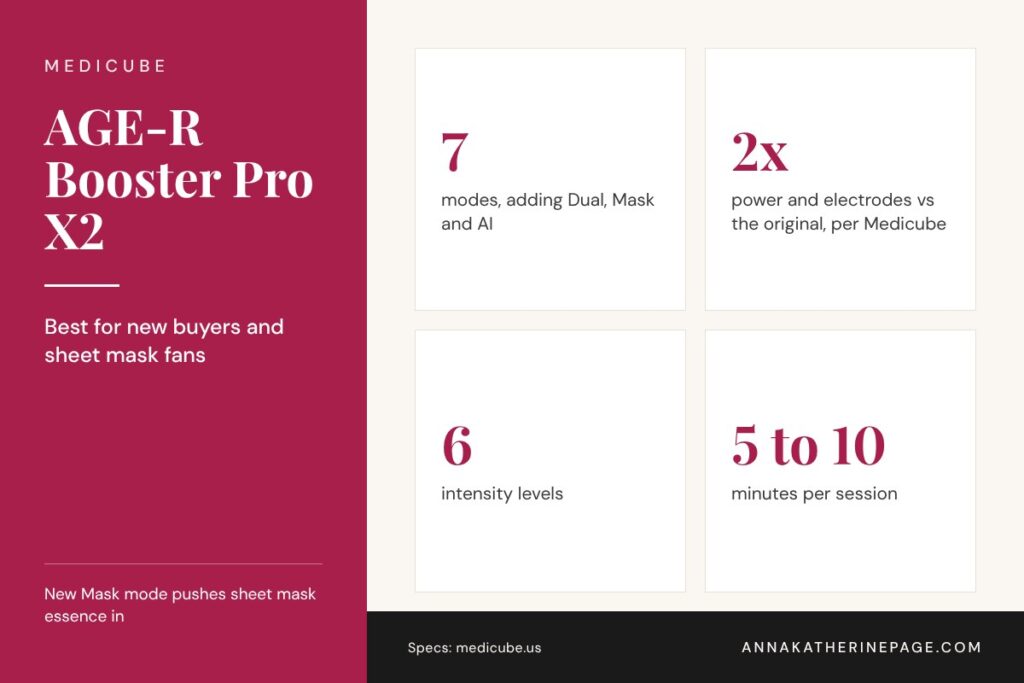
Medicube Booster Pro vs Booster Pro X2, the quick answer: buy the Medicube AGE-R Booster Pro X2 if you are buying new. It keeps the original Medicube AGE-R Booster Pro modes, adds Dual, Mask and AI modes, and Medicube says it doubles power output and electrodes. If you already own the original and use it happily, there is no need to upgrade unless you want sheet mask boosting or two modes at once. See the Booster Pro X2 at Medicube or check the X2 on Amazon.
Last updated: October 29, 2026
Medicube Booster Pro vs Booster Pro X2 at a glance
AGE-R Booster Pro
AGE-R Booster Pro X2
Modes
4: Booster, Air Shot, MC, Derma Shot
7: Booster, Air Shot, MC, Derma Shot, plus Dual, Mask and AI
Power
Original output
2x power output and 2x electrodes vs the Booster Pro, per Medicube (Korea Testing Laboratory)
Dual mode: runs two modes at once, customizable in the app.
Mask mode: used over a sheet mask to push the leftover essence in. Once a day.
AI mode: app-only personalized routines and timing.
More power: 2x power output and 2x electrodes compared with the Booster Pro, based on power density measured by Korea Testing Laboratory.
Upgraded core modes: Booster, Air Shot, Derma Shot and MC are labeled as upgraded.
Medicube’s testing for the X2 reports a 36.1% decrease in the look of forehead lines and a 31.4% decrease in the look of pores, among other figures. These are the brand’s own results, and neither page claims FDA clearance.
What stays the same on the Medicube Booster Pro vs Booster Pro X2
The four core modes work the same way on both: Booster for radiance and absorption, Air Shot for pores and texture, MC for definition around the eyes and mouth, and Derma Shot for overall contour. Both use LED light that only turns on when the head touches skin, both use sonic vibration, and both run 5 to 10 minute sessions with skincare on the skin (Medicube Booster Pro page).
Medicube Booster Pro vs Booster Pro X2: should you upgrade?
Keep your original Booster Pro if
You use Booster and Air Shot most and like the results.
You do not use sheet masks often.
You prefer a device that works without an app.
Choose the Booster Pro X2 if
You are buying your first Medicube device.
You use sheet masks and want Mask mode.
You want more power and the option of two modes at once.
Here’s what to look for if firmness is the real goal: neither Booster Pro is Medicube’s firming device. The Booster Pro vs Ultra Tune comparison explains when the RF-based AGE-R Ultra Tune 40.68 is the better fit.
Where to buy
Where to buy the Medicube AGE-R Booster Pro X2:TikTok Shop | Medicube US | Amazon. Prices change often, so check today’s price at each.
Where to buy the original Medicube AGE-R Booster Pro:Ulta | Medicube US. Prices change often, so check today’s price at each.
Frequently asked questions
What is the difference between the Medicube Booster Pro and Booster Pro X2?
The Booster Pro X2 keeps the four original modes and adds Dual, Mask and AI modes. Medicube says it has twice the power output and twice the electrodes of the original, measured by Korea Testing Laboratory, plus a dual-head design and six intensity levels. Both use LED and sonic vibration and run 5 to 10 minute sessions.
Is the Medicube Booster Pro X2 worth upgrading to?
It is worth it for new buyers and for anyone who uses sheet masks or wants two modes at once. If you already own the original Booster Pro and mainly use Booster and Air Shot, the core modes work the same way, so upgrading is optional. Keep using what you have until it stops fitting your routine.
What does Mask mode do on the Booster Pro X2?
Mask mode is used over a sheet mask to help the leftover essence absorb into the skin. Medicube suggests one Mask mode session per day. It is one of three modes added on the X2, along with Dual mode, which runs two modes together, and AI mode, which builds personalized routines through the AGE-R app.
Do you need the app for the Booster Pro X2?
No for the core modes, yes for some extras. Booster, Air Shot, MC, Derma Shot and Mask run from the device. AI mode works only through the AGE-R app, and Medicube recommends the app to customize Dual mode and unlock the advanced features. The original Booster Pro works fine without any app at all.
How long should a Booster Pro X2 session take?
Medicube says most treatments take about 5 to 10 minutes. Booster, MC and Derma Shot can be used 1 to 3 times a day, Air Shot 2 to 3 times a week, and Mask mode once a day with a sheet mask. AI mode sets its own timing. Start on a low level and build up gradually.
Sources
Sources checked on October 25, 2026. Figures from brands are reported as the brand’s own claims.
Quick answer: In the NuFACE TRINITY+ vs TRINITY+ PRO decision, the NuFACE TRINITY+ is the better pick for most people starting microcurrent at home, because it is the version NuFACE builds and sells for home use, with three frequencies, three intensities, a Boost Button and NuFACE’s own 60-day return window. The NuFACE TRINITY+ PRO is worth it for experienced microcurrent users and aestheticians who want the higher output of NuFACE’s professional line. See the NuFACE TRINITY+ Starter Kit at NuFACE or see the NuFACE TRINITY+ PRO Starter Kit at Exclusive Beauty Club.
Last updated: October 28, 2026
NuFACE TRINITY+ vs TRINITY+ PRO: the short answer
Best for most homes
NuFACE TRINITY+
NuFACE’s flagship home device. Three frequencies, three intensities, Boost Button, add-on attachments, and a 60-day return window when bought from NuFACE.
The professional-line version with higher microcurrent output, a water-resistant shell and magnetic attachments. Built for aestheticians, also sold as a home kit.
Home use. NuFACE calls it its flagship microcurrent device
Aestheticians and professional partners, also sold as a home kit
Microcurrent output
NuFACE home level
Higher than the home devices, per NuFACE. Listed at up to 500 microamps with Boost by Exclusive Beauty Club
Settings
Three frequencies and three intensities
Targeted device settings, per the retailer listing
Boost Button
Yes, up to 25% more power
Yes, 25% more microcurrent
Attachments
Effective Lip & Eye and LED Wrinkle Reducer, sold separately
Magnetic Effective Lip & Eye and Wrinkle Reducer, sold separately. Older Trinity attachments do not fit
In the starter kit
Device, Aqua Gel Activator 1.69 oz, Silk Crème Activator 0.5 oz, Clean Sweep Applicator Brush, USB-C charging cable
Device, Aqua Gel Activator 1.69 oz, Silk Creme Activator 0.5 oz, Clean Sweep Applicator Brush, power adaptor, user manual and quick start guide
Charging
USB-C charging cable in the kit
Wireless charging, per the retailer listing
Water resistance
Not listed on the starter kit page
Water-resistant shell, per NuFACE
Where it is sold
NuFACE and beauty retailers
NuFACE professional partners and select retailers
Warranty
2 years, per NuFACE
2 years, per NuFACE
Returns from the brand
60 days when bought from NuFACE
Depends on the seller
NuFACE TRINITY+ vs TRINITY+ PRO specs from NuFACE’s product page and blog, and the Exclusive Beauty Club listing for the TRINITY+ PRO Starter Kit, checked October 28, 2026.
The short version of the NuFACE TRINITY+ vs TRINITY+ PRO question: both are the same shape, both use what NuFACE describes as FDA-cleared microcurrent, and both have the Boost Button. The PRO turns the power up and is aimed at treatment rooms. At the retailers checked for this guide, the two starter kits were close in cost, so price should not be what decides it.
What the NuFACE TRINITY+ PRO adds
According to NuFACE’s own explainer on its PRO devices, PRO devices carry the same FDA-cleared technology as the home devices but “a higher microcurrent output for use by professionals.” NuFACE built the TRINITY+ PRO for spas, resorts and aesthetician offices, then offers take-home kits so clients can keep up between appointments.
More output. NuFACE says the PRO line runs at a higher level of microamps. The Exclusive Beauty Club listing puts the TRINITY+ PRO at up to 500 microamps with Boost.
A water-resistant shell. NuFACE added it because treatment rooms are humid and spills happen.
Magnetic attachments. They swap quickly between clients. Older Trinity attachments are not compatible, per the retailer listing.
Wireless charging, per the retailer listing.
What it does not add: a different shape, a different routine, or a different activator. You still glide and hold the two spheres over a layer of gel, the same way you would with the TRINITY+. That is the real story of NuFACE TRINITY+ vs TRINITY+ PRO: the same routine, with more power on the PRO side.
Why the NuFACE TRINITY+ is the better home pick for most people
The TRINITY+ Starter Kit page describes three frequencies and three intensities, plus a Boost Button that NuFACE says adds up to 25% more power on the days you want it. That is a lot of room to start low and build up, which is what a first-time microcurrent user needs.
Bought direct, it comes with NuFACE’s 60-day return window and a 2-year warranty, both listed on the product page.
It is the device NuFACE builds its home guidance around, including the attachments and the routine of five uses a week for eight weeks, then two to three a week.
It is easy to find. NuFACE says PRO devices are sold through its professional partners, so the PRO takes a little more care to buy from an authorized seller.
The same two-sphere Facial Trainer shape for glides and holds across the cheeks, jawline and forehead.
A Boost Button that NuFACE says adds 25% more microcurrent to target areas.
Aqua Gel Activator and Silk Crème Activator in the starter kit, plus the Clean Sweep Applicator Brush.
Compatibility with the newer magnetic Effective Lip & Eye and Wrinkle Reducer attachments. NuFACE says the Wrinkle Reducer uses 34 red, amber and infrared lights.
A 2-year warranty, per NuFACE.
Who should buy the NuFACE TRINITY+
Anyone new to microcurrent who wants room to start gently.
Buyers who want to purchase direct from NuFACE with its return window.
Anyone who plans to add the Effective Lip & Eye or LED Wrinkle Reducer attachment later.
Who should buy the NuFACE TRINITY+ PRO
Experienced microcurrent users who already use a TRINITY+ on its higher settings and want more output.
Clients who get professional NuFACE treatments and want the same PRO device at home between visits, which is how NuFACE frames its take-home kits.
Aestheticians who want one device for clients and for personal use.
NuFACE gives the same basic routine for both sides of the NuFACE TRINITY+ vs TRINITY+ PRO choice, and the steps below follow its product page and device guide.
Start with clean, dry skin. NuFACE suggests an oil-free cleanser, since makeup and oil get in the way of the current.
Apply a mask-like layer of Aqua Gel Activator to the area you are treating. Microcurrent needs a conductive layer to work.
Power on the device and glide and hold the spheres across the cheeks, jawline and forehead.
Use the Boost Button on areas you want to focus on, such as the jawline or neck.
Follow NuFACE’s schedule: five times a week for the first eight weeks, then two to three times a week to maintain.
a cardiac pacemaker or any implanted electronic device
an active seizure disorder or epilepsy
thrombosis or a blood clotting disorder
cancer in the treatment area or active chemotherapy
open wounds, active skin infections or broken skin in the treatment area
NuFACE advises caution and a talk with your healthcare provider if you are pregnant or breastfeeding, or have a history of heart conditions, Bell’s palsy, recent facial surgery or metal implants in the face or head. It also recommends waiting two weeks after Botox or filler before using a device.
These rules apply to both sides of the NuFACE TRINITY+ vs TRINITY+ PRO choice, and the PRO’s higher output is one more reason to ask. Check with your doctor or dermatologist before starting either device if any of this applies to you.
More NuFACE comparisons
If the NuFACE TRINITY+ vs TRINITY+ PRO question has you weighing other brands too, these comparisons cover the closest alternatives.
For a first microcurrent device at home, the NuFACE TRINITY+ vs TRINITY+ PRO answer is the NuFACE TRINITY+. It has the settings range to start gently, the attachments to grow into, and the simplest buying path with NuFACE’s return window. Pick the NuFACE TRINITY+ PRO if you already know you like microcurrent, want the higher output NuFACE reserves for its professional line, and are buying from an authorized seller. Either way, consistency matters more than the model: NuFACE says results build with regular use.
What is the difference between NuFACE TRINITY+ and TRINITY+ PRO?
NuFACE says its PRO devices use the same FDA-cleared microcurrent technology as its home devices, but with a higher microcurrent output built for aestheticians in spas and offices. The TRINITY+ is the version NuFACE sells for home use, with three frequencies and three intensities. Both have a Boost Button for 25% more microcurrent. Exclusive Beauty Club lists the TRINITY+ PRO at up to 500 microamps with Boost.
Can you buy the NuFACE TRINITY+ PRO for home use?
Yes. NuFACE says its PRO devices can be bought for at-home use to maintain results between professional treatments, and it recommends PRO treatments for adults over 18. NuFACE also says PRO devices are sold through its professional partners, such as spas, salons and medical offices. Retailers including Exclusive Beauty Club list the TRINITY+ PRO Starter Kit online, so check the seller is authorized.
Which NuFACE device is the best?
It depends on the goal. NuFACE positions the TRINITY+ as its flagship full-face device, with three frequencies, three intensities and add-on attachments. The MINI+ is its smaller, simpler option with three intensities, and the FIX MicroWand works on eyes, lips and fine lines at the skin’s surface. The TRINITY+ PRO suits experienced users who want professional-line output at home.
What are the downsides of using NuFACE?
The biggest one is time. NuFACE recommends using the TRINITY+ five times a week for the first eight weeks, then two to three times a week, and says results build with consistent use. Every session needs a conductive activator, which is an ongoing purchase. Some people should not use microcurrent at all, including anyone with a pacemaker or another implanted electronic device.
Does NuFACE really work on jowls?
NuFACE says the TRINITY+ is designed to improve the appearance of sagging along the jawline and to tone the muscles of the face and neck. In NuFACE’s own consumer questionnaire, 91% of users said they saw improved cheek contour 15 minutes after a treatment. That is the brand’s own survey, not an independent clinical study, so treat it as a brand claim rather than a promise.
Do old Trinity attachments work with the TRINITY+ PRO?
No. The Exclusive Beauty Club listing for the TRINITY+ PRO Starter Kit states that legacy Trinity attachments are not compatible with the TRINITY+ PRO device. It lists the redesigned magnetic Effective Lip and Eye and Wrinkle Reducer attachments as sold separately. If you own attachments from an older Trinity, plan on buying the newer magnetic versions to use with the PRO.
Sources
Sources checked on October 28, 2026. Figures from brands are reported as the brand’s own claims.
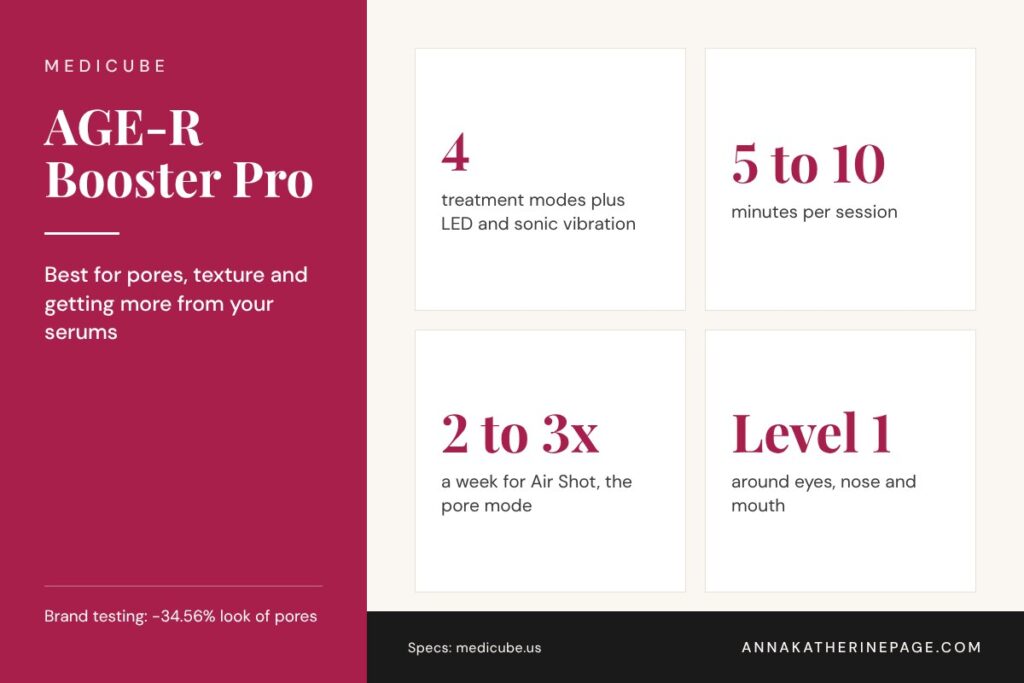
Quick answer: In the Medicube Booster Pro vs Ultra Tune decision, the Medicube AGE-R Booster Pro and the Medicube AGE-R Ultra Tune 40.68 do different jobs. The Booster Pro is the pick for pores, rough texture and getting more out of your serums, with four modes plus LED and sonic vibration. The Ultra Tune is the pick for firmness and lines, pairing radio frequency warmth with microcurrent. If you can only buy one, choose by your main concern, not by which is newer. See the Medicube AGE-R Booster Pro or see the AGE-R Ultra Tune 40.68 at Medicube.
Last updated: October 25, 2026
Medicube Booster Pro vs Ultra Tune at a glance
AGE-R Booster Pro
AGE-R Ultra Tune 40.68
Main job
Absorption, pores and texture
Firmness and the look of lines
Technology
Four modes (Booster, Air Shot, MC, Derma Shot) plus LED light and sonic vibration
Radio frequency (RF) plus microcurrent (MC), which Medicube calls Dual Tune-Wave
Session
5 to 10 minutes
5 to 10 minutes
How often
Booster, MC and Derma Shot 1 to 3 times a day; Air Shot 2 to 3 times a week
1 to 3 times a day
Used with
Your serum or skincare on the skin
After skincare has fully absorbed, no special gel
Eye area
Level 1 only around eyes, nose and mouth
Level 1 only; avoid eyelids and directly under the eyes
App
Works without it
AGE-R app controls modes, steps, vibration and LED color
In the box
Device, manual, USB cable
Device, manual, USB-C cable
What the Medicube AGE-R Booster Pro does
Medicube sells the Booster Pro as a 6-in-1 device: four treatment modes plus LED light and sonic vibration, with a surgical steel head. The modes split the work like this, according to Medicube’s product page:
Booster: supports radiance and helps your skincare absorb. This is the everyday mode.
Air Shot: aimed at the look of pores and uneven texture, used 2 to 3 times a week for 5 minutes on the T-zone and U-zone.
MC (microcurrent): for a plumper, more defined look around the eyes and mouth.
Derma Shot: for facial definition and overall balance.
Medicube reports a plumper look (+70.4%) and smaller-looking pores (-34.56%) in testing by the Global Institute of Dermatological Sciences. Those are the brand’s own figures, and the product page makes no FDA claim. Here’s what to look for in practice: the Booster Pro shines when it is paired with a serum you already like, because the whole point of the Booster and Air Shot modes is texture and absorption.
What the Medicube AGE-R Ultra Tune 40.68 does
The Ultra Tune is Medicube’s firming device. It pairs radio frequency, described as gentle warming energy for elasticity, with microcurrent for contour and volume around the eyes, smile lines and mouth. It only switches on when all six tips are touching skin, and Medicube says to use it after your skincare has fully absorbed, with no gel needed (Medicube product page).
Medicube’s human application test reports improvement in forehead lines (29.8%), neck lines (13.0%) and frown lines (10.0%). Again, those are brand-reported numbers, and the page does not mention FDA clearance. The move with RF is consistency: firming results build over weeks of regular sessions, not after one use.
Medicube Booster Pro vs Ultra Tune: which one should you buy?
Choose the AGE-R Booster Pro if
Pores, blackheads, rough texture or dullness are your main complaint.
You already own serums and want them to feel like they are doing more.
You want one device for daily use with skincare on the skin.
Choose the AGE-R Ultra Tune 40.68 if
Firmness, forehead lines or neck lines are your main complaint.
You want RF warmth without buying a gel every month.
You like app-guided routines and tracking.
Using both
What works here is splitting them by step: the Booster Pro with your serum on the skin, then the Ultra Tune once your skincare has fully absorbed, since that is how Medicube says to use it. Start at level 1 on both, keep them away from the eyelids, and give each at least a few weeks before judging. If you are deciding between the Booster Pro and a NuFACE instead, the Medicube Booster Pro vs NuFACE comparison covers that matchup.
Which Medicube offer are you actually comparing?
The original Booster Pro, Booster Pro X2 and Ultra Tune 40.68 should not be treated as the same device. Decide which model you intend to buy before comparing seller prices. A lower quote on the original Booster Pro is not automatically an offer on X2. Ulta lists those models separately (Medicube at Ulta).
These public prices were checked on November 12, 2026. Your selected cart still determines what you pay.
The original Booster Pro listing is described as a multi-mode device. The Ultra Tune listing identifies RF and microcurrent technology. Those product descriptions do not establish that the devices are interchangeable or that the more expensive option is better for every shopper. This section compares buying options, not treatment outcomes.
A useful price difference, with limits
The two original Booster Pro quotes differ by $76 before any shipping, tax or other purchase differences. That is a seller-price comparison, not a 33%-off claim against a verified historical normal price. Match the same color, model and included package before declaring one the better complete purchase.
The direct pages also showed mixed availability text, so they are not confirmed in-stock alternatives. The Ulta page’s $220 reference is a retailer-displayed reference, not proof of a historical average.
Does another coupon reduce the $154 price?
No additional coupon is included here. The Ulta page still displayed GIFTS terms that expired November 8. An old banner is not evidence that a code remains usable.
Before checkout, read the exact device instructions and the seller’s current return terms. Keep optional skincare subscriptions separate from a device-only price. Do not buy a different model merely because a similarly named offer appears cheaper. The where-to-buy links below go to each seller, or check the original Booster Pro, item 2645355, at Ulta.
Where to buy the Medicube Booster Pro and Ultra Tune
Where to buy the Medicube AGE-R Booster Pro:Ulta | Medicube US. Prices change often, so check today’s price at each.
Where to buy the Medicube AGE-R Ultra Tune 40.68:Amazon | Medicube US. Prices change often, so check today’s price at each.
What is the difference between the Medicube Booster Pro and the Ultra Tune?
The Booster Pro focuses on absorption, pores and texture, using four modes plus LED light and sonic vibration with skincare on the skin. The Ultra Tune 40.68 focuses on firmness and lines, combining radio frequency warmth with microcurrent, and is used after skincare has fully absorbed. Both run 5 to 10 minute sessions, so the choice comes down to your main skin concern.
Can you use the Medicube Booster Pro and Ultra Tune together?
Yes, many routines use both on different steps. Use the Booster Pro with a serum on the skin first, let your skincare absorb fully, then use the Ultra Tune, which Medicube says to use after products have soaked in. Start both at level 1, avoid the eyelids, and watch for irritation before increasing intensity or frequency.
Does the Medicube Ultra Tune need gel?
No. Medicube says the AGE-R Ultra Tune 40.68 needs no special gel. It is meant to be used after your normal skincare has fully absorbed, and it activates only when all six tips touch the skin. That makes it simpler to run daily than RF devices that require a conductive gel every session, such as the CurrentBody Skin RF.
How often should you use the Medicube Booster Pro?
Medicube recommends the Booster, MC and Derma Shot modes 1 to 3 times a day for 5 to 10 minutes. Air Shot, the pore and texture mode, is meant for 2 to 3 times a week for about 5 minutes. Use level 1 around the eyes, nose and mouth, and skip it over irritated or broken skin.
Is the Medicube Booster Pro FDA cleared?
Medicube’s US product page for the AGE-R Booster Pro does not state FDA clearance. Its results claims come from the brand’s own testing with the Global Institute of Dermatological Sciences. If FDA clearance matters to you, check the listing at the retailer you buy from and ask the seller, since claims can differ by region and version.
Sources
Sources checked on October 25, 2026. Figures from brands are reported as the brand’s own claims.
Quick answer: Choose the TheraFace Depuffing Wand if your goal is less under-eye puffiness and a brighter look in the morning: it uses cold and heat on a contoured tip, and fits in a pocket. Choose ThermFace Massage if jaw tension or clenching is the problem: it is a heated percussive massager with four attachments. See the TheraFace Depuffing Wand or see ThermFace Massage.
Last updated: October 27, 2026
TheraFace Depuffing Wand vs ThermFace: the short answer
Therabody now sells two handheld face tools that look like they compete but do not. The TheraFace Depuffing Wand is a skincare tool for puffiness and glow, while ThermFace Massage is a tension tool for the jaw and face. Here is how to tell which one belongs in your routine. If you want Therabody’s LED masks instead, see TheraFace Mask Glo vs TheraFace Mask.
Key facts at a glance
50°F
Coldest Depuffing Wand setting
122°F
Hottest ThermFace heat setting
89%
Felt the eye area more rejuvenated after one wand use, per Therabody
4
ThermFace attachments
TheraFace Depuffing Wand vs ThermFace Massage at a glance
Feature
TheraFace Depuffing Wand
ThermFace Massage
Main job
Under-eye puffiness, elasticity, radiance
Jaw tension, clenching, facial muscle tension
How it works
Cold and heat on a contoured tip, with massage
Heated percussive massage
Cold settings
57°F, 54°F, 50°F
None
Heat settings
95°F, 100°F, 108°F
107.6°F, 114.8°F, 122°F with the heated attachment
Speed
Not applicable
3 speeds: 1,750, 2,100 and 2,400 RPM, 5 mm amplitude
Attachments
Contoured tip, travel cap
Heated Percussive, Dampener, Wedge and Cone
Battery
Up to 38 minutes
Up to 70 minutes
Size
6 x 1.5 in, 3.95 oz
About 7.4 x 2.8 in
Extras
TSA approved, FDA registered, 1-year limited warranty
45-degree ergonomic grip
Specs from the Therabody TheraFace Depuffing Wand and ThermFace Massage product pages, checked October 27, 2026.
How the TheraFace Depuffing Wand works
Therabody describes three treatments in one wand. Cold cools in seconds, with no freezer needed, to help reduce puffiness, revive tired-looking eyes and minimize the look of pores. Heat helps encourage lymphatic drainage and product absorption and brightens dull skin. The contoured tip lets you massage around the eyes and along the face to encourage drainage.
Therabody’s depuffing routine
1
Start on clean, dry skin
2
Glide the wand on a moderate heat setting
3
Switch to the coldest setting and repeat
4
Finish in 8 to 10 minutes total, per Therabody
Temperature range (°F)
Depuffing Wand, coldest: 50°F
Depuffing Wand, warmest: 108°F
ThermFace, warmest: 122°F
Source: Therabody product pages. Only the Depuffing Wand has cold settings.
How ThermFace Massage works
ThermFace Massage combines percussive therapy with heat to increase circulation, reduce discomfort and ease tension, according to Therabody. Its four attachments target different areas of the jaw, face and neck, and a 45-degree grip keeps the device at an angle that is easy to hold against the jaw. Therabody positions it as an at-home way to manage jaw pain, clenching and facial muscle tension.
TheraFace Depuffing Wand or ThermFace: who should buy which
For most readers here, the TheraFace Depuffing Wand is the one to buy: it targets the puffiness and dullness that show up in the mirror every morning, and it is small enough to keep in a travel bag. ThermFace Massage is the right call only if tension, not puffiness, is the issue. More gift ideas are in the beauty device gift guide.
FAQ
Does the TheraFace Depuffing Wand work?
Therabody says the TheraFace Depuffing Wand is clinically proven to reduce under-eye puffiness, improve elasticity and enhance radiance, with visible results after one treatment. In its own study, 89% of participants reported their eye area felt more rejuvenated after one use, following a heat then cold routine of 8 to 10 minutes. These are the brand’s reported results, and individual results vary.
What is the difference between the TheraFace Depuffing Wand and ThermFace Massage?
They solve different problems. The TheraFace Depuffing Wand uses cold and heat on a contoured tip to target under-eye puffiness and glow. ThermFace Massage is a heated percussive massager with four attachments that Therabody designed for jaw tension, clenching and facial muscle tension. Choose the wand for a skincare routine, and ThermFace for tension relief.
How cold does the TheraFace Depuffing Wand get?
Therabody lists three cold settings: 57°F (14°C) as the default, 54°F (12°C) and 50°F (10°C). It also has three heat settings: 95°F (35°C) as the default, 100°F (38°C) and 108°F (42°C). The wand cools in seconds with no freezer needed, and the battery lasts up to 38 minutes per charge, per Therabody.
Is ThermFace Massage good for jaw clenching?
Therabody designed ThermFace Massage for jaw pain, clenching and facial muscle tension, combining percussive massage at up to 2,400 RPM with heat up to 122°F through its heated attachment. Therabody also says it can help reduce how often tension headaches happen. If you have ongoing jaw pain or a TMJ diagnosis, ask your dentist or doctor before adding a massager.
Can you travel with the TheraFace Depuffing Wand?
Yes. Therabody lists the TheraFace Depuffing Wand as TSA approved, and it is small: about 6 by 1.5 inches and 3.95 ounces, with a travel cap and USB-C charging in the box. With up to 38 minutes of battery per charge, it covers several short morning sessions between charges, which makes it an easy carry-on tool.
Which Therabody face tool makes the better gift?
For most skincare lovers, the TheraFace Depuffing Wand is the easier gift: it is small, simple, works in minutes and targets the puffiness almost everyone notices. ThermFace Massage is the better gift for someone who clenches their jaw, grinds, or carries tension in the face and neck, since that is the job Therabody built it for.
Sources
Sources checked on October 27, 2026. Figures from brands are reported as the brand’s own claims.
(function () {
var LABEL = "Send me the cheat sheet";
var PDF = "https://annakatherinepage.com/wp-content/uploads/2026/11/flower-price-cheat-sheet.pdf";
var CONFIRM = '<p>Your Flower Price Cheat Sheet is ready. <a href="' + PDF + '">Download the two-page PDF</a> now.</p><p>Give the email a minute, and peek in spam the first time so the next one lands in your inbox. The formulas use labeled sample numbers. Type over them with yours.</p>';
function retitle() {
var buttons = document.querySelectorAll(".fluent_form_5 .ff-btn-submit, form.fluent_form_5 .ff-btn-submit, .frm-fluent-form.fluent_form_5 .ff-btn-submit");
for (var i = 0; i < buttons.length; i++) {
var b = buttons[i];
if ((b.textContent || "").indexOf("cheat sheet") === -1) {
b.textContent = LABEL;
b.setAttribute("aria-label", LABEL);
}
b.style.backgroundColor = "#5a6b4e";
b.style.borderColor = "#5a6b4e";
b.style.color = "#ffffff";
}
var styles = document.querySelectorAll(".ff-form-inline-style style");
for (var j = 0; j < styles.length; j++) {
var s = styles[j];
if ((s.textContent || "").indexOf("fluent_form_5") !== -1 && (s.textContent || "").indexOf("#123d2e") !== -1) {
s.textContent = s.textContent.replace(/#123d2e/g, "#5a6b4e");
}
}
}
if (document.readyState === "loading") document.addEventListener("DOMContentLoaded", retitle);
else retitle();
setTimeout(retitle, 400);
function maybeFixSuccess(root) {
if (!root) return;
var success = root.querySelector(".ff-message-success, .ff-el-success, .ff-form-success");
if (!success) return;
var t = (success.textContent || "").toLowerCase();
if (t.indexOf("inbox") !== -1 || t.indexOf("cheat sheet") === -1) {
success.innerHTML = CONFIRM;
}
}
document.addEventListener("fluentform_submission_success", function () {
maybeFixSuccess(document.querySelector(".fluentform_wrapper_5, #fluentform_5, .ff_form_wrapper_5"));
});
if (window.jQuery) {
window.jQuery(document).on("fluentform_submission_success", function () {
maybeFixSuccess(document.querySelector(".fluentform_wrapper_5, #fluentform_5, .ff_form_wrapper_5"));
});
}
})();
(function(){
function rgb(c){var m=(c||"").match(/[0-9.]+/g);return m?m.map(Number):null;}
function lum(a){return (0.299*a[0]+0.587*a[1]+0.114*a[2])/255;}
function effbg(el){var n=el;while(n){var c=rgb(getComputedStyle(n).backgroundColor);if(c&&(c.length<4||c[3]>0.5))return c;n=n.parentElement;}return null;}
var sel="main h1,main h2,main h3,main h4,main p,main li,main span,#frc h1,#frc h2,#frc h3,#frc p,#frc span,#frc li";
document.querySelectorAll(sel).forEach(function(t){
var bg=effbg(t);
if(!bg) return;
if(lum(bg)<0.30){
var fc=rgb(getComputedStyle(t).color);
if(fc && lum(fc)<0.5){ t.style.setProperty("color","#f7f1e6","important"); }
}
});
})();
(function () {
function formIdFrom(ev, data) {
var id = "";
var form = null;
if (data) {
if (data.formId != null) id = String(data.formId);
else if (data.form_id != null) id = String(data.form_id);
form = data.form;
if (form && form.jquery) form = form[0];
}
if (!form && ev && ev.detail) {
form = ev.detail.form;
if (form && form.jquery) form = form[0];
if (!id) {
if (ev.detail.formId != null) id = String(ev.detail.formId);
else if (ev.detail.form_id != null) id = String(ev.detail.form_id);
}
}
if (!form && ev && ev.target && ev.target.nodeType === 1) {
form = ev.target.closest ? (ev.target.closest("form") || ev.target.closest("[id^='fluentform_']") || ev.target.closest("[class*='fluent_form_']")) : ev.target;
}
if (!id && form) {
var src = String((form.id || "") + " " + (form.className || "") + " " + (form.getAttribute && (form.getAttribute("data-form_id") || form.getAttribute("data-id") || "") || ""));
var m = src.match(/fluentform_wrapper_(\d+)/) || src.match(/fluentform_(\d+)/) || src.match(/fluent_form_(\d+)/);
if (m) id = m[1];
}
return id;
}
function newEventId() {
try {
if (window.crypto && typeof crypto.randomUUID === "function") return crypto.randomUUID();
} catch (err) {}
return "ff5lead_" + Date.now() + "_" + Math.random().toString(16).slice(2);
}
var lockUntil = 0;
function fireLead(ev, data) {
if (formIdFrom(ev, data) !== "5") return;
if (typeof window.fbq !== "function") return;
var now = Date.now();
if (now < lockUntil) return;
lockUntil = now + 2000;
var eid = newEventId();
try {
fbq("track", "Lead", { content_name: "Flower Price Cheat Sheet" }, { eventID: eid });
} catch (err) {}
}
document.addEventListener("fluentform_submission_success", function (ev) {
fireLead(ev, ev && ev.detail);
});
if (window.jQuery) {
window.jQuery(document).on("fluentform_submission_success", function (ev, data) {
fireLead(ev, data);
});
window.jQuery(document.body).on("fluentform_submission_success", function (ev, data) {
fireLead(ev, data);
});
}
})();