Disclosure
This post contains affiliate links, which means I may earn a small commission if you make a purchase through my links, at no extra cost to you.
Last updated June 5, 2026 by Anna Katherine Page
This post contains affiliate links. If you buy through them I may earn a small commission, at no extra cost to you. I only recommend products I actually use.
Quick answer: Curled aster leaves are usually caused by thrips, broad mites, aphids, herbicide drift, or aster yellows disease. If the newest growth is twisted, thick, and puckered and no herbicide was used nearby, mites or thrips are the most likely cause. Use the white paper test to confirm. Aster yellows shows up as stunting plus strange green flowers and cannot be cured — the plant must be removed.
Asters are beautiful cut flowers, but they can be a little dramatic when something goes wrong. One of the most confusing symptoms is when the leaves start curling, twisting, puckering, or drying up at the tips.
If your asters look like the new growth is deformed, do not automatically assume they need more water or more fertilizer. Curling leaves usually point to pest feeding, disease, or environmental stress. Here is how I would troubleshoot curled aster leaves in a beginner cut flower garden in Zone 7b.
What curled aster leaves can mean
When the newest leaves are curling or twisting, the problem is usually affecting the growing tip. The most common possibilities are:
Thrips
Broad mites
Cyclamen mites
Aphids
Aster yellows
Herbicide exposure
Fertilizer-related pest pressure
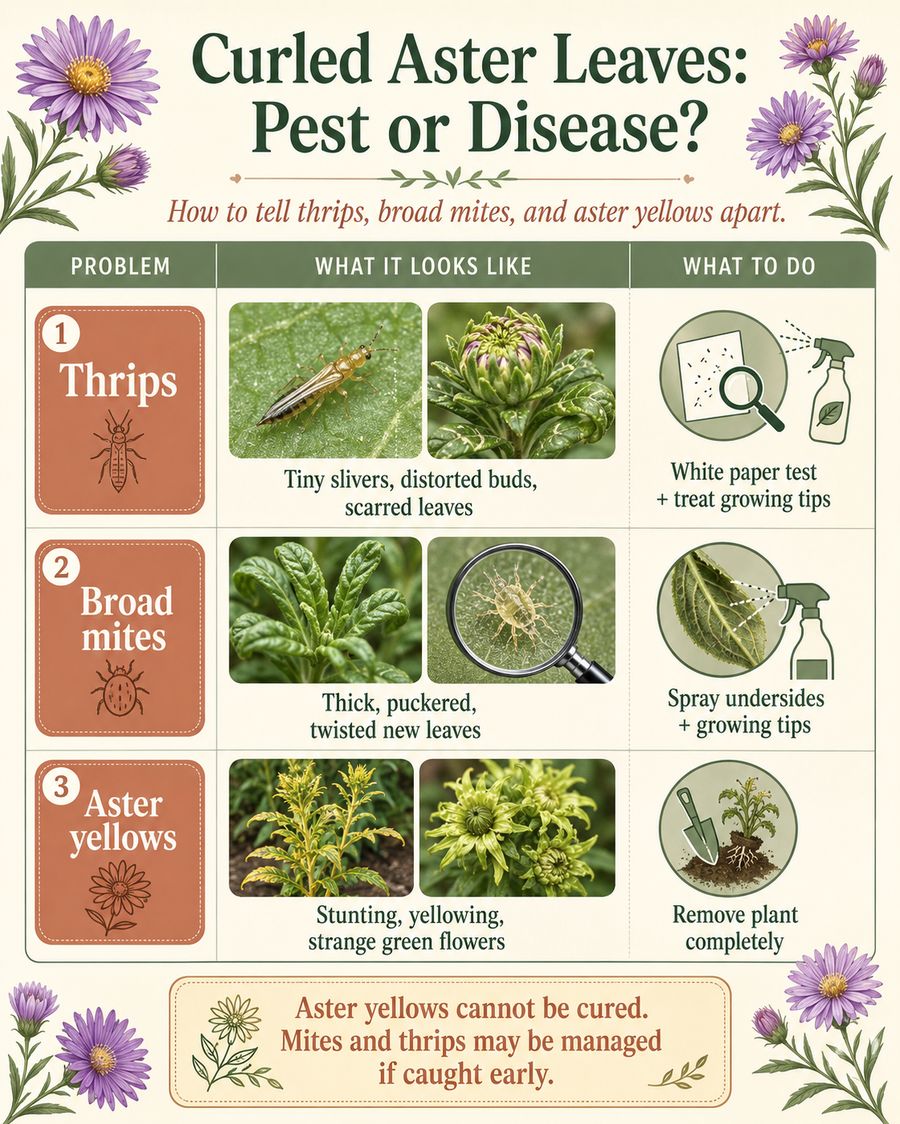
The exact cause depends on what the damage looks like and what has recently happened in the garden. Use the diagnostic flow above, then read the section that matches.
The three most-confused causes side by side. Match the symptom column to your plant before you treat anything.
1. Thrips
Thrips are tiny, slender insects that feed on tender new growth, flower buds, and leaves. They are hard to see because they hide inside curled leaves and buds. Thrips peak in Zone 7b from May through July, exactly when most cut flowers are flushing tender growth.
Signs of thrips
Distorted new leaves
Silvery or scarred patches on leaves
Buds that fail to open properly
Tiny black specks of waste on petals
Tiny tan, brown, or black sliver-shaped insects
How to check for thrips
Use the white paper test (see the next section). If tiny sliver-shaped insects fall onto the paper when you tap the stem or bud, thrips are likely involved.
What to do
Remove the worst distorted growth with bypass pruners. Then spray in the evening, focusing on growing tips and undersides of leaves. Neem-based sprays can help suppress thrips, but heavy infestations call for a spinosad product like Captain Jack’s Deadbug Brew. Spinosad is the most effective thrip-specific home garden option and the active ingredient most extension services recommend.
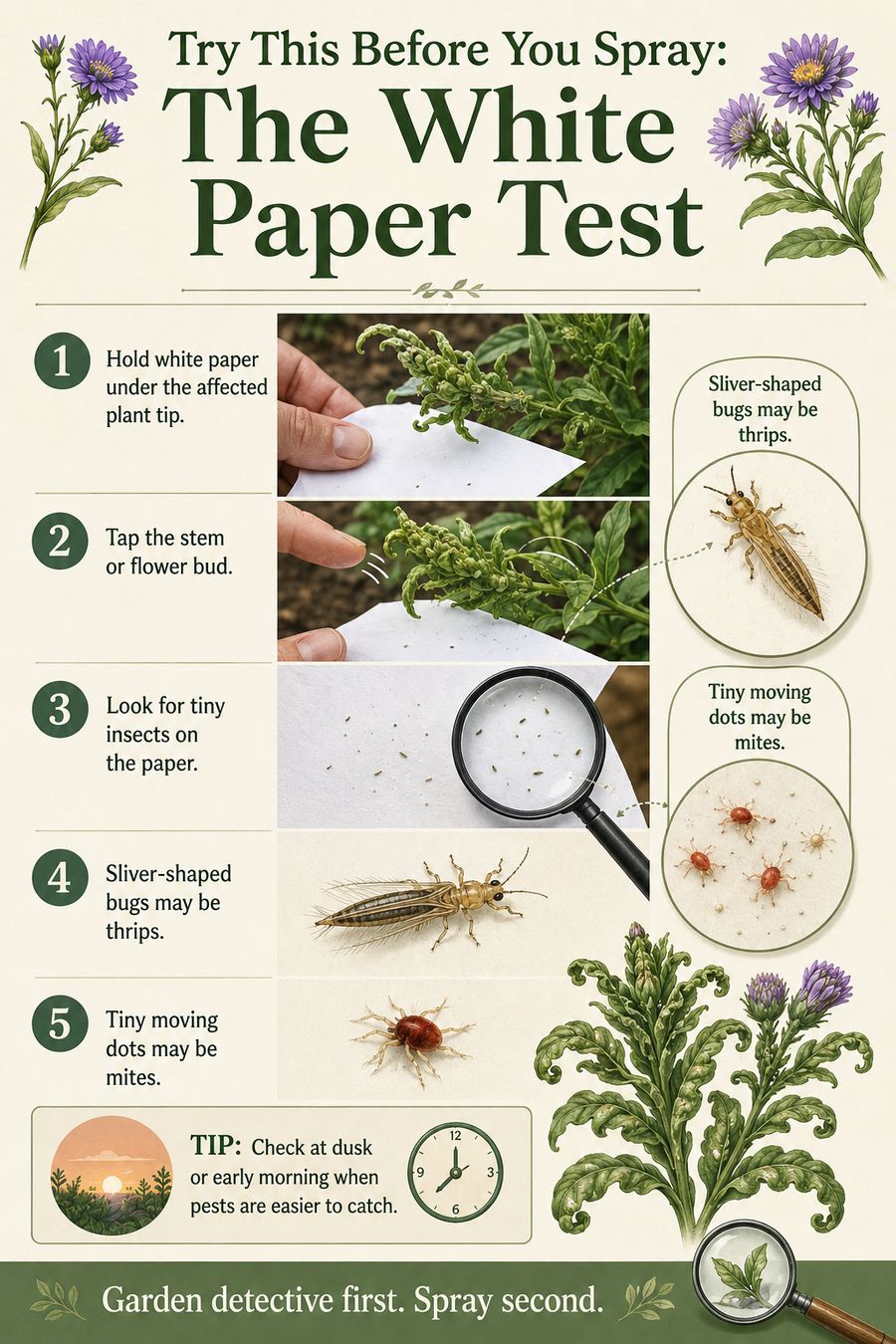
2. The white paper test
The white paper test is the single most useful diagnostic tool for confirming thrips and mites in a home garden. It costs nothing, takes 60 seconds, and tells you exactly what you are dealing with before you spend money on the wrong spray.
Steps 1 through 5 of the white paper test. Garden detective first. Spray second.
If you suspect mites specifically, pair the paper test with a 30x LED jeweler’s loupe. Broad mites are too small to see clearly without magnification. The loupe is $10 and pays for itself the first time it tells you broad mites instead of thrips (different sprays).
3. Broad mites or cyclamen mites
Broad mites and cyclamen mites are microscopic pests that feed on tender plant tissue. They are so small most gardeners never see them with the naked eye.
Signs of mite damage
New leaves look thickened or puckered
Growth tips look twisted
Leaves curl inward
Buds may be distorted
The plant looks stunted at the top
This can look very similar to disease or herbicide damage, which is why it can be frustrating to diagnose.
What to do
Bonide All-Seasons horticultural oil or a neem-based miticide can suppress mites. Spray thoroughly, especially into growing tips and undersides of leaves with a 2-gallon pump sprayer so you can get coverage on every surface. Plan on 2 to 3 applications 5 to 7 days apart; one spray rarely solves the entire problem.
For aphid-only pressure (large clusters of soft-bodied insects on stems), Garden Safe insecticidal soap is the simpler answer. Soap is contact-only, so coverage matters more than chemistry.
4. Aster yellows
Aster yellows is a disease spread by the aster leafhopper. It affects many plants in the aster family, including asters, zinnias, coneflowers, cosmos, daisies, marigolds, and chrysanthemums. In Zone 7b, aster yellows is endemic and shows up most often from June through September.
Signs of aster yellows
Stunted growth
Yellowing
Distorted leaves
Strange, deformed flowers
Excessive branching (witches’ broom)
Green or abnormal flower parts (called virescence)
Unlike pest damage, aster yellows is systemic. The whole plant is infected and there is no cure. According to the Clemson HGIC aster fact sheet, removal is the only response.
What to do
If a plant clearly has aster yellows, remove it completely and bag it for trash. Do not compost it; the phytoplasma can persist in plant tissue. However, if your plant only has dark green, puckered, curled new growth and no strange flowers or yellowing, mites or thrips are more likely than aster yellows.
5. Herbicide drift
Herbicide drift can also cause curled, twisted, or distorted growth, especially from lawn weed killers like 2,4-D or brush killers sprayed nearby.
Signs of herbicide injury
Multiple unrelated plant species are affected
Damage appears suddenly
New growth is twisted or strappy
Plants near the edge of the bed are worse
A neighbor, lawn company, or roadside crew recently sprayed
If no herbicide has been used nearby, this becomes less likely, but it is worth ruling out before you start treating for pests.
6. Recent fertilizer can make pests worse
In my own garden, the curling showed up shortly after fertilizing. That is an important clue. Fertilizer triggers a flush of soft, tender growth. Thrips, aphids, and mites love that kind of growth. The fertilizer may not be the direct cause, but it makes the plants more appealing to pests.
What to do
Pause fertilizing for 3 to 4 weeks while you diagnose and treat the issue. Too much nitrogen leads to leafy, soft growth instead of strong, resilient plants. For more on the fertilizer-pest connection, read the beginner pest and disease guide.
Why are my aster leaves curling? My troubleshooting plan
If your asters are curling and you are not sure why, here is the simple plan I would follow:
Remove the worst curled or dead tips.
Inspect the growing tips and undersides of leaves with a jeweler’s loupe.
Use the white paper test to check for thrips.
Stop fertilizing for 3 to 4 weeks.
Spray in the evening with a product labeled for mites and soft-bodied insects.
Repeat in 5 to 7 days if needed.
Watch the new growth over the next 7 to 14 days.
The old curled leaves will not uncurl. The goal is for new leaves to emerge normal.
Why are my aster leaves curling so badly I should remove the plant?
Remove the entire plant if any of these are true:
It is severely stunted
The flowers are deformed
The plant has strange green flower parts (virescence = aster yellows)
The problem continues after treatment
Only one or two plants are affected and you want to protect the rest of the bed
Sometimes pulling one sick plant saves the rest of the garden.
Key takeaways
Curled new growth points to pests (thrips, mites, aphids) more often than disease.
White paper test + jeweler’s loupe = the cheapest diagnostic toolkit in gardening.
Spinosad (Captain Jack’s Deadbug Brew) for thrips. Horticultural oil for mites.
Aster yellows = strange green flowers + stunting. Remove the plant. No cure.
Herbicide drift damages many unrelated plants at once. Mites and thrips target tender new growth only.
Pause fertilizer for 3 to 4 weeks while treating any curl problem.
Watch the next flush of growth. New leaves tell the truth.
Frequently asked questions
What is the fastest way to diagnose curled aster leaves?
The white paper test. Hold a sheet of white paper under the affected plant tip and tap the stem sharply. Tiny sliver-shaped insects falling onto the paper indicate thrips. Tiny moving dots indicate mites. No insects on the paper plus strange green flowers indicates aster yellows.
Can asters recover from leaf curl?
If the cause is thrips, mites, aphids, or fertilizer flush, yes. The old curled leaves will not uncurl, but the next flush of new growth should emerge normal once the cause is addressed. If the cause is aster yellows, no. Aster yellows is systemic and incurable; the plant must be removed.
What is the best spray for thrips on asters?
Spinosad-based products like Captain Jack’s Deadbug Brew are the most effective home garden thrips treatment. Spray in the evening, focusing on growing tips and undersides of leaves. Two to three applications 5 to 7 days apart usually clear an active infestation.
How do I know if it is aster yellows or just pest damage?
Aster yellows produces strange green flower parts (virescence), excessive branching (witches’ broom), and overall plant stunting in addition to leaf curl. Pest damage usually affects only new growth without flower distortion or whole-plant stunting. When in doubt, look at the flowers.
Should I pull asters with curl damage?
Only if you confirm aster yellows or if the plant continues to decline after treatment. For pest-caused curl that responds to treatment, leave the plant in place and wait for new growth.
How long until new aster leaves grow back normal?
7 to 14 days for visible new growth, longer for that new growth to mature into full leaves. Continue spraying weekly for 2 to 3 weeks after treatment to prevent reinfection. If the next flush still curls, escalate to a stronger product or remove the plant.
About Anna Katherine
I am Anna Katherine Page. I share garden, home, beauty, and resale tips from my home in Seneca, South Carolina (USDA Zone 7b). Follow along on TikTok and YouTube.
Leave a Reply