Disclosure
This post contains affiliate links, which means I may earn a small commission if you make a purchase through my links, at no extra cost to you.
Field-grown cut flowers bring in about $25,000 to $35,000 an acre a year in sales, according to a Virginia Tech extension guide. What you keep is much smaller: in the University of Tennessee Extension’s 2025 zinnia budget, a 1,000 square foot patch sells $9,256 of stems and keeps $3,089 after every cost, labor included, about a third. If you have ever stood in your cutting patch doing quiet math in your head, you are not alone. Flowers are one of the highest-earning things you can grow on a small piece of land, but only if you price them to keep the money.
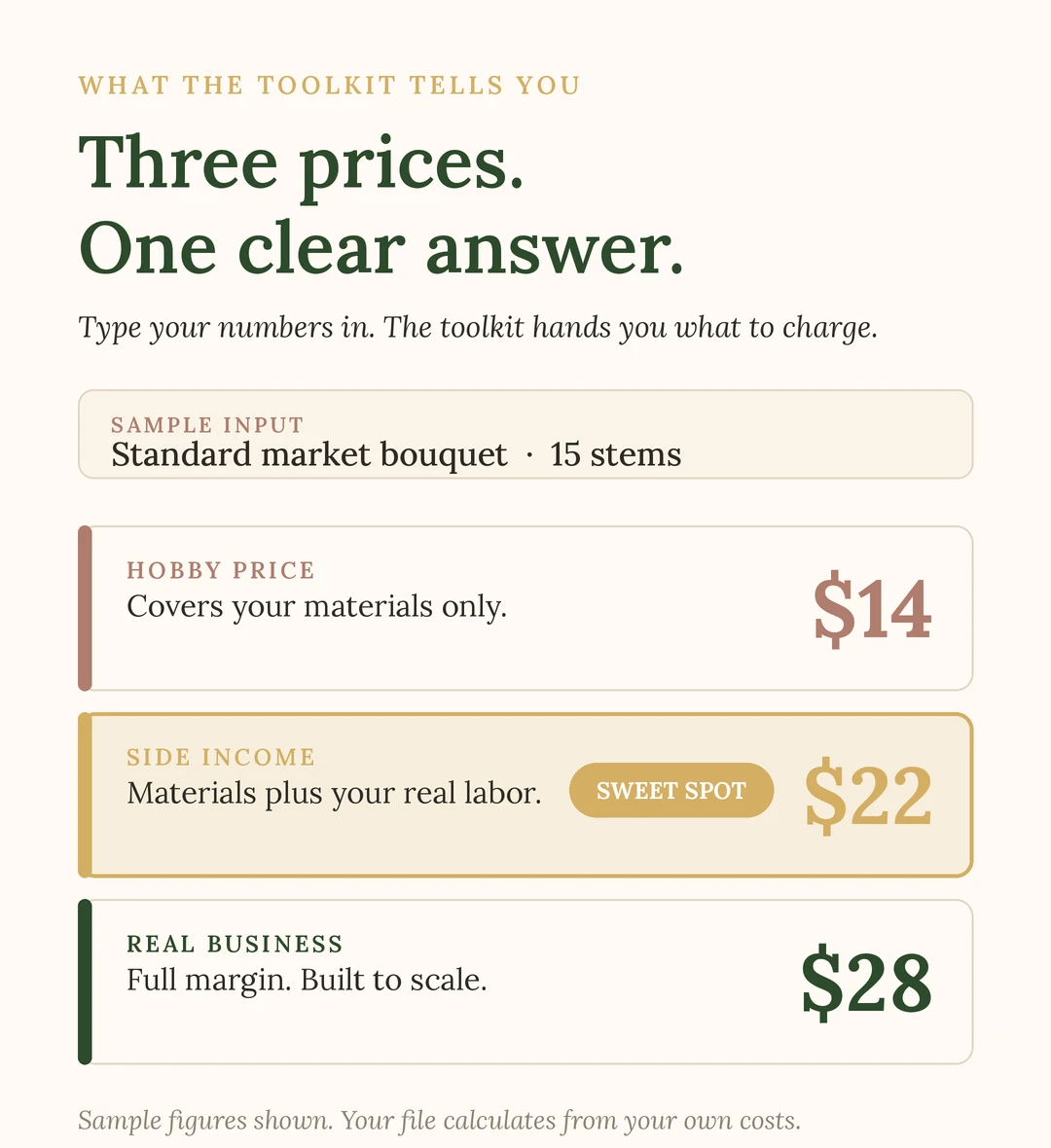
Here is the real picture, and the lever that decides which side of it you land on. If you would rather go straight to your own numbers, the Flower Farm Pricing Toolkit is the spreadsheet I built to price every stem, bouquet, CSA share and wedding with the profit built in.
Quick answer: Field-grown cut flowers are worth about $25,000 to $35,000 per acre per year in sales, according to a Virginia Tech extension guide. That is revenue, not profit. In a 2025 University of Tennessee Extension zinnia budget, 1,000 square feet kept $3,089 of $9,256 in sales after all costs. What you actually keep comes down to how you price.
What growers actually earn
Cut flowers punch far above their footprint. A few realistic benchmarks:
A full acre, field-grown: about $25,000 to $35,000 in sales a year (Virginia Tech)
One 1,000 sq ft zinnia patch: $9,256 in sales, $3,089 kept (UT Extension, 2025)
Those are wide ranges on purpose. Where you land depends on your market, your region, and your skill as a grower. The same bed of zinnias can earn triple in an affluent suburb what it earns at a sleepy rural market.
On-farm stand: $20 to $30 a bouquet, with almost no selling time
Weddings and events: $3,000 to $5,000 per event, and some farms clear $60,000 to $80,000 a year on weddings alone
Wholesale to florists: $500 to $1,000 an order, steady but thinner margins
Grocery wholesale: $8 to $12 a bouquet, the lowest margin of the bunch
A part-time grower working a couple of weekend markets can realistically pull $500 to $800 a week in peak season. Stack a CSA and a few weddings on top and you have a real business.
The catch nobody tells you: revenue is not profit
Here is where the dream meets the spreadsheet. That $30,000 an acre is what comes in, not what you keep. Out of it come seeds, soil, tools, market fees, wraps and buckets, and your own labor, which is the biggest cost of all.
And this is the part that decides everything: the number one reason a busy flower farm still is not profitable is underpricing. You can grow beautifully, sell out every Saturday, and still work for free if your prices do not cover your true costs plus your time. Profit is not what is left over by accident. It is what you build in on purpose, at the moment you set your prices.
This is why I built the Flower Farm Pricing Toolkit. It takes your seed, labor and market costs and turns them into a per-stem floor and a bouquet, CSA and wedding price you can stand behind. If you want to check one number first, the free Flower Pricing Reality Check works out your cost per stem in about a minute, and how to price cut flowers walks through the per-stem and per-bunch formula.
A realistic first-year picture
Most growers do not hit $35,000 an acre in year one, and that is normal. A realistic first season on a small plot, sold mostly at markets and a small CSA, might land somewhere around $8,000 to $20,000, while you learn what grows well and what your market will pay. The farms that grow fast from there are almost never the ones with the prettiest flowers. They are the ones that priced right from the start and reinvested. For what to plant first, start with the cut flower garden cheat sheets.
What to buy before the first market
Here’s what to look for before the first market day. It is a short list.
Harvest snips: long curved blades for clean cuts in tight spots, like the Corona long curved snips.
Lean into high-margin outlets like CSAs, farm stands, and weddings
They do not:
Guess at prices and hope
Compete on being the cheapest bouquet at the market
Forget that their time is the most expensive input on the farm
Key takeaways: Cut flowers can earn $25,000 to $35,000 in sales an acre (Virginia Tech), and in UT Extension’s 2025 zinnia budget about a third of sales was left after costs. But revenue is not profit. The growers who actually keep money are the ones who price right and sell through high-margin channels. Pricing is the lever. Pull it on purpose.
Frequently asked questions
How much can you make selling flowers on a small plot?
Virginia Tech’s extension guide puts field-grown cut flowers at about $25,000 to $35,000 in sales per acre, so a quarter acre brings in a fraction of that. On a smaller scale, University of Tennessee Extension’s 2025 budget shows 1,000 square feet of zinnias selling $9,256 of stems and keeping $3,089 after costs. Your number depends on your yields, your market and your prices.
Is flower farming actually profitable?
It can be one of the most profitable crops per acre, but only if you price to cover your costs and your labor. Underpricing is the most common reason a busy flower farm does not turn a profit.
What is the most profitable way to sell flowers?
High-margin, direct channels like farm stands, flower CSAs, and weddings tend to keep the most money. Grocery wholesale moves volume but has the thinnest margins.
How much do flower farmers charge per bouquet?
Market bouquets commonly sell for $15 to $30, depending on the market and the design. The right number for you depends on your true costs and markup.
How much profit per acre does a flower farm make?
The per-acre figures on this page are revenue. In University of Tennessee Extension’s 2025 zinnia budget, 1,000 square feet kept $3,089 of $9,256 in sales, about 33 percent, after marketing, labor and overhead. Profit is what is left after seeds, soil, market fees, packaging and your own labor, and it is different on every farm. Growers who cost their labor into every stem and sell through high-margin channels keep the most. Run your own cost per stem with the free Flower Pricing Reality Check to see where you stand.
What does a flower farmer earn as a salary?
Most small flower farmers pay themselves out of what is left after costs, not a fixed salary, and in a first season that is usually modest while the market and the growing are still being learned. The farms that reach a real owner’s wage are the ones that priced right from the start. The Flower Farm Pricing Toolkit builds your hourly wage into every price so your pay is a line in the plan, not a leftover.
Want to know your real numbers?
Every figure on this page is an average. Your farm is not average. The only way to know what you can make is to run your own costs, and the only way to keep the money is to price on purpose.
(function(){
if (!window.matchMedia || !window.matchMedia('(max-width: 781px)').matches) return;
var aff = /go\.shopmy\.us|amzn\.to|amazon\.com\/.*tag=|walmrt\.us|pxf\.io|shareasale|awin1|anrdoezrs|dpbolvw|jdoqocy|tkqlhce|kqzyfj|sjv\.io|linksynergy/i;
var root = document.querySelector('.wp-block-post-content') || document.querySelector('.entry-content');
if (!root) return;
var btns = root.querySelectorAll('a.wp-block-button__link');
var first = null;
for (var i = 0; i < btns.length; i++) { if (aff.test(btns[i].href)) { first = btns[i]; break; } }
if (!first) return;
var name = '';
var p = root.querySelector('p');
if (p) { var l = p.querySelector('a'); if (l && l.href === first.href) name = l.textContent; }
if (!name) name = first.textContent;
var bar = document.createElement('div');
bar.className = 'ak-sticky-buy';
bar.setAttribute('role', 'region');
bar.setAttribute('aria-label', 'Top pick');
var span = document.createElement('span'); span.className = 'ak-sb-name'; span.textContent = 'Top pick: ' + name.trim();
var a = document.createElement('a'); a.href = first.href; a.target = '_blank'; a.rel = 'nofollow sponsored noopener'; a.textContent = 'Shop now';
var x = document.createElement('button'); x.type = 'button'; x.setAttribute('aria-label', 'Close'); x.textContent = '×';
bar.appendChild(span); bar.appendChild(a); bar.appendChild(x);
document.body.appendChild(bar);
var closed = false;
x.addEventListener('click', function(){ closed = true; bar.classList.remove('is-on'); });
function check(){
if (closed) return;
var r = first.getBoundingClientRect();
var footer = document.querySelector('footer');
var nearEnd = footer && footer.getBoundingClientRect().top < window.innerHeight;
if (r.bottom < 0 && !nearEnd) bar.classList.add('is-on'); else bar.classList.remove('is-on');
}
window.addEventListener('scroll', check, { passive: true });
check();
})();
(function () {
var c = document.body.className;
c = c.replace(/woocommerce-no-js/, 'woocommerce-js');
document.body.className = c;
})();
Leave a Reply