To price wedding flowers, multiply your flower cost by 4 to 5, then add your labor, hard goods, delivery and setup, and hold a wedding minimum. For context, couples married in 2025 spent $2,800 on wedding flowers on average (The Knot Real Weddings Study). Your first wedding inquiry is thrilling and a little terrifying. Someone loves your flowers enough to want them on the most photographed day of their life. Then comes the hard part: the number. Underquote a market bouquet and you lose a few dollars. Underquote a wedding and you can lose a whole weekend, plus the profit from ten other sales, because a wedding is mostly labor you cannot see when you are staring at a pretty mood board.
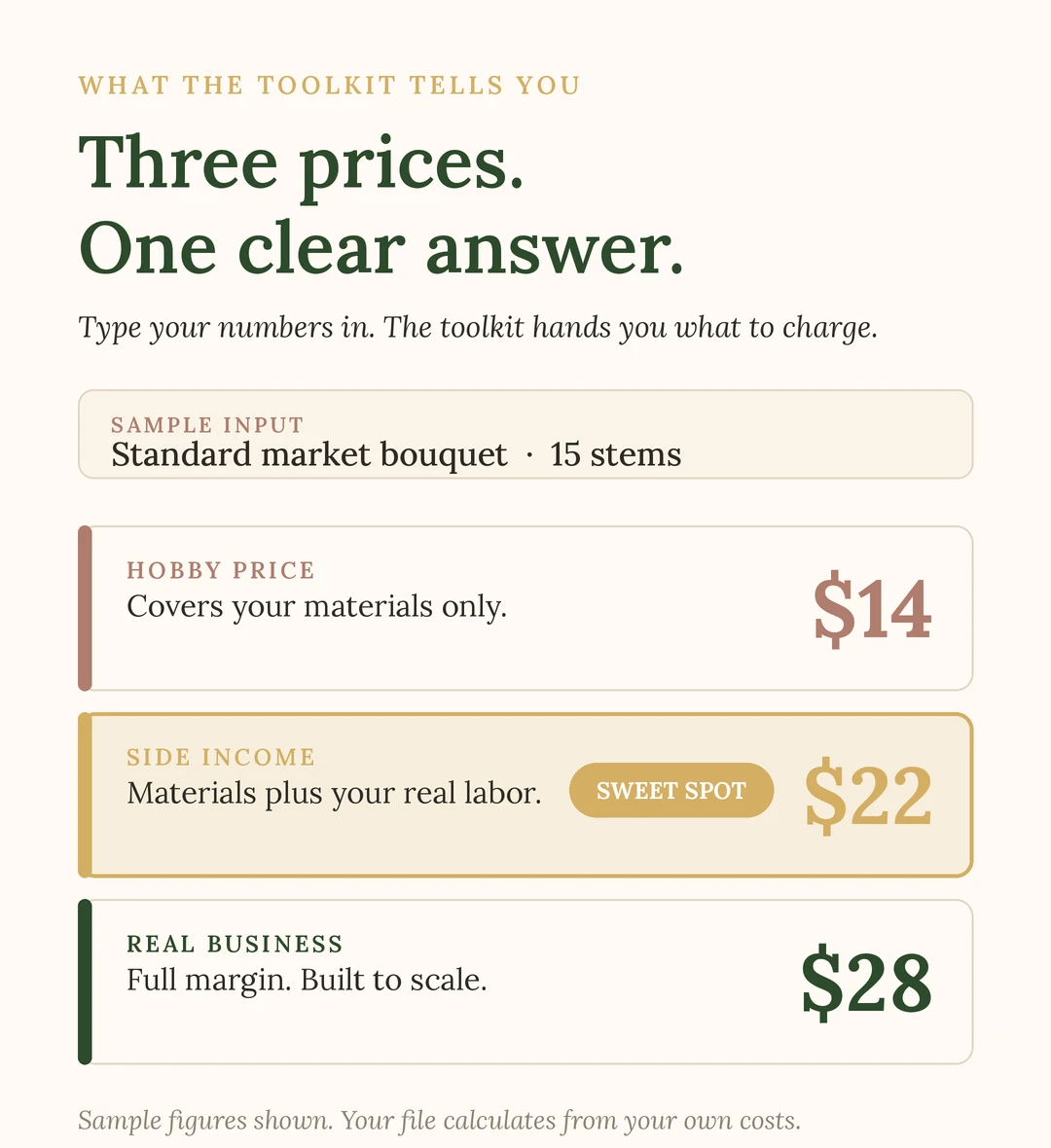
Here is how the pros build a wedding quote, so yours pays you properly. If you would rather have the quote math done for you, the Flower Farm Pricing Toolkit has wedding quote templates and a printable client view.
Quick answer: Price wedding flowers with a recipe, not a guess: multiply your flower cost by 4 to 5, then add labor, hard goods, and delivery and setup on top. Couples married in 2025 spent $2,800 on wedding flowers on average, according to The Knot. If your quote comes in far under that for a full wedding, you are leaving money on the table.
What couples actually pay in 2026
Knowing the market keeps you from quoting scared. Recent averages from The Knot and Joy:
Total wedding flowers: $2,800 on average for couples married in 2025 (The Knot)
Bridal bouquet: $100 to $350
Bridesmaid bouquet: $50 to $110 each
Boutonniere: $10 to $30 each
Centerpieces: $50 to $600 each, depending on size
Altar arrangement: $60 to $450
Arch or arbor: $200 to $1,000 (item ranges: Joy, 2025)
Flowers themselves run about $2 to $8 a stem for wedding work, more for premium blooms. A good sanity check: wedding flowers usually run 8 to 10 percent of the couple’s total budget.
The wedding pricing recipe
Weddings are not priced like market bunches. Use this build:
(flower cost x 4 to 5) + labor + hard goods + delivery and setup + a service minimum
Flowers: mark your wholesale stem cost up 4 to 5 times for weddings, higher than the 3x you use for a market bouquet, because wedding work is custom and labor heavy.
Labor: consultation, sourcing, prep, design, and the wedding day itself. Bill it at 2 to 2.5 times your wage. A single wedding can eat 10 to 20 hours, and this is the cost growers forget most.
Hard goods: vases, foam, tape, ribbon, candles, arch hardware. Pass these through with a markup, do not eat them.
Delivery and setup: $50 to $500 depending on size and distance. Charge separately for teardown if you handle it.
A wedding minimum: set a floor, many growers start at $1,500 to $2,500, so a tiny wedding does not swallow a Saturday for $200.
Price the wedding piece by piece
Build the quote as a recipe of parts, then total it. For each item, cost the stems, multiply by your wedding markup, and add the design time that piece takes. A bridal bouquet is not just flowers, it is the most detailed 45 minutes of your week. Price it like it.
Then add your hard goods, your delivery and setup, and check the grand total against that 8 to 10 percent benchmark. If a couple says the budget is $30,000, flowers in the $2,400 to $3,000 range are completely normal, not greedy.
The mistakes that eat a wedding’s profit
Do:
Charge for every hour, not just the flowers
Set and hold a wedding minimum
Bill delivery, setup, and teardown as their own line items
Quote from your costs, then check against the market
Do not:
Quote only the stems and give the labor away
Say yes to a wedding that comes in under your minimum
Absorb vases, candles, and hardware into your own pocket
Let a couple’s budget set your prices instead of your costs
Key takeaways: Weddings pay well only if you price the whole job. Mark flowers up 4 to 5x, bill your labor at 2 to 2.5x wage, pass through hard goods, charge for delivery and setup, and hold a minimum. Couples married in 2025 spent $2,800 on flowers on average (The Knot). Quote the hours, not just the blooms.
Frequently asked questions
How much should I charge for a bridal bouquet?
Bridal bouquets commonly run $100 to $350, depending on size and stems. Cost your flowers, multiply by 4 to 5, and add the design time, which for a bridal bouquet is significant.
What markup do florists use for weddings?
Most mark flowers up 4 to 5 times wholesale for weddings, then bill labor separately at 2 to 2.5 times their wage, plus hard goods and delivery.
What percentage of a wedding budget goes to flowers?
Typically 8 to 10 percent. It is a useful sanity check on your total quote, not a substitute for costing the actual pieces.
Should I have a wedding minimum?
Yes. A minimum, often $1,500 to $2,500 for full weddings, keeps small jobs from eating a full day of labor for very little profit.
Quote your next wedding without guessing
A wedding quote has a lot of moving parts, and doing the math by hand at 11pm is how mistakes and undercharging happen. My $27 Flower Farm Pricing Toolkit has wedding quote templates with a printable client view built in, so you can price a whole wedding, piece by piece, and hand the couple a clean proposal.
Field-grown cut flowers bring in about $25,000 to $35,000 an acre a year in sales, according to a Virginia Tech extension guide. What you keep is much smaller: in the University of Tennessee Extension’s 2025 zinnia budget, a 1,000 square foot patch sells $9,256 of stems and keeps $3,089 after every cost, labor included, about a third. If you have ever stood in your cutting patch doing quiet math in your head, you are not alone. Flowers are one of the highest-earning things you can grow on a small piece of land, but only if you price them to keep the money.
Here is the real picture, and the lever that decides which side of it you land on. If you would rather go straight to your own numbers, the Flower Farm Pricing Toolkit is the spreadsheet I built to price every stem, bouquet, CSA share and wedding with the profit built in.
Quick answer: Field-grown cut flowers are worth about $25,000 to $35,000 per acre per year in sales, according to a Virginia Tech extension guide. That is revenue, not profit. In a 2025 University of Tennessee Extension zinnia budget, 1,000 square feet kept $3,089 of $9,256 in sales after all costs. What you actually keep comes down to how you price.
What growers actually earn
Cut flowers punch far above their footprint. A few realistic benchmarks:
A full acre, field-grown: about $25,000 to $35,000 in sales a year (Virginia Tech)
One 1,000 sq ft zinnia patch: $9,256 in sales, $3,089 kept (UT Extension, 2025)
Those are wide ranges on purpose. Where you land depends on your market, your region, and your skill as a grower. The same bed of zinnias can earn triple in an affluent suburb what it earns at a sleepy rural market.
On-farm stand: $20 to $30 a bouquet, with almost no selling time
Weddings and events: $3,000 to $5,000 per event, and some farms clear $60,000 to $80,000 a year on weddings alone
Wholesale to florists: $500 to $1,000 an order, steady but thinner margins
Grocery wholesale: $8 to $12 a bouquet, the lowest margin of the bunch
A part-time grower working a couple of weekend markets can realistically pull $500 to $800 a week in peak season. Stack a CSA and a few weddings on top and you have a real business.
The catch nobody tells you: revenue is not profit
Here is where the dream meets the spreadsheet. That $30,000 an acre is what comes in, not what you keep. Out of it come seeds, soil, tools, market fees, wraps and buckets, and your own labor, which is the biggest cost of all.
And this is the part that decides everything: the number one reason a busy flower farm still is not profitable is underpricing. You can grow beautifully, sell out every Saturday, and still work for free if your prices do not cover your true costs plus your time. Profit is not what is left over by accident. It is what you build in on purpose, at the moment you set your prices.
This is why I built the Flower Farm Pricing Toolkit. It takes your seed, labor and market costs and turns them into a per-stem floor and a bouquet, CSA and wedding price you can stand behind. If you want to check one number first, the free Flower Pricing Reality Check works out your cost per stem in about a minute, and how to price cut flowers walks through the per-stem and per-bunch formula.
A realistic first-year picture
Most growers do not hit $35,000 an acre in year one, and that is normal. A realistic first season on a small plot, sold mostly at markets and a small CSA, might land somewhere around $8,000 to $20,000, while you learn what grows well and what your market will pay. The farms that grow fast from there are almost never the ones with the prettiest flowers. They are the ones that priced right from the start and reinvested. For what to plant first, start with the cut flower garden cheat sheets.
What to buy before the first market
Here’s what to look for before the first market day. It is a short list.
Harvest snips: long curved blades for clean cuts in tight spots, like the Corona long curved snips.
Lean into high-margin outlets like CSAs, farm stands, and weddings
They do not:
Guess at prices and hope
Compete on being the cheapest bouquet at the market
Forget that their time is the most expensive input on the farm
Key takeaways: Cut flowers can earn $25,000 to $35,000 in sales an acre (Virginia Tech), and in UT Extension’s 2025 zinnia budget about a third of sales was left after costs. But revenue is not profit. The growers who actually keep money are the ones who price right and sell through high-margin channels. Pricing is the lever. Pull it on purpose.
Frequently asked questions
How much can you make selling flowers on a small plot?
Virginia Tech’s extension guide puts field-grown cut flowers at about $25,000 to $35,000 in sales per acre, so a quarter acre brings in a fraction of that. On a smaller scale, University of Tennessee Extension’s 2025 budget shows 1,000 square feet of zinnias selling $9,256 of stems and keeping $3,089 after costs. Your number depends on your yields, your market and your prices.
Is flower farming actually profitable?
It can be one of the most profitable crops per acre, but only if you price to cover your costs and your labor. Underpricing is the most common reason a busy flower farm does not turn a profit.
What is the most profitable way to sell flowers?
High-margin, direct channels like farm stands, flower CSAs, and weddings tend to keep the most money. Grocery wholesale moves volume but has the thinnest margins.
How much do flower farmers charge per bouquet?
Market bouquets commonly sell for $15 to $30, depending on the market and the design. The right number for you depends on your true costs and markup.
How much profit per acre does a flower farm make?
The per-acre figures on this page are revenue. In University of Tennessee Extension’s 2025 zinnia budget, 1,000 square feet kept $3,089 of $9,256 in sales, about 33 percent, after marketing, labor and overhead. Profit is what is left after seeds, soil, market fees, packaging and your own labor, and it is different on every farm. Growers who cost their labor into every stem and sell through high-margin channels keep the most. Run your own cost per stem with the free Flower Pricing Reality Check to see where you stand.
What does a flower farmer earn as a salary?
Most small flower farmers pay themselves out of what is left after costs, not a fixed salary, and in a first season that is usually modest while the market and the growing are still being learned. The farms that reach a real owner’s wage are the ones that priced right from the start. The Flower Farm Pricing Toolkit builds your hourly wage into every price so your pay is a line in the plan, not a leftover.
Want to know your real numbers?
Every figure on this page is an average. Your farm is not average. The only way to know what you can make is to run your own costs, and the only way to keep the money is to price on purpose.
To price a bouquet, add up your stem cost and sundries, multiply by 3 for a market bouquet (2 to 3 times for markets, 4 to 5 times for weddings), then add your labor. Most mixed market bouquets land between $25 and $45. If you grow flowers to sell, you have probably held a finished bouquet and thought, “what is this actually worth?” Then you picked a number that felt safe and moved on. I did the same thing my first season, and safe almost always means too low.
Underpricing is the quietest way a flower business loses money. It is rarely carelessness. It is that nobody ever handed you the math. So here it is, the same way a florist or an experienced grower would run it. Want the math done for you? Plug your stems into the free Bouquet Pricing Calculator, or price every product at once with my Flower Farm Pricing Toolkit.
Quick answer: Price a market bouquet at (your stem cost x 3) + labor. Markets run 2 to 3 times your flower cost, weddings run 4 to 5 times. If you take one thing from this page: 2x is where most growers quietly lose money once labor is counted.
Step 1: Cost your stems
You cannot price a bouquet until you know what the flowers in it cost you. Sort your stems into three tiers, using what the stem would sell for wholesale. That is the honest way to cost your own flowers, even the ones you grew.
Filler (feverfew, statice, grasses): about $1 a stem
Mid-range (zinnias, snapdragons, cosmos): about $2 a stem
Hero (dahlias, ranunculus, peonies): about $3 a stem, and specialty varieties can run $4 or more
You grew it yourself, so it feels free. It is not. Your time, seed, soil, and land all went into that stem.
Step 2: Add up the bouquet
A typical mixed market bouquet might hold:
3 hero stems at $3 = $9
5 mid-range stems at $2 = $10
4 filler stems at $1 = $4
That is $23 in flowers, plus about $2 in sundries like wrap and a band. Call it $25 in materials.
Step 3: Multiply for your market
Now multiply your materials by the markup that fits how you are selling:
Farmers market or roadside stand: 2 to 3x
Weddings and events: 4 to 5x, plus a design fee
Using 3x on $25 in materials gives you $75. That is your starting retail price, before labor.
Step 4: Add your labor
Every time you touch a flower, that is money. Design time is real work and it belongs in the price. If you value your time at $30 an hour and the bouquet takes about 12 minutes to harvest, condition, and arrange, that is roughly $6 to $9 of labor.
Your bouquet lands around $80. If that number made you wince, that is the point. You were probably charging half of it.
Run your own bouquet
Same math as the steps above: materials times your markup, plus your time at $30 an hour.
$
min
$81
Your floor (materials plus time) is $31.00. Charge less than that and the bouquet loses money.
You just priced one recipe at $81. The Flower Farm Pricing Toolkit does it for bouquets, weddings, CSA shares and market tables, with your labor already in the price.
If you would rather not run this by hand for every recipe, the Flower Farm Pricing Toolkit does it for bouquets, weddings, CSA shares and market tables, with your labor already in the price. To check your cost per stem first, try the free Flower Pricing Reality Check.
The do and do not of bouquet pricing
Do:
Cost your own stems, even the ones you grew
Add labor on top, every single time
Charge more for weddings than for market bouquets
Price to your local market, not to your nerves
Do not:
Double your cost and call it a price. 2x barely covers materials once labor is in
Forget sundries, market fees, and gas
Use one price for every way you sell
Pick a number because you are afraid to say the real one out loud
Bouquet pricing cheat sheet
A rough guide by product, assuming solid materials and a 3x-ish retail markup:
Small market bunch, single variety: $12 to $18
Mixed market bouquet: $25 to $45
Premium or large designer bouquet: $50 to $85
Bridal bouquet: $150 to $350, depending on stems and design
Your local disposable income matters. A bouquet that sells for $35 in a small town may fetch $55 in an affluent suburb.
Extension research backs this up. Shoppers in a Utah State University Extension survey said they spend $9.75 to $151 on each flower purchase, $46 on average (Utah State University Extension, 2025). At one Virginia farmers market, most flowers sold for about $2 a stem, with a discount for buying several (Holly Scoggins, Virginia Tech), which lines up with the mid-range stem value above. Mississippi State University Extension suggests checking your prices against wholesale florist price lists and the USDA Ornamental Wholesale Market Report (MSU Extension, 2025).
Key takeaways: Cost your stems, multiply by 3 for markets and 4 to 5 for weddings, then add labor. Never stop at 2x. Price to your market, and charge what the flowers are actually worth.
Frequently asked questions
How much should I charge for a market bouquet?
Most growers land between $25 and $45 for a mixed market bouquet. Run your stem cost times 3, add labor, and adjust to your local market.
What markup should flower farmers use?
2 to 3 times your flower cost for markets, 4 to 5 times for weddings and events, with labor added on top.
How do I price a wedding bouquet?
Cost the stems, multiply by 4 to 5, then add a design and consultation fee. A bridal bouquet commonly runs $150 to $350.
Should I include my own labor if I grew the flowers?
Yes. Your time is the most valuable thing in the bouquet. Bill it every time.
What is the 3:5:8 rule for flowers?
It is a design rule, not a pricing rule. One common version builds a bouquet from 3 focal flowers, 5 stems of foliage and 8 filler stems, working from the center out (Daily Blooms). Other florists use it more loosely, grouping stems in 3s, 5s and 8s (Livingetc). For pricing, count every stem, foliage included, when you cost the bouquet.
Let the math do itself
Running these numbers by hand for every product gets old fast. I built a one-tap calculator that does exactly this. You enter your costs, and it tells you what to charge and whether that price is hobby money or real money. It is $7, one time. Price your bouquets in two minutes.
Want the whole system, with weddings, CSA shares, market bunches, and bloom bars all built out? The $27 Flower Farm Pricing Toolkit has it in one place.
You grew the flowers. Now charge what they are worth.
(function(){var m=document.getElementById('bq-mat'),n=document.getElementById('bq-min'),k=document.getElementById('bq-mk'),o=document.getElementById('bq-out'),s=document.getElementById('bq-sub'),t=document.getElementById('bq-one');
function v(e){var x=parseFloat(e.value);return isFinite(x)&&x>0?x:0}
function u(){var mat=v(m),lab=v(n)/60*30,mk=parseFloat(k.value)||3,p=Math.ceil(mat*mk+lab-0.0001),f=mat+lab;
if(mat<=0){o.textContent='$0';s.textContent='Enter what the flowers and sundries cost to see your price and floor.';t.textContent='Run one recipe above.';return;}
o.textContent='$'+p;s.innerHTML='Your floor (materials plus time) is <span class="floor">$'+f.toFixed(2)+'</span>. Charge less than that and the bouquet loses money.';
t.textContent='You just priced one recipe at $'+p+'.';}
[m,n,k].forEach(function(e){e.addEventListener('input',u);e.addEventListener('change',u)});u();})();
(function () {
var c = document.body.className;
c = c.replace(/woocommerce-no-js/, 'woocommerce-js');
document.body.className = c;
})();