Disclosure
This post contains affiliate links, which means I may earn a small commission if you make a purchase through my links, at no extra cost to you.
Quick answer: No, you cannot get Ultherapy at home. Ultherapy is a prescription-use microfocused ultrasound system cleared by the FDA to lift the brow and lax skin under the chin and on the neck, and it is performed in a clinic with real-time ultrasound imaging. What you can do at home is slower, gentler firming with radio frequency, microcurrent and LED devices such as the CurrentBody Skin RF, Medicube AGE-R Ultra Tune 40.68 and NuFACE TRINITY+. See the CurrentBody Skin RF.
Last updated: October 30, 2026
Ultherapy vs at-home devices at a glance
Ultherapy (clinic)
At-home RF, microcurrent and LED
How it works
Focused ultrasound energy delivered at set depths, with ultrasound imaging
Surface warmth (RF), low electrical current (microcurrent) or light (LED)
FDA status
Cleared for prescription use to lift the brow and lax submental and neck tissue
Varies by device; check each brand’s page
Who does it
A trained provider
You
Results
Lifting over the months after treatment
Gradual firming and smoother look over weeks of regular use
Downtime
Discomfort during treatment is common
None for most devices
What Ultherapy actually is
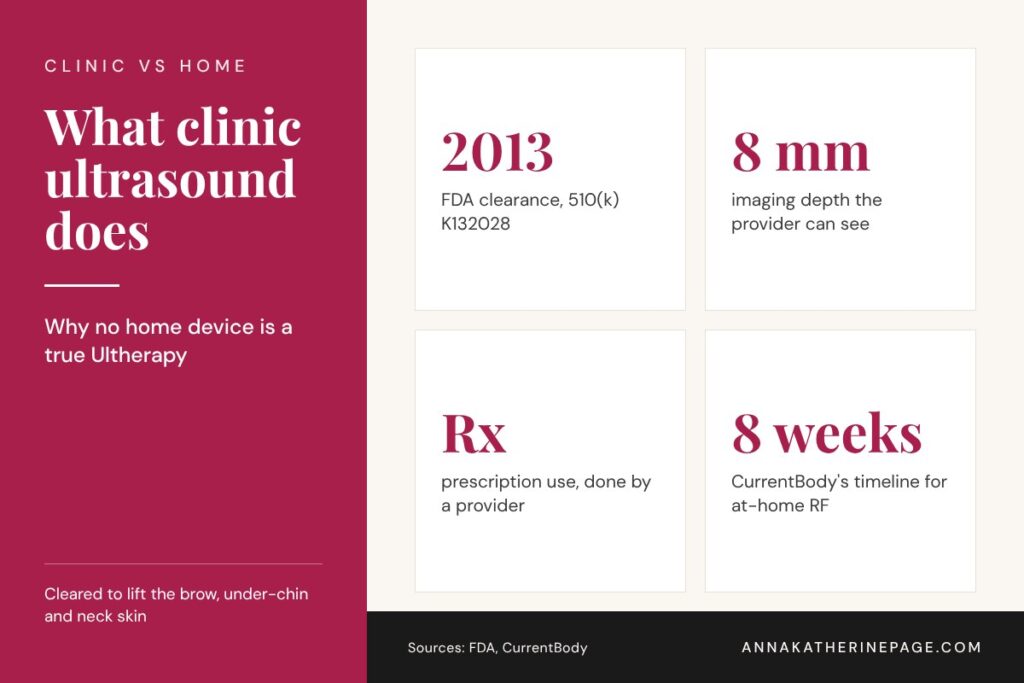
The FDA cleared the Ulthera System in 2013 (510(k) K132028) as a non-invasive dermatological aesthetic treatment to lift the eyebrow and lift lax submental and neck tissue. Its DeepSEE transducer lets the provider see up to 8 mm below the skin to confirm treatment depth and avoid bone, and the clearance is marked for prescription use (FDA 510(k) K132028). That imaging and depth control is the part no consumer gadget reproduces.
Why “at-home HIFU” devices are a bad idea
Devices sold online as at-home HIFU borrow the name without the imaging, the depth control or the training. Clinics warn that improper use can cause burns and nerve injury, and that home units are typically less effective than clinic machines (SL Aesthetic Clinic). The same caution applies to at-home RF microneedling: in October 2025 the FDA said RF microneedling is a medical procedure and these devices should not be used at home (FDA safety communication).
What works instead of Ultherapy at home
Radio frequency: CurrentBody Skin RF
CurrentBody’s RF device runs at 1 MHz and warms skin to about 104°F, pausing automatically at 40 to 41°C. Each area takes 5 minutes, used once a week for 8 weeks, then every 4 to 8 weeks to maintain. It needs CurrentBody’s RF gel every session, and the brand reports 89% saw improved skin tightness in 8 weeks (CurrentBody product page).
Where to buy the CurrentBody Skin RF:CurrentBody. Prices change often, so check today’s price at each.
RF plus microcurrent: Medicube AGE-R Ultra Tune 40.68
A daily option with no gel. The Ultra Tune pairs RF warmth with microcurrent in 5 to 10 minute sessions after skincare has absorbed, and Medicube reports improvement in forehead and neck lines in its own testing (Medicube product page). Compare it with the Booster Pro in Booster Pro vs Ultra Tune.
Where to buy the Medicube AGE-R Ultra Tune 40.68:Amazon | Medicube US. Prices change often, so check today’s price at each.
Microcurrent: NuFACE TRINITY+
FDA-cleared microcurrent in 5-minute sessions, 5 times a week for the first 60 days, then 2 to 3 times a week (NuFACE product page). Microcurrent is about muscle tone and a lifted look, so results fade if you stop.
Where to buy the NuFACE TRINITY+:NuFACE | Ulta | Sephora. Prices change often, so check today’s price at each.
Red light: an LED face mask
Red and near-infrared light support collagen over time and pair well with RF or microcurrent on alternate days. The best LED face masks guide compares the top masks by concern.
Setting realistic expectations for Ultherapy at home alternatives
None of these devices is Ultherapy at home. They are maintenance tools. They work slowly and need a routine you will keep.
Expect weeks, not days. CurrentBody’s own timeline is 8 weeks for its RF device.
If you were hoping for Ultherapy at home to treat marked jowling, neck laxity or a heavy brow, a board-certified dermatologist can tell you whether Ultherapy or another clinic treatment fits.
Skip any device sold as at-home HIFU or at-home RF microneedling.
Frequently asked questions
Is there an at-home version of Ultherapy?
No. Ultherapy is a microfocused ultrasound system cleared by the FDA for prescription use to lift the brow and lax skin under the chin and on the neck. It relies on ultrasound imaging and set treatment depths controlled by a trained provider. Consumer devices sold as at-home HIFU do not have that imaging or depth control and carry burn risks.
Are at-home HIFU devices safe?
They carry real risk. Clinics warn that home HIFU units used incorrectly can cause burns and nerve injury, and that they are usually less effective than clinic machines. They also lack the ultrasound imaging used in Ultherapy to confirm depth. Safer at-home options for firming are radio frequency, microcurrent and LED devices used as directed.
What is the best at-home alternative to Ultherapy?
Radio frequency is the closest at-home approach to skin tightening. The CurrentBody Skin RF warms skin to about 104°F in weekly sessions for 8 weeks, and the Medicube AGE-R Ultra Tune 40.68 combines RF with microcurrent for daily use without gel. Pairing either with an LED mask on other days is a common routine.
How long does at-home RF take to show results?
Expect several weeks. CurrentBody reports that 89% of users saw improved skin tightness after 8 weeks of weekly sessions with its Skin RF device, then recommends maintenance every 4 to 8 weeks. Daily devices like the Medicube Ultra Tune still need consistent use over weeks. Results are subtler than clinic treatments and fade without maintenance.
Can you do RF microneedling at home?
The FDA says no. In an October 2025 safety communication, it described RF microneedling as a medical procedure and said these devices should not be used at home, citing reports of burns, scarring, fat loss, disfigurement and nerve damage. Needle-free at-home RF devices are a different category that warms the skin surface without needles.
Sources
Sources checked on October 25, 2026. Figures from brands are reported as the brand’s own claims.
Leave a Reply