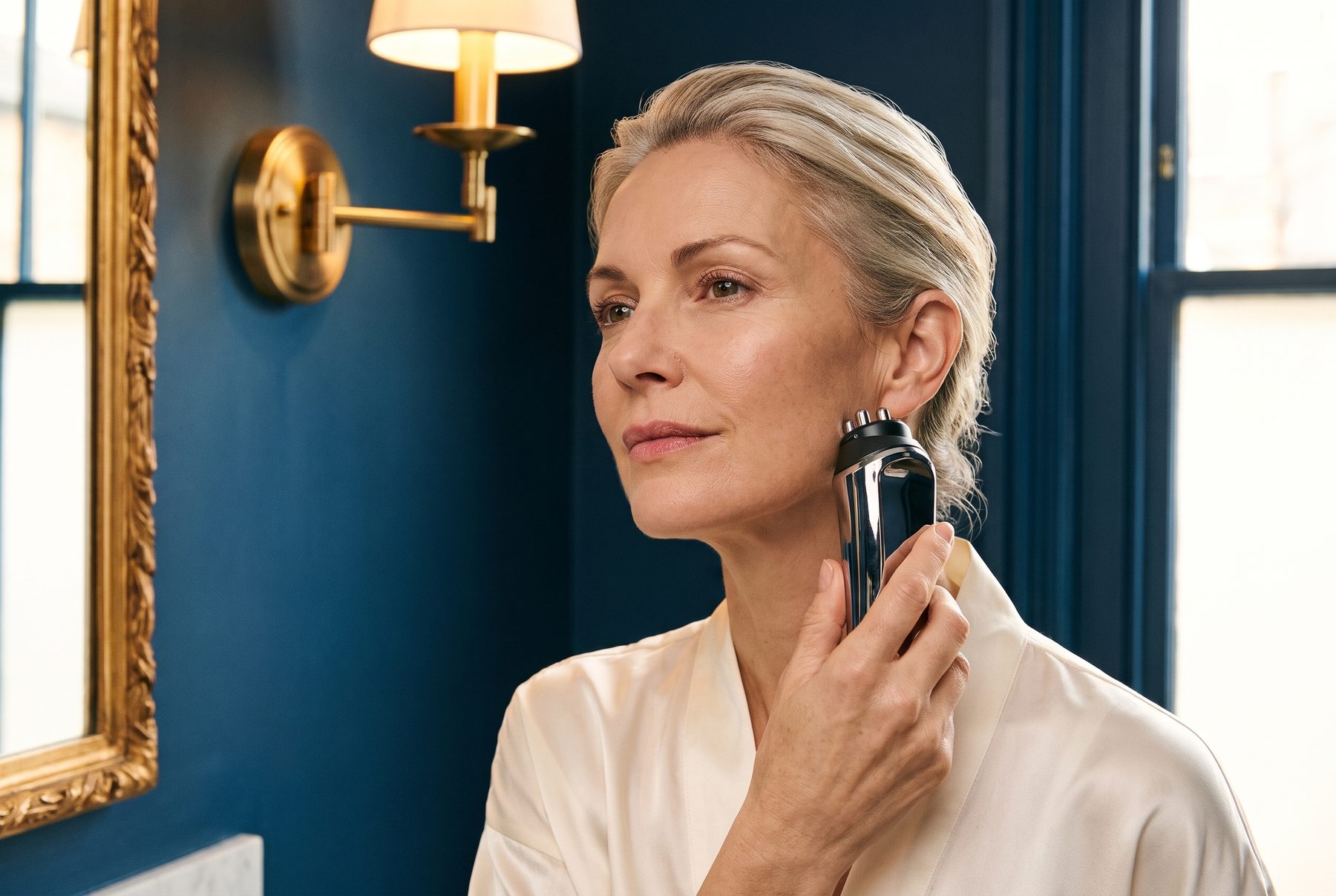
Quick answer: No, you cannot get Ultherapy at home. Ultherapy is a prescription-use microfocused ultrasound system cleared by the FDA to lift the brow and lax skin under the chin and on the neck, and it is performed in a clinic with real-time ultrasound imaging. What you can do at home is slower, gentler firming with radio frequency, microcurrent and LED devices such as the CurrentBody Skin RF, Medicube AGE-R Ultra Tune 40.68 and NuFACE TRINITY+. See the CurrentBody Skin RF.
Last updated: October 30, 2026
Ultherapy vs at-home devices at a glance
Ultherapy (clinic)
At-home RF, microcurrent and LED
How it works
Focused ultrasound energy delivered at set depths, with ultrasound imaging
Surface warmth (RF), low electrical current (microcurrent) or light (LED)
FDA status
Cleared for prescription use to lift the brow and lax submental and neck tissue
Varies by device; check each brand’s page
Who does it
A trained provider
You
Results
Lifting over the months after treatment
Gradual firming and smoother look over weeks of regular use
Downtime
Discomfort during treatment is common
None for most devices
What Ultherapy actually is
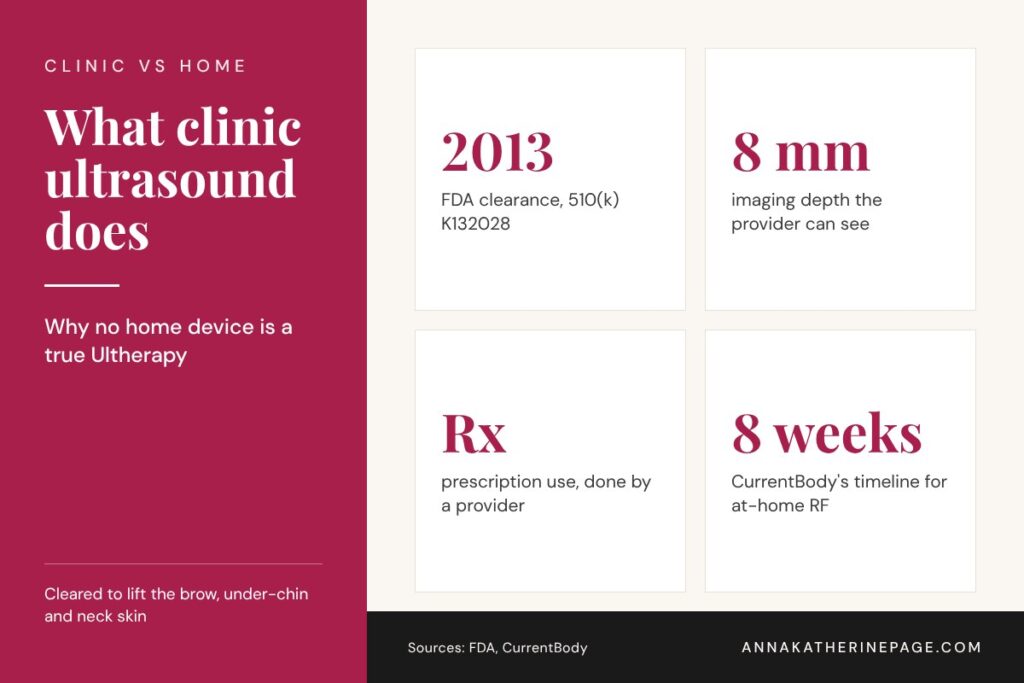
The FDA cleared the Ulthera System in 2013 (510(k) K132028) as a non-invasive dermatological aesthetic treatment to lift the eyebrow and lift lax submental and neck tissue. Its DeepSEE transducer lets the provider see up to 8 mm below the skin to confirm treatment depth and avoid bone, and the clearance is marked for prescription use (FDA 510(k) K132028). That imaging and depth control is the part no consumer gadget reproduces.
Why “at-home HIFU” devices are a bad idea
Devices sold online as at-home HIFU borrow the name without the imaging, the depth control or the training. Clinics warn that improper use can cause burns and nerve injury, and that home units are typically less effective than clinic machines (SL Aesthetic Clinic). The same caution applies to at-home RF microneedling: in October 2025 the FDA said RF microneedling is a medical procedure and these devices should not be used at home (FDA safety communication).
What works instead of Ultherapy at home
Radio frequency: CurrentBody Skin RF
CurrentBody’s RF device runs at 1 MHz and warms skin to about 104°F, pausing automatically at 40 to 41°C. Each area takes 5 minutes, used once a week for 8 weeks, then every 4 to 8 weeks to maintain. It needs CurrentBody’s RF gel every session, and the brand reports 89% saw improved skin tightness in 8 weeks (CurrentBody product page).
Where to buy the CurrentBody Skin RF:CurrentBody. Prices change often, so check today’s price at each.
RF plus microcurrent: Medicube AGE-R Ultra Tune 40.68
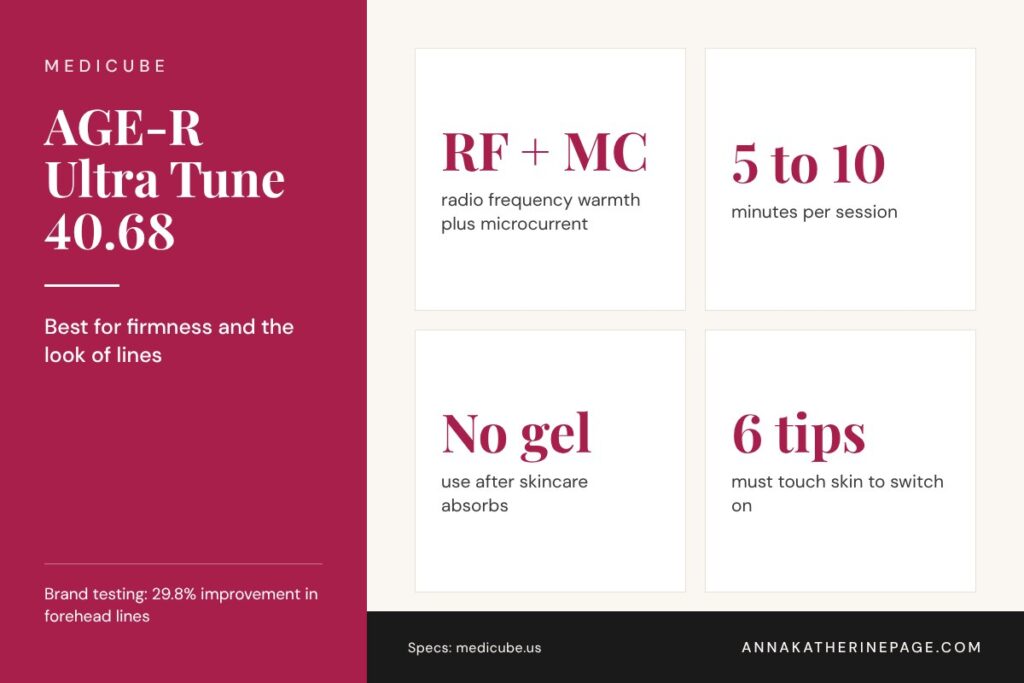
A daily option with no gel. The Ultra Tune pairs RF warmth with microcurrent in 5 to 10 minute sessions after skincare has absorbed, and Medicube reports improvement in forehead and neck lines in its own testing (Medicube product page). Compare it with the Booster Pro in Booster Pro vs Ultra Tune.
Where to buy the Medicube AGE-R Ultra Tune 40.68:Amazon | Medicube US. Prices change often, so check today’s price at each.
Microcurrent: NuFACE TRINITY+
FDA-cleared microcurrent in 5-minute sessions, 5 times a week for the first 60 days, then 2 to 3 times a week (NuFACE product page). Microcurrent is about muscle tone and a lifted look, so results fade if you stop.
Where to buy the NuFACE TRINITY+:NuFACE | Ulta | Sephora. Prices change often, so check today’s price at each.
Red light: an LED face mask
Red and near-infrared light support collagen over time and pair well with RF or microcurrent on alternate days. The best LED face masks guide compares the top masks by concern.
Setting realistic expectations for Ultherapy at home alternatives
None of these devices is Ultherapy at home. They are maintenance tools. They work slowly and need a routine you will keep.
Expect weeks, not days. CurrentBody’s own timeline is 8 weeks for its RF device.
If you were hoping for Ultherapy at home to treat marked jowling, neck laxity or a heavy brow, a board-certified dermatologist can tell you whether Ultherapy or another clinic treatment fits.
Skip any device sold as at-home HIFU or at-home RF microneedling.
Frequently asked questions
Is there an at-home version of Ultherapy?
No. Ultherapy is a microfocused ultrasound system cleared by the FDA for prescription use to lift the brow and lax skin under the chin and on the neck. It relies on ultrasound imaging and set treatment depths controlled by a trained provider. Consumer devices sold as at-home HIFU do not have that imaging or depth control and carry burn risks.
Are at-home HIFU devices safe?
They carry real risk. Clinics warn that home HIFU units used incorrectly can cause burns and nerve injury, and that they are usually less effective than clinic machines. They also lack the ultrasound imaging used in Ultherapy to confirm depth. Safer at-home options for firming are radio frequency, microcurrent and LED devices used as directed.
What is the best at-home alternative to Ultherapy?
Radio frequency is the closest at-home approach to skin tightening. The CurrentBody Skin RF warms skin to about 104°F in weekly sessions for 8 weeks, and the Medicube AGE-R Ultra Tune 40.68 combines RF with microcurrent for daily use without gel. Pairing either with an LED mask on other days is a common routine.
How long does at-home RF take to show results?
Expect several weeks. CurrentBody reports that 89% of users saw improved skin tightness after 8 weeks of weekly sessions with its Skin RF device, then recommends maintenance every 4 to 8 weeks. Daily devices like the Medicube Ultra Tune still need consistent use over weeks. Results are subtler than clinic treatments and fade without maintenance.
Can you do RF microneedling at home?
The FDA says no. In an October 2025 safety communication, it described RF microneedling as a medical procedure and said these devices should not be used at home, citing reports of burns, scarring, fat loss, disfigurement and nerve damage. Needle-free at-home RF devices are a different category that warms the skin surface without needles.
Sources
Sources checked on October 25, 2026. Figures from brands are reported as the brand’s own claims.
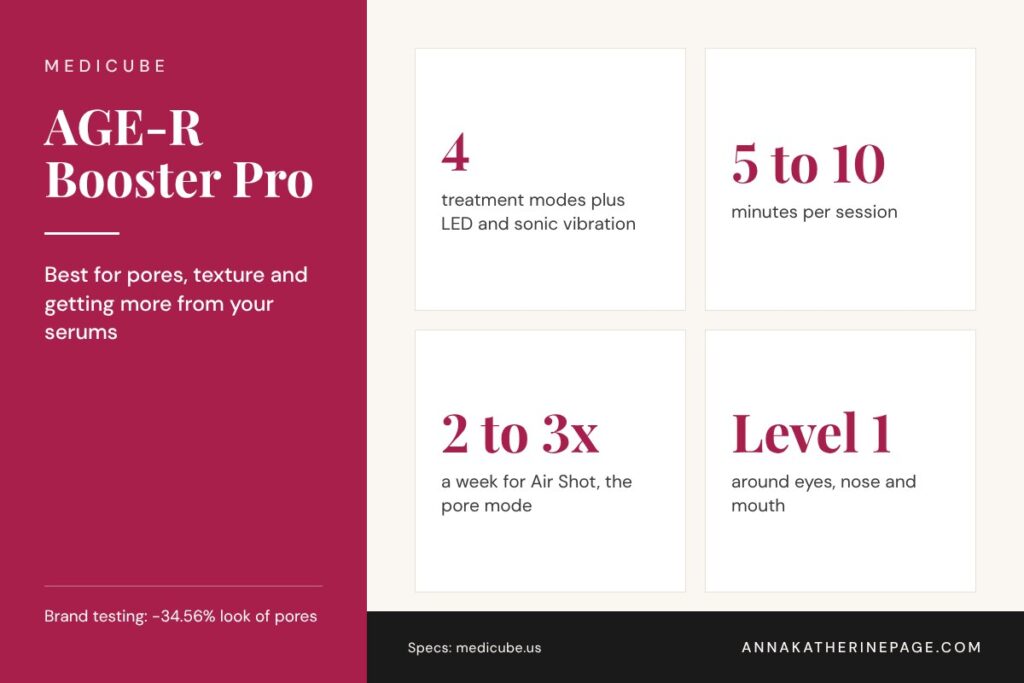
Quick answer: In the Medicube Booster Pro vs Ultra Tune decision, the Medicube AGE-R Booster Pro and the Medicube AGE-R Ultra Tune 40.68 do different jobs. The Booster Pro is the pick for pores, rough texture and getting more out of your serums, with four modes plus LED and sonic vibration. The Ultra Tune is the pick for firmness and lines, pairing radio frequency warmth with microcurrent. If you can only buy one, choose by your main concern, not by which is newer. See the Medicube AGE-R Booster Pro or see the AGE-R Ultra Tune 40.68 at Medicube.
Last updated: October 25, 2026
Medicube Booster Pro vs Ultra Tune at a glance
AGE-R Booster Pro
AGE-R Ultra Tune 40.68
Main job
Absorption, pores and texture
Firmness and the look of lines
Technology
Four modes (Booster, Air Shot, MC, Derma Shot) plus LED light and sonic vibration
Radio frequency (RF) plus microcurrent (MC), which Medicube calls Dual Tune-Wave
Session
5 to 10 minutes
5 to 10 minutes
How often
Booster, MC and Derma Shot 1 to 3 times a day; Air Shot 2 to 3 times a week
1 to 3 times a day
Used with
Your serum or skincare on the skin
After skincare has fully absorbed, no special gel
Eye area
Level 1 only around eyes, nose and mouth
Level 1 only; avoid eyelids and directly under the eyes
App
Works without it
AGE-R app controls modes, steps, vibration and LED color
In the box
Device, manual, USB cable
Device, manual, USB-C cable
What the Medicube AGE-R Booster Pro does
Medicube sells the Booster Pro as a 6-in-1 device: four treatment modes plus LED light and sonic vibration, with a surgical steel head. The modes split the work like this, according to Medicube’s product page:
Booster: supports radiance and helps your skincare absorb. This is the everyday mode.
Air Shot: aimed at the look of pores and uneven texture, used 2 to 3 times a week for 5 minutes on the T-zone and U-zone.
MC (microcurrent): for a plumper, more defined look around the eyes and mouth.
Derma Shot: for facial definition and overall balance.
Medicube reports a plumper look (+70.4%) and smaller-looking pores (-34.56%) in testing by the Global Institute of Dermatological Sciences. Those are the brand’s own figures, and the product page makes no FDA claim. Here’s what to look for in practice: the Booster Pro shines when it is paired with a serum you already like, because the whole point of the Booster and Air Shot modes is texture and absorption.
What the Medicube AGE-R Ultra Tune 40.68 does
The Ultra Tune is Medicube’s firming device. It pairs radio frequency, described as gentle warming energy for elasticity, with microcurrent for contour and volume around the eyes, smile lines and mouth. It only switches on when all six tips are touching skin, and Medicube says to use it after your skincare has fully absorbed, with no gel needed (Medicube product page).
Medicube’s human application test reports improvement in forehead lines (29.8%), neck lines (13.0%) and frown lines (10.0%). Again, those are brand-reported numbers, and the page does not mention FDA clearance. The move with RF is consistency: firming results build over weeks of regular sessions, not after one use.
Medicube Booster Pro vs Ultra Tune: which one should you buy?
Choose the AGE-R Booster Pro if
Pores, blackheads, rough texture or dullness are your main complaint.
You already own serums and want them to feel like they are doing more.
You want one device for daily use with skincare on the skin.
Choose the AGE-R Ultra Tune 40.68 if
Firmness, forehead lines or neck lines are your main complaint.
You want RF warmth without buying a gel every month.
You like app-guided routines and tracking.
Using both
What works here is splitting them by step: the Booster Pro with your serum on the skin, then the Ultra Tune once your skincare has fully absorbed, since that is how Medicube says to use it. Start at level 1 on both, keep them away from the eyelids, and give each at least a few weeks before judging. If you are deciding between the Booster Pro and a NuFACE instead, the Medicube Booster Pro vs NuFACE comparison covers that matchup.
Which Medicube offer are you actually comparing?
The original Booster Pro, Booster Pro X2 and Ultra Tune 40.68 should not be treated as the same device. Decide which model you intend to buy before comparing seller prices. A lower quote on the original Booster Pro is not automatically an offer on X2. Ulta lists those models separately (Medicube at Ulta).
These public prices were checked on November 12, 2026. Your selected cart still determines what you pay.
The original Booster Pro listing is described as a multi-mode device. The Ultra Tune listing identifies RF and microcurrent technology. Those product descriptions do not establish that the devices are interchangeable or that the more expensive option is better for every shopper. This section compares buying options, not treatment outcomes.
A useful price difference, with limits
The two original Booster Pro quotes differ by $76 before any shipping, tax or other purchase differences. That is a seller-price comparison, not a 33%-off claim against a verified historical normal price. Match the same color, model and included package before declaring one the better complete purchase.
The direct pages also showed mixed availability text, so they are not confirmed in-stock alternatives. The Ulta page’s $220 reference is a retailer-displayed reference, not proof of a historical average.
Does another coupon reduce the $154 price?
No additional coupon is included here. The Ulta page still displayed GIFTS terms that expired November 8. An old banner is not evidence that a code remains usable.
Before checkout, read the exact device instructions and the seller’s current return terms. Keep optional skincare subscriptions separate from a device-only price. Do not buy a different model merely because a similarly named offer appears cheaper. The where-to-buy links below go to each seller, or check the original Booster Pro, item 2645355, at Ulta.
Where to buy the Medicube Booster Pro and Ultra Tune
Where to buy the Medicube AGE-R Booster Pro:Ulta | Medicube US. Prices change often, so check today’s price at each.
Where to buy the Medicube AGE-R Ultra Tune 40.68:Amazon | Medicube US. Prices change often, so check today’s price at each.
What is the difference between the Medicube Booster Pro and the Ultra Tune?
The Booster Pro focuses on absorption, pores and texture, using four modes plus LED light and sonic vibration with skincare on the skin. The Ultra Tune 40.68 focuses on firmness and lines, combining radio frequency warmth with microcurrent, and is used after skincare has fully absorbed. Both run 5 to 10 minute sessions, so the choice comes down to your main skin concern.
Can you use the Medicube Booster Pro and Ultra Tune together?
Yes, many routines use both on different steps. Use the Booster Pro with a serum on the skin first, let your skincare absorb fully, then use the Ultra Tune, which Medicube says to use after products have soaked in. Start both at level 1, avoid the eyelids, and watch for irritation before increasing intensity or frequency.
Does the Medicube Ultra Tune need gel?
No. Medicube says the AGE-R Ultra Tune 40.68 needs no special gel. It is meant to be used after your normal skincare has fully absorbed, and it activates only when all six tips touch the skin. That makes it simpler to run daily than RF devices that require a conductive gel every session, such as the CurrentBody Skin RF.
How often should you use the Medicube Booster Pro?
Medicube recommends the Booster, MC and Derma Shot modes 1 to 3 times a day for 5 to 10 minutes. Air Shot, the pore and texture mode, is meant for 2 to 3 times a week for about 5 minutes. Use level 1 around the eyes, nose and mouth, and skip it over irritated or broken skin.
Is the Medicube Booster Pro FDA cleared?
Medicube’s US product page for the AGE-R Booster Pro does not state FDA clearance. Its results claims come from the brand’s own testing with the Global Institute of Dermatological Sciences. If FDA clearance matters to you, check the listing at the retailer you buy from and ask the seller, since claims can differ by region and version.
Sources
Sources checked on October 25, 2026. Figures from brands are reported as the brand’s own claims.
(function () {
var LABEL = "Send me the cheat sheet";
var PDF = "https://annakatherinepage.com/wp-content/uploads/2026/11/flower-price-cheat-sheet.pdf";
var CONFIRM = '<p>Your Flower Price Cheat Sheet is ready. <a href="' + PDF + '">Download the two-page PDF</a> now.</p><p>Give the email a minute, and peek in spam the first time so the next one lands in your inbox. The formulas use labeled sample numbers. Type over them with yours.</p>';
function retitle() {
var buttons = document.querySelectorAll(".fluent_form_5 .ff-btn-submit, form.fluent_form_5 .ff-btn-submit, .frm-fluent-form.fluent_form_5 .ff-btn-submit");
for (var i = 0; i < buttons.length; i++) {
var b = buttons[i];
if ((b.textContent || "").indexOf("cheat sheet") === -1) {
b.textContent = LABEL;
b.setAttribute("aria-label", LABEL);
}
b.style.backgroundColor = "#5a6b4e";
b.style.borderColor = "#5a6b4e";
b.style.color = "#ffffff";
}
var styles = document.querySelectorAll(".ff-form-inline-style style");
for (var j = 0; j < styles.length; j++) {
var s = styles[j];
if ((s.textContent || "").indexOf("fluent_form_5") !== -1 && (s.textContent || "").indexOf("#123d2e") !== -1) {
s.textContent = s.textContent.replace(/#123d2e/g, "#5a6b4e");
}
}
}
if (document.readyState === "loading") document.addEventListener("DOMContentLoaded", retitle);
else retitle();
setTimeout(retitle, 400);
function maybeFixSuccess(root) {
if (!root) return;
var success = root.querySelector(".ff-message-success, .ff-el-success, .ff-form-success");
if (!success) return;
var t = (success.textContent || "").toLowerCase();
if (t.indexOf("inbox") !== -1 || t.indexOf("cheat sheet") === -1) {
success.innerHTML = CONFIRM;
}
}
document.addEventListener("fluentform_submission_success", function () {
maybeFixSuccess(document.querySelector(".fluentform_wrapper_5, #fluentform_5, .ff_form_wrapper_5"));
});
if (window.jQuery) {
window.jQuery(document).on("fluentform_submission_success", function () {
maybeFixSuccess(document.querySelector(".fluentform_wrapper_5, #fluentform_5, .ff_form_wrapper_5"));
});
}
})();
(function(){
function rgb(c){var m=(c||"").match(/[0-9.]+/g);return m?m.map(Number):null;}
function lum(a){return (0.299*a[0]+0.587*a[1]+0.114*a[2])/255;}
function effbg(el){var n=el;while(n){var c=rgb(getComputedStyle(n).backgroundColor);if(c&&(c.length<4||c[3]>0.5))return c;n=n.parentElement;}return null;}
var sel="main h1,main h2,main h3,main h4,main p,main li,main span,#frc h1,#frc h2,#frc h3,#frc p,#frc span,#frc li";
document.querySelectorAll(sel).forEach(function(t){
var bg=effbg(t);
if(!bg) return;
if(lum(bg)<0.30){
var fc=rgb(getComputedStyle(t).color);
if(fc && lum(fc)<0.5){ t.style.setProperty("color","#f7f1e6","important"); }
}
});
})();
(function () {
function formIdFrom(ev, data) {
var id = "";
var form = null;
if (data) {
if (data.formId != null) id = String(data.formId);
else if (data.form_id != null) id = String(data.form_id);
form = data.form;
if (form && form.jquery) form = form[0];
}
if (!form && ev && ev.detail) {
form = ev.detail.form;
if (form && form.jquery) form = form[0];
if (!id) {
if (ev.detail.formId != null) id = String(ev.detail.formId);
else if (ev.detail.form_id != null) id = String(ev.detail.form_id);
}
}
if (!form && ev && ev.target && ev.target.nodeType === 1) {
form = ev.target.closest ? (ev.target.closest("form") || ev.target.closest("[id^='fluentform_']") || ev.target.closest("[class*='fluent_form_']")) : ev.target;
}
if (!id && form) {
var src = String((form.id || "") + " " + (form.className || "") + " " + (form.getAttribute && (form.getAttribute("data-form_id") || form.getAttribute("data-id") || "") || ""));
var m = src.match(/fluentform_wrapper_(\d+)/) || src.match(/fluentform_(\d+)/) || src.match(/fluent_form_(\d+)/);
if (m) id = m[1];
}
return id;
}
function newEventId() {
try {
if (window.crypto && typeof crypto.randomUUID === "function") return crypto.randomUUID();
} catch (err) {}
return "ff5lead_" + Date.now() + "_" + Math.random().toString(16).slice(2);
}
var lockUntil = 0;
function fireLead(ev, data) {
if (formIdFrom(ev, data) !== "5") return;
if (typeof window.fbq !== "function") return;
var now = Date.now();
if (now < lockUntil) return;
lockUntil = now + 2000;
var eid = newEventId();
try {
fbq("track", "Lead", { content_name: "Flower Price Cheat Sheet" }, { eventID: eid });
} catch (err) {}
}
document.addEventListener("fluentform_submission_success", function (ev) {
fireLead(ev, ev && ev.detail);
});
if (window.jQuery) {
window.jQuery(document).on("fluentform_submission_success", function (ev, data) {
fireLead(ev, data);
});
window.jQuery(document.body).on("fluentform_submission_success", function (ev, data) {
fireLead(ev, data);
});
}
})();