Quick answer: when your field is done, buy stems from an online wholesaler that ships to your door (FiftyFlowers sells to the public, no business license needed), a local wholesale florist, a trade wholesaler like Mayesh if you hold a resale license, or farms with greenhouse crops. Price bought-in stems from landed cost, then mark them up.
Disclosure: some supplier links on this page may become affiliate links. If you buy through an affiliate link, Cut & Bloom Co. may earn a small commission at no extra cost to you. No supplier paid to be listed, and the comparison would read the same without the links.
By Anna Katherine Page, Cut & Bloom Co. Supplier prices, platform fees and policies quoted here were checked on each source’s own page on November 21, 2026. They change, so confirm before you buy.
Growers who quote a winter or early spring wedding often ask where to buy stems that ship straight to them. Here is a comparison of who can buy where, the pricing math, and when to have flowers arrive.
Where can a flower farmer buy wedding flowers in the off-season?
Floral professionals with a resale license, or a valid EIN in states that do not require one. “Farmer Florist” is one of its approved customer types. It does not sell to the public.
Branches plus online ordering for full box lots and bunches
Account approval takes 1 to 3 business days, and you need resale documentation.
Other flower farms (farmer to farmer)
Varies by farm
Local or regional, a seasonal look that matches your style
Limited supply in winter. Book early.
Grocery or warehouse club bulk flowers
Anyone
Easy for a few filler stems in a pinch
Quality and quantity are not guaranteed for a wedding date.
To find farms with greenhouse or off-season crops, the Slow Flowers member listings include flower farmers and wholesalers.
How do you price bought-in flowers?
Use landed cost, not the per-stem price on the website.
Sample numbers. These are example inputs to show the math, not a recommended price, not a market average, and not a claim about what any grower earns. Swap in your own costs.
Line
Sample
Stems ordered (100 stems at $1.20)
$120.00
Shipping
$35.00
Processing time (1 hour at $25)
$25.00
Landed cost
$180.00
Landed cost per usable stem (90 usable after 10% waste)
$2.00
Stem price inside your wedding pieces (x 2)
$4.00
The $1.20 website price turns into $2.00 a usable stem once shipping, waste and your time are in. A grower who prices from $1.20 loses money on every piece.
When should bought-in flowers arrive?
Earlier than you think. FiftyFlowers lists an ideal delivery date on each flower’s page, ships flowers in bud so they need a couple of days to open, suggests delivery 1 to 2 days before the event for delicate flowers like hydrangeas, and for a Saturday event in snowy winter weather suggests delivery no later than Thursday (FiftyFlowers FAQ). Build your design days around the arrival date, not the other way around.
How many extra stems should you order?
Plan for loss. If 1 to 2 flowers in a 10-stem bunch arrive bruised, that is 10% to 20% of the bunch. The sample above uses 10% waste. Order more for fragile flowers and long shipping routes, and price from usable stems, not stems ordered.
Can a flower farmer buy from a trade wholesaler?
Often, yes, if you have the paperwork. Mayesh lists “Farmer Florist” as an approved customer type and asks for a resale license, seller’s permit or similar sales tax ID, or a valid EIN in states that do not require a resale license (Mayesh Help Center). FiftyFlowers sells to anyone, and its PRO program requires resale certification (FiftyFlowers Help Center).
Should you tell couples which flowers are bought in?
If your brand is farm-grown flowers, yes. Say which pieces use your own stems and which use bought-in flowers. It sets clear expectations and protects your reputation. Quote a palette, not varieties, and include a substitution clause. See how to quote a wedding when stem prices are unknown.
Keep landed cost and wedding math on one page
The cheat sheet has the wedding and wholesale formulas, plus cost per stem, bouquet and CSA, with labeled sample numbers on two printable pages. Enter your email and I will send the free two-page Flower Price Cheat Sheet PDF.
How do you build the quote with bought-in stems included?
The Wedding Quotes tab in the Flower Farm Pricing Toolkit ($27) includes an extra-stem buffer line, setup labor, travel and a deposit. If you sell your own stems to florists in season, the Florist and Wholesale Sales Kit ($14) prices your wholesale bunches and availability list.
Where can a flower farmer buy wholesale flowers for a winter wedding?
Online wholesalers that ship direct (FiftyFlowers sells to the public without a business license), local wholesale florists, trade wholesalers like Mayesh if you have a resale license, and other farms with greenhouse or warm-region crops.
Do I need a business license to buy wholesale flowers?
Not everywhere. FiftyFlowers sells to anyone. Trade wholesalers such as Mayesh require a resale license or similar sales tax ID, or an EIN in states that do not require a resale license. Check with each supplier.
How do I price flowers I buy in for a wedding?
Start from landed cost: stem price plus shipping, expected waste and processing time. Divide by the usable stems, then mark up. In the sample, $1.20 stems become $2.00 per usable stem before markup.
How early should wholesale wedding flowers arrive?
Flowers often ship in bud and need a couple of days to open. FiftyFlowers lists an ideal delivery date for each flower and suggests a Thursday delivery at the latest for a Saturday event in winter weather.
Should I tell couples which flowers were bought in?
If your brand is farm-grown flowers, yes. It sets clear expectations and protects your reputation.
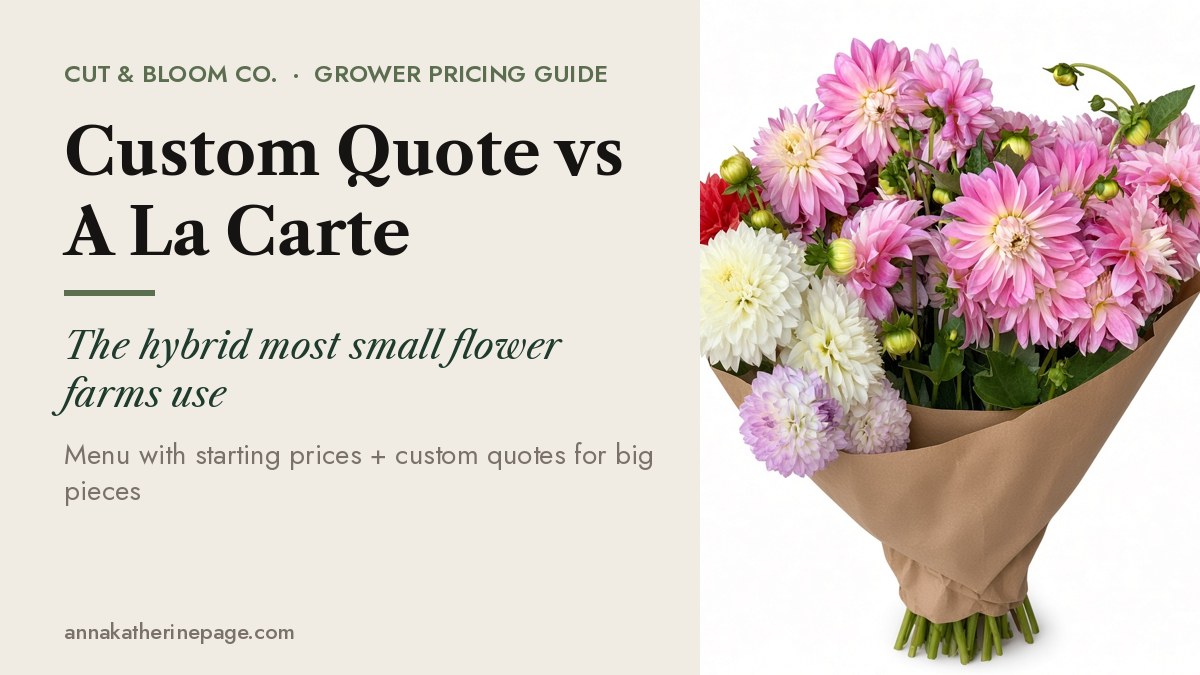
Quick answer: most small flower farms do best with a hybrid: a public a la carte menu with “starting at” prices and a wedding minimum, plus custom quotes for large or structural pieces like arches. The menu filters out budgets that do not fit before you spend an hour on a consult. Custom quotes protect your margin on complex work.
By Anna Katherine Page, Cut & Bloom Co. Supplier prices, platform fees and policies quoted here were checked on each source’s own page on November 21, 2026. They change, so confirm before you buy.
This debate shows up often among growers who are adding weddings: post prices publicly, or make every couple request a quote? Here is a fair comparison, a sample menu, and the follow-up questions growers ask next: minimums, delivery fees, and oversized pieces.
How do a la carte menus, custom quotes and a hybrid compare?
A la carte price list
Custom quote
Hybrid (menu + custom for big pieces)
Time per inquiry
Low. Couples self-select.
High. Consult, design, written quote.
Low for most, high only for large weddings
Margin protection
Good on standard pieces, weak on oversized ones
Strong. Each piece is priced from its design.
Strong
Fits your harvest
Good if items are described by size and palette
Good
Good
Couples who expect a florist experience
May feel generic
Fits
Fits
Price shoppers
Filtered out early, which saves you time
Can take hours before they decline
Filtered early
Risk
A posted price that is too low gets locked in
Inconsistent prices from quote to quote
Low if you review the menu every season
Best for
DIY buckets, elopements, small weddings
Full-service, installations, large guest counts
Most growers adding weddings
What does a sample a la carte menu look like?
These are the sample unit prices from the Wedding Quotes tab in the Flower Farm Pricing Toolkit. They show the format, not a price you should copy.
Sample numbers. These are example inputs to show the math, not a recommended price, not a market average, and not a claim about what any grower earns. Swap in your own costs.
Item
Starting at
Bridal bouquet
$150
Bridesmaid bouquet
$65
Boutonniere
$18
Corsage
$28
Reception centerpiece
$85
Aisle marker
$35
Cake flowers
$65
Ceremony arch or altar
Custom quote
Delivery, setup and breakdown
Quoted by distance and hours
Add a line like “Wedding minimum: $X” and “Prices are for a garden-style design in a seasonal palette.” The wedding pricing guide covers how to build each piece price from your costs.
How do you set a wedding minimum?
Add up the smallest wedding you would happily take, including your delivery and setup time, then round up.
Sample numbers. These are example inputs to show the math, not a recommended price, not a market average, and not a claim about what any grower earns. Swap in your own costs.
Anything below the minimum can go to a DIY bucket or a pickup-only bouquet order instead. See how to price DIY flower buckets.
How do you charge for delivery, setup and breakdown?
Quote them as their own lines so the menu prices stay clean. The toolkit sample uses hours x your hourly rate for setup and breakdown (6 hours x $25 = $150) and round-trip miles beyond a free radius x a mileage rate (25 miles, first 15 free, $0.70 a mile = $7). Use your own rate and distances.
How do you handle the “oversized bouquet from a photo” problem?
A couple sends a photo of a huge bridal bouquet and asks if your $150 bridal bouquet looks like that. This is where a pure menu breaks. Fix it by pricing size tiers, not just item names.
Sample numbers. These are example inputs to show the math, not a recommended price, not a market average, and not a claim about what any grower earns. Swap in your own costs.
Estimate the stems in the photo. Count one quarter of the bouquet and multiply by four, and count focal flowers separately from filler and greenery. For scale, FiftyFlowers’ FAQ puts a standard bridal bouquet at about 15 to 20 flowers (FiftyFlowers FAQ).
Compare it with your standard bridal bouquet. If your standard uses 35 stems including filler and greens and the photo shows about 70, it is about 2x the flowers.
Scale the flower and design portion, not the whole price. If stems are 30% of your $150 bouquet ($45), double stems add about $45. Add design time: 30 more minutes at $25 an hour is $12.50.
Quote it as an “oversized bridal bouquet” at about $210 ($150 + $45 + $12.50, rounded up) and add that tier to your menu.
Will posting your prices let other farms undercut you?
Other growers can usually learn your prices anyway, by asking. Your menu is written for couples, not competitors. If your prices come from your own costs and time, a cheaper farm down the road is pricing for a different business. The bigger risk is a posted price that is too low, so review the menu every winter.
How do you switch to a hybrid this winter?
Price each menu item from a real design with your costs, not from another farm’s list.
Show “starting at” prices and a minimum.
Mark anything structural (arches, hanging pieces, large installs) as custom quote only.
Add size tiers for bridal bouquets and centerpieces.
Review the menu every winter, and before you raise prices, check last season’s actual stem costs.
Price your menu from real numbers
The cheat sheet has the wedding and bouquet formulas, plus cost-per-stem, wholesale and CSA, with labeled sample numbers on two printable pages. Enter your email and I will send the free two-page Flower Price Cheat Sheet PDF.
Not sure your current prices hold up? The free Flower Pricing Reality Check takes about two minutes, and no email is needed to see your score.
Frequently asked questions
Should flower farmers post wedding prices on their website?
Posting ‘starting at’ prices and a minimum saves time and filters out budgets that do not fit. Keep large or structural pieces as custom quote only.
What is a la carte wedding flower pricing?
A menu where each piece, such as a bridal bouquet, boutonniere or centerpiece, has a set or starting price, and the couple builds their order from the list.
Is a custom wedding flower quote better than a price list?
For large or complex weddings, yes, because each piece is priced from its design. For small weddings and DIY orders, a menu is faster for you and clearer for the couple.
How do I set a minimum for wedding flowers?
Add up the smallest wedding you would happily take, including delivery and setup time, and round up. In the sample, a bridal bouquet, two bridesmaid bouquets, four boutonnieres, two corsages and two hours of setup come to $458, so the minimum is $500.
How do I price a bigger bouquet than the one on my menu?
Estimate how many more stems it needs, scale the flower portion of the price, and add the extra design time. Then add that size as a new tier on your menu.
How often should I update my wedding price list?
At least once a year, in winter, after you check last season’s actual stem and supply costs.
Sources
FiftyFlowers FAQ. typical flower count in a standard bridal bouquet
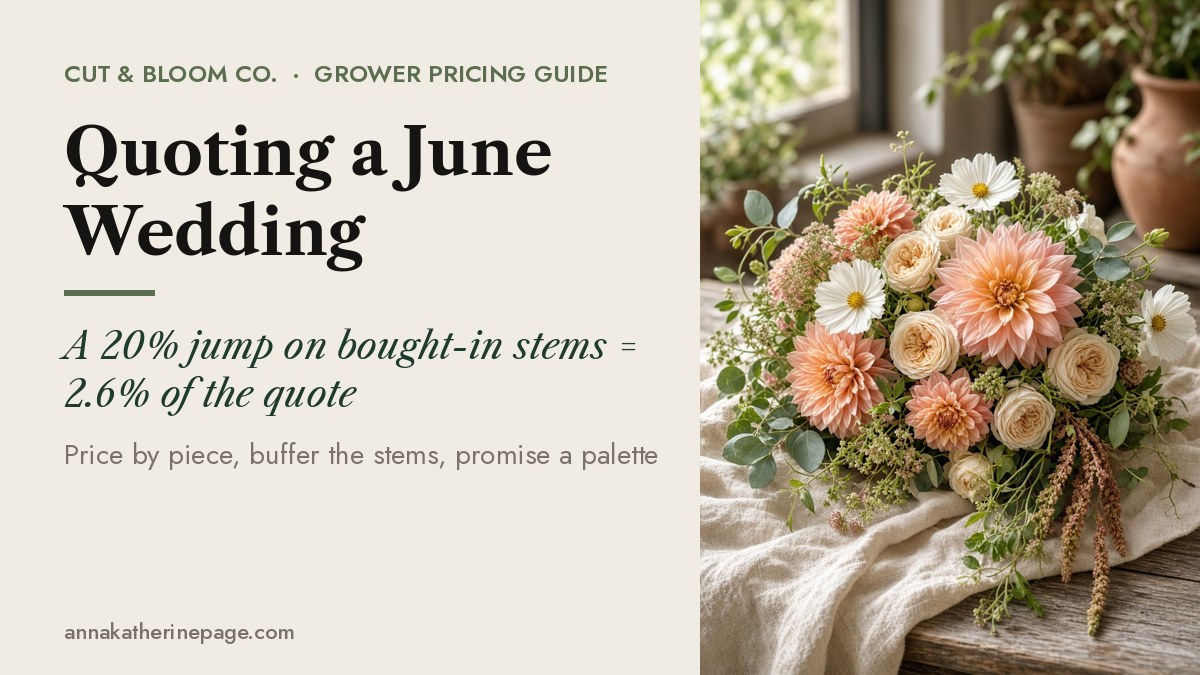
Quick answer: quote by the piece, not the stem. Price each bouquet, centerpiece and arch from its design, add a stem buffer for flowers you may buy in, promise a palette instead of varieties, and add a substitution clause and deposit. In our sample, a 20% rise in bought-in stem prices adds only 2.6% to the total.
By Anna Katherine Page, Cut & Bloom Co. Supplier prices, platform fees and policies quoted here were checked on each source’s own page on November 21, 2026. They change, so confirm before you buy.
Newer growers run into this every winter: a couple wants a quote for a June wedding, and you do not know yet what stems will cost or what your field will have. Here is the method, with the math that shows how much risk you are actually carrying, plus sample contract wording and ordering timelines.
What are the three ways to quote a wedding months ahead?
Per-stem quote
Per-piece quote with buffer (recommended)
Flat package
How it works
Count every stem in every piece and price each one
A set price per bridal bouquet, centerpiece, arch and so on, plus a stem buffer line
One price for a set list of pieces
Risk if stem costs rise
High. Every change means a new quote.
Low. The buffer and palette absorb it.
Medium. Fine for small weddings, tight for big ones.
Sample numbers. These are example inputs to show the math, not a recommended price, not a market average, and not a claim about what any grower earns. Swap in your own costs.
Item
Qty
Unit price
Subtotal
Bridal bouquet
1
$150
$150
Bridesmaid bouquets
4
$65
$260
Boutonnieres
6
$18
$108
Corsages
4
$28
$112
Ceremony arch or altar
1
$475
$475
Reception centerpieces
12
$85
$1,020
Aisle markers or petals
6
$35
$210
Cake flowers
1
$65
$65
Welcome sign or cocktail accents
2
$45
$90
Pieces subtotal
$2,490
Extra-stem buffer (30% on the stem share of the pieces)
$224.10
Setup and breakdown (6 hours x $25)
$150
Travel (25 round-trip miles, first 15 free, $0.70 a mile)
$7
Total quote
$2,871.10
Deposit to book the date (50%)
$1,435.55
How the buffer works: the sample assumes stems are 30% of each piece’s price, so the stem share of $2,490 is $747. The 30% buffer on that share is $224.10.
How much risk are you really carrying?
Suppose half of those stems ($373.50 of the $747 stem share) are ones you will buy in, not grow, and wholesale prices rise before June.
Sample numbers. These are example inputs to show the math, not a recommended price, not a market average, and not a claim about what any grower earns. Swap in your own costs.
What happens
Extra cash cost
Covered by the $224.10 buffer?
Share of the $2,871 quote
Bought-in stems rise 10%
$37.35
Yes
1.3%
Bought-in stems rise 20%
$74.70
Yes
2.6%
Bought-in stems rise 40%
$149.40
Yes
5.2%
Field failure: you must also buy the half you planned to grow, at a 20% premium ($373.50 x 1.2)
$448.20
No, about $224 short
15.6%
The lesson: price swings on bought-in stems are small next to the total. The real risk is a crop failure that forces you to buy everything. That is what the palette promise and the substitution clause are for.
What is the five-step method?
Price each piece from a design, not a stem count. Use last season’s highest cost for that month if you have it.
Add a stem buffer line. 20% to 30% of the stem share is a reasonable starting range. Raise it for couples who want specific bought-in flowers.
Quote a palette and a style, not varieties. “Blush, apricot and cream, garden style” instead of “12 Cafe au Lait dahlias.”
Add a substitution clause. You will substitute flowers of similar color, style and value if a variety is not available, and tell the couple about any major change.
Take a deposit and set a final-details date. A non-refundable booking deposit (50% in the sample) and final counts about 30 days out.
The quote validity window, deposit refund terms and contract language are business decisions. Have your contract reviewed for your state.
What should a substitution clause say?
Keep it short and plain. Sample wording, to adapt and have reviewed, not legal advice:
“Flowers are living, seasonal products. If a flower in this proposal is unavailable, out of season, or not at our quality standard for your date, we will substitute flowers of similar color, style and value. We will tell you about any major change before the wedding.”
Pair it with a palette in the proposal (“blush, apricot, cream and soft green”) and a short list of “likely” flowers, so the couple knows what to expect without you promising a specific variety.
Should you add a price-increase clause?
Most growers handle cost risk with the buffer line, because couples prefer a fixed total. If a couple insists on specific bought-in flowers, you have two honest options: quote those flowers as a separate line priced from today’s landed cost plus a larger buffer, or state that the line can be repriced if the wholesale cost changes before you order. Whichever you pick, say it in the proposal, not after the deposit.
When should you order bought-in flowers?
Confirm final counts first, then order to arrive with time to open. FiftyFlowers, for example, lists an ideal delivery date on each flower’s page, ships flowers in bud so they need a couple of days to open, and suggests a Thursday delivery at the latest for a Saturday event in snowy winter weather (FiftyFlowers FAQ). Where to buy and how to price bought-in stems is in wholesale flowers for an off-season wedding.
What if the couple wants a flower that will not be in season?
Price it as a bought-in flower at landed cost (stem price plus shipping, waste and your processing time), mark it up, and show it as its own line. Or offer a seasonal flower in the same color and shape. Either way, the couple sees the trade-off and chooses.
Keep the wedding formula next to your quote
The cheat sheet includes the wedding pricing formula alongside cost-per-stem, bouquet, wholesale and CSA formulas, with labeled sample numbers, on two printable pages. Enter your email and I will send the free two-page Flower Price Cheat Sheet PDF.
How can you quote your next wedding without guessing?
The Wedding Quotes tab in the Flower Farm Pricing Toolkit ($27) builds this quote line by line, including the extra-stem buffer, setup labor, travel beyond your free miles and the deposit. It has a 14-day refund. If you also sell to florists and run a CSA, the Complete Flower Farm Pricing Bundle ($44) includes the toolkit plus the Florist and Wholesale Sales Kit and the Flower CSA Launch Kit.
How do you quote wedding flowers when the wedding is months away?
Quote by the piece, add a stem buffer line for flowers you may need to buy in, promise a palette rather than specific varieties, and include a substitution clause and a booking deposit.
How much buffer should I add for unknown stem prices?
20% to 30% of the stem share of the quote is a reasonable starting range. In the sample, stems are 30% of $2,490, and a 30% buffer on that share adds $224.10.
Should a flower farmer promise specific varieties to a couple?
Only for flowers you are sure you can supply. Promise a color palette and style, and name varieties as likely, not certain.
What is a substitution clause for wedding flowers?
A contract line that lets you replace an unavailable flower with one of similar color, style and value. It protects you from crop failures and supply gaps.
How much deposit should I take for wedding flowers?
Set your own terms and put them in the contract. The toolkit sample uses a 50% booking deposit with final counts about 30 days before the wedding.
When should bought-in wedding flowers arrive?
Early enough to open. Flowers often ship in bud, and suppliers such as FiftyFlowers list an ideal delivery date for each flower. Allow extra time in winter in case of shipping delays.
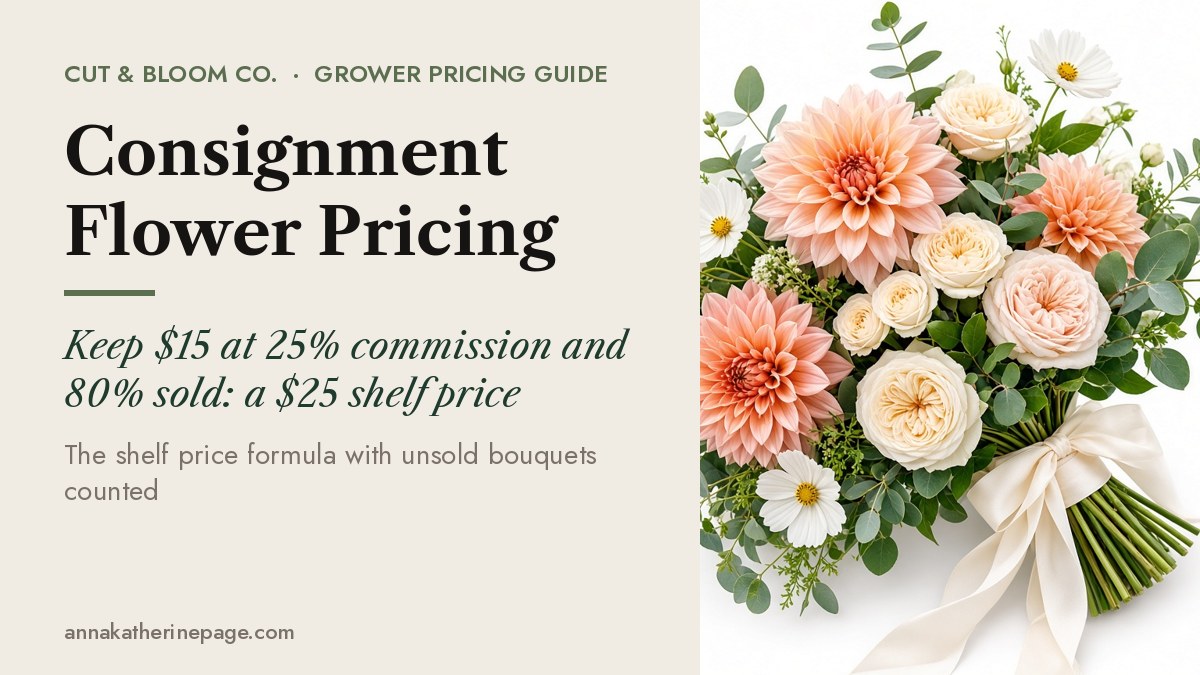
Quick answer: set the shelf price so what you keep, after commission and unsold bouquets, still covers your cost. Shelf price = what you need per bouquet / ((1 – commission) x sell-through). To keep $15 a bouquet at 25% commission with 80% selling: $15 / (0.75 x 0.8) = $25.
By Anna Katherine Page, Cut & Bloom Co. Supplier prices, platform fees and policies quoted here were checked on each source’s own page on November 21, 2026. They change, so confirm before you buy.
Growers who sell through a farm shop often wonder whether a $25 bouquet is priced too low once the shop takes its 25%. The answer depends on two numbers most growers never put together: the commission, and how many bouquets come back unsold. On consignment, the shop only pays you for what sells. Wilted bouquets are your loss.
How does consignment compare with wholesale and your own stand?
Consignment (farm shop, cafe, boutique)
Wholesale (shop buys outright)
Your own stand or market booth
Who sets the retail price
Usually you, sometimes agreed with the shop
The shop
You
Your cut of a $25 sale
$25 x (1 – commission). At 25%, $18.75
The wholesale price you agreed with the shop, paid whether or not it sells
Each cell is the shelf price needed to keep $15 per bouquet made. Rounded up to the next dollar.
Sample numbers. These are example inputs to show the math, not a recommended price, not a market average, and not a claim about what any grower earns. Swap in your own costs.
Commission
100% sell
90% sell
80% sell
70% sell
15%
$18
$20
$23
$26
20%
$19
$21
$24
$27
25%
$20
$23
$25
$29
30%
$22
$24
$27
$31
35%
$24
$26
$29
$33
“Sell” means the share of bouquets you deliver that sell before you pull them. If you deliver 10 bouquets and 8 sell, that is 80%.
Is a $25 bouquet too low at a 25% commission?
Sample numbers. These are example inputs to show the math, not a recommended price, not a market average, and not a claim about what any grower earns. Swap in your own costs.
You deliver 10 bouquets a week at a $25 shelf price.
8 sell. The shop keeps 25% of $200, which is $50. You receive $150.
You made 10 bouquets, so you earned $15 per bouquet made, not $18.75.
If each bouquet costs you $8 in stems and supplies plus $5 of your time, your true cost is $13. You keep $2 per bouquet made, before the delivery drive.
So is $25 too low? In this example, it is right at the edge. A $28 shelf price at the same sell-through keeps about $16.80 per bouquet made. Smaller, tighter bouquets at $25 also work. The Bouquet & Market Pricing Calculator ($7) shows your true cost and three price points from your own recipe. For how bouquet prices compare at markets, see farmers market flower prices and how much to charge for a bouquet.
Is consignment worth it for flower farmers?
It can be, but go in with your eyes open. Virginia Cooperative Extension’s guide to field-grown specialty cut flowers says plainly that consignment sales are not recommended, and suggests letting buyers who pay wholesale prices do the retail marketing (Virginia Tech, SPES-171). The reason is the risk in the table above: on consignment, every unsold bouquet is your cost.
Consignment makes the most sense as a short trial in a busy shop, with your price set from the table and a plan to switch to wholesale once you know what sells. If you sell outright to florists instead, keep your expectations realistic on “local” as a selling point: in a 2022 survey of Utah florists, most were unwilling to pay more than 10% more for locally sourced flowers (Utah State University Extension). Quality, freshness and reliable supply carry more weight.
What should you put in writing with the shop?
The commission percentage, and whether it is taken before or after card fees and sales tax.
How often they pay you, and how they report what sold.
Who sets the price, and whether the shop can discount your bouquets.
Who refreshes water, and when you pull and replace tired bouquets.
What happens to unsold bouquets: returned to you, composted, or marked down.
Whether you can switch to a wholesale arrangement once sales are steady.
How do you track sell-through?
Keep a simple log for each delivery: date, bouquets delivered, bouquets sold, bouquets pulled. After four deliveries, divide total sold by total delivered. That is your real sell-through, and it is the number to use in the table. Log the day of the week too, because many shops sell very differently on a Tuesday and a Friday.
Keep the consignment math on one page
The cheat sheet puts the cost-per-stem, bouquet and wholesale formulas you need before you set a shelf price on two printable pages, with labeled sample numbers. Enter your email and I will send the free two-page Flower Price Cheat Sheet PDF.
Sell-through is the number you control most. Deliver smaller batches more often, use long-lasting stems for shop bouquets, and track what sells by day of the week. Moving from 70% to 90% sell-through at a 25% commission lowers the shelf price you need from $29 to $23 in the table above.
Is $25 too low for a bouquet in a shop that takes 25%?
It depends on your cost and how many bouquets sell. At 25% commission you keep $18.75 per sale. If only 8 of 10 sell, you keep $15 per bouquet made. If your bouquet costs more than about $13 in stems, supplies and time, $25 is too low.
How do I calculate a consignment price for flowers?
Shelf price = the amount you need per bouquet / ((1 – commission) x sell-through rate). For $15 per bouquet at 25% commission and 80% sell-through: $15 / (0.75 x 0.8) = $25.
What commission do farm shops take on flowers?
There is no standard rate. It varies by shop, and some shops prefer to buy outright at a wholesale price. Ask each shop for its number and get it in writing before your first delivery. The table in this guide covers 15% to 35%.
Is consignment or wholesale better for flower farmers?
Wholesale moves the waste risk to the shop, so it is more predictable. Consignment can pay more per bouquet if most of them sell. If fewer than about 7 in 10 sell, wholesale usually wins. Virginia Cooperative Extension does not recommend consignment for cut flowers.
Who pays for bouquets that wilt on consignment?
Usually the grower. That is why sell-through belongs in your price formula, and why the agreement should say what happens to unsold bouquets.
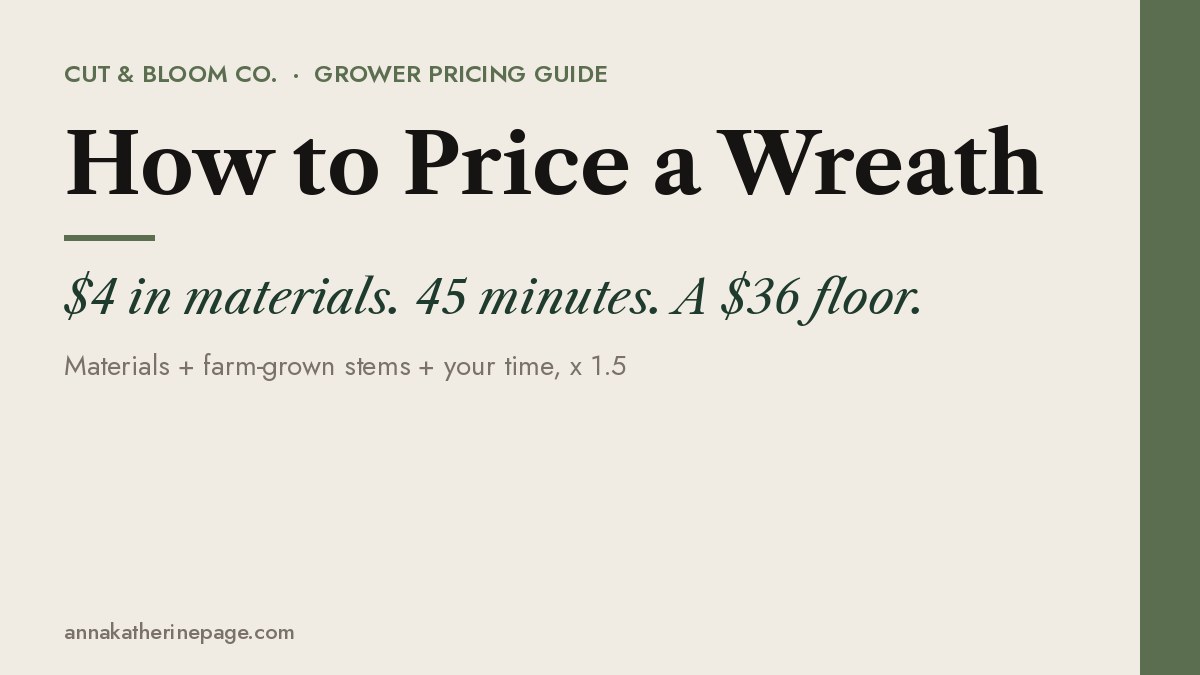
Quick answer: price a wreath from its true cost: bought materials, plus farm-grown stems at what you could sell them for, plus your time, plus packaging, then multiply by 1.5 to 2. A wreath with $4 in materials, $1 packaging and 45 minutes at $25 an hour costs $23.75, so its floor is about $36.
By Anna Katherine Page, Cut & Bloom Co. Supplier prices, platform fees and policies quoted here were checked on each source’s own page on November 21, 2026. They change, so confirm before you buy.
Every holiday season, growers ask some version of this: what should a wreath cost when the bought materials are only a few dollars but it takes most of an hour to make? The usual answers are to triple your materials or to match the craft fair. Both skip the two biggest costs on a farm wreath: your time and your own flowers. Below is the formula, four methods side by side, size tiers, and real survey data on what shoppers say they will pay.
What happens when you price the same wreath four ways?
Here is one 16-inch wreath priced four different ways.
Sample numbers. These are example inputs to show the math, not a recommended price, not a market average, and not a claim about what any grower earns. Swap in your own costs.
Method
Formula
Price
What you earn per hour of work
Verdict
Materials x 3
$4 x 3
$12
about $9 (after $4 materials and $1 packaging)
Underpriced. Labor is never counted.
Cost plus labor, no markup
$4 + $18.75 + $1 packaging
$23.75
$25, and $0 profit
Break-even. One damaged wreath wipes out the batch.
True cost x 1.5
$23.75 x 1.5
$36
$25 plus about $12 margin
A working floor for wreaths made from bought materials only.
True cost with farm-grown stems x 1.5
($23.75 + $15 in your own dried stems) x 1.5
$58
$25 plus about $19 margin, and your stems are paid for
The honest price when the wreath is covered in flowers you grew.
Inputs used: bought materials $4 (ring, wire, ribbon), 45 minutes at $25 an hour ($18.75), $1 packaging and tag, and 30 dried strawflower or statice stems that you would otherwise sell at $0.50 each ($15). Prices are rounded to the nearest dollar.
What will shoppers actually pay for a wreath?
Real data on this is thin, so here is one useful study. In a 2019 Mississippi State University Extension and research bulletin, shoppers rated six wreaths made from Mississippi-grown plant materials. Their average willingness to pay ranged from $22.52 to $31.77 per wreath. The wholesale value of the materials in each design ranged from $34.45 to $139.95, and those figures did not include any labor (MSU Bulletin 1227).
Two lessons for flower farmers:
Shoppers do not see your material cost. In that study, every design used more in wholesale-value materials than shoppers said they would pay for it.
Design the wreath to the price, not the price to the wreath. If your true cost lands above what your buyers pay, make it smaller, use fewer premium stems, or use shorter and broken stems that would not sell in a bunch. Do not cut your labor to zero to make the price fit.
It is one regional survey, not a national price list. Use it as a reality check next to what wreaths sell for where you sell.
Why should you count the flowers you grew yourself?
A florist who buys every stem counts them on the invoice. A flower farmer who grew them often counts them as free. They are not. Every dried stem on a wreath is a stem you did not put in a bouquet, a bunch, or a dried-flower jar. Count farm-grown material at the price you would charge for it, or at least your cost per stem. If you do not know your cost per stem yet, the free price per stem calculator works it out.
What is the wreath pricing formula, step by step?
Bought materials. Ring or base, wire, ribbon, hot glue, hooks. In the example, $4.
Farm-grown materials. Stems x what you would sell each for. In the example, 30 x $0.50 = $15.
Labor. Minutes to make it, plus a share of harvest, drying and selling time, x your hourly rate / 60. In the example, 45 x $25 / 60 = $18.75. University of Maryland Extension’s holiday greenery budget also treats wreath-making labor as its own cost line (UMD Extension).
Packaging and selling costs. Bag, tag, box, card fees. In the example, $1.
Markup. True cost x 1.5 for a floor, x 2 if you sell through a shop that takes a cut or you want room for discounts.
Round and check. Round to a clean price, then compare with what wreaths sell for where you sell. If your floor is above the local going rate, change the recipe (fewer premium stems, a smaller ring), not your floor.
How does build time change your price floor?
Your first wreath takes longer than your tenth. Here is the same bought-materials wreath (no farm-grown stems) at different build times.
Sample numbers. These are example inputs to show the math, not a recommended price, not a market average, and not a claim about what any grower earns. Swap in your own costs.
Build time
Labor at $25/hour
True cost ($4 materials + $1 packaging)
Floor price (x 1.5)
60 minutes
$25.00
$30.00
$45
45 minutes
$18.75
$23.75
$36
30 minutes
$12.50
$17.50
$26
20 minutes
$8.33
$13.33
$20
Do not drop your price the day you get faster. Time your next five wreaths, take the average, and price from that.
How should you price different wreath sizes?
Bigger wreaths take more stems and more time, so price each size from its own recipe instead of adding a flat amount.
Sample numbers. These are example inputs to show the math, not a recommended price, not a market average, and not a claim about what any grower earns. Swap in your own costs.
Size
Bought materials
Farm-grown stems
Time at $25/hour
Packaging
True cost
Floor (x 1.5)
12-inch
$3
15 x $0.50 = $7.50
30 min = $12.50
$1
$24.00
$36
16-inch
$4
30 x $0.50 = $15
45 min = $18.75
$1
$38.75
$58
22-inch
$6
50 x $0.50 = $25
75 min = $31.25
$2
$64.25
$96
If a size lands well above what your buyers pay, sell fewer of that size or change its recipe. A small wreath at a price that sells can be a better product than a big one that sits.
How do you price wreaths for a shop or on consignment?
If a shop takes a commission, work backward from what you need to keep. A $36 floor at a 25% commission needs a $48 shelf price, because $48 x 0.75 = $36. If some wreaths come back unsold, the shelf price needs to go higher again. The full table is in how to price flowers for consignment.
If a shop buys outright instead, ask what markup it uses. If it doubles the wholesale price to set retail, your $36 floor becomes a $72 shelf price, which may be more than wreath buyers in that shop will pay. Agree on the numbers before you make the batch. For more on selling outright, see how to price flowers for florists.
Get the cost-per-stem formula behind this wreath
The farm-grown stems are the line most growers guess at. The cheat sheet has the cost-per-stem formula, plus bouquet, wholesale, CSA and wedding formulas with labeled sample numbers, so you can value your own stems before you price a wreath. Enter your email and I will send the free two-page Flower Price Cheat Sheet PDF.
How can you check the rest of your prices in two minutes?
Wreaths are usually a side line. If you are unsure about wreath prices, your bouquets and bunches may be underpriced too. The free Flower Pricing Reality Check scores your pricing in about two minutes, and no email is needed to see your score. If you want every product line in one place, the Flower Farm Pricing Toolkit ($27) has a pricing calculator, a price check tab, and labor built into every price.
What should I charge for a wreath with $4 in materials and 45 minutes of work?
Count your time. At $25 an hour, 45 minutes is $18.75, so the true cost is $23.75 with $1 of packaging. A floor of about $36 (true cost x 1.5) pays your wage plus a margin. If the wreath uses dried flowers you grew, add their value and the price goes up.
Is tripling the cost of materials a good way to price wreaths?
Not for handmade wreaths. Tripling $4 in materials gives $12. After $4 of materials and $1 of packaging, that pays about $9 an hour for 45 minutes of work and nothing for farm-grown flowers. It only works when materials are most of the cost.
What do customers pay for a handmade wreath?
It depends on your market. In a 2019 Mississippi State University study of six wreaths made from local plant materials, shoppers’ average willingness to pay ranged from $22.52 to $31.77 per wreath. Check what wreaths sell for where you sell, then design a wreath that meets your price floor.
Should I count flowers I grew myself in the wreath price?
Yes. Value them at what you would sell them for, or at least your cost per stem. Each stem on a wreath is one you cannot sell in a bouquet.
How much more should a wreath cost if a shop takes a commission?
Divide the price you need to keep by 1 minus the commission. To keep $36 at a 25% commission, the shelf price is $36 / 0.75 = $48.
Do fresh and dried wreaths use the same formula?
Yes. The formula is the same. Dried wreaths usually carry more farm-grown stems and more drying time, so their true cost is often higher.
window.fluent_form_ff_form_instance_5_1 = {"id":"5","ajaxUrl":"https:\/\/annakatherinepage.com\/wp-admin\/admin-ajax.php","settings":{"layout":{"labelPlacement":"top","asteriskPlacement":"asterisk-right","helpMessagePlacement":"with_label","errorMessagePlacement":"inline","cssClassName":""},"restrictions":{"denyEmptySubmission":{"enabled":false}}},"form_instance":"ff_form_instance_5_1","form_id_selector":"fluentform_5","rules":{"email":{"required":{"value":true,"message":"This field is required"},"email":{"value":true,"message":"This field must contain a valid email"}}},"debounce_time":300,"file_upload_settings":[]};
window.fluent_form_ff_form_instance_5_2 = {"id":"5","ajaxUrl":"https:\/\/annakatherinepage.com\/wp-admin\/admin-ajax.php","settings":{"layout":{"labelPlacement":"top","asteriskPlacement":"asterisk-right","helpMessagePlacement":"with_label","errorMessagePlacement":"inline","cssClassName":""},"restrictions":{"denyEmptySubmission":{"enabled":false}}},"form_instance":"ff_form_instance_5_2","form_id_selector":"fluentform_5","rules":{"email":{"required":{"value":true,"message":"This field is required"},"email":{"value":true,"message":"This field must contain a valid email"}}},"debounce_time":300,"file_upload_settings":[]};
window.fluent_form_ff_form_instance_5_3 = {"id":"5","ajaxUrl":"https:\/\/annakatherinepage.com\/wp-admin\/admin-ajax.php","settings":{"layout":{"labelPlacement":"top","asteriskPlacement":"asterisk-right","helpMessagePlacement":"with_label","errorMessagePlacement":"inline","cssClassName":""},"restrictions":{"denyEmptySubmission":{"enabled":false}}},"form_instance":"ff_form_instance_5_3","form_id_selector":"fluentform_5","rules":{"email":{"required":{"value":true,"message":"This field is required"},"email":{"value":true,"message":"This field must contain a valid email"}}},"debounce_time":300,"file_upload_settings":[]};
window.fluent_form_ff_form_instance_5_4 = {"id":"5","ajaxUrl":"https:\/\/annakatherinepage.com\/wp-admin\/admin-ajax.php","settings":{"layout":{"labelPlacement":"top","asteriskPlacement":"asterisk-right","helpMessagePlacement":"with_label","errorMessagePlacement":"inline","cssClassName":""},"restrictions":{"denyEmptySubmission":{"enabled":false}}},"form_instance":"ff_form_instance_5_4","form_id_selector":"fluentform_5","rules":{"email":{"required":{"value":true,"message":"This field is required"},"email":{"value":true,"message":"This field must contain a valid email"}}},"debounce_time":300,"file_upload_settings":[]};
window.fluent_form_ff_form_instance_5_5 = {"id":"5","ajaxUrl":"https:\/\/annakatherinepage.com\/wp-admin\/admin-ajax.php","settings":{"layout":{"labelPlacement":"top","asteriskPlacement":"asterisk-right","helpMessagePlacement":"with_label","errorMessagePlacement":"inline","cssClassName":""},"restrictions":{"denyEmptySubmission":{"enabled":false}}},"form_instance":"ff_form_instance_5_5","form_id_selector":"fluentform_5","rules":{"email":{"required":{"value":true,"message":"This field is required"},"email":{"value":true,"message":"This field must contain a valid email"}}},"debounce_time":300,"file_upload_settings":[]};
(function () {
var c = document.body.className;
c = c.replace(/woocommerce-no-js/, 'woocommerce-js');
document.body.className = c;
})();
var fluentFormVars = {"ajaxUrl":"https://annakatherinepage.com/wp-admin/admin-ajax.php","forms":[],"step_text":"Step %activeStep% of %totalStep% - %stepTitle%","step_completed_text":"Completed","is_rtl":"","date_i18n":{"previousMonth":"Previous Month","nextMonth":"Next Month","months":{"shorthand":["Jan","Feb","Mar","Apr","May","Jun","Jul","Aug","Sep","Oct","Nov","Dec"],"longhand":["January","February","March","April","May","June","July","August","September","October","November","December"]},"weekdays":{"longhand":["Sunday","Monday","Tuesday","Wednesday","Thursday","Friday","Saturday"],"shorthand":["Sun","Mon","Tue","Wed","Thu","Fri","Sat"]},"daysInMonth":[31,28,31,30,31,30,31,31,30,31,30,31],"rangeSeparator":" to ","weekAbbreviation":"Wk","scrollTitle":"Scroll to increment","toggleTitle":"Click to toggle","amPM":["AM","PM"],"yearAriaLabel":"Year","firstDayOfWeek":1},"pro_version":"","fluentform_version":"6.2.17","force_init":"","stepAnimationDuration":"350","upload_completed_txt":"100% Completed","upload_start_txt":"0% Completed","uploading_txt":"Uploading","choice_js_vars":{"noResultsText":"No results found","loadingText":"Loading...","noChoicesText":"No choices to choose from","itemSelectText":"Press to select","maxItemTextSingular":"Only %%maxItemCount%% option can be added","maxItemTextPlural":"Only %%maxItemCount%% options can be added"},"input_mask_vars":{"clearIfNotMatch":false},"nonce":"288c4d2939","file_delete_nonce":"d1f71bbd77","form_id":"5","step_change_focus":"1","has_cleantalk":"","pro_payment_script_compatible":"","token_nonce":"b9d4116b3d"};
var fluentform_submission_messages_5 = {"file_upload_in_progress":"File upload in progress. Please wait...","javascript_handler_failed":"Javascript handler could not be loaded. Form submission has been failed. Reload the page and try again"};
var fluentform_payment_messages_5 = {"stock_out_message":"This Item is Stock Out","item_label":"Item","price_label":"Price","qty_label":"Qty","line_total_label":"Line Total","sub_total_label":"Sub Total","discount_label":"Discount","total_label":"Total","signup_fee_label":"Signup Fee","trial_label":"Trial","processing_text":"Processing...","confirming_text":"Confirming..."};
var fluentform_save_progress_messages_5 = {"copy_button":"Copy","email_button":"Email","email_placeholder":"Your Email Here","copy_success":"Copied"};
var fluentform_address_messages_5 = {"please_wait":"Please wait ...","location_not_determined":"Could not determine address from location.","address_fetch_failed":"Failed to fetch address from coordinates.","geolocation_failed":"Geolocation failed or was denied.","geolocation_not_supported":"Geolocation is not supported by this browser."};
var fluentform_gateway_messages_5 = {"request_failed":"Request failed. Please try again","payment_failed":"Payment process failed!","no_method_found":"No method found","processing_text":"Processing..."};
var fluentform_submission_messages_global = {"javascript_handler_failed":"Javascript handler could not be loaded. Form submission has been failed. Reload the page and try again"};
var fluentform_address_messages_global = {"please_wait":"Please wait ...","location_not_determined":"Could not determine address from location.","address_fetch_failed":"Failed to fetch address from coordinates.","geolocation_failed":"Geolocation failed or was denied.","geolocation_not_supported":"Geolocation is not supported by this browser."};
//# sourceURL=fluent-form-submission-js-extra
(function(){
var AJAX="https:\/\/annakatherinepage.com\/wp-admin\/admin-ajax.php",LOAD=Date.now(),freshP=null;
function post(d){return fetch(AJAX+"?t="+Date.now(),{method:"POST",credentials:"same-origin",cache:"no-store",headers:{"Content-Type":"application/x-www-form-urlencoded"},body:new URLSearchParams(d).toString()}).then(function(r){return r.json();});}
function getFresh(){if(freshP){return freshP;}freshP=post({action:"akp_ffc_fresh_nonce"}).then(function(j){if(j&&j.success&&j.data){if(window.fluentFormVars){window.fluentFormVars.token_nonce=j.data.token_nonce;}var ns=document.querySelectorAll('input[name$="_fluentformnonce"]');for(var i=0;i<ns.length;i++){ns[i].value=j.data.form_nonce;}return j.data;}freshP=null;return null;}).catch(function(){freshP=null;return null;});return freshP;}
function fid(f){var m=(f.className||"").match(/fluent_form_(\d+)/);return m?m[1]:(f.getAttribute("data-form_id")||"");}
function fld(f){return f.querySelector(".fluent-form-token-field");}
function stale(f){var t=fld(f);if(!t){return false;}return !t.value||(Date.now()-(f.__akpAt||LOAD))>45*60*1000;}
function mint(f){if(f.__akpP){return f.__akpP;}var t=fld(f);if(!t){return Promise.resolve(true);}
f.__akpP=getFresh().then(function(fr){var n=(fr&&fr.token_nonce)||(window.fluentFormVars&&window.fluentFormVars.token_nonce)||"";return post({action:"fluentform_generate_protection_token",form_id:fid(f),nonce:n});}).then(function(j){f.__akpP=null;if(j&&j.success&&j.data&&j.data.token){t.value=j.data.token;f.classList.add("ff_tokenized");f.classList.remove("ff_tokenizing");f.__akpAt=Date.now();return true;}return false;}).catch(function(){f.__akpP=null;return false;});return f.__akpP;}
function init(){var fs=document.querySelectorAll("form.frm-fluent-form");if(!fs.length){return;}var any=false;for(var i=0;i<fs.length;i++){if(fld(fs[i])){any=true;}}if(!any){return;}getFresh();
if("IntersectionObserver" in window){var io=new IntersectionObserver(function(es){es.forEach(function(e){if(e.isIntersecting&&stale(e.target)){mint(e.target);}});},{rootMargin:"900px 0px"});for(var k=0;k<fs.length;k++){if(fld(fs[k])){io.observe(fs[k]);}}}
document.addEventListener("focusin",function(e){var f=e.target&&e.target.closest&&e.target.closest("form.frm-fluent-form");if(f&&stale(f)){mint(f);}},true);
document.addEventListener("submit",function(e){var f=e.target;if(!f||!f.classList||!f.classList.contains("frm-fluent-form")){return;}if(f.__akpPass){f.__akpPass=false;return;}if(!stale(f)){return;}e.preventDefault();e.stopImmediatePropagation();
mint(f).then(function(){f.__akpPass=true;window.ff_sumitting_form=false;if(f.requestSubmit){var b=f.querySelector("[type=submit]");try{b?f.requestSubmit(b):f.requestSubmit();}catch(x){if(window.jQuery){window.jQuery(f).trigger("submit");}}}else if(window.jQuery){window.jQuery(f).trigger("submit");}});},true);}
var CS_PDF="https://annakatherinepage.com/wp-content/uploads/2026/11/flower-price-cheat-sheet.pdf";
var CS_MSG='<p>Your Flower Price Cheat Sheet is ready. <a href="'+CS_PDF+'">Download the two-page PDF</a> now.</p><p>A copy is on its way to your inbox too. Give it a minute, and peek in spam the first time so the next one lands in your inbox.</p>';
function fixCS(){var ms=document.querySelectorAll(".fluentform_wrapper_5 .ff-message-success");for(var i=0;i<ms.length;i++){if(!ms[i].__akpCS&&(ms[i].textContent||"").indexOf("Download the two-page PDF")===-1){ms[i].__akpCS=1;ms[i].innerHTML=CS_MSG;}}}
function initCS(){if(!document.querySelector("form.fluent_form_5")){return;}try{new MutationObserver(fixCS).observe(document.body,{childList:true,subtree:true});}catch(x){}document.addEventListener("fluentform_submission_success",function(){setTimeout(fixCS,50);setTimeout(fixCS,600);});}
function boot(){init();initCS();}
if(document.readyState==="loading"){document.addEventListener("DOMContentLoaded",boot);}else{boot();}
})();
(function () {
var LABEL = "Send me the cheat sheet";
var PDF = "https://annakatherinepage.com/wp-content/uploads/2026/11/flower-price-cheat-sheet.pdf";
var CONFIRM = '<p>Your Flower Price Cheat Sheet is ready. <a href="' + PDF + '">Download the two-page PDF</a> now.</p><p>Give the email a minute, and peek in spam the first time so the next one lands in your inbox. The formulas use labeled sample numbers. Type over them with yours.</p>';
function retitle() {
var buttons = document.querySelectorAll(".fluent_form_5 .ff-btn-submit, form.fluent_form_5 .ff-btn-submit, .frm-fluent-form.fluent_form_5 .ff-btn-submit");
for (var i = 0; i < buttons.length; i++) {
var b = buttons[i];
if ((b.textContent || "").indexOf("cheat sheet") === -1) {
b.textContent = LABEL;
b.setAttribute("aria-label", LABEL);
}
b.style.backgroundColor = "#5a6b4e";
b.style.borderColor = "#5a6b4e";
b.style.color = "#ffffff";
}
var styles = document.querySelectorAll(".ff-form-inline-style style");
for (var j = 0; j < styles.length; j++) {
var s = styles[j];
if ((s.textContent || "").indexOf("fluent_form_5") !== -1 && (s.textContent || "").indexOf("#123d2e") !== -1) {
s.textContent = s.textContent.replace(/#123d2e/g, "#5a6b4e");
}
}
}
if (document.readyState === "loading") document.addEventListener("DOMContentLoaded", retitle);
else retitle();
setTimeout(retitle, 400);
function maybeFixSuccess(root) {
if (!root) return;
var success = root.querySelector(".ff-message-success, .ff-el-success, .ff-form-success");
if (!success) return;
var t = (success.textContent || "").toLowerCase();
if (t.indexOf("inbox") !== -1 || t.indexOf("cheat sheet") === -1) {
success.innerHTML = CONFIRM;
}
}
document.addEventListener("fluentform_submission_success", function () {
maybeFixSuccess(document.querySelector(".fluentform_wrapper_5, #fluentform_5, .ff_form_wrapper_5"));
});
if (window.jQuery) {
window.jQuery(document).on("fluentform_submission_success", function () {
maybeFixSuccess(document.querySelector(".fluentform_wrapper_5, #fluentform_5, .ff_form_wrapper_5"));
});
}
})();
(function(){
function rgb(c){var m=(c||"").match(/[0-9.]+/g);return m?m.map(Number):null;}
function lum(a){return (0.299*a[0]+0.587*a[1]+0.114*a[2])/255;}
function effbg(el){var n=el;while(n){var c=rgb(getComputedStyle(n).backgroundColor);if(c&&(c.length<4||c[3]>0.5))return c;n=n.parentElement;}return null;}
var sel="main h1,main h2,main h3,main h4,main p,main li,main span,#frc h1,#frc h2,#frc h3,#frc p,#frc span,#frc li";
document.querySelectorAll(sel).forEach(function(t){
var bg=effbg(t);
if(!bg) return;
if(lum(bg)<0.30){
var fc=rgb(getComputedStyle(t).color);
if(fc && lum(fc)<0.5){ t.style.setProperty("color","#f7f1e6","important"); }
}
});
})();
(function () {
function formIdFrom(ev, data) {
var id = "";
var form = null;
if (data) {
if (data.formId != null) id = String(data.formId);
else if (data.form_id != null) id = String(data.form_id);
form = data.form;
if (form && form.jquery) form = form[0];
}
if (!form && ev && ev.detail) {
form = ev.detail.form;
if (form && form.jquery) form = form[0];
if (!id) {
if (ev.detail.formId != null) id = String(ev.detail.formId);
else if (ev.detail.form_id != null) id = String(ev.detail.form_id);
}
}
if (!form && ev && ev.target && ev.target.nodeType === 1) {
form = ev.target.closest ? (ev.target.closest("form") || ev.target.closest("[id^='fluentform_']") || ev.target.closest("[class*='fluent_form_']")) : ev.target;
}
if (!id && form) {
var src = String((form.id || "") + " " + (form.className || "") + " " + (form.getAttribute && (form.getAttribute("data-form_id") || form.getAttribute("data-id") || "") || ""));
var m = src.match(/fluentform_wrapper_(\d+)/) || src.match(/fluentform_(\d+)/) || src.match(/fluent_form_(\d+)/);
if (m) id = m[1];
}
return id;
}
function newEventId() {
try {
if (window.crypto && typeof crypto.randomUUID === "function") return crypto.randomUUID();
} catch (err) {}
return "ff5lead_" + Date.now() + "_" + Math.random().toString(16).slice(2);
}
var lockUntil = 0;
function fireLead(ev, data) {
if (formIdFrom(ev, data) !== "5") return;
if (typeof window.fbq !== "function") return;
var now = Date.now();
if (now < lockUntil) return;
lockUntil = now + 2000;
var eid = newEventId();
try {
fbq("track", "Lead", { content_name: "Flower Price Cheat Sheet" }, { eventID: eid });
} catch (err) {}
}
document.addEventListener("fluentform_submission_success", function (ev) {
fireLead(ev, ev && ev.detail);
});
if (window.jQuery) {
window.jQuery(document).on("fluentform_submission_success", function (ev, data) {
fireLead(ev, data);
});
window.jQuery(document.body).on("fluentform_submission_success", function (ev, data) {
fireLead(ev, data);
});
}
})();