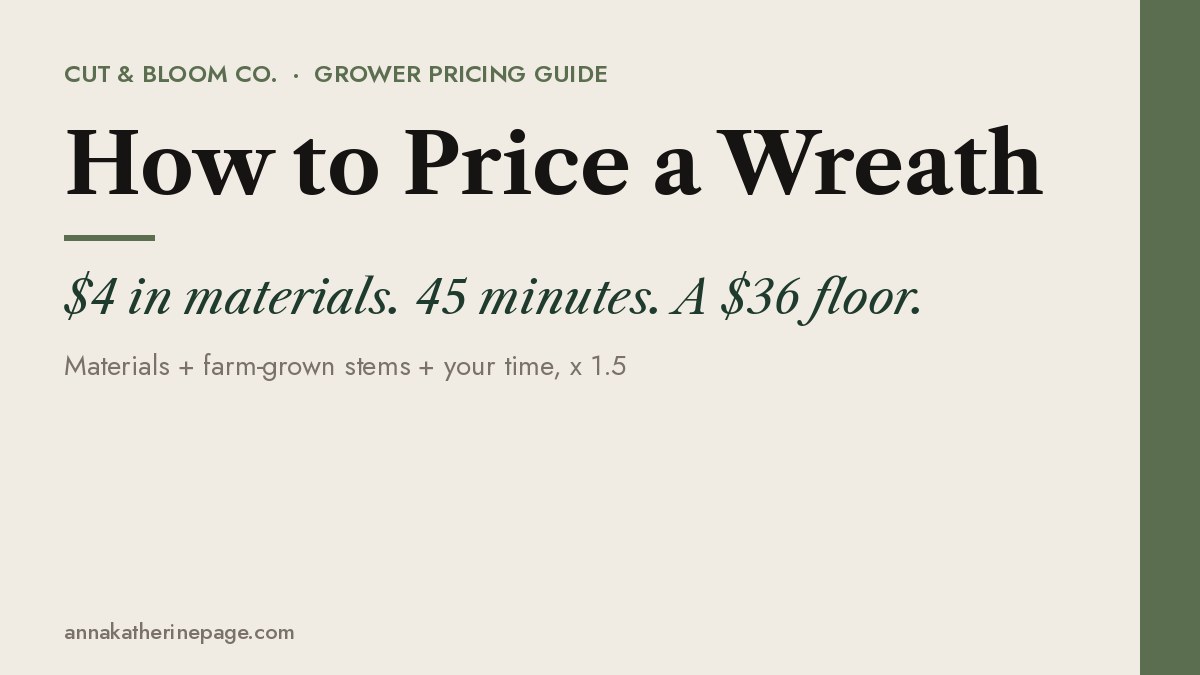
Quick answer: price a wreath from its true cost: bought materials, plus farm-grown stems at what you could sell them for, plus your time, plus packaging, then multiply by 1.5 to 2. A wreath with $4 in materials, $1 packaging and 45 minutes at $25 an hour costs $23.75, so its floor is about $36.
By Anna Katherine Page, Cut & Bloom Co. Supplier prices, platform fees and policies quoted here were checked on each source’s own page on November 21, 2026. They change, so confirm before you buy.
Every holiday season, growers ask some version of this: what should a wreath cost when the bought materials are only a few dollars but it takes most of an hour to make? The usual answers are to triple your materials or to match the craft fair. Both skip the two biggest costs on a farm wreath: your time and your own flowers. Below is the formula, four methods side by side, size tiers, and real survey data on what shoppers say they will pay.
What happens when you price the same wreath four ways?
Here is one 16-inch wreath priced four different ways.
Sample numbers. These are example inputs to show the math, not a recommended price, not a market average, and not a claim about what any grower earns. Swap in your own costs.
Method
Formula
Price
What you earn per hour of work
Verdict
Materials x 3
$4 x 3
$12
about $9 (after $4 materials and $1 packaging)
Underpriced. Labor is never counted.
Cost plus labor, no markup
$4 + $18.75 + $1 packaging
$23.75
$25, and $0 profit
Break-even. One damaged wreath wipes out the batch.
True cost x 1.5
$23.75 x 1.5
$36
$25 plus about $12 margin
A working floor for wreaths made from bought materials only.
True cost with farm-grown stems x 1.5
($23.75 + $15 in your own dried stems) x 1.5
$58
$25 plus about $19 margin, and your stems are paid for
The honest price when the wreath is covered in flowers you grew.
Inputs used: bought materials $4 (ring, wire, ribbon), 45 minutes at $25 an hour ($18.75), $1 packaging and tag, and 30 dried strawflower or statice stems that you would otherwise sell at $0.50 each ($15). Prices are rounded to the nearest dollar.
What will shoppers actually pay for a wreath?
Real data on this is thin, so here is one useful study. In a 2019 Mississippi State University Extension and research bulletin, shoppers rated six wreaths made from Mississippi-grown plant materials. Their average willingness to pay ranged from $22.52 to $31.77 per wreath. The wholesale value of the materials in each design ranged from $34.45 to $139.95, and those figures did not include any labor (MSU Bulletin 1227).
Two lessons for flower farmers:
Shoppers do not see your material cost. In that study, every design used more in wholesale-value materials than shoppers said they would pay for it.
Design the wreath to the price, not the price to the wreath. If your true cost lands above what your buyers pay, make it smaller, use fewer premium stems, or use shorter and broken stems that would not sell in a bunch. Do not cut your labor to zero to make the price fit.
It is one regional survey, not a national price list. Use it as a reality check next to what wreaths sell for where you sell.
Why should you count the flowers you grew yourself?
A florist who buys every stem counts them on the invoice. A flower farmer who grew them often counts them as free. They are not. Every dried stem on a wreath is a stem you did not put in a bouquet, a bunch, or a dried-flower jar. Count farm-grown material at the price you would charge for it, or at least your cost per stem. If you do not know your cost per stem yet, the free price per stem calculator works it out.
What is the wreath pricing formula, step by step?
Bought materials. Ring or base, wire, ribbon, hot glue, hooks. In the example, $4.
Farm-grown materials. Stems x what you would sell each for. In the example, 30 x $0.50 = $15.
Labor. Minutes to make it, plus a share of harvest, drying and selling time, x your hourly rate / 60. In the example, 45 x $25 / 60 = $18.75. University of Maryland Extension’s holiday greenery budget also treats wreath-making labor as its own cost line (UMD Extension).
Packaging and selling costs. Bag, tag, box, card fees. In the example, $1.
Markup. True cost x 1.5 for a floor, x 2 if you sell through a shop that takes a cut or you want room for discounts.
Round and check. Round to a clean price, then compare with what wreaths sell for where you sell. If your floor is above the local going rate, change the recipe (fewer premium stems, a smaller ring), not your floor.
How does build time change your price floor?
Your first wreath takes longer than your tenth. Here is the same bought-materials wreath (no farm-grown stems) at different build times.
Sample numbers. These are example inputs to show the math, not a recommended price, not a market average, and not a claim about what any grower earns. Swap in your own costs.
Build time
Labor at $25/hour
True cost ($4 materials + $1 packaging)
Floor price (x 1.5)
60 minutes
$25.00
$30.00
$45
45 minutes
$18.75
$23.75
$36
30 minutes
$12.50
$17.50
$26
20 minutes
$8.33
$13.33
$20
Do not drop your price the day you get faster. Time your next five wreaths, take the average, and price from that.
How should you price different wreath sizes?
Bigger wreaths take more stems and more time, so price each size from its own recipe instead of adding a flat amount.
Sample numbers. These are example inputs to show the math, not a recommended price, not a market average, and not a claim about what any grower earns. Swap in your own costs.
Size
Bought materials
Farm-grown stems
Time at $25/hour
Packaging
True cost
Floor (x 1.5)
12-inch
$3
15 x $0.50 = $7.50
30 min = $12.50
$1
$24.00
$36
16-inch
$4
30 x $0.50 = $15
45 min = $18.75
$1
$38.75
$58
22-inch
$6
50 x $0.50 = $25
75 min = $31.25
$2
$64.25
$96
If a size lands well above what your buyers pay, sell fewer of that size or change its recipe. A small wreath at a price that sells can be a better product than a big one that sits.
How do you price wreaths for a shop or on consignment?
If a shop takes a commission, work backward from what you need to keep. A $36 floor at a 25% commission needs a $48 shelf price, because $48 x 0.75 = $36. If some wreaths come back unsold, the shelf price needs to go higher again. The full table is in how to price flowers for consignment.
If a shop buys outright instead, ask what markup it uses. If it doubles the wholesale price to set retail, your $36 floor becomes a $72 shelf price, which may be more than wreath buyers in that shop will pay. Agree on the numbers before you make the batch. For more on selling outright, see how to price flowers for florists.
Get the cost-per-stem formula behind this wreath
The farm-grown stems are the line most growers guess at. The cheat sheet has the cost-per-stem formula, plus bouquet, wholesale, CSA and wedding formulas with labeled sample numbers, so you can value your own stems before you price a wreath. Enter your email and I will send the free two-page Flower Price Cheat Sheet PDF.
How can you check the rest of your prices in two minutes?
Wreaths are usually a side line. If you are unsure about wreath prices, your bouquets and bunches may be underpriced too. The free Flower Pricing Reality Check scores your pricing in about two minutes, and no email is needed to see your score. If you want every product line in one place, the Flower Farm Pricing Toolkit ($27) has a pricing calculator, a price check tab, and labor built into every price.
What should I charge for a wreath with $4 in materials and 45 minutes of work?
Count your time. At $25 an hour, 45 minutes is $18.75, so the true cost is $23.75 with $1 of packaging. A floor of about $36 (true cost x 1.5) pays your wage plus a margin. If the wreath uses dried flowers you grew, add their value and the price goes up.
Is tripling the cost of materials a good way to price wreaths?
Not for handmade wreaths. Tripling $4 in materials gives $12. After $4 of materials and $1 of packaging, that pays about $9 an hour for 45 minutes of work and nothing for farm-grown flowers. It only works when materials are most of the cost.
What do customers pay for a handmade wreath?
It depends on your market. In a 2019 Mississippi State University study of six wreaths made from local plant materials, shoppers’ average willingness to pay ranged from $22.52 to $31.77 per wreath. Check what wreaths sell for where you sell, then design a wreath that meets your price floor.
Should I count flowers I grew myself in the wreath price?
Yes. Value them at what you would sell them for, or at least your cost per stem. Each stem on a wreath is one you cannot sell in a bouquet.
How much more should a wreath cost if a shop takes a commission?
Divide the price you need to keep by 1 minus the commission. To keep $36 at a 25% commission, the shelf price is $36 / 0.75 = $48.
Do fresh and dried wreaths use the same formula?
Yes. The formula is the same. Dried wreaths usually carry more farm-grown stems and more drying time, so their true cost is often higher.
window.fluent_form_ff_form_instance_5_1 = {"id":"5","ajaxUrl":"https:\/\/annakatherinepage.com\/wp-admin\/admin-ajax.php","settings":{"layout":{"labelPlacement":"top","asteriskPlacement":"asterisk-right","helpMessagePlacement":"with_label","errorMessagePlacement":"inline","cssClassName":""},"restrictions":{"denyEmptySubmission":{"enabled":false}}},"form_instance":"ff_form_instance_5_1","form_id_selector":"fluentform_5","rules":{"email":{"required":{"value":true,"message":"This field is required"},"email":{"value":true,"message":"This field must contain a valid email"}}},"debounce_time":300,"file_upload_settings":[]};
(function () {
var c = document.body.className;
c = c.replace(/woocommerce-no-js/, 'woocommerce-js');
document.body.className = c;
})();
var fluentFormVars = {"ajaxUrl":"https://annakatherinepage.com/wp-admin/admin-ajax.php","forms":[],"step_text":"Step %activeStep% of %totalStep% - %stepTitle%","step_completed_text":"Completed","is_rtl":"","date_i18n":{"previousMonth":"Previous Month","nextMonth":"Next Month","months":{"shorthand":["Jan","Feb","Mar","Apr","May","Jun","Jul","Aug","Sep","Oct","Nov","Dec"],"longhand":["January","February","March","April","May","June","July","August","September","October","November","December"]},"weekdays":{"longhand":["Sunday","Monday","Tuesday","Wednesday","Thursday","Friday","Saturday"],"shorthand":["Sun","Mon","Tue","Wed","Thu","Fri","Sat"]},"daysInMonth":[31,28,31,30,31,30,31,31,30,31,30,31],"rangeSeparator":" to ","weekAbbreviation":"Wk","scrollTitle":"Scroll to increment","toggleTitle":"Click to toggle","amPM":["AM","PM"],"yearAriaLabel":"Year","firstDayOfWeek":1},"pro_version":"","fluentform_version":"6.2.17","force_init":"","stepAnimationDuration":"350","upload_completed_txt":"100% Completed","upload_start_txt":"0% Completed","uploading_txt":"Uploading","choice_js_vars":{"noResultsText":"No results found","loadingText":"Loading...","noChoicesText":"No choices to choose from","itemSelectText":"Press to select","maxItemTextSingular":"Only %%maxItemCount%% option can be added","maxItemTextPlural":"Only %%maxItemCount%% options can be added"},"input_mask_vars":{"clearIfNotMatch":false},"nonce":"288c4d2939","file_delete_nonce":"d1f71bbd77","form_id":"5","step_change_focus":"1","has_cleantalk":"","pro_payment_script_compatible":"","token_nonce":"b9d4116b3d"};
var fluentform_submission_messages_5 = {"file_upload_in_progress":"File upload in progress. Please wait...","javascript_handler_failed":"Javascript handler could not be loaded. Form submission has been failed. Reload the page and try again"};
var fluentform_payment_messages_5 = {"stock_out_message":"This Item is Stock Out","item_label":"Item","price_label":"Price","qty_label":"Qty","line_total_label":"Line Total","sub_total_label":"Sub Total","discount_label":"Discount","total_label":"Total","signup_fee_label":"Signup Fee","trial_label":"Trial","processing_text":"Processing...","confirming_text":"Confirming..."};
var fluentform_save_progress_messages_5 = {"copy_button":"Copy","email_button":"Email","email_placeholder":"Your Email Here","copy_success":"Copied"};
var fluentform_address_messages_5 = {"please_wait":"Please wait ...","location_not_determined":"Could not determine address from location.","address_fetch_failed":"Failed to fetch address from coordinates.","geolocation_failed":"Geolocation failed or was denied.","geolocation_not_supported":"Geolocation is not supported by this browser."};
var fluentform_gateway_messages_5 = {"request_failed":"Request failed. Please try again","payment_failed":"Payment process failed!","no_method_found":"No method found","processing_text":"Processing..."};
var fluentform_submission_messages_global = {"javascript_handler_failed":"Javascript handler could not be loaded. Form submission has been failed. Reload the page and try again"};
var fluentform_address_messages_global = {"please_wait":"Please wait ...","location_not_determined":"Could not determine address from location.","address_fetch_failed":"Failed to fetch address from coordinates.","geolocation_failed":"Geolocation failed or was denied.","geolocation_not_supported":"Geolocation is not supported by this browser."};
//# sourceURL=fluent-form-submission-js-extra
(function(){
var AJAX="https:\/\/annakatherinepage.com\/wp-admin\/admin-ajax.php",LOAD=Date.now(),freshP=null;
function post(d){return fetch(AJAX+"?t="+Date.now(),{method:"POST",credentials:"same-origin",cache:"no-store",headers:{"Content-Type":"application/x-www-form-urlencoded"},body:new URLSearchParams(d).toString()}).then(function(r){return r.json();});}
function getFresh(){if(freshP){return freshP;}freshP=post({action:"akp_ffc_fresh_nonce"}).then(function(j){if(j&&j.success&&j.data){if(window.fluentFormVars){window.fluentFormVars.token_nonce=j.data.token_nonce;}var ns=document.querySelectorAll('input[name$="_fluentformnonce"]');for(var i=0;i<ns.length;i++){ns[i].value=j.data.form_nonce;}return j.data;}freshP=null;return null;}).catch(function(){freshP=null;return null;});return freshP;}
function fid(f){var m=(f.className||"").match(/fluent_form_(\d+)/);return m?m[1]:(f.getAttribute("data-form_id")||"");}
function fld(f){return f.querySelector(".fluent-form-token-field");}
function stale(f){var t=fld(f);if(!t){return false;}return !t.value||(Date.now()-(f.__akpAt||LOAD))>45*60*1000;}
function mint(f){if(f.__akpP){return f.__akpP;}var t=fld(f);if(!t){return Promise.resolve(true);}
f.__akpP=getFresh().then(function(fr){var n=(fr&&fr.token_nonce)||(window.fluentFormVars&&window.fluentFormVars.token_nonce)||"";return post({action:"fluentform_generate_protection_token",form_id:fid(f),nonce:n});}).then(function(j){f.__akpP=null;if(j&&j.success&&j.data&&j.data.token){t.value=j.data.token;f.classList.add("ff_tokenized");f.classList.remove("ff_tokenizing");f.__akpAt=Date.now();return true;}return false;}).catch(function(){f.__akpP=null;return false;});return f.__akpP;}
function init(){var fs=document.querySelectorAll("form.frm-fluent-form");if(!fs.length){return;}var any=false;for(var i=0;i<fs.length;i++){if(fld(fs[i])){any=true;}}if(!any){return;}getFresh();
if("IntersectionObserver" in window){var io=new IntersectionObserver(function(es){es.forEach(function(e){if(e.isIntersecting&&stale(e.target)){mint(e.target);}});},{rootMargin:"900px 0px"});for(var k=0;k<fs.length;k++){if(fld(fs[k])){io.observe(fs[k]);}}}
document.addEventListener("focusin",function(e){var f=e.target&&e.target.closest&&e.target.closest("form.frm-fluent-form");if(f&&stale(f)){mint(f);}},true);
document.addEventListener("submit",function(e){var f=e.target;if(!f||!f.classList||!f.classList.contains("frm-fluent-form")){return;}if(f.__akpPass){f.__akpPass=false;return;}if(!stale(f)){return;}e.preventDefault();e.stopImmediatePropagation();
mint(f).then(function(){f.__akpPass=true;window.ff_sumitting_form=false;if(f.requestSubmit){var b=f.querySelector("[type=submit]");try{b?f.requestSubmit(b):f.requestSubmit();}catch(x){if(window.jQuery){window.jQuery(f).trigger("submit");}}}else if(window.jQuery){window.jQuery(f).trigger("submit");}});},true);}
var CS_PDF="https://annakatherinepage.com/wp-content/uploads/2026/11/flower-price-cheat-sheet.pdf";
var CS_MSG='<p>Your Flower Price Cheat Sheet is ready. <a href="'+CS_PDF+'">Download the two-page PDF</a> now.</p><p>A copy is on its way to your inbox too. Give it a minute, and peek in spam the first time so the next one lands in your inbox.</p>';
function fixCS(){var ms=document.querySelectorAll(".fluentform_wrapper_5 .ff-message-success");for(var i=0;i<ms.length;i++){if(!ms[i].__akpCS&&(ms[i].textContent||"").indexOf("Download the two-page PDF")===-1){ms[i].__akpCS=1;ms[i].innerHTML=CS_MSG;}}}
function initCS(){if(!document.querySelector("form.fluent_form_5")){return;}try{new MutationObserver(fixCS).observe(document.body,{childList:true,subtree:true});}catch(x){}document.addEventListener("fluentform_submission_success",function(){setTimeout(fixCS,50);setTimeout(fixCS,600);});}
function boot(){init();initCS();}
if(document.readyState==="loading"){document.addEventListener("DOMContentLoaded",boot);}else{boot();}
})();
(function () {
var LABEL = "Send me the cheat sheet";
var PDF = "https://annakatherinepage.com/wp-content/uploads/2026/11/flower-price-cheat-sheet.pdf";
var CONFIRM = '<p>Your Flower Price Cheat Sheet is ready. <a href="' + PDF + '">Download the two-page PDF</a> now.</p><p>Give the email a minute, and peek in spam the first time so the next one lands in your inbox. The formulas use labeled sample numbers. Type over them with yours.</p>';
function retitle() {
var buttons = document.querySelectorAll(".fluent_form_5 .ff-btn-submit, form.fluent_form_5 .ff-btn-submit, .frm-fluent-form.fluent_form_5 .ff-btn-submit");
for (var i = 0; i < buttons.length; i++) {
var b = buttons[i];
if ((b.textContent || "").indexOf("cheat sheet") === -1) {
b.textContent = LABEL;
b.setAttribute("aria-label", LABEL);
}
b.style.backgroundColor = "#5a6b4e";
b.style.borderColor = "#5a6b4e";
b.style.color = "#ffffff";
}
var styles = document.querySelectorAll(".ff-form-inline-style style");
for (var j = 0; j < styles.length; j++) {
var s = styles[j];
if ((s.textContent || "").indexOf("fluent_form_5") !== -1 && (s.textContent || "").indexOf("#123d2e") !== -1) {
s.textContent = s.textContent.replace(/#123d2e/g, "#5a6b4e");
}
}
}
if (document.readyState === "loading") document.addEventListener("DOMContentLoaded", retitle);
else retitle();
setTimeout(retitle, 400);
function maybeFixSuccess(root) {
if (!root) return;
var success = root.querySelector(".ff-message-success, .ff-el-success, .ff-form-success");
if (!success) return;
var t = (success.textContent || "").toLowerCase();
if (t.indexOf("inbox") !== -1 || t.indexOf("cheat sheet") === -1) {
success.innerHTML = CONFIRM;
}
}
document.addEventListener("fluentform_submission_success", function () {
maybeFixSuccess(document.querySelector(".fluentform_wrapper_5, #fluentform_5, .ff_form_wrapper_5"));
});
if (window.jQuery) {
window.jQuery(document).on("fluentform_submission_success", function () {
maybeFixSuccess(document.querySelector(".fluentform_wrapper_5, #fluentform_5, .ff_form_wrapper_5"));
});
}
})();
(function(){
function rgb(c){var m=(c||"").match(/[0-9.]+/g);return m?m.map(Number):null;}
function lum(a){return (0.299*a[0]+0.587*a[1]+0.114*a[2])/255;}
function effbg(el){var n=el;while(n){var c=rgb(getComputedStyle(n).backgroundColor);if(c&&(c.length<4||c[3]>0.5))return c;n=n.parentElement;}return null;}
var sel="main h1,main h2,main h3,main h4,main p,main li,main span,#frc h1,#frc h2,#frc h3,#frc p,#frc span,#frc li";
document.querySelectorAll(sel).forEach(function(t){
var bg=effbg(t);
if(!bg) return;
if(lum(bg)<0.30){
var fc=rgb(getComputedStyle(t).color);
if(fc && lum(fc)<0.5){ t.style.setProperty("color","#f7f1e6","important"); }
}
});
})();
(function () {
function formIdFrom(ev, data) {
var id = "";
var form = null;
if (data) {
if (data.formId != null) id = String(data.formId);
else if (data.form_id != null) id = String(data.form_id);
form = data.form;
if (form && form.jquery) form = form[0];
}
if (!form && ev && ev.detail) {
form = ev.detail.form;
if (form && form.jquery) form = form[0];
if (!id) {
if (ev.detail.formId != null) id = String(ev.detail.formId);
else if (ev.detail.form_id != null) id = String(ev.detail.form_id);
}
}
if (!form && ev && ev.target && ev.target.nodeType === 1) {
form = ev.target.closest ? (ev.target.closest("form") || ev.target.closest("[id^='fluentform_']") || ev.target.closest("[class*='fluent_form_']")) : ev.target;
}
if (!id && form) {
var src = String((form.id || "") + " " + (form.className || "") + " " + (form.getAttribute && (form.getAttribute("data-form_id") || form.getAttribute("data-id") || "") || ""));
var m = src.match(/fluentform_wrapper_(\d+)/) || src.match(/fluentform_(\d+)/) || src.match(/fluent_form_(\d+)/);
if (m) id = m[1];
}
return id;
}
function newEventId() {
try {
if (window.crypto && typeof crypto.randomUUID === "function") return crypto.randomUUID();
} catch (err) {}
return "ff5lead_" + Date.now() + "_" + Math.random().toString(16).slice(2);
}
var lockUntil = 0;
function fireLead(ev, data) {
if (formIdFrom(ev, data) !== "5") return;
if (typeof window.fbq !== "function") return;
var now = Date.now();
if (now < lockUntil) return;
lockUntil = now + 2000;
var eid = newEventId();
try {
fbq("track", "Lead", { content_name: "Flower Price Cheat Sheet" }, { eventID: eid });
} catch (err) {}
}
document.addEventListener("fluentform_submission_success", function (ev) {
fireLead(ev, ev && ev.detail);
});
if (window.jQuery) {
window.jQuery(document).on("fluentform_submission_success", function (ev, data) {
fireLead(ev, data);
});
window.jQuery(document.body).on("fluentform_submission_success", function (ev, data) {
fireLead(ev, data);
});
}
})();